Key facts
- Dates
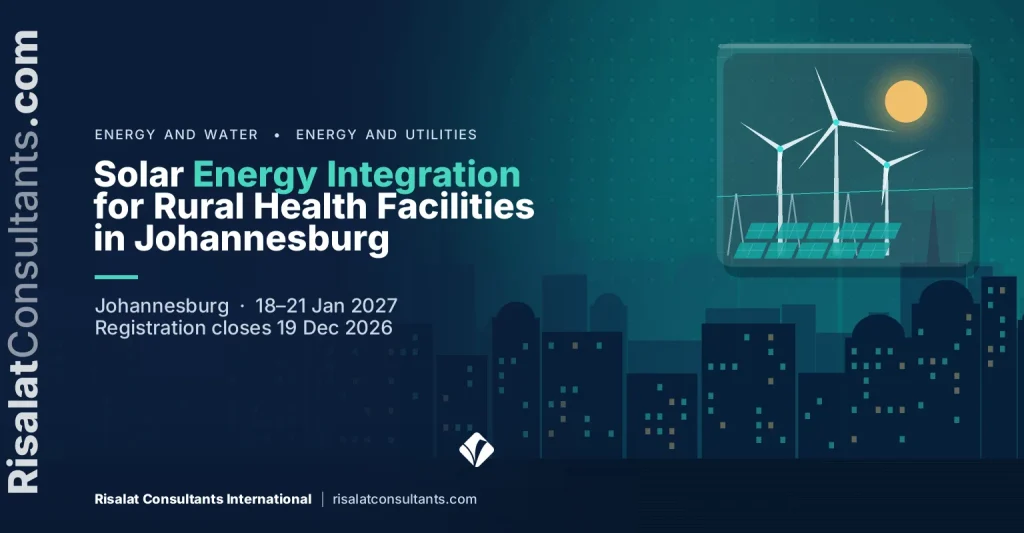
- 18–21 Jan 2027 (4 days)
- Where
- Johannesburg, South Africa
- Fee per participant
- £2,850 (GBP)
- Payment
- By invoice and bank transfer
- Registration closes
- 19 Dec 2026
- Certificate
- Certificate of completion
- In-house option
- Run it for your team, on your dates
On this page 14 sections
Programme Overview
Unreliable electrical supply in rural medical centres compromises primary healthcare delivery, vaccine potency, and maternal survival rates. This four-day professional training course provides technical specialists with the engineering and management expertise required to deploy resilient solar photovoltaic systems. Participants examine off-grid and hybrid architectures designed to withstand extreme operating conditions, ensuring critical healthcare infrastructure maintains steady, continuous electrical service. The curriculum balances electro-technical theory with applied diagnostics to address systemic operational weaknesses in remote public health facilities.
Delegates undertake detailed assessments of hybrid photovoltaic generation coupled with modern battery energy storage systems, focusing on real-world operational demands. Instruction covers rigorous load auditing methodologies, component sizing procedures, and compliance with applicable international electro-technical standards. Through realistic case exercises, technical teams evaluate inverter-charger configurations, surge suppression, and switchgear integration. Special focus is placed on continuous power provision for essential medical machinery, immunisation cold chain preservation, operating theatres, and around-the-clock maternity care units across southern African health posts.
Beyond system sizing, the programme establishes preventative maintenance protocols, asset monitoring frameworks, and fault diagnostic routines essential for long-term operational sustainability. Attendees investigate common equipment failure modes, premature battery degradation causes, and balance-of-system vulnerabilities. By mastering remote telemetry and scheduled service routines, public sector engineers and project implementation specialists ensure that donor-financed solar infrastructure delivers uninterrupted, life-saving service well beyond initial commissioning, thereby securing the operational viability of off-grid medical infrastructure investments.
Primary healthcare networks face accelerating operational demands that require dependable power for life-saving services, particularly under projects like the Zimbabwe COVID-19 Response and Essential Health Services Additional Financing. Extending resilient, off-grid solar energy systems directly reinforces the integrity of medical cold chains, diagnostic laboratories, and emergency maternity care during grid failures. Public sector planners and project units must adopt standard engineering practices, durable battery technologies, and preventative maintenance regimes to safeguard capital investments and maintain healthcare continuity across vulnerable rural communities.
Delivered by Risalat Consultants International in Johannesburg, South Africa, it combines expert-led sessions, real cases and group work, so that participants can apply what they learn in their own institution.
The Programme Strengthens Institutional Capability
- Audit protocols for primary clinic electrical demand and seasonal variations
- Critical load segregation for maternal clinics, lighting, and WHO PQS-qualified cold chains
- Solar resource assessment and irradiation data utilisation for off-grid sites
- System architecture appraisal: pure off-grid, grid-tied with storage, and generator hybridisation
- Sizing solar photovoltaic arrays in compliance with IEC 62124 international standards
- Battery chemistry evaluation: Lithium Iron Phosphate (LiFePO4) versus deep-cycle gel technologies
- Battery sizing calculations for autonomy requirements and depth of discharge thresholds
- Inverter-charger selection, bidirectional conversion, and electrical surge capacity analysis
- Climate and environmental risk assessment
- Adaptation and mitigation planning
- Sector strategies for energy, water and land
- Project design for climate and environmental goals
It is designed for health facility energy engineers and electro-mechanical officers, rural infrastructure planners from ministries of health and public works, project Implementation Unit (PIU) technical specialists managing donor-funded health portfolios and others who want practical, current skills in climate, environment and natural resources.
The Growing Importance of Solar Energy Integration for Rural Health Facilities in Johannesburg
Climate change, environmental pressure and resource management now shape national plans, budgets and investment decisions. Financiers increasingly expect climate and environmental considerations to be built into projects from the start.
Institutions that can plan for climate risks, manage natural resources well and prepare sound proposals are better placed to protect services and to access the funding available for this work.
Organisations increasingly require professionals capable of:
- Assess climate and environmental risks to their services and assets
- Design projects that meet climate and environmental goals
- Prepare proposals that financiers can approve
- Measure and report results credibly
- Work with communities and partners across sectors
Strong climate, environment and natural resources systems help organisations:
- Protect services and infrastructure from climate risks
- Access climate and environmental finance
- Meet national and international commitments
- Use natural resources sustainably
This Solar Energy Integration for Rural Health Facilities in Johannesburg programme brings these elements together in a practical format, so that participants understand not only what good practice looks like but also how to introduce it in their own setting, with the people and resources they have.
Who Should Attend This Solar Energy Integration for Rural Health Facilities in Johannesburg Training?
This programme is designed for:
- Health facility energy engineers and electro-mechanical officers
- Rural infrastructure planners from ministries of health and public works
- Project Implementation Unit (PIU) technical specialists managing donor-funded health portfolios
- Cold chain technicians and biomedical engineering personnel
- Procurement officers responsible for solar equipment technical specifications
- District infrastructure maintenance supervisors and monitoring engineers
- Renewable energy programme managers in public institutions
- Donor-financed project engineers working on off-grid electrification schemes
- Public works site engineers overseeing rural clinic modernisations
- Climate change and environment officers
- Energy, water and agriculture sector staff
- Planning and policy officers
The programme suits experienced professionals as well as those moving into new responsibilities. Groups that mix institutions and countries are encouraged, because participants learn a great deal from each other’s experience.
Tick what your team needs to be able to do.
Solar Energy Integration for Rural Health Facilities in Johannesburg Training Objectives
Upon successful completion of this Solar Energy Integration for Rural Health Facilities in Johannesburg Training, participants will be able to:
- Calculate precise multi-seasonal electrical load profiles for primary clinics, immunisation cold chains, and maternal wards
- Evaluate hybrid solar photovoltaic and battery energy storage system specifications against IEC and WHO performance standards
- Formulate resilient balance-of-system designs incorporating circuit protection, surge arrestors, and grounding networks
- Analyse technical compatibility between solar inverters, lithium-based or lead-acid storage systems, and auxiliary backup generators
- Apply technical fault diagnostic methodologies to identify and rectify solar PV array, inverter, and storage failures
- Develop structured preventative maintenance schedules and remote monitoring frameworks to extend system operational lifespans
- Construct comprehensive technical procurement requirements and terms of reference for public solar electrification tenders
- Explain the main climate and environmental challenges for their sector
- Assess climate and environmental risks to services and assets
- Plan adaptation and mitigation measures
Each objective is practised during the programme through exercises, cases or group work, so that participants leave able to do it, not only to describe it.
Programme Contents and Structure
- Audit protocols for primary clinic electrical demand and seasonal variations
- Critical load segregation for maternal clinics, lighting, and WHO PQS-qualified cold chains
- Solar resource assessment and irradiation data utilisation for off-grid sites
- System architecture appraisal: pure off-grid, grid-tied with storage, and generator hybridisation
- Sizing solar photovoltaic arrays in compliance with IEC 62124 international standards
- Battery chemistry evaluation: Lithium Iron Phosphate (LiFePO4) versus deep-cycle gel technologies
- Battery sizing calculations for autonomy requirements and depth of discharge thresholds
- Inverter-charger selection, bidirectional conversion, and electrical surge capacity analysis
- System integration, DC busbar arrangements, and switchgear selection criteria
- Temperature derating, thermal management, and battery room safety requirements
- Circuit protection sizing: DC disconnects, fuses, breakers, and busbar configuration
- Earthing architectures, lightning protection, and surge protection devices (SPDs) per IEC 62305
- Cabling selection, voltage drop management, and UV-resistant outdoor conduits
- Pre-commissioning verification procedures and insulation resistance testing per IEC 62446
- Quality assurance protocols for site acceptance tests and contractor handover
- Diagnostic practices for inverter trip events, earth faults, and string underperformance
- Preventative maintenance frameworks, inspection checklists, and component replacement cycles
- Telemetry integration, remote performance monitoring, and fault alarm categorisation
- End-of-life battery disposal protocols and environmental compliance management
- Drafting robust technical specifications and service-level agreements for donor tenders
Full day-by-day contents
The programme runs over 4 days. Each day combines expert input, practical work and a closing workshop or case study:
- First Day: Clinical Load Profiling and Solar PV System Architectures
- Second Day: Battery Energy Storage and Power Conversion Engineering
- Third Day: Electrical Safety, Balance of System, and Installation Quality
- Fourth Day: Diagnostics, Maintenance Frameworks, and Procurement Specifications
Full day-by-day contents
First Day | Clinical Load Profiling and Solar PV System Architectures
- Audit protocols for primary clinic electrical demand and seasonal variations
- Critical load segregation for maternal clinics, lighting, and WHO PQS-qualified cold chains
- Solar resource assessment and irradiation data utilisation for off-grid sites
- System architecture appraisal: pure off-grid, grid-tied with storage, and generator hybridisation
- Sizing solar photovoltaic arrays in compliance with IEC 62124 international standards
Workshop: Clinical Load Profiling and Solar PV System Architectures: Applying It to Your Institution
Working in small groups, participants apply the day's methods to examples from their own institutions and agree practical next steps.
Second Day | Battery Energy Storage and Power Conversion Engineering
- Battery chemistry evaluation: Lithium Iron Phosphate (LiFePO4) versus deep-cycle gel technologies
- Battery sizing calculations for autonomy requirements and depth of discharge thresholds
- Inverter-charger selection, bidirectional conversion, and electrical surge capacity analysis
- System integration, DC busbar arrangements, and switchgear selection criteria
- Temperature derating, thermal management, and battery room safety requirements
Workshop: Battery Energy Storage and Power Conversion Engineering: Applying It to Your Institution
Working in small groups, participants apply the day's methods to examples from their own institutions and agree practical next steps.
Third Day | Electrical Safety, Balance of System, and Installation Quality
- Circuit protection sizing: DC disconnects, fuses, breakers, and busbar configuration
- Earthing architectures, lightning protection, and surge protection devices (SPDs) per IEC 62305
- Cabling selection, voltage drop management, and UV-resistant outdoor conduits
- Pre-commissioning verification procedures and insulation resistance testing per IEC 62446
- Quality assurance protocols for site acceptance tests and contractor handover
Case Study: Electrical Safety, Balance of System, and Installation Quality in Practice
Participants analyse a realistic case, compare the choices made with good practice and draw lessons they can use in their own setting.
Fourth Day | Diagnostics, Maintenance Frameworks, and Procurement Specifications
- Diagnostic practices for inverter trip events, earth faults, and string underperformance
- Preventative maintenance frameworks, inspection checklists, and component replacement cycles
- Telemetry integration, remote performance monitoring, and fault alarm categorisation
- End-of-life battery disposal protocols and environmental compliance management
- Drafting robust technical specifications and service-level agreements for donor tenders
Capstone Exercise: Solar Energy Integration for Rural Health Facilities in Johannesburg Action Plan for Your Institution
Participants bring the week together in an action plan for their own institution, with priorities, owners and first steps, and present it for feedback from peers and facilitators.
Solar Energy Integration for Rural Health Facilities in Johannesburg Training Methodology
The training employs an applied professional methodology combining technical lectures, practical engineering design exercises, and diagnostic analysis of operating solar health installations. Participants work with engineering calculation workbooks to design balanced hybrid systems and draft preventive maintenance protocols. Daily collaborative working groups evaluate real-world design specifications, examine failed component samples, and review commissioning reports from rural electrification projects, reinforcing practical problem-solving for public sector deployment.
The programme combines:
- Expert-led sessions on current practice
- Regional and international case studies
- Group work and practical exercises
- Simulations and role plays where relevant
- Discussion of participants' own challenges
- Peer learning across institutions and countries
- Practical tools and templates to take back to work
- Daily reflection and action planning
Before the programme, a short pre-assessment helps the facilitators understand each participant’s role and priorities, so that examples and exercises can be adjusted to the group. Each day ends with a short reflection in which participants note what they will apply at work.
Expected Outcomes
Upon completion of this Solar Energy Integration for Rural Health Facilities in Johannesburg Training, participants will be able to:
- Accurately calculate and document clinical daily energy demands, differentiating between baseline and surge critical loads
- Specify appropriate photovoltaic modules, hybrid inverters, and battery chemistries based on operational realities
- Appraise contractor engineering drawings, single-line diagrams, and equipment submittals for tender compliance
- Identify electrical faults and degradation patterns in off-grid solar equipment using structured troubleshooting workflows
- Establish preventative maintenance protocols that ensure uninterrupted power supply for cold chain storage
- Generate comprehensive technical documentation and commissioning checklists for capital procurement projects
- Assess climate and environmental risks
- Plan adaptation and mitigation measures
Participants leave with a personal action plan and practical tools they can use in their institution from the first week back. Institutions that send several participants can use the programme to agree shared methods and templates across teams, which makes improvements easier to sustain.
£2,850 per participant · invoice and bank transfer · groups of 5 or more receive a discount
Five or more from one organisation: ask for the group rate on the invoice request.
Ten or more: an in-house version for your institution may cost less per person. Ask for an in-house quote.
Registration closes in 40 days (19 Dec 2026)
Institutional Application of Solar Energy Integration for Rural Health Facilities in Johannesburg Training
This programme supports organisations in strengthening:
- Climate and environmental planning
- Project design
- Access to finance
- Results measurement
- Stakeholder involvement
Participants return with practical tools to improve:
- Risk assessments
- Concept notes
- Results frameworks
- Monitoring systems
- Partnership arrangements
The programme is built so that learning moves from the classroom into the institution. Participants work on their own processes and documents where possible, and leave with an action plan that their managers can review and support.
Regional Relevance & Application
Europe
European institutions apply climate, environment and natural resources within detailed regulatory frameworks and reform agendas. Participants from Europe can compare their practice with colleagues from other regions and test how established methods work under different conditions.
Africa
Across Africa, ministries, agencies and project teams working in climate, environment and natural resources increasingly operate alongside donor-financed programmes that expect clear systems and evidence. The programme helps participants adapt good practice to the institutions and resources they work with.
Middle East
In the Middle East, national development strategies and diversification plans place growing demands on climate, environment and natural resources. Participants explore how to build the capability these plans need inside public bodies and companies.
Asia
Institutions across Asia combine rapid growth with ambitious modernisation programmes. Participants from Asia can share their experience of scaling systems quickly and learn from approaches used elsewhere.
Pacific
Small island and Pacific states face particular constraints of size, distance and capacity. The programme highlights practical, proportionate approaches to climate, environment and natural resources that suit smaller institutions.
Holding the programme in Johannesburg, South Africa brings participants together away from their daily pressures, so they can compare how climate, environment and natural resources is handled in different settings. The same programme can also be delivered in-house for one institution, in its own country or online, with cases taken from its current work.
Host Country Profile – South Africa
Risalat Consultants International runs open-enrolment training programmes in Johannesburg, South Africa for officials, project teams and professionals from across the region. Dates, fees and what each programme covers are listed above, and any programme can also be delivered in-house for your institution.
Studying away from their own country gives participants time to focus, a fresh view of their own institution and the chance to build a network with colleagues from other countries.
Solar Energy Integration for Rural Health Facilities in Johannesburg Training Deliverables
Participants receive support before, during and after the programme, so that preparation, learning and follow-up form one continuous experience.
Before the Programme
- Participant Pre-Assessment
- Solar Energy Integration for Rural Health Facilities in Johannesburg Readiness Assessment
- Solar Energy Integration for Rural Health Facilities in Johannesburg Resource Pack
- Preparatory Reading Materials
- Complimentary Visa Support & Advisory
During the Programme
- Airport Pickup & Welcome Assistance
- Accommodation with Breakfast
- Welcome Networking Dinner
- Risalat Training Kit (Bag, Bottle, Mug, T-Shirt, Cap, Passport Cover, Pens, Notebook, Magnet & Keychain)
- Comprehensive Solar Energy Integration for Rural Health Facilities in Johannesburg Training Manual
- Climate Risk Screening Checklist
- Options Appraisal Template
- Concept Note Template
- Results Measurement Template
- Practical Workshops & Simulations
- Group Discussions & Peer Learning
- Daily Lunch and Refreshments
- Full Access to Training Venue Facilities
- Mini Pad / Tablet with Digital Learning Materials
- Field Visit (where applicable)
- Entertaining City Tour
After the Programme
- Certificate of Completion
- Risalat Programme Participation Recognition Award
- Post-Training Reference Materials
- Funding Readiness Checklist
- Monitoring and Reporting Template
- Post-Training Support & Follow-Up Guidance
- Programme Report
Institutions can also request a tailored in-house version of this programme, delivered at their premises or online. Request a proposal.
Common Challenges in Solar Energy Integration for Rural Health Facilities in Johannesburg, And How This Training Helps
How can institutions assess climate and environmental risks to their services and assets?
The programme addresses this directly on the first day (Clinical Load Profiling and Solar PV System Architectures), where participants practise the methods involved and adapt them to their own institution, then build it into their action plan.
How can institutions design projects that meet climate and environmental goals?
The programme addresses this directly on the second day (Battery Energy Storage and Power Conversion Engineering), where participants practise the methods involved and adapt them to their own institution, then build it into their action plan.
How can institutions prepare proposals that financiers can approve?
The programme addresses this directly on the third day (Electrical Safety, Balance of System, and Installation Quality), where participants practise the methods involved and adapt them to their own institution, then build it into their action plan.
How can institutions measure and report results credibly?
The programme addresses this directly on the fourth day (Diagnostics, Maintenance Frameworks, and Procurement Specifications), where participants practise the methods involved and adapt them to their own institution, then build it into their action plan.
How can institutions work with communities and partners across sectors?
The programme addresses this directly on the first day (Clinical Load Profiling and Solar PV System Architectures), where participants practise the methods involved and adapt them to their own institution, then build it into their action plan.
Frequently Asked Questions
When and where does the Solar Energy Integration for Rural Health Facilities in Johannesburg programme take place?
It runs from 18 Jan 2027 to 21 Jan 2027, in Johannesburg, South Africa. The registration deadline is shown at the top of this page.
Who should attend?
The programme is designed for health facility energy engineers and electro-mechanical officers, rural infrastructure planners from ministries of health and public works, project Implementation Unit (PIU) technical specialists managing donor-funded health portfolios, cold chain technicians and biomedical engineering personnel, and others who want practical skills in climate, environment and natural resources.
Will I receive a certificate?
Yes. Participants who complete the programme receive a Certificate of Completion from Risalat Consultants International.
Can this programme be delivered for our institution only?
Yes. We can deliver a tailored in-house version at your premises, in another city or online, built around your own cases. Use the proposal request on this page.
Do I need prior experience in climate, environment and natural resources?
No specialist background is required beyond experience in a related role. A short pre-assessment helps the facilitators adapt the sessions to the group.
Training courses in JohannesburgEnergy and Water training courses
Why Johannesburg for this programme
Johannesburg is Southern Africa's business centre with a wide flight network.
The Solar Energy Integration for Rural Health Facilities in Johannesburg programme in January 2027 brings together officials and professionals from across the Africa region and beyond. Sessions combine short inputs, case studies and group work on participants' own files, and the city's institutions can be added as a study visit on request.
Getting there: O. R. Tambo (JNB).
Check whether you need a visa with the free Visa Checker, and ask for an invitation letter once you are registered.
The same topic in other cities
- Environmental & Social Management Frameworks for Solar Developments in Nairobi (Nairobi)
- Grid Extension and Solar Distribution Management in Dubai (Dubai)
- Healthcare Facility Design Standards and Quality Infrastructure in London (London)
- Agri-Market Infrastructure Management and Cooperative Aggregation in Kigali (Kigali)
- Last-Mile Solar Mini-Grid Deployment and Productive Use Programmes in Nairobi (Nairobi)
- Grid Expansion and Last-Mile Distribution Management in Nairobi (Nairobi)
Other programmes in Johannesburg
- Supervisory Control and Data Acquisition (SCADA) in Water Systems in Johannesburg
- Independent Power Producer Procurement & Power Purchase Agreements in Johannesburg
- MSME Credit Guarantee Scheme Design and Risk-Sharing Facilities in Johannesburg
- District Health Procurement and Medical Stores Management in Johannesburg
- Infection Prevention and Control in Clinical Facilities in Johannesburg
Related: Climate finance and energy programmes · free Climate Finance Proposal Readiness · all programmes
- Procurement Framework and Regulations for Projects World Bank
- MAPS: Methodology for Assessing Procurement Systems MAPS Initiative
- Open Contracting Partnership Open Contracting Partnership
More training courses in South Africa · All programmes in Africa · Full training calendar
Plan this programme in a roadmap: why it matters, why to approve it, the dates to plan and the career it builds.