Key facts
- Dates
- 8–12 Feb 2027 (5 days)
- Where
- Dubai, United Arab Emirates
- Fee per participant
- £2,900 (GBP)
- Payment
- By invoice and bank transfer
- Registration closes
- 30 Dec 2026
- Format
- 5-day short course: a practical capacity-building programme for government, NGO and project teams in Dubai
- In-house option
- Run it for your team, on your dates
On this page 11 sections
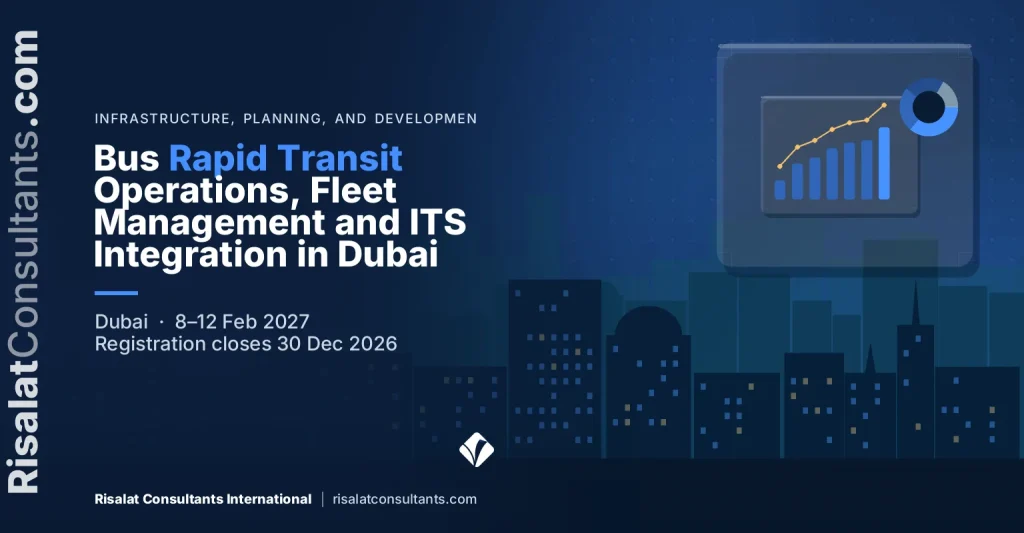
Bus Rapid Transit Operations, Fleet Management and ITS Integration in Dubai
Programme Overview
High-capacity urban transit systems require rigorous operational planning, dependable asset stewardship, and robust digital integration to deliver reliable public transport services. This five-day course equips transport officials with operational methods to oversee bus rapid transit corridors, regulate private service providers, and manage high-volume passenger terminals. Participants explore service planning concepts that balance peak-hour passenger demand with efficient vehicle rostering and route cycle times.
The curriculum addresses the deployment of modern fleet management architectures and Intelligent Transport Systems compliant with internationally recognised transit standards. Participants evaluate automated vehicle location systems, transit signal priority protocols, and real-time operational control centre procedures. Sessions examine the technical frameworks underpinning integrated fare management, depot management, multi-operator dispatch coordination, and preventive maintenance regimes designed to preserve high fleet availability across demanding metropolitan operating cycles.
Held in Dubai, a regional pioneer in coordinated multimodal transport planning and control centre operations, the programme provides delegates with practical context for high-capacity corridor management. Delivered by Risalat Consultants International in Dubai, United Arab Emirates, it combines expert-led sessions, real cases and group work, so that participants can apply what they learn in their own institution.
The programme strengthens institutional capability in:
- Metropolitan transit corridor fundamentals: trunk-feeder design and dedicated right-of-way planning
- Demand profiling, passenger boarding volumes, and capacity calculations using the Transit Capacity and Quality of Service Manual
- Timetable construction, vehicle cycle calculations, and turn-around management under varying traffic conditions
- Driver duty scheduling, rest-break compliance, and shift rostering optimization techniques
- Service design exercises: balancing express, limited-stop, and all-stop operational patterns on high-volume corridors
- Architectural layers of transit ITS: automated vehicle location, CAD/AVL, and open data schemas including GTFS and SIRI
- Transit signal priority implementation: optical, wireless, and centralized traffic management system integration
- Operations Control Centre setup: dynamic dispatching, headway maintenance, and bunching mitigation tactics
- Strategic thinking and direction setting
- Leading and developing teams
- Decision making and problem solving
- Communication and influence
Why this matters now
Organisations increasingly require professionals capable of:
- Set clear direction and priorities
- Lead and motivate teams through change
- Communicate and negotiate effectively
- Manage performance fairly
- Make sound decisions under pressure
Strong leadership, management and communication systems help organisations:
- Turn strategies into results
- Build motivated, capable teams
- Manage change with less resistance
- Improve relations with partners and stakeholders
- Collect
- Clean
- Store
- Analyse
- Decide
Who Should Attend
This programme is designed for:
- Urban transport planners from national ministries and municipal councils
- Transit authority traffic and transport engineers
- Municipal traffic and mobility directors
- Bus rapid transit project implementation unit specialists
- Operations and fleet supervisors within metropolitan transit agencies
- Fare collection and ITS system administrators
- Transport procurement officers managing operator concession contracts
- Regulatory officials supervising private bus operating companies
- Civil engineers responsible for corridor traffic signal integration
- Directors and senior managers
- Heads of department and unit
- Middle managers and team leaders
Tick what your team needs to be able to do.
Programme Objectives
By the end of this programme participants will be able to:
- Model corridor operational schedules that align passenger demand with vehicle capacity and headway requirements
- Establish automated vehicle location and transit signal priority architectures using open transport data specifications
- Design closed and account-based ticketing systems conforming to ISO/IEC 14443 contactless standards
- Draft service-level performance benchmarks and penalty deductions for gross-cost operator concession agreements
- Formulate depot maintenance management procedures that ensure fleet compliance with statutory safety standards
- Execute terminal crowd control and platform boarding strategies for peak-period operational safety
- Implement operational control centre protocols to manage on-corridor incidents, service delays, and emergency responses
- Explain current approaches to leadership in public and private institutions
- Set direction and priorities for their team
- Lead, motivate and develop people
Training Structure & Contents
- Metropolitan transit corridor fundamentals: trunk-feeder design and dedicated right-of-way planning
- Demand profiling, passenger boarding volumes, and capacity calculations using the Transit Capacity and Quality of Service Manual
- Timetable construction, vehicle cycle calculations, and turn-around management under varying traffic conditions
- Driver duty scheduling, rest-break compliance, and shift rostering optimization techniques
- Service design exercises: balancing express, limited-stop, and all-stop operational patterns on high-volume corridors
- Workshop on applying corridor capacity, headway design, and service scheduling to participant institutions
- Architectural layers of transit ITS: automated vehicle location, CAD/AVL, and open data schemas including GTFS and SIRI
- Transit signal priority implementation: optical, wireless, and centralized traffic management system integration
- Operations Control Centre setup: dynamic dispatching, headway maintenance, and bunching mitigation tactics
- Passenger information systems: on-board displays, wayside indicators, and mobile data feeds for multimodal trip planning
- Incident response protocols: managing vehicle breakdowns, corridor lane blockages, and service diversion procedures
- Workshop on applying ITS and control centre operations to participant institutions
- Fare media architectures: closed-loop smart cards, EMV contactless payments, and mobile QR-code ticketing
- Application of ISO/IEC 14443 standards and security keys in metropolitan clearinghouse environments
- Revenue reconciliation workflows: secure fare collection, multi-operator allocation, and apportionment frameworks
- Off-board validation equipment: turnstiles, platform validation units, and barrier-free Proof of Payment systems
- Fare evasion mitigation strategies: roving inspection regimes, automated audit logs, and penalty collection frameworks
- Case study analysing automated fare collection and financial architecture in practice
- Vehicle specification strategies: high-capacity articulated buses, powertrain selection, and emissions compliance
- Preventive maintenance systems: computerized maintenance management systems (CMMS) and telemetry data monitoring
- Depot design principles: daily vehicle circulation, rapid refuelling or charging setups, and workshop staging workflows
- Spare parts inventory optimization, warranty tracking, and lifecycle asset management standards under ISO 55000
- Vehicle safety inspections, statutory audits, and emission monitoring protocols for operating bus fleets
- Workshop on applying fleet management, depot systems, and asset preservation to participant institutions
- Operator contract structures: comparative analysis of gross-cost, net-cost, and hybrid operational agreements
- Key performance indicators: tracking on-time dispatch, fleet reliability, vehicle cleanliness, and safety events
- Contract enforcement mechanisms: penalty deductions, bonus payments, and independent performance monitoring audits
- Station management: passenger circulation modelling, level of service metrics, and platform edge crowd management
- Institutional oversight, trunk and feeder operations regulation, and service-level monitoring
Full day-by-day contents
First Day | Corridor Capacity, Headway Design, and Service Scheduling
- Metropolitan transit corridor fundamentals: trunk-feeder design and dedicated right-of-way planning
- Demand profiling, passenger boarding volumes, and capacity calculations using the Transit Capacity and Quality of Service Manual
- Timetable construction, vehicle cycle calculations, and turn-around management under varying traffic conditions
- Driver duty scheduling, rest-break compliance, and shift rostering optimization techniques
- Service design exercises: balancing express, limited-stop, and all-stop operational patterns on high-volume corridors
- Workshop on applying corridor capacity, headway design, and service scheduling to participant institutions
Second Day | Intelligent Transport Systems (ITS) and Control Centre Operations
- Architectural layers of transit ITS: automated vehicle location, CAD/AVL, and open data schemas including GTFS and SIRI
- Transit signal priority implementation: optical, wireless, and centralized traffic management system integration
- Operations Control Centre setup: dynamic dispatching, headway maintenance, and bunching mitigation tactics
- Passenger information systems: on-board displays, wayside indicators, and mobile data feeds for multimodal trip planning
- Incident response protocols: managing vehicle breakdowns, corridor lane blockages, and service diversion procedures
- Workshop on applying ITS and control centre operations to participant institutions
Third Day | Automated Fare Collection and Financial Architecture
- Fare media architectures: closed-loop smart cards, EMV contactless payments, and mobile QR-code ticketing
- Application of ISO/IEC 14443 standards and security keys in metropolitan clearinghouse environments
- Revenue reconciliation workflows: secure fare collection, multi-operator allocation, and apportionment frameworks
- Off-board validation equipment: turnstiles, platform validation units, and barrier-free Proof of Payment systems
- Fare evasion mitigation strategies: roving inspection regimes, automated audit logs, and penalty collection frameworks
- Case study analysing automated fare collection and financial architecture in practice
Fourth Day | Fleet Management, Depot Systems, and Asset Preservation
- Vehicle specification strategies: high-capacity articulated buses, powertrain selection, and emissions compliance
- Preventive maintenance systems: computerized maintenance management systems (CMMS) and telemetry data monitoring
- Depot design principles: daily vehicle circulation, rapid refuelling or charging setups, and workshop staging workflows
- Spare parts inventory optimization, warranty tracking, and lifecycle asset management standards under ISO 55000
- Vehicle safety inspections, statutory audits, and emission monitoring protocols for operating bus fleets
- Workshop on applying fleet management, depot systems, and asset preservation to participant institutions
Fifth Day | Concession Contracting, Performance Monitoring, and Station Safety
- Operator contract structures: comparative analysis of gross-cost, net-cost, and hybrid operational agreements
- Key performance indicators: tracking on-time dispatch, fleet reliability, vehicle cleanliness, and safety events
- Contract enforcement mechanisms: penalty deductions, bonus payments, and independent performance monitoring audits
- Station management: passenger circulation modelling, level of service metrics, and platform edge crowd management
- Institutional oversight, trunk and feeder operations regulation, and service-level monitoring
Training Methodology
The programme runs over five days and combines expert input, practical work, and closing workshops or case studies. Working in small groups, participants analyse realistic cases, apply methods to examples from their own institutions, and agree on practical next steps.
- Expert-led instructional sessions
- Small group exercises and institutional application workshops
- Real-world case study evaluations
- Peer learning and experience sharing across institutions and countries
Expected Outcomes
- Ability to design, implement, and regulate sustainable trunk and feeder transit operations
- Proficiency in applying ITS architectures, CAD/AVL, and open transit data standards
- Capacity to formulate gross-cost and net-cost operational contracts with robust enforcement mechanisms
- Establishment of depot management regimes and preventive maintenance systems compliant with ISO 55000
- Improved leadership, decision-making, and communication skills for managing transport teams and institutional change
£2,900 per participant · invoice and bank transfer · groups of 5 or more receive a discount
Five or more from one organisation: ask for the group rate on the invoice request.
Ten or more: an in-house version for your institution may cost less per person. Ask for an in-house quote.
Registration closes in 31 days (30 Dec 2026)
Regional Relevance & Application
Rapid urbanization across sub-Saharan Africa places immense pressure on existing road infrastructure, making the delivery of high-capacity mass transit systems essential for sustained economic mobility. Large-scale infrastructure investments, such as the corridor buildout under the Dar es Salaam Urban Transport Improvement Project, require public transit authorities to significantly elevate institutional capacity in operational scheduling, ITS deployment, and contract enforcement. Mastering multi-operator regulation, interoperable automated fare collection, and data-driven fleet monitoring ensures that newly constructed physical corridors translate into reliable, safe, and financially viable services for expanding urban populations.
Who Will Deliver This Programme
Each date is delivered by a team assigned from Risalat's expert network for this subject. For this programme we assign:
How we choose them: Experience in the region of the participants or comparable settings; Command of the financier rules that apply (World Bank, ADB, AfDB, EU, UN) where relevant; Delivery in English; other languages on request for in-house groups; No conflict of interest with participants' institutions.
Training courses in DubaiInfrastructure, Planning, and Development training courses
Why Dubai for this programme
Dubai is a one-flight hub for Africa, Asia and Europe, with simple visas for many nationalities and modern training venues.
The Bus Rapid Transit Operations, Fleet Management and ITS Integration in Dubai programme in February 2027 brings together officials and professionals from across the Middle East region and beyond. Sessions combine short inputs, case studies and group work on participants' own files, and the city's institutions can be added as a study visit on request.
Getting there: Dubai International (DXB).
Check whether you need a visa with the free Visa Checker, and ask for an invitation letter once you are registered.
The same topic in other cities
- Pharmaceutical Supply Chain Security and Last-Mile Distribution in Dubai (Dubai)
- Emergency Medical Supply Warehousing and Last-Mile Distribution in Penang (Penang)
- Bus Rapid Transit Planning and Integrated Fare Systems in Casablanca (Casablanca)
- Bus Rapid Transit Implementation and Urban Mobility Coordination in Marrakech (Marrakech)
- Electric BRT Operations and Fleet Management in Casablanca (Casablanca)
- Artisanal Fisheries Management, Post-Harvest Cold Chains and Quality in Cape Town (Cape Town)
Other programmes in Dubai
- Mini Degree in Internal Audit and Risk Management in Dubai
- Refugee and Host Community Programme Management in Dubai
- Performance Audit for Supreme Audit Institutions in Dubai
- Artificial Intelligence for Public Sector Leaders Training in Dubai
- Records and Archives Management for Public Institutions in Dubai
Questions before you nominate your team? Book a 30-minute call with us, or ask for this programme in-house.
Teams often travel here from Maldives, Sri Lanka, Bangladesh, Nepal, Pakistan, Afghanistan, Kazakhstan, Uzbekistan. Funding, visa letters and group rates are explained on each country page.
- World Bank: Transport World Bank
- PPP Resource Center World Bank
Is there infrastructure and urban development training for government officials in Dubai in February 2027?
Can "Bus Rapid Transit Operations, Fleet Management and ITS Integration in Dubai" be delivered in-house for one organisation?
Which other infrastructure and urban development programmes does Risalat run?
How do organisations register and pay?
For teams and institutions
Bring your team
Teams that learn together apply more at work. Tell us how many people and how you would like to take part: we reply with a group quote within two working days.
Watch: this programme in short


Other dates and cities for this subject: Infrastructure, Roads and Transport Projects training courses (162 upcoming dates).
More training courses in the United Arab Emirates · All programmes in Middle East · Full training calendar
Plan this programme in a roadmap: why it matters, why to approve it, the dates to plan and the career it builds.