Key facts
- Dates
- 8–12 Feb 2027 (5 days)
- Where
- TBD, Geneva, Switzerland
- Fee per participant
- £4,360 (GBP)
- Payment
- By invoice and bank transfer
- Registration closes
- 20 Dec 2026
- Format
- 5-day short course: a practical capacity-building programme for government, NGO and project teams in Geneva
- Certificate
- Certificate of completion
- In-house option
- Run it for your team, on your dates
On this page 13 sections
Programme Overview
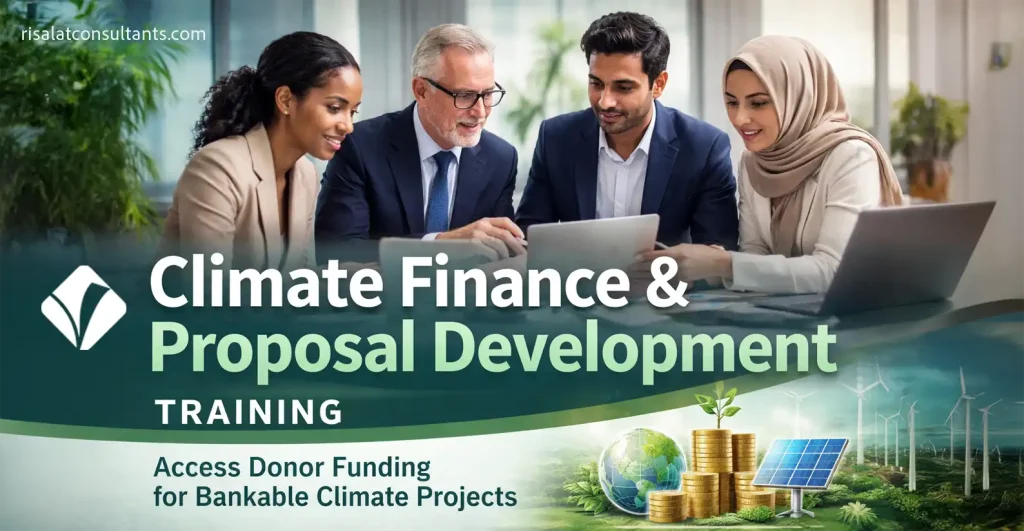
Climate Finance Access & Proposal Development Training equips professionals with practical skills to design, structure, and submit bankable climate projects to international funding mechanisms. Delivered by Risalat Consultants International in Geneva, Switzerland, it combines expert-led sessions, real cases and group work, so that participants can apply what they learn in their own institution.
It covers: climate finance landscape navigation, project concept development, proposal writing for multilateral funds and others who want practical, current skills in public financial management and finance.
Watch: a short video on this subject
How to Align Project Proposals With Climate Targets
One minute, practical, made for ministries and project teams.
This Climate Finance Access & Proposal Development programme brings these elements together in a practical format, so that participants understand not only what good practice looks like but also how to introduce it in their own setting, with the people and resources they have.
The programme strengthens institutional capability in:
- Global climate finance architecture
- Adaptation vs mitigation funding priorities
- Overview of major climate funds and facilities
- National climate strategies and NDC alignment
- Identifying fundable project ideas
- Common reasons proposals fail
- Turning climate challenges into bankable projects
- Climate vulnerability and baseline analysis
- Budget preparation and execution
- Financial reporting and accounting standards
- Cash and treasury management
- Internal control over payments and assets
Why this matters now
Organisations increasingly require professionals capable of:
- Prepare and execute budgets in line with plans
- Produce accurate, timely financial reports
- Apply controls over payments and assets
- Meet financier financial management requirements
- Use financial information to support decisions
Strong public financial management and finance systems help organisations:
- Improve budget credibility and execution
- Produce reliable reports and clean audits
- Reduce payment delays and errors
- Build trust with financiers and oversight bodies
- Funds
- Entity
- Project
- Results
- MRV
Who Should Attend
This programme is designed for:
- Climate finance landscape navigation
- Project concept development
- Proposal writing for multilateral funds
- Financial structuring and co-financing
- Results frameworks and safeguards
- Implementation readiness
- Government climate focal points and planning officials
- Project managers in environment, energy, water, and agriculture sectors
- NGO and donor-funded programme staff
- Development finance professionals
- Climate consultants and technical advisors
- Utilities and infrastructure agencies
Tick what your team needs to be able to do.
Programme Objectives
By the end of this programme participants will be able to:
- Explain the budget cycle and the role of each actor
- Prepare and monitor budgets linked to plans
- Apply the main principles of the relevant reporting standards
- Manage cash and payments with sound controls
- Meet the financial management requirements of financiers
- Analyse financial information for decisions
- Prepare for audits and respond to findings
- Identify and manage financial risks
- Prepare an improvement plan for their finance function
Training Structure & Contents
- Global climate finance architecture
- Adaptation vs mitigation funding priorities
- Overview of major climate funds and facilities
- National climate strategies and NDC alignment
- Identifying fundable project ideas
- Common reasons proposals fail
- Workshop: Climate Finance Landscape & Entry Points: Applying It to Your Institution
- Turning climate challenges into bankable projects
- Climate vulnerability and baseline analysis
- Developing theories of change and results chains
- Climate impact indicators and SDG alignment
- Stakeholder mapping and country ownership
- Workshop: Project Concept Design & Theory of Change: Applying It to Your Institution
- Proposal components and donor templates
- Budget development and cost justification
- Co-financing strategies and blended finance basics
- Economic and financial analysis fundamentals
- Risk identification and mitigation planning
- Case Study: Proposal Writing & Financial Structuring in Practice
- Environmental and social safeguards
- Gender integration in climate proposals
- Monitoring & evaluation frameworks
- Procurement and implementation planning
- Institutional arrangements and governance
- Workshop: Safeguards, Gender & Implementation Readiness: Applying It to Your Institution
- Group work on real project concepts
- Proposal pitch simulations
- Peer review and expert feedback
- Action planning for participants’ organizations
- Roadmaps for post-training submission
- Capstone Exercise: Climate Finance Access & Proposal Development Action Plan for Your Institution
Full day-by-day contents
First Day | Climate Finance Landscape & Entry Points
- Global climate finance architecture
- Adaptation vs mitigation funding priorities
- Overview of major climate funds and facilities
- National climate strategies and NDC alignment
- Identifying fundable project ideas
- Common reasons proposals fail
- Workshop: Climate Finance Landscape & Entry Points: Applying It to Your Institution
Second Day | Project Concept Design & Theory of Change
- Turning climate challenges into bankable projects
- Climate vulnerability and baseline analysis
- Developing theories of change and results chains
- Climate impact indicators and SDG alignment
- Stakeholder mapping and country ownership
- Workshop: Project Concept Design & Theory of Change: Applying It to Your Institution
Third Day | Proposal Writing & Financial Structuring
- Proposal components and donor templates
- Budget development and cost justification
- Co-financing strategies and blended finance basics
- Economic and financial analysis fundamentals
- Risk identification and mitigation planning
- Case Study: Proposal Writing & Financial Structuring in Practice
Fourth Day | Safeguards, Gender & Implementation Readiness
- Environmental and social safeguards
- Gender integration in climate proposals
- Monitoring & evaluation frameworks
- Procurement and implementation planning
- Institutional arrangements and governance
- Workshop: Safeguards, Gender & Implementation Readiness: Applying It to Your Institution
Fifth Day | Practical Proposal Lab
- Group work on real project concepts
- Proposal pitch simulations
- Peer review and expert feedback
- Action planning for participants’ organizations
- Roadmaps for post-training submission
- Capstone Exercise: Climate Finance Access & Proposal Development Action Plan for Your Institution
Training Methodology
Participants leave with draft concepts and clear next steps toward submission. Before the programme, a short pre-assessment helps the facilitators understand each participant’s role and priorities, so that examples and exercises can be adjusted to the group. Each day ends with a short reflection in which participants note what they will apply at work.
- Interactive lectures
- Real donor proposal examples
- Guided proposal-writing exercises
- Financial structuring workshops
- Group simulations
- Expert feedback sessions
- Practical templates and checklists
- Expert-led sessions on current practice
- Regional and international case studies
- Group work and practical exercises
Expected Outcomes
- Prepare and monitor budgets linked to plans
- Produce accurate financial reports
- Apply sound payment and cash controls
- Meet financier financial management requirements
- Prepare for audits and close findings
- Use financial analysis in decisions
£4,360 per participant · invoice and bank transfer · groups of 5 or more receive a discount
Five or more from one organisation: ask for the group rate on the invoice request.
Ten or more: an in-house version for your institution may cost less per person. Ask for an in-house quote.
Registration closes in 23 days (20 Dec 2026)
Regional Relevance & Application
- Europe: European institutions apply public financial management and finance within detailed regulatory frameworks and reform agendas. Participants from Europe can compare their practice with colleagues from other regions and test how established methods work under different conditions.
- Africa: Across Africa, ministries, agencies and project teams working in public financial management and finance increasingly operate alongside donor-financed programmes that expect clear systems and evidence. The programme helps participants adapt good practice to the institutions and resources they work with.
- Middle East: In the Middle East, national development strategies and diversification plans place growing demands on public financial management and finance.
Host Country Profile
Geneva is one of the world’s leading centers for international cooperation, climate policy, and development finance dialogue. The city hosts major UN agencies, climate-focused NGOs, and global donors, creating a unique ecosystem where policy, financing, and implementation intersect. Institutions such as United Nations Office at Geneva, Green Climate Fund partners, UNDP networks, and numerous international NGOs make Geneva a strategic hub for climate governance and project preparation. Hosting the programme in Geneva enables participants to gain direct exposure to global climate finance frameworks, proposal standards, and donor expectations. The setting supports high-level learning for professionals working on nationally determined contributions (NDCs), adaptation planning, and bankable climate investments, making Geneva ideal for executive cohorts, government climate units, and international NGOs. This location is particularly suited for policy-facing, donor-aligned climate finance training with a strong emphasis on proposal quality, safeguards, and results-based financing.
Who Will Deliver This Programme
Each date is delivered by a team assigned from Risalat's expert network for this subject. For this programme we assign:
How we choose them: Experience in the region of the participants or comparable settings; Command of the financier rules that apply (World Bank, ADB, AfDB, EU, UN) where relevant; Delivery in English; other languages on request for in-house groups; No conflict of interest with participants' institutions.
Course Deliverables
Before the Programme
During the Programme
- Project-based templates, tools, and worksheets for bankable climate initiatives
- Digital case studies and reference materials from real donor-funded climate projects
- Access to sample funding applications and proposal datasets for hands-on exercises
- Practical group exercises on climate project design and donor proposal writing
- Pitch simulations and peer-reviewed proposal clinics
- Daily lunch and complimentary refreshments during training days
- Full access to training venue facilities and learning support
- Certificate of Completion
- Risalat Programme Participation Recognition Award
After the Programme
- Participants seeking deeper technical capability may also explore complementary programmes such as our Project Designing, Proposal Writing & Fundraising Training in France, which further strengthen donor engagement and funding readiness.
Training courses in GenevaClimate Change & Environment training courses
Why Geneva for this programme
Geneva is home to UN agencies and international funds, making it a natural venue for development finance and humanitarian topics.
The Climate Finance Access & Proposal Development Training programme in February 2027 brings together officials and professionals from across Europe, Africa, the Middle East and Asia. Sessions combine short inputs, case studies and group work on participants' own files, and the city's institutions can be added as a study visit on request.
Getting there: Geneva Airport (GVA).
Check whether you need a visa with the free Visa Checker, and ask for an invitation letter once you are registered.
The same topic in other cities
- Public Debt Management and Debt Sustainability Training in Miami (Miami)
- Blue Economy, Fisheries and Ocean Governance Training for Southern African Officials in Dubai (Dubai)
- Health Systems Strengthening and Health Financing Training for Pacific Island Officials in Nadi (Nadi)
- Climate Resilience and Adaptation Planning Training in Panama City (Panama City)
- Disaster Risk Management and Early Warning Systems in Sapporo (Sapporo)
- Mini Degree in Climate Finance and Resilience in Copenhagen (Copenhagen)
Other programmes in Geneva
- Practical AI Tools for Project Teams and Analysts in Geneva
- HSE Management Systems and ISO 45001 for Public Agencies in Geneva
- AI for Health Systems and Health Data Training in Geneva
- Contingent Disaster Financing Operations and Cat DDO Drawdown Trigger Audits in Geneva
- National Fibre Optic Backbone Contracting and Telecom PPPs in Geneva
Related: Climate finance and energy programmes · free Climate Finance Proposal Readiness · all programmes
Questions before you nominate your team? Book a 30-minute call with us, or ask for this programme in-house.
Is there climate finance training for government officials in Geneva in February 2027?
Can "Climate Finance Access & Proposal Development Training" be delivered in-house for one organisation?
Which other climate finance programmes does Risalat run?
How do organisations register and pay?
For teams and institutions
Bring your team
Teams that learn together apply more at work. Tell us how many people and how you would like to take part: we reply with a group quote within two working days.
Watch: this programme in short


Other dates and cities for this subject: Climate Finance and GCF Proposal Development training courses (20 upcoming dates).
More training courses in Switzerland · All programmes in Europe · Full training calendar
Plan this programme in a roadmap: why it matters, why to approve it, the dates to plan and the career it builds.