Datos clave
- Fechas
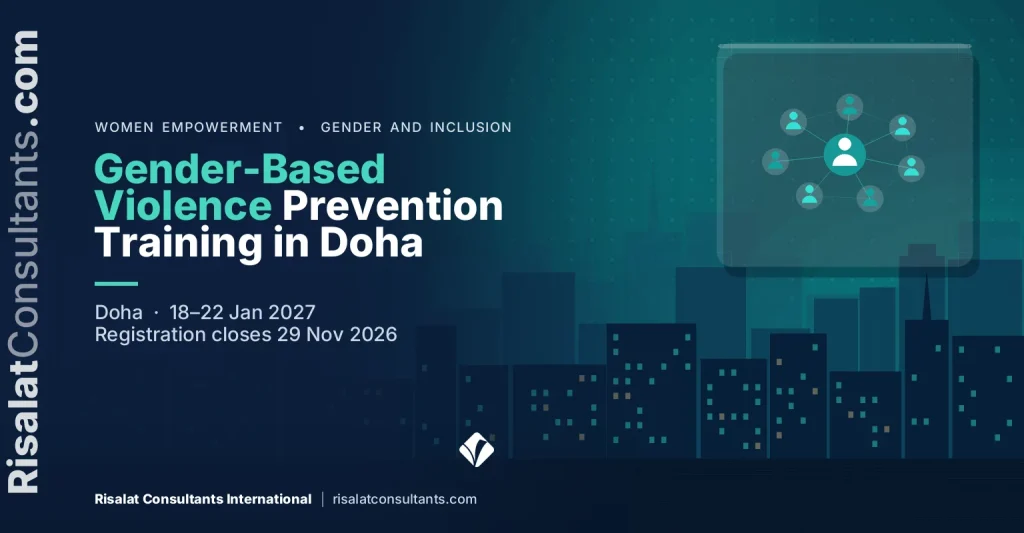
- 18–22 ene 2027 (5 días)
- Dónde
- Saphire Plaza Hotel, Doha, Catar
- Tarifa por participante
- 2.860 £ (GBP)
- Pago
- Mediante factura y transferencia bancaria
- Cierre de inscripciones
- 29 nov 2026
- Formato
- 5-day short course: a practical capacity-building programme for government, NGO and project teams in Doha
- Certificado
- Certificado de finalización
- Opción interna
- Impártalo para su equipo, en sus fechas
En esta página 15 secciones
Descripción del programa
Gender-Based Violence Prevention Training in Doha gives government agencies, donor-financed project units, public service providers and private-sector teams a practical way to strengthen GBV risk assessment, prevention, safeguarding and survivor-centred referral. The five-day learning journey concentrates on tasks that professionals can demonstrate at work, rather than a collection of unrelated management topics.
The World Health Organization’s 2026 global overview reports that nearly one in three women aged 15 or older have experienced physical or sexual intimate-partner violence, non-partner sexual violence, or both during their lifetime. This is a population estimate, not a prevalence estimate for Qatar.
UNFPA’s inter-agency GBV minimum standards set expectations for prevention and multisectoral support in emergencies. Their core principle is that safety, dignity, informed consent and confidentiality guide decisions rather than administrative convenience.
New UNFPA guidance published in October 2026 addresses safer data practices and integration of sexual and reproductive health and GBV referrals. Public agencies and implementing partners need clear responsibilities even when specialist clinical and protection services are delivered by other institutions.
In a mixed professional group, participants compare the procedures they use, the documents that demonstrate compliance and the decisions for which they are accountable. Every technical case is assessed for practicality, evidence quality and risks that could arise during implementation. The programme is a skills course, not a promise of institutional accreditation or an externally arranged visit.
The Programme Strengthens Institutional Capability
- Análisis de género y poder
- GBV forms and associated risks
- Human rights and non-discrimination
- Principios de respuesta centrados en los supervivientes
- Safe and voluntary disclosure procedures
- Informed consent and confidentiality
- Community-based prevention approaches
- Service mapping and referral pathway design
- Accessible information on support services
- PSEA y códigos de conducta de salvaguarda
- Risk mitigation in procurement and works
- Sensitive incident escalation without investigation by untrained staff
- Safe storage and minimisation of case information
- Coordination with specialist health and protection providers
- Training and supervision of focal points
- Ethical monitoring and programme adaptation
The output of the week is an institution-specific working package, combining documented decisions, review checklists, a short executive brief and a realistic adoption plan. Participants are encouraged to bring non-sensitive examples from their own work while all teaching datasets and scenarios can be completed with fictional material.
The Growing Importance of Gender-Based Violence Prevention
La competencia técnica en la prevención de la violencia de género y la respuesta segura está cada vez más conectada con la rendición de cuentas institucional. Los equipos necesitan saber no solo cómo opera una herramienta o procedimiento, sino cuándo es apropiado, quién lo autoriza, qué evidencia se retiene y cómo se escalan los problemas. La práctica confiable mejora la calidad de las decisiones al tiempo que reduce el trabajo repetido evitable.
The World Health Organization’s 2026 global overview reports that nearly one in three women aged 15 or older have experienced physical or sexual intimate-partner violence, non-partner sexual violence, or both during their lifetime. This is a population estimate, not a prevalence estimate for Qatar.
Las organizaciones necesitan cada vez más profesionales capaces de:
- Planning gender and power analysis for a defined operational purpose
- Planning gbv forms and associated risks for a defined operational purpose
- Planning human rights and non-discrimination for a defined operational purpose
- Planning survivor-centred response principles for a defined operational purpose
- Planning safe and voluntary disclosure procedures for a defined operational purpose
- Planning informed consent and confidentiality for a defined operational purpose
- Planning community-based prevention approaches for a defined operational purpose
- Planning service mapping and referral pathway design for a defined operational purpose
- Planning accessible information on support services for a defined operational purpose
- Planning psea and safeguarding codes of conduct for a defined operational purpose
- Planning risk mitigation in procurement and works for a defined operational purpose
- Planificación de la escalada de incidentes sensibles sin investigación por parte de personal no capacitado para un propósito operativo definido
Strong gender-based violence prevention and safe response systems help organisations:
- Hacer de los derechos humanos y la no discriminación una rutina documentada en lugar de una suposición informal
- Make survivor-centred response principles a documented routine instead of an informal assumption
- Make safe and voluntary disclosure procedures a documented routine instead of an informal assumption
- Hacer del consentimiento informado y la confidencialidad una rutina documentada en lugar de una suposición informal
- Make community-based prevention approaches a documented routine instead of an informal assumption
- Make service mapping and referral pathway design a documented routine instead of an informal assumption
- Make accessible information on support services a documented routine instead of an informal assumption
- Make psea and safeguarding codes of conduct a documented routine instead of an informal assumption
- Make risk mitigation in procurement and works a documented routine instead of an informal assumption
An effective institutional approach links senior management ownership with staff capability, written procedures and proportionate monitoring. This programme uses Doha as a professional learning venue while inviting participants to compare methods across agencies and countries.
1. What is a survivor-centred first response to a GBV disclosure?
UNFPA standards prioritise safety, respect, confidentiality and informed consent.
2. What does an increase in reported GBV cases necessarily mean?
UNFPA October 2026 guidance warns that service data do not establish population prevalence.
3. How should an agency share identifiable GBV case information?
UNFPA guidance describes data minimisation and controls through the service data lifecycle.
Who Should Attend This Gender-Based Violence Prevention Training?
Este programa está dirigido a:
- Puntos focales de género
- Public health and social development officials
- Government safeguarding teams
- Development project managers
- UN agency programme officers
- Directores de ONG nacionales
- Protection coordinators
- Community engagement officers
- Human resources safeguarding staff
- Women’s rights advocates
- Health service referral coordinators
- M&E specialists working with sensitive information
- Puntos focales de PSEA
- Oficiales de desempeño social del contratista
The course is most useful to people who have a real operational responsibility or are preparing to supervise one. Mixed groups enable a technical specialist to test recommendations with finance, compliance, programme and management colleagues before applying them to an institution.
Marque lo que su equipo necesita ser capaz de hacer.
Gender-Based Violence Prevention Training Objectives
Upon successful completion of this Gender-Based Violence Prevention Training, participants will be able to:
- Explain gender and power analysis and its practical boundaries
- Diagnose gaps in gbv forms and associated risks using appropriate evidence
- Apply human rights and non-discrimination to a realistic work case
- Choose suitable approaches for survivor-centred response principles
- Prepare defensible records for safe and voluntary disclosure procedures
- Evaluate operational risks associated with informed consent and confidentiality
- Controles de diseño para enfoques de prevención basados en la comunidad
- Coordinate staff responsible for service mapping and referral pathway design
- Interpret data and feedback relating to accessible information on support services
- Communicate decisions about psea and safeguarding codes of conduct to leadership
- Develop a phased institutional plan for risk mitigation in procurement and works
Each objective is practised through an assessment, demonstration, structured case or group decision. The emphasis is on repeatable methods that can be embedded in existing workflows and adapted to the participant’s legal, organisational and financing constraints.
Contenido y estructura del programa
- Define GBV and distinguish its major forms
- Examine gender roles and structural discrimination
- Analyse risk factors without blaming affected people
- Apply human rights and non-discrimination principles
- Understand how crisis and displacement intensify risks
- Distinguish community prevention from specialist response
- Revisar la participación segura de hombres y niños en la prevención
- Identify risks across workplaces services and communities
- Use participatory analysis without soliciting personal disclosures
- Map physical and procedural barriers to safe access
- Integrate GBV mitigation into project design choices
- Design safer consultation and complaint information
- Elegir actividades de prevención comunitaria y socios locales
- Prepare ethical communications and awareness materials
- Apply safety respect confidentiality and informed consent
- Recognise signs of distress without forcing disclosure
- Distinguish case referral from informal investigation
- Map healthcare psychosocial legal and safety services
- Confirm current contacts and service availability safely
- Practise first-line compassionate communication in simulations
- Define procedures for child safeguarding situations
- Review partner due diligence and safeguarding provisions
- Draft clear codes of conduct and reporting routes
- Establish confidential feedback and complaint options
- Manage service records using data minimisation principles
- Protect staff and community members against retaliation
- Adapt field activities to disability and language access
- Monitor programme reach without collecting unnecessary identities
- Probar el plan de prevención frente a escenarios de crisis realistas
- Ejecutar un ejercicio de decisión de tipo simulacro sobre divulgaciones seguras
- Revisar la coordinación entre las unidades de salud de género y protección
- Specify incident escalation and specialist handover limits
- Planificar el aprendizaje del personal y la supervisión de apoyo
- Define ethically acceptable monitoring and feedback indicators
- Develop budget needs for prevention and referral functions
Contenido completo día a día
The five-day sequence moves from understanding the problem and evidence base through operational design and assurance to an actionable institutional plan. The themes are:
- Day one: foundations rights and patterns of gender-based violence
- Day two: risk analysis and prevention programme design
- Day three: survivor-centred support and confidential referrals
- Day four: safe delivery monitoring and accountable partnerships
- Day five: institutional response leadership and learning plan
Contenido completo día a día
Primer día | Fundamentos, derechos y patrones de la violencia de género
- Define GBV and distinguish its major forms
- Examine gender roles and structural discrimination
- Analyse risk factors without blaming affected people
- Apply human rights and non-discrimination principles
- Understand how crisis and displacement intensify risks
- Distinguish community prevention from specialist response
- Revisar la participación segura de hombres y niños en la prevención
- Introduce safeguarding and prevention of sexual exploitation
- Map institutional responsibilities and referral limits
Workshop: Baseline assessment
Develop a GBV risk map for a fictional service and document why an ordinary consultation may be unsafe. The group records evidence used, unresolved assumptions, responsible officers and decisions requiring verification. Participants then compare approaches with colleagues, revise their work and identify a practical step for their own institution.
Second Day | Risk analysis and prevention programme design
- Identify risks across workplaces services and communities
- Use participatory analysis without soliciting personal disclosures
- Map physical and procedural barriers to safe access
- Integrate GBV mitigation into project design choices
- Design safer consultation and complaint information
- Elegir actividades de prevención comunitaria y socios locales
- Prepare ethical communications and awareness materials
- Set realistic responsibilities and available resources
- Draft a contextual prevention and referral plan
Workshop: Design choices
Design prevention actions for a public works programme with clear referral and safeguarding responsibilities. The group records evidence used, unresolved assumptions, responsible officers and decisions requiring verification. Participants then compare approaches with colleagues, revise their work and identify a practical step for their own institution.
Third Day | Survivor-centred support and confidential referrals
- Apply safety respect confidentiality and informed consent
- Recognise signs of distress without forcing disclosure
- Distinguish case referral from informal investigation
- Map healthcare psychosocial legal and safety services
- Confirm current contacts and service availability safely
- Practise first-line compassionate communication in simulations
- Define procedures for child safeguarding situations
- Develop protected access and minimum-data recording rules
- Preparar una matriz de derivación con limitaciones de servicios
Case Study: Risk and decisions
Practise a confidential, non-investigative first response and referral decision using fictional scenarios. The group records evidence used, unresolved assumptions, responsible officers and decisions requiring verification. Participants then compare approaches with colleagues, revise their work and identify a practical step for their own institution.
Fourth Day | Safe delivery monitoring and accountable partnerships
- Review partner due diligence and safeguarding provisions
- Draft clear codes of conduct and reporting routes
- Establish confidential feedback and complaint options
- Manage service records using data minimisation principles
- Protect staff and community members against retaliation
- Adapt field activities to disability and language access
- Monitor programme reach without collecting unnecessary identities
- Use aggregate indicators without treating reports as prevalence
- Prepare corrective actions for weak referral coverage
Workshop: Operations and assurance
Audit a sample GBV data process for consent, unnecessary identifiers, unsafe sharing and escalation gaps. The group records evidence used, unresolved assumptions, responsible officers and decisions requiring verification. Participants then compare approaches with colleagues, revise their work and identify a practical step for their own institution.
Fifth Day | Institutional response leadership and learning plan
- Probar el plan de prevención frente a escenarios de crisis realistas
- Ejecutar un ejercicio de decisión de tipo simulacro sobre divulgaciones seguras
- Revisar la coordinación entre las unidades de salud de género y protección
- Specify incident escalation and specialist handover limits
- Planificar el aprendizaje del personal y la supervisión de apoyo
- Define ethically acceptable monitoring and feedback indicators
- Develop budget needs for prevention and referral functions
- Prepare a 90-day safeguarding improvement roadmap
- Communicate organisational commitments without making false guarantees
Capstone Exercise: Institutional action plan
Present a survivor-centred institutional prevention plan, with ownership and checks for implementation. The group records evidence used, unresolved assumptions, responsible officers and decisions requiring verification. Participants then compare approaches with colleagues, revise their work and identify a practical step for their own institution.
Gender-Based Violence Prevention Training Methodology
Facilitators introduce concepts through short explanations and then ask participants to work through realistic decisions related to GBV risk assessment, prevention, safeguarding and survivor-centred referral. The format uses controlled datasets, fictional records and carefully selected public references; participants are never required to share confidential customer information, protected case files or unpublished institutional records.
El programa combina:
- Instructor-led explanations of terminology and current guidance
- Daily applied workshops using topic-specific exercises
- Structured comparison of official policies and standards
- Small-group analysis of competing operational options
- Individual review of an institutional readiness baseline
- Short presentations of decisions and their evidence
- Peer scrutiny of assumptions and implementation risks
- Simulation of procedures and escalation decisions
- Desarrollo de plantillas y verificación de requisitos
- Daily reflective notes on changes to working practice
- Facilitator feedback on participant-produced documents
- Final presentation of a feasible institutional action plan
Before arrival, a short pre-assessment identifies job roles, expected outputs and practical barriers. The trainer uses it to adjust examples while retaining the published technical content. Exercises favour local adaptation over copying another country’s arrangements.
The final peer review tests feasibility, ownership, evidence needs and a realistic timetable for introducing the proposed changes.
Resultados esperados
Upon completion of this Gender-Based Violence Prevention Training, participants will be able to:
- Produce a usable review or working document for gender and power analysis
- Produce a usable review or working document for gbv forms and associated risks
- Producir un documento de trabajo o revisión útil sobre derechos humanos y no discriminación
- Produce a usable review or working document for survivor-centred response principles
- Produce a usable review or working document for safe and voluntary disclosure procedures
- Produce a usable review or working document for informed consent and confidentiality
- Produce a usable review or working document for community-based prevention approaches
- Produce a usable review or working document for service mapping and referral pathway design
- Producir una revisión utilizable o un documento de trabajo para obtener información accesible sobre los servicios de apoyo
Participants should be able to explain why a selected method is appropriate, what information is still missing and who must authorise its implementation. Their final products are designed for managerial discussion and further adaptation, not as substitutes for professional certification, legal advice or regulatory approval.
2.860 £ por participante · factura y transferencia bancaria · descuento para grupos de 5 o más personas
Cinco o más personas de una misma organización: solicite la tarifa de grupo al pedir la factura.
Diez o más: una versión interna para su institución puede costar menos por persona. Solicite una cotización interna.
Registration closes in 7 days (29 Nov 2026)
Institutional Application of Gender-Based Violence Prevention Training
Este programa ayuda a las organizaciones a fortalecer:
- Governance and staff ownership of gender and power analysis
- Governance and staff ownership of gbv forms and associated risks
- Governance and staff ownership of human rights and non-discrimination
- Governance and staff ownership of survivor-centred response principles
- Governance and staff ownership of safe and voluntary disclosure procedures
- Governance and staff ownership of informed consent and confidentiality
- Governance and staff ownership of community-based prevention approaches
- Governance and staff ownership of service mapping and referral pathway design
- Governance and staff ownership of accessible information on support services
- Governance and staff ownership of psea and safeguarding codes of conduct
- Governance and staff ownership of risk mitigation in procurement and works
- Gobernanza y apropiación por parte del personal de la escalada de incidentes delicados sin investigación por parte de personal no capacitado
Los participantes regresan con herramientas prácticas para mejorar:
- A practical checklist or decision record for survivor-centred response principles
- A practical checklist or decision record for safe and voluntary disclosure procedures
- A practical checklist or decision record for informed consent and confidentiality
- Una lista de verificación práctica o registro de decisiones para enfoques de prevención basados en la comunidad
- A practical checklist or decision record for service mapping and referral pathway design
- A practical checklist or decision record for accessible information on support services
- A practical checklist or decision record for psea and safeguarding codes of conduct
- Una lista de verificación práctica o registro de decisiones para la mitigación de riesgos en adquisiciones y obras
- A practical checklist or decision record for sensitive incident escalation without investigation by untrained staff
Institutional adaptation begins with a named management sponsor and a narrow process where improvement can be observed. Participants identify baseline records, reporting responsibilities, resources and review dates, then recommend whether to pilot, revise or defer each intervention. A capacity assessment may help the organisation identify readiness gaps.
Pertinencia y aplicación regionales
Oriente Medio
Governments and humanitarian actors can adapt the same protection principles to services and programmes while applying their own laws and verified local referral pathways.
África
GBV prevention and safe referral are essential considerations for health, education, humanitarian and infrastructure programmes, particularly where access to specialist support is uneven.
Asia and the Pacific
Community programmes and donor-financed works can integrate safeguarding into contractors, public consultations and service access without turning general staff into clinical case managers.
The cases are intended as comparative learning, not universal legal advice. Each team must verify the applicable national rules, sector requirements and institutional capacity before adopting a template. For pre-course prioritisation, participants may use Risalat’s Training Needs Assessment.
Perfil del país anfitrión: Catar
Doha es la capital de Catar y un centro de convocatorias internacionales para profesionales humanitarios, gubernamentales y de desarrollo.
The curriculum is benchmarked against WHO and UNFPA global standards, not against an unverified local institution or a promised specialist facility visit. Facilitators must adapt examples to each participant’s actual legal and service context.
Los delegados deben confirmar los requisitos nacionales de visado y viaje antes del registro. Cualquier compromiso técnico presencial requeriría consentimiento y arreglos verificados, particularmente porque los servicios en vivo para sobrevivientes no deben utilizarse como demostraciones de capacitación.
Gender-Based Violence Prevention Training Deliverables
Risalat estructura este programa en torno a la preparación, la participación práctica y el seguimiento. Las plantillas específicas para cada tema están diseñadas para adaptarse al contexto institucional del participante. Los arreglos de viaje, alojamiento y participación siguen estando sujetos a las condiciones de reserva confirmadas emitidas por Risalat.
Antes del programa
- Evaluación previa del participante
- Gender-Based Violence Prevention Readiness Assessment
- Gender-Based Violence Prevention Resource Pack
- Materiales de lectura preparatoria
- Apoyo y asesoramiento gratuitos para el visado
Durante el programa
- Recogida en el aeropuerto y asistencia de bienvenida
- Accommodation with breakfast: 6 nights, check-in Sunday 17 January 2027, check-out Saturday 23 January 2027 (one night before and one night after the programme)
- Cena de bienvenida y networking
- Kit de formación de Risalat (bolsa, botella, taza, camiseta, gorra, funda de pasaporte, bolígrafos, cuaderno, imán y llavero)
- Comprehensive Gender-Based Violence Prevention Training Manual
- Practical diagnostic checklist for gender and power analysis
- Process mapping and baseline analysis worksheet
- Risk and controls assessment matrix
- Performance indicator and evidence register
- Case study decision log and peer review form
- Institutional 30, 60 and 90-day action plan template
- Talleres prácticos y simulaciones
- Debates en grupo y aprendizaje entre pares
- Almuerzo y refrigerios diarios
- Acceso completo a las instalaciones de la sede de formación
- Mini Pad / tableta con materiales didácticos digitales
- Visita de campo (cuando proceda)
- Recorrido turístico por la ciudad
Después del programa
- Certificado de finalización
- Reconocimiento a la participación en programas de Risalat
- Materiales de consulta posteriores a la formación
- Completed Gender-Based Violence Prevention case and decision toolkit
- Institutional implementation roadmap
- Selected monitoring and quality review templates
- Apoyo posterior a la formación y orientación de seguimiento
- Informe del programa
Organisations seeking dedicated group delivery, tailored case exercises or additional implementation support can request a tailored in-house proposal.
Common Challenges in Gender-Based Violence Prevention, And How This Training Helps
¿Cómo puede una organización establecer prioridades cuando varios problemas exigen atención?
Day one uses gender and power analysis to identify what is known, what is assumed and which operational outcome matters most. The exercise assigns a review owner and produces a practical record of what should change.
How can an organisation find reliable evidence for a difficult decision?
Days one and two develop a documented baseline for human rights and non-discrimination and test whether information is complete and fit for purpose. The exercise assigns a review owner and produces a practical record of what should change.
How can an organisation translate general standards into procedures staff can use?
Day two turns survivor-centred response principles into a practical checklist, record and decision sequence. The exercise assigns a review owner and produces a practical record of what should change.
¿Cómo puede una organización gestionar los riesgos y errores sin ocultarlos?
Days three and four create clear review gates for informed consent and confidentiality and assign accountability for correcting failures. The exercise assigns a review owner and produces a practical record of what should change.
How can an organisation coordinate different units without losing ownership?
Los ejercicios del cuarto día asignan funciones, transferencias y escalamiento en torno al mapeo de servicios y el diseño de rutas de derivación. El ejercicio asigna un responsable de revisión y produce un registro práctico de lo que debe cambiar.
How can an organisation measure improvement when resources and time are limited?
Day five chooses a small set of indicators linked to accessible information on support services and a realistic review cycle. The exercise assigns a review owner and produces a practical record of what should change.
How can an organisation make training useful after participants return to work?
El hito final convierte la mitigación de riesgos en adquisiciones y obras en una secuencia de 90 días con propietarios designados, decisiones de gestión y resultados observables. El ejercicio asigna un propietario de revisión y produce un registro práctico de lo que debe cambiar.
Preguntas frecuentes
Who should attend Gender-Based Violence Prevention Training in Doha?
The course is intended for responsible professionals such as gender focal points, public health and social development officials, government safeguarding teams, and cross-functional colleagues whose decisions affect GBV risk assessment, prevention, safeguarding and survivor-centred referral.
Is this a practical course or mainly lectures?
It combines technical explanations with five applied cases, review templates, group decisions and a final action plan linked to gender-based violence prevention and safe response.
What should participants prepare before attending?
Complete the pre-assessment, identify one relevant process or institutional challenge, and bring only public or appropriately anonymised records. Confidential files are not required.
¿Se pueden utilizar los métodos en proyectos gubernamentales y financiados por donantes?
Yes, the cases can be adapted to public agencies, implementation units and regulated organisations, provided users check applicable national law, donor requirements and organisational controls.
Is a particular institution or technical visit confirmed?
No external institution or visit is represented as confirmed. Any field or technical exposure component depends on prior host acceptance and appropriate safeguarding arrangements.
Who Will Deliver This Programme
Each date is delivered by a team assigned from Risalat's expert network for this subject. For this programme we assign:
How we choose them: Experience in the region of the participants or comparable settings; Command of the financier rules that apply (World Bank, ADB, AfDB, EU, UN) where relevant; Delivery in English; other languages on request for in-house groups; No conflict of interest with participants' institutions.
Training courses in DohaWomen Empowerment training courses
Por qué Doha para este programa
Doha ofrece trayectos cortos desde el Golfo, África y Asia meridional, y un entorno tranquilo para el estudio concentrado.
The Gender-Based Violence Prevention Training in Doha programme in January 2027 brings together officials and professionals from across the Middle East region and beyond. Sessions combine short inputs, case studies and group work on participants' own files, and the city's institutions can be added as a study visit on request.
Cómo llegar: Aeropuerto Internacional Hamad (DOH).
Compruebe si necesita visado con el Verificador de visados gratuito y solicite una carta de invitación una vez inscrito.
Otros programas en Doha
Free roadmap: Violence Against Children: a 12-month plan for your team
For teams and institutions
Bring your team
Teams that learn together apply more at work. Tell us how many people and how you would like to take part: we reply with a group quote within two working days.
Watch: this programme in short

Other dates and cities for this subject: Gender Mainstreaming and Women's Economic Empowerment training courses (24 upcoming dates).
Más cursos de formación en Catar · Todos los programas en Oriente Medio · Calendario de formación completo
Planificar este programa en una hoja de ruta: por qué es importante, por qué aprobarlo, las fechas a planificar y la carrera que construye.