Points clés
- Dates
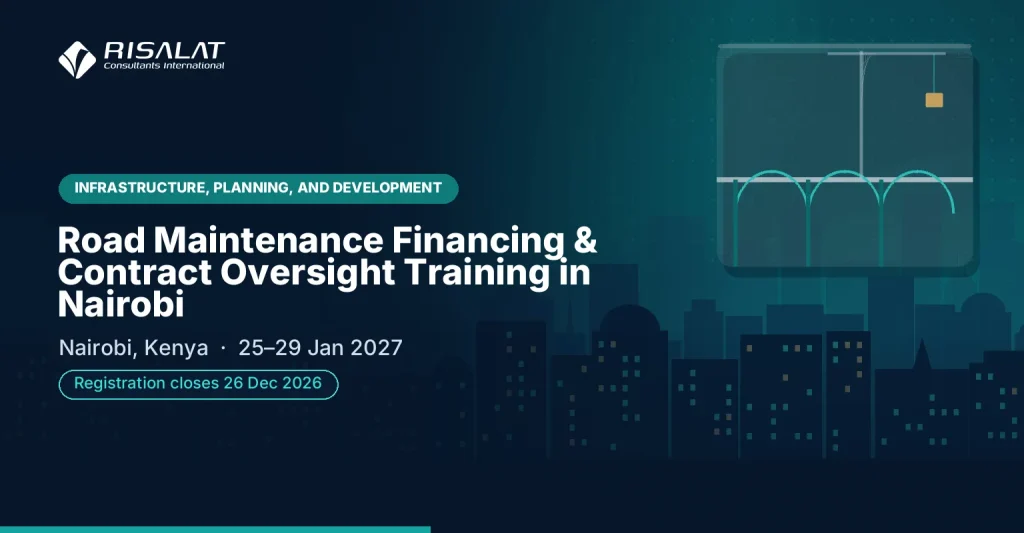
- 25–29 janv. 2027 (5 jours)
- Lieu
- Shared on registration, Nairobi, Kenya
- Frais par participant
- 3 630 £ (GBP)
- Paiement
- Sur facture et par virement bancaire
- Clôture des inscriptions
- 26 déc. 2026
- Certificat
- Certificat de participation
- Option intra
- Organisez-le pour votre équipe, à vos dates
Présentation du programme
Roads lose value quickly when maintenance is late, and road budgets lose value quickly when contracts are late, varied or paid in arrears. For road agencies and road funds in Southern and East Africa, the hard questions are often not technical: how much maintenance the network needs, how it will be paid for each year, and how contracts are managed so that money reaches the road rather than interest, variations and unrecovered advances.
Zambia offers a clear case. A special audit of the Road Development Agency for 2017–2022 reported that the agency owed contractors and consultants about K9.89 billion at the end of 2022 and accrued K1.3 billion in interest for late payment. It also found that 14 contracts valued at K4.53 billion were varied to K6.65 billion, and that K90.95 million in advance payments had not been recovered. At the same time, the World Bank-financed Improved Rural Connectivity Project, which used output and performance-based road contracts (OPRC) for feeder roads, reached its closing date at the end of 2025, and its results framework tracks whether government-funded maintenance contracts continue after the Bank-supported contracts end.
This five-day programme, designed by Risalat Consultants International, works through the full chain: network condition and maintenance needs, multi-year maintenance financing, procurement of performance-based maintenance, contract administration, payment planning, variations and claims, and the oversight of long-term PPP concessions. Each day uses Zambian and regional cases, including the World Bank-financed TRACER corridor project and Zambia’s road concessions.
Nairobi gives participants a working comparison. Kenya funds road maintenance through a dedicated fuel levy distributed by the Kenya Roads Board under an allocation formula, and it operates the Nairobi Expressway under a long-term concession. Both offer lessons on what works and on the pressures such systems face.
Le programme renforce les capacités institutionnelles en matière de :
- Road asset data, condition surveys and maintenance needs assessment
- Multi-year maintenance programmes and budget allocation rules
- Road fund governance, revenue sources and transparent allocation
- Output and performance-based road contracts and their handover
- Contract administration, measurement and certification
- Payment planning to avoid arrears and interest on late payment
- Variation control, claims and dispute avoidance
- Advance payment securities, performance guarantees and liquidated damages
- PPP concession monitoring and contingent liability reporting
- Responding to audit findings and parliamentary committees
The programme is designed for road agencies, road fund agencies, transport and infrastructure ministries, local road authorities, PPP units and finance ministries in Zambia and neighbouring countries, and for consultants and contractors who work with them.
Why Road Maintenance Financing Matters Now
Zambia’s road programme is moving on several fronts at once. The World Bank’s US$270 million TRACER grant will rehabilitate the Serenje–Mpika section of the Dar es Salaam corridor, build a One Stop Border Post at Nakonde and create a SMART corridor, with institutional capacity building for corridor management. The Road Development Agency has also reported 11 PPP concession agreements to upgrade and maintain over 1,002 km of roads. Each of these adds long-term maintenance and contract obligations that must be planned and paid for.
Audit work keeps pointing to the same areas. The special audit recommended that projects be prioritised and budgeted in line with Ministry of Finance and National Planning approvals and that quality assurance be met before payments. The Auditor General’s report for 2024 called for tighter procurement oversight and improved contract management, and Parliament has considered an Auditor General report on the use of the Road Fund for road maintenance over 2020–2024.
Les institutions ont de plus en plus besoin de professionnels capables de :
- Translate network condition data into a costed, prioritised maintenance programme
- Align contract commitments with approved budgets and cash forecasts
- Manage OPRC and other performance-based contracts after donor financing ends
- Control variations and assess claims with clear evidence
- Track securities, guarantees and liquidated damages throughout a contract
- Monitor concession performance and report fiscal commitments
- Respond to audit findings with practical corrective action plans
Des capacités solides aident les institutions à :
- Spend more of each year’s road budget on actual works
- Reduce interest, penalties and disputes
- Protect the value of rehabilitated roads
- Build confidence with financiers, contractors and road users
- Manage PPPs without unplanned fiscal costs
Who Should Attend This Road Maintenance Financing Training
Ce programme s'adresse à :
- Directors and managers of maintenance, planning and contracts in road agencies
- Road fund finance, allocation and audit staff
- Engineers in local road authorities and municipal councils
- Project coordinators and engineers on World Bank, AfDB, EIB and EU road projects
- PPP unit staff and concession monitoring officers
- Finance ministry budget and fiscal risk officers covering transport
- Procurement specialists handling works and maintenance contracts
- Internal auditors and risk managers in road sector bodies
- Supervision consultants and contractor contract managers
- Staff of parliamentary and oversight bodies supporting road sector scrutiny
Cochez ce que votre équipe doit être capable de faire.
Objectifs du programme
À l'issue de ce programme, les participants seront en mesure de :
- Prepare a multi-year road maintenance programme from condition data
- Assess road fund revenue, allocation rules and their effect on maintenance
- Structure and manage performance-based maintenance contracts
- Plan handover from donor-financed contracts to government-funded maintenance
- Align commitments, certificates and payments with approved budgets
- Control variations and evaluate claims consistently
- Manage advance payment securities, guarantees and liquidated damages
- Monitor PPP concessions and report contingent liabilities
- Draft a corrective action plan in response to audit findings
- Préparer un plan d'action à 90 jours pour leur propre institution
Source: Special Audit Report on the Road Development Agency, 2017–2022, as reported by Zambia Monitor.
1. According to the special audit, how much did the RDA owe contractors and consultants at 31 December 2022?
The special audit reported K9,888,072,680 owed for road works at 31 December 2022.
2. Which contracting model did the World Bank-financed Improved Rural Connectivity Project use for feeder roads?
Project documents state that IRCP works were carried out using output and performance-based road contracting.
3. How many PPP concession agreements has the RDA reported for road upgrading and maintenance?
The RDA reported 11 concession agreements to upgrade and maintain over 1,002 km of roads.
Road Maintenance Financing Training Structure & Contents
- Road networks as assets: value, condition and deterioration
- Condition surveys, road registers and data quality
- Estimating routine, periodic and emergency maintenance needs
- Case study: feeder roads under Zambia’s Improved Rural Connectivity Project
- The cost of delayed maintenance and late payment
- Group exercise: prioritising a sample maintenance programme
- Road fund models, revenue sources and governance
- Allocation formulas based on length, traffic, condition and class
- Tolling, fuel levies and protecting maintenance from diversion
- Benchmarking session: Kenya’s road maintenance levy and Kenya Roads Board
- Medium-term budgeting and commitment control for road programmes
- Simulation: building a three-year maintenance financing plan
- OPRC and other performance-based maintenance contracts
- Service levels, inspections and payment deductions
- Planning handover from donor-financed to government-funded contracts
- Measurement, certification and payment timelines
- Advance payments, guarantees, bonds and their expiry dates
- Exercise: a contract monitoring register
- Why contract values grow: scope, design and site risks
- Variation control procedures and approval thresholds
- Claims, interest on late payment and dispute avoidance
- Case study: findings of the Road Development Agency special audit
- Responding to Auditor General and parliamentary recommendations
- Group work: a corrective action plan for a sample agency
- Road PPP concession structures and risk allocation
- Concession monitoring: performance, tolls, maintenance and handback
- Contingent liabilities and fiscal risk reporting
- Case discussion: the Nairobi Expressway concession and Zambia’s road concessions
- Corridor projects such as TRACER: coordination and institutional roles
- Individual 90-day action plans, closing session and certificates
Contenu détaillé jour par jour
First Day | Road assets, maintenance needs and the cost of delay
- Road networks as assets: value, condition and deterioration
- Condition surveys, road registers and data quality
- Estimating routine, periodic and emergency maintenance needs
- Case study: feeder roads under Zambia’s Improved Rural Connectivity Project
- The cost of delayed maintenance and late payment
- Group exercise: prioritising a sample maintenance programme
Second Day | Financing maintenance: road funds, levies and allocation rules
- Road fund models, revenue sources and governance
- Allocation formulas based on length, traffic, condition and class
- Tolling, fuel levies and protecting maintenance from diversion
- Benchmarking session: Kenya’s road maintenance levy and Kenya Roads Board
- Medium-term budgeting and commitment control for road programmes
- Simulation: building a three-year maintenance financing plan
Third Day | Performance-based contracts and contract administration
- OPRC and other performance-based maintenance contracts
- Service levels, inspections and payment deductions
- Planning handover from donor-financed to government-funded contracts
- Measurement, certification and payment timelines
- Advance payments, guarantees, bonds and their expiry dates
- Exercise: a contract monitoring register
Fourth Day | Variations, claims, arrears and audit findings
- Why contract values grow: scope, design and site risks
- Variation control procedures and approval thresholds
- Claims, interest on late payment and dispute avoidance
- Case study: findings of the Road Development Agency special audit
- Responding to Auditor General and parliamentary recommendations
- Group work: a corrective action plan for a sample agency
Fifth Day | PPP concessions, corridor projects and action planning
- Road PPP concession structures and risk allocation
- Concession monitoring: performance, tolls, maintenance and handback
- Contingent liabilities and fiscal risk reporting
- Case discussion: the Nairobi Expressway concession and Zambia’s road concessions
- Corridor projects such as TRACER: coordination and institutional roles
- Individual 90-day action plans, closing session and certificates
Méthodologie de formation
The programme is practical and case-based. Short expert inputs are followed by exercises on sample road data, contract registers and audit findings, so participants practise the decisions they make at work.
- Regional case studies from Zambia, Kenya and neighbouring countries
- Simulations on maintenance programming and financing
- Group work on contract registers, variations and audit responses
- Expert-led sessions on road financing, contracts and PPPs
- Site visit to road and corridor infrastructure in Nairobi (where applicable)
- Plan d'action individuel avec retours des pairs
Application institutionnelle
Ce programme aide les institutions à renforcer :
- Road asset management and maintenance planning
- Road fund allocation and reporting
- Performance-based maintenance contracting
- Contract administration and payment control
- Variation, claims and securities management
- PPP concession oversight and fiscal risk reporting
Les participants repartent avec des outils pratiques pour améliorer :
- Maintenance needs estimates and priority lists
- Multi-year maintenance financing plans
- Contract monitoring registers
- Variation and claims procedures
- Audit corrective action plans
Pertinence régionale & mise en application
In Zambia, the special audit of the Road Development Agency for 2017–2022 reported contract sums of about K9.80 billion for 24 projects, around K9.89 billion owed to contractors and consultants at the end of 2022, K1.3 billion in interest for late payment and K2.13 billion added through variations on 14 contracts. The World Bank’s Improved Rural Connectivity Project, approved in 2017 with US$200 million to improve rural roads when only 17% of the rural population lived within 2 km of a good road, used OPRC contracts and reached its closing date at the end of 2025. Sustaining those roads now depends on government-funded maintenance contracts and timely payment.
New commitments are also growing: the TRACER corridor project, 11 reported road concessions and further rehabilitation contracts. For Malawi, Tanzania, Zimbabwe and other countries in the region, the same questions arise wherever road funds, performance-based contracts and concessions operate together, which makes the programme relevant to teams across Southern and East Africa.
Profil du pays d'accueil – Kenya
Nairobi is East Africa’s main business and air hub. Since 2025, Kenya has exempted all African nationals except those of Somalia and Libya from the electronic travel authorisation, which makes the city easy to reach for participants from Zambia and the wider region.
Kenya finances road maintenance mainly through the Road Maintenance Levy, raised from Sh18 to Sh25 per litre in July 2024 and distributed by the Kenya Roads Board to national, urban, rural and county road authorities. Kenya Roads Board data shows the public road network grew to 239,122 km in 2024, and the Board estimates an annual maintenance financing gap of Sh63 billion. Recent debates over levy diversion, securitisation and county shares show both the strengths and the pressures of a dedicated road fund.
The 27.1 km Nairobi Expressway was built under Kenya’s first road PPP concession, with the concessionaire operating the toll road for 27 years before handing it back to the Kenya National Highways Authority. The project gives participants a live example of concession monitoring, tolling and handback planning.
Expected Outcomes of Road Maintenance Financing Training
Les participants seront en mesure de :
- Present a costed and prioritised maintenance programme
- Explain how road fund rules affect maintenance delivery
- Manage performance-based contracts and plan their handover
- Keep contract commitments and payments within approved budgets
- Control variations, claims and securities with clear records
- Monitor PPP concessions and report their fiscal obligations
Agencies that send planning, contracts and finance staff together gain most, because the programme follows money and contracts across those functions.
3 630 £ par participant · facture et virement bancaire · réduction pour les groupes de 5 personnes ou plus
Cinq personnes ou plus d'une même organisation : demandez le tarif de groupe lors de votre demande de facture.
Ten or more: an in-house version for your institution may cost less per person. Ask for an in-house quote.
Registration closes in 54 days (26 Dec 2026)
Livrables de la formation
Avant le programme
- Pré-évaluation des participants
- Road Maintenance Financing Readiness Assessment
- Road Asset and Contract Management Resource Pack
- Lectures préparatoires
- Aide et conseils gratuits pour le visa
- Accueil à l'aéroport & assistance à l'arrivée
- Hébergement avec petit-déjeuner
- Dîner de bienvenue et de réseautage
Pendant le programme
- Kit de formation Risalat (sac, gourde, mug, t-shirt, casquette, protège-passeport, stylos, carnet, magnet & porte-clés)
- Comprehensive Road Maintenance Financing Training Manual
- Maintenance Needs and Prioritisation Template
- Contract Monitoring Register
- Variation and Claims Checklist
- Concession Monitoring Scorecard
- Ateliers pratiques & simulations
- Discussions de groupe & apprentissage entre pairs
- Déjeuner et pauses-café quotidiens
- Accès complet aux installations du lieu de formation
- Mini tablette avec supports pédagogiques numériques
- Visite de terrain (le cas échéant)
- Visite récréative de la ville
Après le programme
- Certificat de participation
- Distinction Risalat de participation au programme
- Documents de référence après la formation
- Audit Corrective Action Plan Template
- Revue du plan d'action à 90 jours
- Accompagnement après la formation & conseils de suivi
- Rapport du programme
Institutions that want a version tailored to their own network and contracts can request an in-house programme. Teams can also review their procurement systems with our free procurement maturity diagnostic.
Questions fréquentes
Who should attend this road maintenance financing training?
Road agency, road fund, local road authority, PPP unit and finance ministry staff, plus project teams on financed road projects and supervision consultants.
Does it cover OPRC contracts?
Yes. The third day covers output and performance-based road contracts, service levels and planning handover from donor-financed to government-funded maintenance.
Why Nairobi?
Kenya funds maintenance through a dedicated fuel levy distributed by the Kenya Roads Board and runs the Nairobi Expressway as a long-term concession, and African nationals except those of Somalia and Libya are exempt from its travel authorisation.
Le programme peut-il être organisé en intra ?
Yes. Agencies can request a tailored version built on their own network data and contract registers.
Tous les programmes à NairobiPlus de programmes Infrastructures, planification et développement
Pourquoi Nairobi pour ce programme
Nairobi accueille le PNUE, ONU-Habitat et de nombreux bureaux régionaux, avec des vols vers toute l'Afrique.
The Road Maintenance Financing & Contract Oversight Training in Nairobi programme in January 2027 brings together officials and professionals from across the Africa region and beyond. Sessions combine short inputs, case studies and group work on participants' own files, and the city's institutions can be added as a study visit on request.
Accès : Jomo Kenyatta (NBO).
Vérifiez si vous avez besoin d'un visa avec le vérificateur de visa gratuit, et demandez une lettre d'invitation une fois inscrit.
Le même thème dans d'autres villes
Autres programmes à Nairobi
- Sécurité alimentaire et nutrition en situation d'urgence – Répondre à la malnutrition
- Formation à la communication pour le changement social & comportemental à Nairobi
Voir aussi : Passation des marchés et gestion des contrats · diagnostic gratuit de maturité de la passation des marchés · tous les programmes
Plus de formations au Kenya · Tous les programmes en Afrique · Calendrier complet des formations