Points clés
- Dates
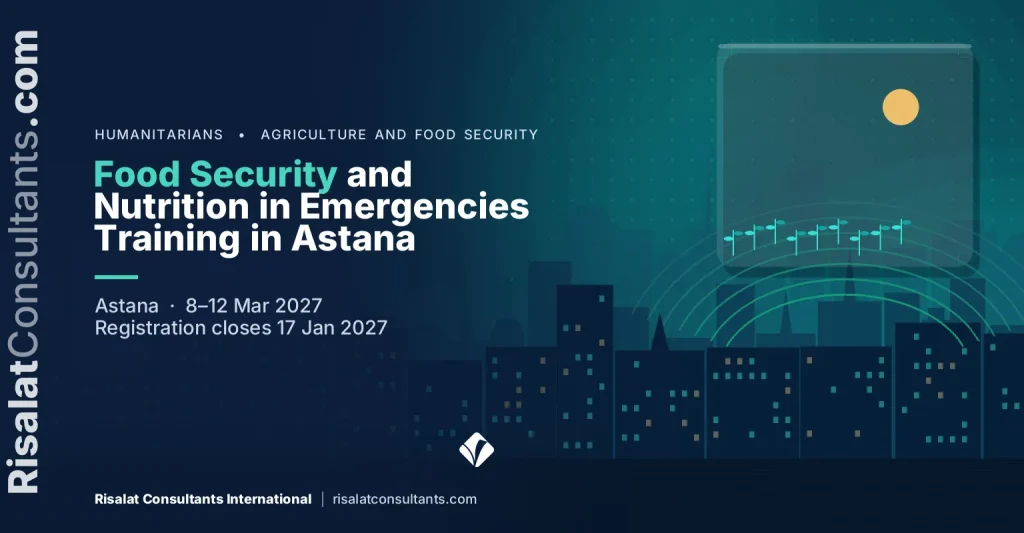
- 8–12 mars 2027 (5 jours)
- Lieu
- King Hotel Astana, Astana, Kazakhstan
- Frais par participant
- 2 760 £ (GBP)
- Paiement
- Sur facture et par virement bancaire
- Clôture des inscriptions
- 17 janv. 2027
- Format
- 5-day short course: a practical capacity-building programme for government, NGO and project teams in Astana
- Certificat
- Certificat de participation
- Option intra
- Organisez-le pour votre équipe, à vos dates
Sur cette page 15 sections
Présentation du programme
Food Security and Nutrition in Emergencies Training in Astana gives government agencies, donor-financed project units, public service providers and private-sector teams a practical way to strengthen emergency food security assessment, targeting, response and nutrition coordination. The five-day learning journey concentrates on tasks that professionals can demonstrate at work, rather than a collection of unrelated management topics.
The Global Report on Food Crises 2026 documents continued acute food insecurity and malnutrition across conflict- and crisis-affected settings. Kazakhstan is the programme’s host location, not a country that the report identifies as being in famine.
WFP’s Emergency Food Security Assessment guidance, updated in October 2025, sets out planning, field collection, analysis and reporting steps that humanitarian teams can adapt to rapid response.
IPC Technical Manual 3.1 provides a recognised evidence convergence framework for classifying food insecurity and malnutrition. WHO’s September 2026 clinical implementation guidance also clarifies age-appropriate identification and care pathways for children with acute malnutrition, which requires specialist clinical oversight.
In a mixed professional group, participants compare the procedures they use, the documents that demonstrate compliance and the decisions for which they are accountable. Every technical case is assessed for practicality, evidence quality and risks that could arise during implementation. The programme is a skills course, not a promise of institutional accreditation or an externally arranged visit.
The Programme Strengthens Institutional Capability
- Food security and nutrition assessment concepts
- Crisis drivers and vulnerability profiles
- Household food consumption measurement
- Market functionality and price monitoring
- Livelihood and coping strategy analysis
- Sampling and enumerator quality procedures
- Use and limits of IPC classifications
- Acute malnutrition screening referral coordination
- Response targeting and accountability
- In-kind cash and voucher option appraisal
- Supply chain and food safety risk controls
- Nutrition-sensitive response design
- Coordination with health and WASH clusters
- Protection and community participation
- Monitoring post-distribution outcomes
- Response transition and learning
The output of the week is an institution-specific working package, combining documented decisions, review checklists, a short executive brief and a realistic adoption plan. Participants are encouraged to bring non-sensitive examples from their own work while all teaching datasets and scenarios can be completed with fictional material.
- Intrants
- Activités
- Produits
- Effets
- Impact
L'importance croissante de la sécurité alimentaire et de la nutrition en situation d'urgence
Technical proficiency in emergency food security and nutrition programming is increasingly connected with institutional accountability. Teams need to know not just how a tool or procedure operates but when it is appropriate, who authorises it, what evidence is retained and how problems are escalated. Reliable practice improves the quality of decisions while reducing avoidable rework.
The Global Report on Food Crises 2026 documents continued acute food insecurity and malnutrition across conflict- and crisis-affected settings. Kazakhstan is the programme’s host location, not a country that the report identifies as being in famine.
Les organisations ont de plus en plus besoin de professionnels capables de :
- Planning food security and nutrition assessment concepts for a defined operational purpose
- Planning crisis drivers and vulnerability profiles for a defined operational purpose
- Planning household food consumption measurement for a defined operational purpose
- Planning market functionality and price monitoring for a defined operational purpose
- Planning livelihood and coping strategy analysis for a defined operational purpose
- Planning sampling and enumerator quality procedures for a defined operational purpose
- Planning use and limits of ipc classifications for a defined operational purpose
- Planning acute malnutrition screening referral coordination for a defined operational purpose
- Planning response targeting and accountability for a defined operational purpose
- Planning in-kind cash and voucher option appraisal for a defined operational purpose
- Planning supply chain and food safety risk controls for a defined operational purpose
- Planning nutrition-sensitive response design for a defined operational purpose
Strong emergency food security and nutrition programming systems help organisations:
- Make household food consumption measurement a documented routine instead of an informal assumption
- Make market functionality and price monitoring a documented routine instead of an informal assumption
- Make livelihood and coping strategy analysis a documented routine instead of an informal assumption
- Make sampling and enumerator quality procedures a documented routine instead of an informal assumption
- Make use and limits of ipc classifications a documented routine instead of an informal assumption
- Make acute malnutrition screening referral coordination a documented routine instead of an informal assumption
- Make response targeting and accountability a documented routine instead of an informal assumption
- Make in-kind cash and voucher option appraisal a documented routine instead of an informal assumption
- Make supply chain and food safety risk controls a documented routine instead of an informal assumption
An effective institutional approach links senior management ownership with staff capability, written procedures and proportionate monitoring. This programme uses Astana as a professional learning venue while inviting participants to compare methods across agencies and countries.
1. What is the purpose of a WFP emergency food security assessment?
The 2025 WFP EFSA guidance prioritises methodologically sound crisis assessments.
2. How is an IPC classification most appropriately produced?
The IPC Technical Manual uses evidence convergence for food insecurity and malnutrition classification.
3. What should non-clinical humanitarian staff do when acute malnutrition is suspected?
WHO 2026 guidance is intended to support national clinical implementation and referral practice.
Who Should Attend This Food Security and Nutrition in Emergencies Training?
Ce programme s'adresse à :
- Humanitarian food security coordinators
- Nutrition programme managers
- WFP and NGO field partners
- Government food security analysts
- National disaster authority staff
- Public health nutrition officers
- Assessment and survey teams
- Cash and voucher programme managers
- Agricultural livelihood advisers
- Logistics and procurement specialists
- Community engagement officers
- MEAL staff
- UN implementing partner leads
- Donor-funded emergency project officers
The course is most useful to people who have a real operational responsibility or are preparing to supervise one. Mixed groups enable a technical specialist to test recommendations with finance, compliance, programme and management colleagues before applying them to an institution.
Cochez ce que votre équipe doit être capable de faire.
Food Security and Nutrition in Emergencies Training Objectives
Upon successful completion of this Food Security and Nutrition in Emergencies Training, participants will be able to:
- Explain food security and nutrition assessment concepts and its practical boundaries
- Diagnose gaps in crisis drivers and vulnerability profiles using appropriate evidence
- Apply household food consumption measurement to a realistic work case
- Choose suitable approaches for market functionality and price monitoring
- Prepare defensible records for livelihood and coping strategy analysis
- Evaluate operational risks associated with sampling and enumerator quality procedures
- Design checks for use and limits of ipc classifications
- Coordinate staff responsible for acute malnutrition screening referral coordination
- Interpret data and feedback relating to response targeting and accountability
- Communicate decisions about in-kind cash and voucher option appraisal to leadership
- Develop a phased institutional plan for supply chain and food safety risk controls
Each objective is practised through an assessment, demonstration, structured case or group decision. The emphasis is on repeatable methods that can be embedded in existing workflows and adapted to the participant’s legal, organisational and financing constraints.
Contenu et structure du programme
- Distinguish chronic food insecurity from acute crisis conditions
- Identify conflict climate economic and market shocks
- Review WFP’s emergency assessment decision cycle
- Define affected populations and data protection needs
- Design a rapid household food security questionnaire
- Plan representative and safe data collection procedures
- Select indicators for food consumption and coping
- Assess availability access utilisation and stability factors
- Interpret market price and availability observations
- Analyse food consumption and livelihood coping indicators
- Distinguish screening results from clinical diagnosis
- Review WHO child malnutrition referral guidance boundaries
- Develop vulnerability and inclusion criteria for assistance
- Check targeting bias and community verification risks
- Compare in-kind food cash and voucher assistance options
- Assess market functionality and transfer feasibility
- Plan safe distribution and beneficiary protection arrangements
- Include nutrition-sensitive and context-specific activities
- Coordinate referrals with qualified health and nutrition teams
- Prepare procurement storage and food safety checks
- Estimate demand and basic unit costs transparently
- Manage food pipelines stock controls and supplier reliability
- Track cash transfer reconciliation and delivery exceptions
- Conduct safe post-distribution monitoring
- Interpret changing food prices and market supply
- Adjust transfer value or ration decisions using evidence
- Coordinate with WASH and health services appropriately
- Review data confidentiality for sensitive household records
- Test the response against a new access or price shock
- Reassess needs and priority groups using updated data
- Prepare an operational food security monitoring dashboard
- Document partner roles and assurance requirements
- Choose feasible exit or transition conditions
- Align short-term assistance with recovery and livelihoods
- Review nutrition referrals without practising clinical diagnosis
Contenu détaillé jour par jour
The five-day sequence moves from understanding the problem and evidence base through operational design and assurance to an actionable institutional plan. The themes are:
- Day one: food crisis analysis and emergency assessment foundations
- Day two: food insecurity nutrition indicators and targeting
- Day three: response options and coordinated programme design
- Day four: delivery quality market monitoring and nutrition integration
- Day five: response evaluation transition and institutional readiness
Contenu détaillé jour par jour
First Day | Food crisis analysis and emergency assessment foundations
- Distinguish chronic food insecurity from acute crisis conditions
- Identify conflict climate economic and market shocks
- Review WFP’s emergency assessment decision cycle
- Define affected populations and data protection needs
- Design a rapid household food security questionnaire
- Plan representative and safe data collection procedures
- Select indicators for food consumption and coping
- Understand IPC evidence convergence and classification limits
- Draft an emergency assessment terms of reference
Workshop: Baseline assessment
Design an EFSA plan for a simulated drought and displacement event with clear collection and safeguarding rules. The group records evidence used, unresolved assumptions, responsible officers and decisions requiring verification. Participants then compare approaches with colleagues, revise their work and identify a practical step for their own institution.
Second Day | Food insecurity nutrition indicators and targeting
- Assess availability access utilisation and stability factors
- Interpret market price and availability observations
- Analyse food consumption and livelihood coping indicators
- Distinguish screening results from clinical diagnosis
- Review WHO child malnutrition referral guidance boundaries
- Develop vulnerability and inclusion criteria for assistance
- Check targeting bias and community verification risks
- Create a baseline and disaggregation plan
- Produce a concise needs and priority analysis
Workshop: Design choices
Use fictitious household and market observations to prioritise support without overinterpreting indicators. The group records evidence used, unresolved assumptions, responsible officers and decisions requiring verification. Participants then compare approaches with colleagues, revise their work and identify a practical step for their own institution.
Third Day | Response options and coordinated programme design
- Compare in-kind food cash and voucher assistance options
- Assess market functionality and transfer feasibility
- Plan safe distribution and beneficiary protection arrangements
- Include nutrition-sensitive and context-specific activities
- Coordinate referrals with qualified health and nutrition teams
- Prepare procurement storage and food safety checks
- Estimate demand and basic unit costs transparently
- Design community feedback and grievance procedures
- Draft a response framework with assumptions and risks
Case Study: Risk and decisions
Choose between food, cash and vouchers for three market scenarios and document decision conditions. The group records evidence used, unresolved assumptions, responsible officers and decisions requiring verification. Participants then compare approaches with colleagues, revise their work and identify a practical step for their own institution.
Fourth Day | Delivery quality market monitoring and nutrition integration
- Manage food pipelines stock controls and supplier reliability
- Track cash transfer reconciliation and delivery exceptions
- Conduct safe post-distribution monitoring
- Interpret changing food prices and market supply
- Adjust transfer value or ration decisions using evidence
- Coordinate with WASH and health services appropriately
- Review data confidentiality for sensitive household records
- Prepare operational indicators and escalation triggers
- Record unintended harms and corrective measures
Workshop: Operations and assurance
Create a monitoring dashboard and corrective response to a hypothetical market price shock. The group records evidence used, unresolved assumptions, responsible officers and decisions requiring verification. Participants then compare approaches with colleagues, revise their work and identify a practical step for their own institution.
Fifth Day | Response evaluation transition and institutional readiness
- Test the response against a new access or price shock
- Reassess needs and priority groups using updated data
- Prepare an operational food security monitoring dashboard
- Document partner roles and assurance requirements
- Choose feasible exit or transition conditions
- Align short-term assistance with recovery and livelihoods
- Review nutrition referrals without practising clinical diagnosis
- Build a 90-day field capability and logistics improvement plan
- Present a coordinated emergency response proposal
Capstone Exercise: Institutional action plan
Present a coordinated emergency food security and nutrition-sensitive response with referral boundaries. The group records evidence used, unresolved assumptions, responsible officers and decisions requiring verification. Participants then compare approaches with colleagues, revise their work and identify a practical step for their own institution.
Food Security and Nutrition in Emergencies Training Methodology
Facilitators introduce concepts through short explanations and then ask participants to work through realistic decisions related to emergency food security assessment, targeting, response and nutrition coordination. The format uses controlled datasets, fictional records and carefully selected public references; participants are never required to share confidential customer information, protected case files or unpublished institutional records.
Le programme associe :
- Instructor-led explanations of terminology and current guidance
- Daily applied workshops using topic-specific exercises
- Structured comparison of official policies and standards
- Small-group analysis of competing operational options
- Individual review of an institutional readiness baseline
- Short presentations of decisions and their evidence
- Peer scrutiny of assumptions and implementation risks
- Simulation of procedures and escalation decisions
- Template development and checking against requirements
- Daily reflective notes on changes to working practice
- Facilitator feedback on participant-produced documents
- Final presentation of a feasible institutional action plan
Before arrival, a short pre-assessment identifies job roles, expected outputs and practical barriers. The trainer uses it to adjust examples while retaining the published technical content. Exercises favour local adaptation over copying another country’s arrangements.
The final peer review tests feasibility, ownership, evidence needs and a realistic timetable for introducing the proposed changes.
Résultats attendus
Upon completion of this Food Security and Nutrition in Emergencies Training, participants will be able to:
- Produce a usable review or working document for food security and nutrition assessment concepts
- Produce a usable review or working document for crisis drivers and vulnerability profiles
- Produce a usable review or working document for household food consumption measurement
- Produce a usable review or working document for market functionality and price monitoring
- Produce a usable review or working document for livelihood and coping strategy analysis
- Produce a usable review or working document for sampling and enumerator quality procedures
- Produce a usable review or working document for use and limits of ipc classifications
- Produce a usable review or working document for acute malnutrition screening referral coordination
- Produce a usable review or working document for response targeting and accountability
Participants should be able to explain why a selected method is appropriate, what information is still missing and who must authorise its implementation. Their final products are designed for managerial discussion and further adaptation, not as substitutes for professional certification, legal advice or regulatory approval.
2 760 £ par participant · facture et virement bancaire · remise pour les groupes de 5 personnes ou plus
Cinq personnes ou plus d'une même organisation : demandez le tarif de groupe lors de votre demande de facture.
Ten or more: an in-house version for your institution may cost less per person. Ask for an in-house quote.
Registration closes in 56 days (17 Jan 2027)
Institutional Application of Food Security and Nutrition in Emergencies Training
Ce programme aide les organisations à renforcer :
- Governance and staff ownership of food security and nutrition assessment concepts
- Governance and staff ownership of crisis drivers and vulnerability profiles
- Governance and staff ownership of household food consumption measurement
- Governance and staff ownership of market functionality and price monitoring
- Governance and staff ownership of livelihood and coping strategy analysis
- Governance and staff ownership of sampling and enumerator quality procedures
- Governance and staff ownership of use and limits of ipc classifications
- Governance and staff ownership of acute malnutrition screening referral coordination
- Governance and staff ownership of response targeting and accountability
- Governance and staff ownership of in-kind cash and voucher option appraisal
- Governance and staff ownership of supply chain and food safety risk controls
- Governance and staff ownership of nutrition-sensitive response design
Les participants repartent avec des outils pratiques pour améliorer :
- A practical checklist or decision record for market functionality and price monitoring
- A practical checklist or decision record for livelihood and coping strategy analysis
- A practical checklist or decision record for sampling and enumerator quality procedures
- A practical checklist or decision record for use and limits of ipc classifications
- A practical checklist or decision record for acute malnutrition screening referral coordination
- A practical checklist or decision record for response targeting and accountability
- A practical checklist or decision record for in-kind cash and voucher option appraisal
- A practical checklist or decision record for supply chain and food safety risk controls
- A practical checklist or decision record for nutrition-sensitive response design
Institutional adaptation begins with a named management sponsor and a narrow process where improvement can be observed. Participants identify baseline records, reporting responsibilities, resources and review dates, then recommend whether to pilot, revise or defer each intervention. A capacity assessment may help the organisation identify readiness gaps.
Pertinence régionale & mise en application
Asie centrale
Astana offers a regional convening setting for practitioners from food security, agriculture, social protection and emergency institutions. Kazakhstan should not be portrayed as a documented famine response setting.
Africa and the Middle East
Conflict-related access constraints and high humanitarian need require careful targeting, safe delivery, market monitoring and nutrition referrals.
South Asia and the Pacific
Floods, droughts and economic shocks call for context-specific needs assessment, market analysis and a coordinated response with health, WASH and local authorities.
The cases are intended as comparative learning, not universal legal advice. Each team must verify the applicable national rules, sector requirements and institutional capacity before adopting a template. For pre-course prioritisation, participants may use Risalat’s Training Needs Assessment.
Profil du pays d'accueil – Kazakhstan
Astana is Kazakhstan’s capital and provides a venue for an international classroom programme on humanitarian food and nutrition response methods.
The technical reference points are WFP emergency assessments, IPC classifications and WHO guidance. These are global methods for simulated scenarios; the course does not claim any famine condition in Kazakhstan or a hosted UN technical visit.
Delegates should verify Kazakhstan entry conditions for their own nationality and confirm winter weather and travel arrangements when selecting a course date.
Food Security and Nutrition in Emergencies Training Deliverables
Risalat structures this programme around preparation, practical participation and follow-up. Topic-specific templates are designed for adaptation to the participant’s institutional context. Travel, accommodation and participation arrangements remain subject to the confirmed booking conditions issued by Risalat.
Avant le programme
- Pré-évaluation des participants
- Food Security and Nutrition in Emergencies Readiness Assessment
- Food Security and Nutrition in Emergencies Resource Pack
- Lectures préparatoires
- Aide et conseils gratuits pour le visa
Pendant le programme
- Accueil à l'aéroport & assistance à l'arrivée
- Hébergement avec petit-déjeuner : 6 nuits, arrivée le dimanche 7 mars 2027, départ le samedi 13 mars 2027 (une nuit avant et une nuit après le programme)
- Dîner de bienvenue et de réseautage
- Kit de formation Risalat (sac, gourde, mug, t-shirt, casquette, protège-passeport, stylos, carnet, magnet & porte-clés)
- Comprehensive Food Security and Nutrition in Emergencies Training Manual
- Practical diagnostic checklist for food security and nutrition assessment concepts
- Process mapping and baseline analysis worksheet
- Risk and controls assessment matrix
- Performance indicator and evidence register
- Case study decision log and peer review form
- Institutional 30, 60 and 90-day action plan template
- Ateliers pratiques & simulations
- Discussions de groupe & apprentissage entre pairs
- Déjeuner et pauses-café quotidiens
- Accès complet aux installations du lieu de formation
- Mini tablette avec supports pédagogiques numériques
- Visite de terrain (le cas échéant)
- Visite récréative de la ville
Après le programme
- Certificat de participation
- Distinction Risalat de participation au programme
- Documents de référence après la formation
- Completed Food Security and Nutrition in Emergencies case and decision toolkit
- Institutional implementation roadmap
- Selected monitoring and quality review templates
- Accompagnement après la formation & conseils de suivi
- Rapport du programme
Organisations seeking dedicated group delivery, tailored case exercises or additional implementation support can request a tailored in-house proposal.
Common Challenges in Food Security and Nutrition in Emergencies, And How This Training Helps
How can an organisation set priorities when several problems demand attention?
Day one uses food security and nutrition assessment concepts to identify what is known, what is assumed and which operational outcome matters most. The exercise assigns a review owner and produces a practical record of what should change.
How can an organisation find reliable evidence for a difficult decision?
Days one and two develop a documented baseline for household food consumption measurement and test whether information is complete and fit for purpose. The exercise assigns a review owner and produces a practical record of what should change.
How can an organisation translate general standards into procedures staff can use?
Day two turns market functionality and price monitoring into a practical checklist, record and decision sequence. The exercise assigns a review owner and produces a practical record of what should change.
How can an organisation manage risks and mistakes without hiding them?
Days three and four create clear review gates for sampling and enumerator quality procedures and assign accountability for correcting failures. The exercise assigns a review owner and produces a practical record of what should change.
How can an organisation coordinate different units without losing ownership?
The day-four exercises map roles, handoffs and escalation around acute malnutrition screening referral coordination. The exercise assigns a review owner and produces a practical record of what should change.
How can an organisation measure improvement when resources and time are limited?
Day five chooses a small set of indicators linked to response targeting and accountability and a realistic review cycle. The exercise assigns a review owner and produces a practical record of what should change.
How can an organisation make training useful after participants return to work?
The final capstone turns supply chain and food safety risk controls into a 90-day sequence with named owners, management decisions and observable outputs. The exercise assigns a review owner and produces a practical record of what should change.
Questions fréquentes
Who should attend Food Security and Nutrition in Emergencies Training in Astana?
The course is intended for responsible professionals such as humanitarian food security coordinators, nutrition programme managers, wfp and ngo field partners, and cross-functional colleagues whose decisions affect emergency food security assessment, targeting, response and nutrition coordination.
Is this a practical course or mainly lectures?
It combines technical explanations with five applied cases, review templates, group decisions and a final action plan linked to emergency food security and nutrition programming.
What should participants prepare before attending?
Complete the pre-assessment, identify one relevant process or institutional challenge, and bring only public or appropriately anonymised records. Confidential files are not required.
Can the methods be used in government and donor-financed projects?
Yes, the cases can be adapted to public agencies, implementation units and regulated organisations, provided users check applicable national law, donor requirements and organisational controls.
Is a particular institution or technical visit confirmed?
No external institution or visit is represented as confirmed. Any field or technical exposure component depends on prior host acceptance and appropriate safeguarding arrangements.
Who Will Deliver This Programme
Each date is delivered by a team assigned from Risalat's expert network for this subject. For this programme we assign:
How we choose them: Experience in the region of the participants or comparable settings; Command of the financier rules that apply (World Bank, ADB, AfDB, EU, UN) where relevant; Delivery in English; other languages on request for in-house groups; No conflict of interest with participants' institutions.
Cours de formation à AstanaHumanitarians training courses
Why Astana for this programme
Astana serves as Kazakhstan's political and administrative centre, housing key ministries, state agencies, and the Astana International Financial Centre. Visiting delegations can observe modern public administration facilities and urban planning initiatives first-hand. Nursultan Nazarbayev International Airport provides direct flight connections to major regional and international transit hubs.
The Food Security and Nutrition in Emergencies Training in Astana programme in March 2027 brings together officials and professionals from across the Central Asia and the Caucasus region and beyond. Sessions combine short inputs, case studies and group work on participants' own files, and the city's institutions can be added as a study visit on request.
Getting there: Nursultan Nazarbayev International Airport (NQZ).
Vérifiez si vous avez besoin d'un visa avec le vérificateur de visa gratuit, et demandez une lettre d'invitation une fois inscrit.
Le même thème dans d'autres villes
Pour les équipes et les institutions
Bring your team
Teams that learn together apply more at work. Tell us how many people and how you would like to take part: we reply with a group quote within two working days.
Watch: this programme in short


Other dates and cities for this subject: Health Systems and Health Project Management training courses (111 upcoming dates).
Plus de formations au Kazakhstan · Tous les programmes en Asie · Calendrier complet des formations
Plan this programme in a roadmap: why it matters, why to approve it, the dates to plan and the career it builds.