Key facts
- Dates
- 5–8 Jul 2027 (4 days)
- Where
- Bali, Indonesia
- Fee per participant
- £2,350 (GBP)
- Payment
- By invoice and bank transfer
- Registration closes
- 26 May 2027
- Format
- 4-day short course: a practical capacity-building programme for government, NGO and project teams in Bali
- Groups
- Teams of 3 or more qualify for a group discount, offered case by case: ask for a group quote.
- In-house option
- Run it for your team, on your dates
On this page 10 sections
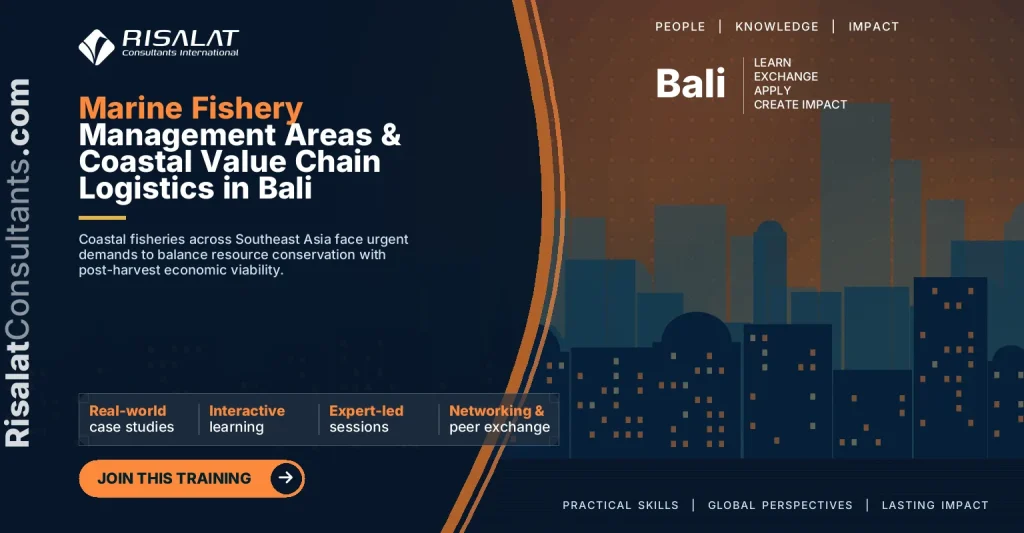
Marine Fishery Management Areas & Coastal Value Chain Logistics in Bali
Programme Overview
Coastal fisheries across Southeast Asia face urgent demands to balance resource conservation with post-harvest economic viability. This professional programme in Bali examines Fisheries Management Area zoning, vessel monitoring frameworks, and coastal infrastructure planning. Participants analyse how spatial management regulations protect marine biomes whilst preserving artisanal livelihoods. Through applied case analyses of Indonesian and regional coastal logistics, delegates explore modern landing site management, cold chain integrity, and digital catch documentation necessary for regulatory compliance and sustainable maritime resource stewardship.
Free self-check: the procurement maturity assessment gives 30 questions on planning, tendering, contract management, integrity and e-procurement, with a score per area, in about 10 minutes.
The curriculum links spatial governance with commercial supply chain efficiency, focusing on primary landing infrastructure and loss reduction. Officers evaluate shore reception facilities, sanitary handling protocols, and energy-efficient cold chain solutions designed for rural archipelagic settings. By reviewing international guidelines such as the FAO Code of Conduct for Responsible Fisheries and standard environmental and social frameworks, the training equips practitioners to design integrated landing hubs that lower spoilage rates, improve sanitary conformity, and support small-scale fishing communities.
Operational enforcement and value chain logistics require collaborative execution across national agencies, local governments, and coastal communities. This course provides comprehensive training on community-based monitoring, control, and surveillance mechanisms alongside digital traceability platforms. Attendees investigate practical methods to modernise municipal fish ports, structure public investment in post-harvest processing centres, and align coastal logistics with international market standards. The programme builds institutional capabilities to supervise coastal marine corridors while driving local economic development.
The programme strengthens institutional capability in:
- Principles of Fisheries Management Area delineation and marine spatial zoning
- Ecosystem approaches to coastal resource management and stock assessment integration
- Artisanal exclusive use zones, offshore commercial corridors, and marine protected area buffers
- Regulatory alignment between national marine mandates and local municipal water ordinances
- Spatial mapping tools and community participatory zoning techniques for resource allocation
- Monitoring, control, and surveillance architectures for municipal and small commercial fleets
- Deployment of vessel monitoring systems, automatic identification systems, and mobile reporting
- Community-based enforcement frameworks and operationalisation of deputised coastal patrols
- Procurement planning and market analysis
- Choosing procurement methods and approaches
- Writing specifications and terms of reference
- Bidding documents and evaluation criteria
Why this matters now
Organisations increasingly require professionals capable of:
- Plan procurement that matches project needs and timelines
- Prepare clear specifications and evaluation criteria
- Evaluate bids consistently and defend the decision
- Manage contracts, variations and performance
- Keep complete records for audit and review
Strong procurement and contract management systems help organisations:
- Reduce procurement delays and failed tenders
- Achieve value for money
- Lower the risk of complaints and audit findings
- Deliver contracts on time and to quality
Who Should Attend
This programme is designed for:
- Bureau of Fisheries and Aquatic Resources (BFAR) coastal resource management officers
- Municipal agricultural and fisheries technicians from coastal local government units
- Agri-fishery infrastructure planning engineers and regional development coordinators
- Project management unit specialists implementing donor-funded coastal resource investments
- Provincial planning and development office marine desk officers
- Port operations managers and municipal fish landing site supervisors
- Monitoring, control, and surveillance officers handling artisanal fleet tracking
- Post-harvest specialists focused on cold chain infrastructure and loss mitigation
- Procurement officers and managers
- Contract managers and administrators
- Project and programme managers
- PIU procurement specialists
Tick what your team needs to be able to do.
Programme Objectives
By the end of this programme participants will be able to:
- Analyse Fisheries Management Area zoning frameworks and spatial designations to balance resource preservation with artisanal fishing rights
- Evaluate coastal landing infrastructure requirements to maintain sanitary standards and lower post-harvest fishery losses
- Design energy-efficient cold store hubs and primary shore collection facilities adapted to rural island geographies
- Structure monitoring, control, and surveillance protocols that incorporate community enforcement frameworks and vessel tracking technologies
- Apply catch documentation and traceability standards consistent with the FAO Voluntary Guidelines for Securing Sustainable Small-Scale Fisheries
- Assess environmental and social safeguards applicable to marine landing infrastructure and coastal port modernisation projects
- Formulate bankable coastal value chain investment plans that align municipal fishery priorities with national development targets
- Explain the procurement cycle and the rules that apply to it
- Prepare a procurement plan linked to project timelines
- Choose a suitable method and approach to the market
Training Structure & Contents
- Principles of Fisheries Management Area delineation and marine spatial zoning
- Ecosystem approaches to coastal resource management and stock assessment integration
- Artisanal exclusive use zones, offshore commercial corridors, and marine protected area buffers
- Regulatory alignment between national marine mandates and local municipal water ordinances
- Spatial mapping tools and community participatory zoning techniques for resource allocation
- Workshop: Applying Fisheries Management Area zoning and spatial governance to your institution
- Monitoring, control, and surveillance architectures for municipal and small commercial fleets
- Deployment of vessel monitoring systems, automatic identification systems, and mobile reporting
- Community-based enforcement frameworks and operationalisation of deputised coastal patrols
- Catch documentation schemes to counter illegal, unreported, and unregulated fishing
- Inter-agency coordination mechanisms for maritime compliance and municipal port inspections
- Workshop: Applying vessel tracking, catch documentation, and community enforcement to your institution
- Engineering criteria and sanitary layouts for municipal fish landing stations
- Cold chain integrity: solar-powered cold stores, ice production units, and insulated transit
- HACCP principles and primary processing standards for coastal landing sites
- Logistical consolidation models linking remote island production to commercial consumption centres
- Operational management and cost recovery models for public post-harvest infrastructure
- Case Study: Coastal landing hubs and cold chain logistics in practice
- Environmental and social safeguard integration for marine post-harvest civil works
- Developing bankable feasibility studies for regional agri-fishery logistics hubs
- Inclusive value chain financing and working capital structures for fisherfolk enterprises
- Mitigating climate hazard risks for shorefront landing stations and seafood storage assets
- Action planning: drafting municipal coastal logistics and management implementation roadmaps
- Capstone Exercise: Marine fishery management areas and coastal value chain logistics action plan for your institution
- Procurement cycle principles and regulatory frameworks applied to coastal programmes
- Writing clear specifications and terms of reference for landing site infrastructure
- Choosing procurement methods and market analysis approaches
- Preparing bidding documents and applying objective evaluation criteria
- Managing contracts, variations, supplier performance, and audit documentation
Full day-by-day contents
First Day | Fisheries Management Area Zoning and Spatial Governance
- Principles of Fisheries Management Area delineation and marine spatial zoning
- Ecosystem approaches to coastal resource management and stock assessment integration
- Artisanal exclusive use zones, offshore commercial corridors, and marine protected area buffers
- Regulatory alignment between national marine mandates and local municipal water ordinances
- Spatial mapping tools and community participatory zoning techniques for resource allocation
- Workshop: Applying Fisheries Management Area zoning and spatial governance to your institution
Second Day | Vessel Tracking, Catch Documentation, and Community Enforcement
- Monitoring, control, and surveillance architectures for municipal and small commercial fleets
- Deployment of vessel monitoring systems, automatic identification systems, and mobile reporting
- Community-based enforcement frameworks and operationalisation of deputised coastal patrols
- Catch documentation schemes to counter illegal, unreported, and unregulated fishing
- Inter-agency coordination mechanisms for maritime compliance and municipal port inspections
- Workshop: Applying vessel tracking, catch documentation, and community enforcement to your institution
Third Day | Coastal Landing Hubs and Cold Chain Logistics
- Engineering criteria and sanitary layouts for municipal fish landing stations
- Cold chain integrity: solar-powered cold stores, ice production units, and insulated transit
- HACCP principles and primary processing standards for coastal landing sites
- Logistical consolidation models linking remote island production to commercial consumption centres
- Operational management and cost recovery models for public post-harvest infrastructure
- Case Study: Coastal landing hubs and cold chain logistics in practice
Fourth Day | Value Chain Modernisation and Public Investment Planning
- Environmental and social safeguard integration for marine post-harvest civil works
- Developing bankable feasibility studies for regional agri-fishery logistics hubs
- Inclusive value chain financing and working capital structures for fisherfolk enterprises
- Mitigating climate hazard risks for shorefront landing stations and seafood storage assets
- Action planning: drafting municipal coastal logistics and management implementation roadmaps
- Capstone Exercise: Marine fishery management areas and coastal value chain logistics action plan for your institution
Fifth Day | Procurement Planning and Contract Management in Fishery Projects
- Procurement cycle principles and regulatory frameworks applied to coastal programmes
- Writing clear specifications and terms of reference for landing site infrastructure
- Choosing procurement methods and market analysis approaches
- Preparing bidding documents and applying objective evaluation criteria
- Managing contracts, variations, supplier performance, and audit documentation
Training Methodology
The training employs an applied, adult-learning methodology combining structured technical lectures, comparative case analyses, and practical design studios. Participants review authentic coastal masterplans and post-harvest facilities from across Southeast Asia, conducting comparative assessments against FAO and World Bank environmental standards. Working in multi-disciplinary planning groups, delegates utilise real-world scenarios to practise implementation.
- Expert-led instructional modules and structured technical lectures
- Comparative case study evaluations of regional coastal infrastructure
- Practical design studios and small group application exercises
- Participatory planning workshops addressing institutional priorities
- Capstone action planning with peer and facilitator review
Expected Outcomes
- Strengthened capacity to delineate Fisheries Management Areas and operationalise marine spatial zoning
- Enhanced ability to plan compliant municipal fish landing facilities and cold storage logistics
- Operational models for community-based monitoring, control, surveillance, and vessel tracking
- Improved institutional execution of catch documentation and sanitary traceability standards
- Practical skills in preparing bankable investment proposals, specifications, and procurement plans
- Actionable implementation roadmaps tailored to home institutions and coastal local government units
£2,350 per participant · invoice and bank transfer · groups of 5 or more receive a discount
Five or more from one organisation: ask for the group rate on the invoice request.
Ten or more: an in-house version for your institution may cost less per person. Ask for an in-house quote.
Registration closes in 178 days (26 May 2027)
Who Will Deliver This Programme
Each date is delivered by a team assigned from Risalat's expert network for this subject. For this programme we assign:
How we choose them: Experience in the region of the participants or comparable settings; Command of the financier rules that apply (World Bank, ADB, AfDB, EU, UN) where relevant; Delivery in English; other languages on request for in-house groups; No conflict of interest with participants' institutions.
Training courses in BaliAgriculture & Forestry training courses
Why Bali for this programme
Bali offers a retreat setting for leadership and team programmes, with links to tourism and community development.
The Marine Fishery Management Areas & Coastal Value Chain Logistics in Bali programme in July 2027 brings together officials and professionals from across the Asia region and beyond. Sessions combine short inputs, case studies and group work on participants' own files, and the city's institutions can be added as a study visit on request.
Getting there: Ngurah Rai (DPS).
Check whether you need a visa with the free Visa Checker, and ask for an invitation letter once you are registered.
The same topic in other cities
Other programmes in Bali
- Coastal Fisheries Co-Management and Marine Protected Area Operations in Bali
- Export Agribusiness Incubation & Smallholder Market Linkages in Bali
- Mangrove Ecosystem Restoration & Blue Carbon Coastal Habitat Management in Bali
- Disaster Catastrophe Drawdown Governance & Fiscal Shock Readiness in Bali
- REDD+ Jurisdictional Carbon Accounting & Benefit Sharing Mechanisms in Bali
Questions before you nominate your team? Book a 30-minute call with us, or ask for this programme in-house.
Teams often travel here from Timor-Leste, Nepal, Myanmar, Vietnam, Philippines, Indonesia, Papua New Guinea, Fiji. Funding, visa letters and group rates are explained on each country page.
- Open Contracting Partnership Open Contracting Partnership
- Food and Agriculture Organization of the UN FAO
Is there agriculture and food security training for government officials in Bali in July 2027?
Can "Marine Fishery Management Areas & Coastal Value Chain Logistics in Bali" be delivered in-house for one organisation?
Which other agriculture and food security programmes does Risalat run?
How do organisations register and pay?
For teams and institutions
Bring your team
Teams that learn together apply more at work. Tell us how many people and how you would like to take part: we reply with a group quote within two working days.
Watch: this programme in short


Other dates and cities for this subject: Agriculture, Value Chains and Food Security training courses (97 upcoming dates).
More training courses in Indonesia · All programmes in Asia · Full training calendar
Plan this programme in a roadmap: why it matters, why to approve it, the dates to plan and the career it builds.