Key facts
- Dates
- 13–16 Sep 2027 (4 days)
- Where
- Dubai, United Arab Emirates
- Fee per participant
- £2,600 (GBP)
- Payment
- By invoice and bank transfer
- Registration closes
- 4 Aug 2027
- Format
- 4-day short course: a practical capacity-building programme for government, NGO and project teams in Dubai
- Groups
- Teams of 3 or more qualify for a group discount, offered case by case: ask for a group quote.
- In-house option
- Run it for your team, on your dates
On this page 10 sections
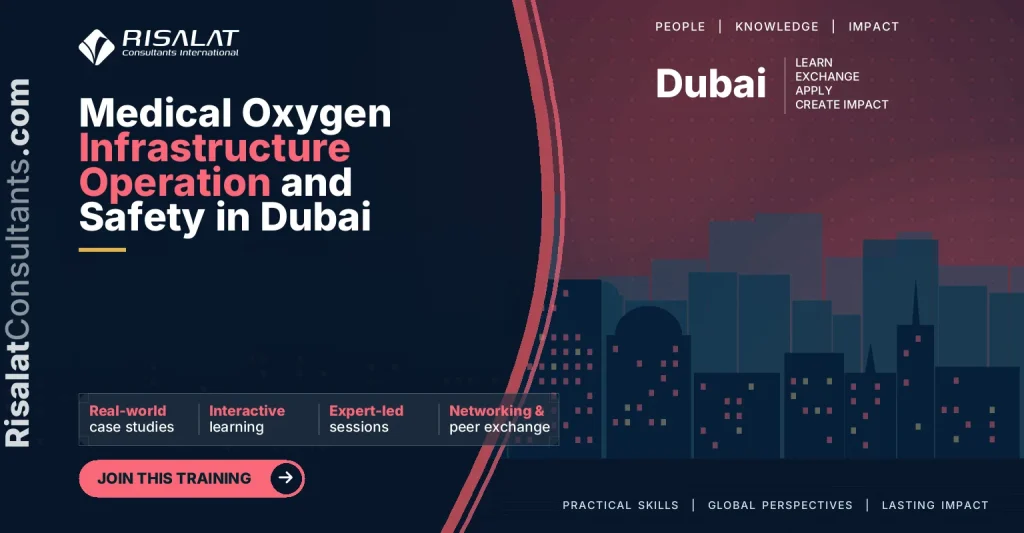
Medical Oxygen Infrastructure Operation and Safety in Dubai
Programme Overview
Medical oxygen is a vital clinical medicine requiring robust production, distribution, and monitoring infrastructure across secondary and tertiary health facilities. This four-day intensive programme addresses the operational complexities of pressure swing adsorption plants, high-pressure cylinder refilling systems, and medical gas pipeline networks. Participants study technical guidelines from the World Health Organisation, ISO 7396-1 pipeline engineering standards, and international fire safety codes, ensuring medical gas systems deliver uninterrupted clinical supply safely.
Health infrastructure managers frequently encounter technical challenges, including feed air contamination, pressure instability, and inadequate preventive maintenance regimes. This course provides comprehensive instruction on troubleshooting air compressors, refrigerant dryers, and molecular sieve beds, alongside rigorous testing of vacuum and terminal units. Technical personnel gain practical competence in inspecting copper distribution networks, setting up automatic changeover manifolds, and maintaining digital alarm systems to safeguard vulnerable clinical environments against sudden pipeline failures.
Delivered in Dubai, the programme combines engineering principles with health facility risk governance. Technical teams evaluate fire prevention strategies, cryogenic safety protocols, and safe cylinder handling practices. By completing applied exercises, participants learn to calculate facility flow demands, implement scheduled servicing regimes, and manage technical documentation. This practical grounding ensures public healthcare assets operate safely, reliably, and in full compliance with rigorous international safety and quality standards throughout their operational lifecycles.
The programme strengthens institutional capability in:
- International standards and WHO technical specifications for medical oxygen production
- Air intake, multi-stage compression, filtration, and refrigerant dryer mechanics
- Molecular sieve bed operation, cycle timing, and oxygen concentration dynamics
- Air receiver vessel inspection, condensate management, and pressure relief maintenance
- Routine monitoring protocols for purity, moisture content, and carbon dioxide traces
- Booster compressor operation, pressure stages, and cylinder refilling cascade systems
- Cylinder inspection protocols, hydrostatic test date verification, and valve maintenance
- Colour coding, pin-index safety systems, and labelling according to international norms
- Infrastructure planning and prioritisation
- Project appraisal and business cases
- Financing options and public-private partnerships
- Procurement and contracting for works
- Transaction
- Record
- Control
- Evidence
- Opinion
Why this matters now
Organisations increasingly require professionals capable of:
- Plan and prioritise infrastructure investments
- Appraise projects and prepare business cases
- Choose financing and delivery models
- Supervise works for time, cost and quality
- Manage assets over their life
Strong infrastructure, urban development and partnerships systems help organisations:
- Select the right investments
- Deliver projects on time and on budget
- Attract financing and partners
- Keep assets working for longer
Who Should Attend
This programme is designed for:
- Clinical engineers responsible for tertiary and secondary hospital systems
- Hospital facility maintenance engineers and technical directors
- Biomedical technicians managing medical gas plant and refilling operations
- Intensive care operational supervisors and senior anaesthetic nurses
- Public health infrastructure officers from ministries of health
- Project technical officers overseeing health facility modernisation works
- Hospital occupational health and safety compliance inspectors
- Estates management supervisors managing medical pipeline networks
- Infrastructure and urban planners
- Engineers and technical managers
- Project and programme managers
- PPP unit staff
Tick what your team needs to be able to do.
Programme Objectives
By the end of this programme participants will be able to:
- Operate pressure swing adsorption generation units, compressors, and dryers according to international technical guidelines
- Inspect high-pressure medical gas cylinder refilling cascades, testing manifolds, and safety relief assemblies
- Apply ISO 7396-1 design, installation, and testing standards to hospital medical gas pipeline systems
- Execute planned preventive maintenance routines on terminal units, automatic changeover manifolds, and area alarms
- Analyse medical gas quality parameters including oxygen purity, moisture levels, carbon monoxide, and oil mist traces
- Implement fire safety protocols and hazard control procedures in oxygen-enriched storage and plant room environments
- Draft comprehensive facility maintenance schedules and daily technical inspection registers for health facilities
- Explain how infrastructure is planned and prioritised
- Appraise projects and prepare a business case
- Compare financing and delivery models, including partnerships
Training Structure & Contents
- International standards and WHO technical specifications for medical oxygen production
- Air intake, multi-stage compression, filtration, and refrigerant dryer mechanics
- Molecular sieve bed operation, cycle timing, and oxygen concentration dynamics
- Air receiver vessel inspection, condensate management, and pressure relief maintenance
- Routine monitoring protocols for purity, moisture content, and carbon dioxide traces
- Application of methods to institutional examples and agreement of practical next steps
- Booster compressor operation, pressure stages, and cylinder refilling cascade systems
- Cylinder inspection protocols, hydrostatic test date verification, and valve maintenance
- Colour coding, pin-index safety systems, and labelling according to international norms
- Hazards of oxygen enrichment, fire prevention, and ventilation in plant rooms
- Cryogenic liquid storage overview, ambient vaporisers, and emergency backup connections
- Institutional safety applications and agreement of next steps
- ISO 7396-1 compliant pipeline architecture: primary, secondary, and reserve supplies
- Automatic manifold changeover mechanisms, line regulators, and emergency shut-off valves
- Central plant alarm panels, operational pressure ranges, and pressure drop troubleshooting
- Degreased medical-grade copper pipe installation standards, brazing, and support spacing
- Terminal unit maintenance, flow testing, and clinical area valve box isolations
- Analysis of realistic pipeline engineering case studies and lessons learned
- Pipeline cross-connection testing, particle purging, and system pressure leak decay tests
- Developing daily, weekly, and monthly maintenance routines for biomedical teams
- Drafting hospital medical gas safety check registers and technical audit logs
- Risk management during plant failure: clinical notification, manual bypass, and emergency supplies
- Final technical review, documentation sign-off, and institutional action planning
- Capstone action plan development with priorities, owners, first steps, and peer review
- Infrastructure planning and prioritisation frameworks for health facilities
- Project appraisal methodologies and preparation of formal business cases
- Financing options and public-private partnerships in healthcare facilities
- Procurement processes and contracting standards for works
- Long-term life-cycle management and maintenance oversight of public healthcare assets
Full day-by-day contents
First Day | Medical Oxygen Generation and Pressure Swing Adsorption Plant Architecture
- International standards and WHO technical specifications for medical oxygen production
- Air intake, multi-stage compression, filtration, and refrigerant dryer mechanics
- Molecular sieve bed operation, cycle timing, and oxygen concentration dynamics
- Air receiver vessel inspection, condensate management, and pressure relief maintenance
- Routine monitoring protocols for purity, moisture content, and carbon dioxide traces
- Application of methods to institutional examples and agreement of practical next steps
Second Day | Cylinder Refilling Stations, High-Pressure Safety, and Gas Storage
- Booster compressor operation, pressure stages, and cylinder refilling cascade systems
- Cylinder inspection protocols, hydrostatic test date verification, and valve maintenance
- Colour coding, pin-index safety systems, and labelling according to international norms
- Hazards of oxygen enrichment, fire prevention, and ventilation in plant rooms
- Cryogenic liquid storage overview, ambient vaporisers, and emergency backup connections
- Institutional safety applications and agreement of next steps
Third Day | Medical Gas Pipeline Systems (MGPS) and Central Manifold Engineering
- ISO 7396-1 compliant pipeline architecture: primary, secondary, and reserve supplies
- Automatic manifold changeover mechanisms, line regulators, and emergency shut-off valves
- Central plant alarm panels, operational pressure ranges, and pressure drop troubleshooting
- Degreased medical-grade copper pipe installation standards, brazing, and support spacing
- Terminal unit maintenance, flow testing, and clinical area valve box isolations
- Analysis of realistic pipeline engineering case studies and lessons learned
Fourth Day | Quality Assurance, Facility Safety Checks, and Maintenance Scheduling
- Pipeline cross-connection testing, particle purging, and system pressure leak decay tests
- Developing daily, weekly, and monthly maintenance routines for biomedical teams
- Drafting hospital medical gas safety check registers and technical audit logs
- Risk management during plant failure: clinical notification, manual bypass, and emergency supplies
- Final technical review, documentation sign-off, and institutional action planning
- Capstone action plan development with priorities, owners, first steps, and peer review
Fifth Day | Infrastructure Appraisal, Delivery Models, and Asset Management
- Infrastructure planning and prioritisation frameworks for health facilities
- Project appraisal methodologies and preparation of formal business cases
- Financing options and public-private partnerships in healthcare facilities
- Procurement processes and contracting standards for works
- Long-term life-cycle management and maintenance oversight of public healthcare assets
Training Methodology
Training delivery relies on practical, engineering-focused adult learning principles. Participants examine physical component assemblies, interpret pipeline schematics, and review plant diagnostic logs. Facilitated sessions combine technical presentations with practical group exercises where participants audit mock facility configurations, calculate oxygen demand for intensive care units, and resolve simulated system faults. Structured peer review sessions enable engineers and operational supervisors to compare plant management challenges and refine standard operating procedures directly relevant to their hospitals.
- Expert-led sessions on current practice
- Regional and international case studies
- Group work and practical exercises
- Simulations and role plays where relevant
- Discussion of participants’ own challenges
- Peer learning across institutions
Expected Outcomes
- Ability to operate and maintain pressure swing adsorption plants, air compressors, and molecular sieves in accordance with international guidelines
- Competence in managing high-pressure cylinder refilling cascades, testing safety relief assemblies, and upholding gas storage safety
- Practical skills in inspecting, testing, and maintaining ISO 7396-1 compliant medical gas distribution networks and manifolds
- Mastery of medical gas purity testing, moisture analysis, and contamination risk controls
- Establishment of robust planned preventive maintenance schedules, registers, and plant failure risk mitigation procedures
- Enhanced understanding of infrastructure planning, project appraisal, business case drafting, and public-private partnership models
£2,600 per participant · invoice and bank transfer · groups of 5 or more receive a discount
Five or more from one organisation: ask for the group rate on the invoice request.
Ten or more: an in-house version for your institution may cost less per person. Ask for an in-house quote.
Registration closes in 248 days (4 Aug 2027)
Who Will Deliver This Programme
Each date is delivered by a team assigned from Risalat's expert network for this subject. For this programme we assign:
How we choose them: Experience in the region of the participants or comparable settings; Command of the financier rules that apply (World Bank, ADB, AfDB, EU, UN) where relevant; Delivery in English; other languages on request for in-house groups; No conflict of interest with participants' institutions.
Training courses in DubaiHealthcare training courses
Why Dubai for this programme
Dubai is a one-flight hub for Africa, Asia and Europe, with simple visas for many nationalities and modern training venues.
The Medical Oxygen Infrastructure Operation and Safety in Dubai programme in September 2027 brings together officials and professionals from across the Middle East region and beyond. Sessions combine short inputs, case studies and group work on participants' own files, and the city's institutions can be added as a study visit on request.
Getting there: Dubai International (DXB).
Check whether you need a visa with the free Visa Checker, and ask for an invitation letter once you are registered.
The same topic in other cities
- Hospital Emergency Triage and Medical Oxygen Supply Assurance in Casablanca (Casablanca)
- Maternal and Neonatal Health Facility Quality and Clinical Auditing in Kigali (Kigali)
- Hospital Infection Prevention and Clinical Facility Readiness in Seoul (Seoul)
- Hospital Facility Rehabilitation, Medical Gas & Biohazard Works in Casablanca (Casablanca)
- Public Hospital Infectious Disease Infrastructure & Biosafety in Kuala Lumpur (Kuala Lumpur)
- Public Health Emergency Preparedness and ICU Management in Istanbul (Istanbul)
Other programmes in Dubai
- Mini Degree in Internal Audit and Risk Management in Dubai
- Refugee and Host Community Programme Management in Dubai
- Performance Audit for Supreme Audit Institutions in Dubai
- Artificial Intelligence for Public Sector Leaders Training in Dubai
- Records and Archives Management for Public Institutions in Dubai
Questions before you nominate your team? Book a 30-minute call with us, or ask for this programme in-house.
Teams often travel here from Maldives, Sri Lanka, Bangladesh, Nepal, Pakistan, Afghanistan, Kazakhstan, Uzbekistan. Funding, visa letters and group rates are explained on each country page.
- World Health Organization World Health Organization
- PPP Resource Center World Bank
Is there health systems training for government officials in Dubai in September 2027?
Can "Medical Oxygen Infrastructure Operation and Safety in Dubai" be delivered in-house for one organisation?
Which other health systems programmes does Risalat run?
How do organisations register and pay?
For teams and institutions
Bring your team
Teams that learn together apply more at work. Tell us how many people and how you would like to take part: we reply with a group quote within two working days.
Watch: this programme in short


Other dates and cities for this subject: Infrastructure, Roads and Transport Projects training courses (162 upcoming dates).
More training courses in the United Arab Emirates · All programmes in Middle East · Full training calendar
Plan this programme in a roadmap: why it matters, why to approve it, the dates to plan and the career it builds.