Key facts
- Dates
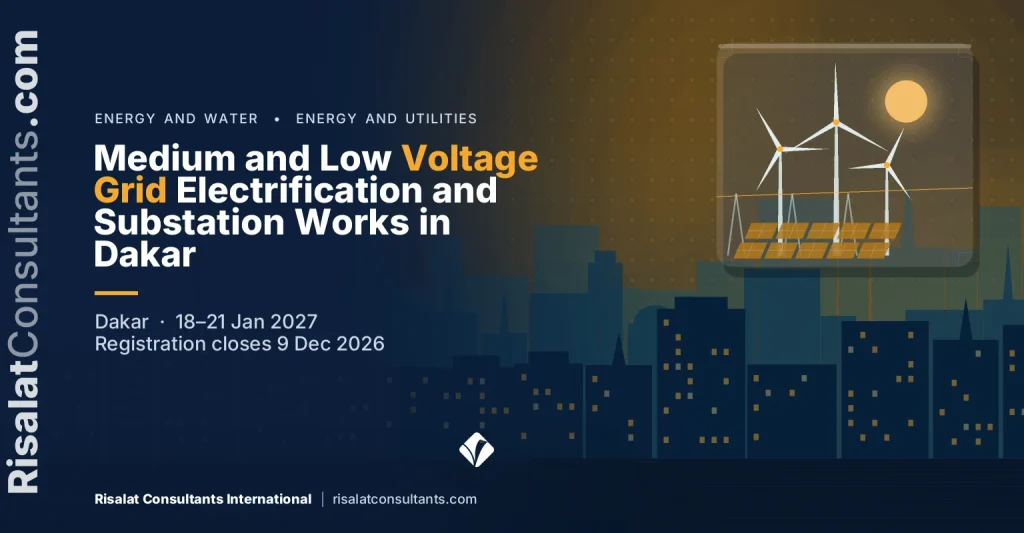
- 18–21 Jan 2027 (4 days)
- Where
- Novotel Dakar, Plateau (proposed), Dakar, Senegal
- Fee per participant
- £2,350 (GBP)
- Payment
- By invoice and bank transfer
- Registration closes
- 9 Dec 2026
- Format
- 4-day short course: a practical capacity-building programme for government, NGO and project teams in Dakar
- Certificate
- Certificate of completion
- Groups
- Teams of 3 or more qualify for a group discount, offered case by case: ask for a group quote.
- In-house option
- Run it for your team, on your dates
On this page 14 sections
Programme Overview
This intensive four-day professional course in Dakar addresses the engineering, design, and operational supervision of medium-voltage (MV) and low-voltage (LV) distribution networks and associated substation assets. Delivered in the context of major donor-funded infrastructure programmes, the curriculum covers network topology, substation civil works, electromechanical installation, and rigorous commissioning protocols. Participants examine practical approaches to network reinforcement and last-mile connections aligned with international standards such as IEC and donor technical guidelines.
Engineers and project planners will gain in-depth exposure to rural electrification scheme design, conductor sizing, protection coordination, and distribution transformer sizing. The programme bridges the gap between high-level utility planning and ground-level execution, ensuring that capital works meet strict durability, safety, and loss-reduction benchmarks. Emphasis is placed on addressing environmental constraints, right-of-way management, and substation civil safety across peri-urban and off-grid rural corridors in Senegal and the wider West African region.
Through technical analyses, equipment evaluation exercises, and specification drafting workshops, participants acquire actionable engineering tools to supervise contractors and verify compliance on site. The course directly examines the technical specifications for modern distribution automation, smart distribution boards, and systematic commercial and technical loss auditing. Practitioners leave prepared to enforce design baselines, manage substation handover testing, and implement quality assurance frameworks on active public distribution projects.
Sub-Saharan Africa is experiencing rapid expansion of donor-backed energy programmes, highlighted by large-scale interventions such as the US$150m Senegal Energy Access Scale Up Project. Meeting universal access goals demands immediate capacity to roll out durable MV/LV distribution grids, erect dependable substations, and reduce severe distribution losses. Public utilities, project implementation units, and regional engineers require up-to-date technical competencies to draft bankable technical specifications, supervise civil and electromechanical works, and ensure compliance with World Bank, AfDB, and IEC quality frameworks.
Delivered by Risalat Consultants International in Dakar, Senegal, it combines expert-led sessions, real cases and group work, so that participants can apply what they learn in their own institution.
The Programme Strengthens Institutional Capability
- Rural and peri-urban electrification layouts: radial, loop, and mini-grid interconnected systems
- Overhead line design: conductor selection, pole loading, clearance criteria, and IEC standards
- Low-voltage distribution planning: phase balancing, drop calculations, and service connection methods
- Environmental constraints, right-of-way profiling, and climate resilience in distribution routes
- Interactive session: evaluating feeder route profiles and sizing network conductors
- Substation site selection, geotechnical parameters, foundation design, and plinth construction
- Earthing and lightning protection: step and touch potential calculations according to IEEE 80 / IEC
- Civil infrastructure inspection: bund walls, transformer oil containment, and drainage systems
- Fraud risk assessment and fraud risk registers
- Design and testing of internal controls
- The Three Lines model and the role of oversight
- Audit planning, evidence and documentation
It is designed for power distribution engineers managing MV and LV networks, project management unit (PIU) engineers under donor-funded energy schemes, rural electrification agency technical officers and planners and others who want practical, current skills in fraud, audit and internal control.
- Transaction
- Record
- Control
- Evidence
- Opinion
The Growing Importance of Medium and Low Voltage Grid Electrification and Substation Works in Dakar
Public bodies and donor-financed projects are expected to show that funds are used for their intended purpose. Auditors, oversight bodies and financiers increasingly look beyond the financial statements to the controls, records and behaviours behind them.
Fraud and control weaknesses rarely come from one failure. They grow where roles are unclear, records are incomplete and warning signs are not followed up. Teams that understand how fraud happens, and how controls stop it, protect both their institution and the people it serves.
Organisations increasingly require professionals capable of:
- Identify and rate fraud and control risks in their own processes
- Design controls that are proportionate and testable
- Gather and document reliable audit evidence
- Recognise red flags early and escalate them correctly
- Turn findings into practical, agreed actions
Strong fraud, audit and internal control systems help organisations:
- Reduce losses and ineligible expenditure
- Pass external audits with fewer findings
- Strengthen trust with financiers and citizens
- Respond to allegations in a fair and documented way
This Medium and Low Voltage Grid Electrification and Substation Works in Dakar programme brings these elements together in a practical format, so that participants understand not only what good practice looks like but also how to introduce it in their own setting, with the people and resources they have.
Who Should Attend This Medium and Low Voltage Grid Electrification and Substation Works in Dakar Training?
This programme is designed for:
- Power distribution engineers managing MV and LV networks
- Project management unit (PIU) engineers under donor-funded energy schemes
- Rural electrification agency technical officers and planners
- Substation civil works and electromechanical site supervisors
- Electrical engineers drafting donor procurement specifications
- Quality assurance and quality control (QA/QC) distribution inspectors
- Distribution loss reduction and revenue protection specialists
- Utility operations and network maintenance managers
- Consulting engineers overseeing rural electrification contracts
- Internal auditors and audit managers
- Finance managers and accountants
- Compliance and risk officers
The programme suits experienced professionals as well as those moving into new responsibilities. Groups that mix institutions and countries are encouraged, because participants learn a great deal from each other’s experience.
Tick what your team needs to be able to do.
Medium and Low Voltage Grid Electrification and Substation Works in Dakar Training Objectives
Upon successful completion of this Medium and Low Voltage Grid Electrification and Substation Works in Dakar Training, participants will be able to:
- Design robust MV and LV distribution networks in accordance with IEC standards and donor requirements
- Appraise substation civil layouts, structural foundations, earthing grids, and containment designs
- Supervise electromechanical installation and pre-commissioning testing for distribution transformers and switchgear
- Formulate bankable technical specifications for smart distribution boards and metering enclosures
- Structure comprehensive line loss monitoring plans to mitigate technical and non-technical distribution losses
- Implement systematic factory acceptance tests (FAT) and site acceptance tests (SAT) for network assets
- Audit contractor compliance against engineering drawings, health and safety codes, and environmental benchmarks
- Explain how and why fraud happens, using recognised fraud risk models
- Carry out a fraud and control risk assessment for a real process
- Map controls to risks using the Three Lines model
Each objective is practised during the programme through exercises, cases or group work, so that participants leave able to do it, not only to describe it.
Programme Contents and Structure
- Rural and peri-urban electrification layouts: radial, loop, and mini-grid interconnected systems
- Overhead line design: conductor selection, pole loading, clearance criteria, and IEC standards
- Low-voltage distribution planning: phase balancing, drop calculations, and service connection methods
- Environmental constraints, right-of-way profiling, and climate resilience in distribution routes
- Interactive session: evaluating feeder route profiles and sizing network conductors
- Substation site selection, geotechnical parameters, foundation design, and plinth construction
- Earthing and lightning protection: step and touch potential calculations according to IEEE 80 / IEC
- Civil infrastructure inspection: bund walls, transformer oil containment, and drainage systems
- Pre-commissioning civil QA/QC: structural checks, penetration sealing, and safety clearances
- Practical exercise: review of substation civil inspection checklists and defect identification
- Distribution transformer handling, positioning, vector groups, and insulation resistance testing
- MV switchgear and compact secondary substations: installation, gas insulation, and busbar alignment
- Protection schemes: overcurrent, earth fault coordination, auto-reclosers, and sectionaliser placement
- Site Acceptance Testing (SAT): dielectric oil tests, relay injection, and contact resistance checks
- Practical exercise: developing a protection coordination and test log for MV/LV substations
- Drafting technical specifications for smart distribution boards, breakers, and split prepayment meters
- Technical vs non-technical loss mechanisms: feeder balance, conductor degradation, and meter bypassing
- Designing a line loss monitoring plan using smart grid data, bulk meters, and boundary auditing
- Asset handover procedures: snags resolution, as-built documentation review, and provisional acceptance
- Final workshop: drafting a distribution board technical schedule and network loss mitigation plan
Full day-by-day contents
The programme runs over 4 days. Each day combines expert input, practical work and a closing workshop or case study:
- First Day: Day 1: MV/LV Network Planning and Rural Electrification Topologies
- Second Day: Day 2: Substation Civil Works, Earthing Systems, and Structural Commissioning
- Third Day: Day 3: Electromechanical Installation, Switchgear, and Protection
- Fourth Day: Day 4: Smart Distribution Boards, Loss Reduction, and Handover
Full day-by-day contents
First Day | Day 1: MV/LV Network Planning and Rural Electrification Topologies
- Rural and peri-urban electrification layouts: radial, loop, and mini-grid interconnected systems
- Overhead line design: conductor selection, pole loading, clearance criteria, and IEC standards
- Low-voltage distribution planning: phase balancing, drop calculations, and service connection methods
- Environmental constraints, right-of-way profiling, and climate resilience in distribution routes
- Interactive session: evaluating feeder route profiles and sizing network conductors
Workshop: Day 1: MV/LV Network Planning and Rural Electrification Topologies: Applying It to Your Institution
Working in small groups, participants apply the day's methods to examples from their own institutions and agree practical next steps.
Second Day | Day 2: Substation Civil Works, Earthing Systems, and Structural Commissioning
- Substation site selection, geotechnical parameters, foundation design, and plinth construction
- Earthing and lightning protection: step and touch potential calculations according to IEEE 80 / IEC
- Civil infrastructure inspection: bund walls, transformer oil containment, and drainage systems
- Pre-commissioning civil QA/QC: structural checks, penetration sealing, and safety clearances
- Practical exercise: review of substation civil inspection checklists and defect identification
Workshop: Day 2: Substation Civil Works, Earthing Systems, and Structural Commissioning: Applying It to Your Institution
Working in small groups, participants apply the day's methods to examples from their own institutions and agree practical next steps.
Third Day | Day 3: Electromechanical Installation, Switchgear, and Protection
- Distribution transformer handling, positioning, vector groups, and insulation resistance testing
- MV switchgear and compact secondary substations: installation, gas insulation, and busbar alignment
- Protection schemes: overcurrent, earth fault coordination, auto-reclosers, and sectionaliser placement
- Site Acceptance Testing (SAT): dielectric oil tests, relay injection, and contact resistance checks
- Practical exercise: developing a protection coordination and test log for MV/LV substations
Case Study: Day 3: Electromechanical Installation, Switchgear, and Protection in Practice
Participants analyse a realistic case, compare the choices made with good practice and draw lessons they can use in their own setting.
Fourth Day | Day 4: Smart Distribution Boards, Loss Reduction, and Handover
- Drafting technical specifications for smart distribution boards, breakers, and split prepayment meters
- Technical vs non-technical loss mechanisms: feeder balance, conductor degradation, and meter bypassing
- Designing a line loss monitoring plan using smart grid data, bulk meters, and boundary auditing
- Asset handover procedures: snags resolution, as-built documentation review, and provisional acceptance
- Final workshop: drafting a distribution board technical schedule and network loss mitigation plan
Capstone Exercise: Medium and Low Voltage Grid Electrification and Substation Works in Dakar Action Plan for Your Institution
Participants bring the week together in an action plan for their own institution, with priorities, owners and first steps, and present it for feedback from peers and facilitators.
Medium and Low Voltage Grid Electrification and Substation Works in Dakar Training Methodology
The training employs an applied adult-learning methodology designed for practicing engineers and project coordinators. Core technical lectures referencing international standards (such as IEC and IEEE) and multilateral development bank guidelines are balanced with hands-on exercises. Participants engage in line-loss diagnostic calculations, critique substation design drawings, review equipment failure case studies, and draft operational specifications. Small-group working sessions encourage cross-institutional knowledge exchange, directly addressing field implementation challenges encountered in current Senegalese and West African distribution electrification projects.
The programme combines:
- Expert-led sessions on current practice
- Regional and international case studies
- Group work and practical exercises
- Simulations and role plays where relevant
- Discussion of participants' own challenges
- Peer learning across institutions and countries
- Practical tools and templates to take back to work
- Daily reflection and action planning
Before the programme, a short pre-assessment helps the facilitators understand each participant’s role and priorities, so that examples and exercises can be adjusted to the group. Each day ends with a short reflection in which participants note what they will apply at work.
Expected Outcomes
Upon completion of this Medium and Low Voltage Grid Electrification and Substation Works in Dakar Training, participants will be able to:
- Produce verified engineering calculations for low-voltage feeder drops and medium-voltage line sizing
- Direct civil and electromechanical inspection regimes for rural distribution substations
- Identify and correct non-compliant contractor installations prior to provisional asset handover
- Generate precise technical specifications for modern smart distribution boards and secure enclosures
- Execute systematic site acceptance testing programmes for transformers, switchgear, and earthing arrays
- Deploy data-led loss reduction plans combining feeder metering, phase balancing, and anti-tamper controls
- Assess fraud and control risks in their own processes
- Design and test proportionate controls
Participants leave with a personal action plan and practical tools they can use in their institution from the first week back. Institutions that send several participants can use the programme to agree shared methods and templates across teams, which makes improvements easier to sustain.
£2,350 per participant · invoice and bank transfer · groups of 5 or more receive a discount
Five or more from one organisation: ask for the group rate on the invoice request.
Ten or more: an in-house version for your institution may cost less per person. Ask for an in-house quote.
Registration closes in 9 days (9 Dec 2026)
Institutional Application of Medium and Low Voltage Grid Electrification and Substation Works in Dakar Training
This programme supports organisations in strengthening:
- Fraud and corruption risk management
- Internal control frameworks
- Audit and oversight arrangements
- Follow-up of audit findings
- Integrity and reporting channels
Participants return with practical tools to improve:
- Risk registers and control maps
- Audit planning and testing
- Evidence and documentation
- Reporting to management and boards
- Prevention of ineligible expenditure
The programme is built so that learning moves from the classroom into the institution. Participants work on their own processes and documents where possible, and leave with an action plan that their managers can review and support.
Regional Relevance & Application
Europe
European institutions apply fraud, audit and internal control within detailed regulatory frameworks and reform agendas. Participants from Europe can compare their practice with colleagues from other regions and test how established methods work under different conditions.
Africa
Across Africa, ministries, agencies and project teams working in fraud, audit and internal control increasingly operate alongside donor-financed programmes that expect clear systems and evidence. The programme helps participants adapt good practice to the institutions and resources they work with.
Middle East
In the Middle East, national development strategies and diversification plans place growing demands on fraud, audit and internal control. Participants explore how to build the capability these plans need inside public bodies and companies.
Asia
Institutions across Asia combine rapid growth with ambitious modernisation programmes. Participants from Asia can share their experience of scaling systems quickly and learn from approaches used elsewhere.
Pacific
Small island and Pacific states face particular constraints of size, distance and capacity. The programme highlights practical, proportionate approaches to fraud, audit and internal control that suit smaller institutions.
Holding the programme in Dakar, Senegal brings participants together away from their daily pressures, so they can compare how fraud, audit and internal control is handled in different settings. The same programme can also be delivered in-house for one institution, in its own country or online, with cases taken from its current work.
Host Country Profile – Senegal
Training programmes and study tours in Dakar suit professionals, project teams, and civil servants seeking exposure to West African governance, regional trade, and infrastructure development.
Studying away from their own country gives participants time to focus, a fresh view of their own institution and the chance to build a network with colleagues from other countries.
Medium and Low Voltage Grid Electrification and Substation Works in Dakar Training Deliverables
Participants receive support before, during and after the programme, so that preparation, learning and follow-up form one continuous experience.
Before the Programme
- Participant Pre-Assessment
- Medium and Low Voltage Grid Electrification and Substation Works in Dakar Readiness Assessment
- Medium and Low Voltage Grid Electrification and Substation Works in Dakar Resource Pack
- Preparatory Reading Materials
- Complimentary Visa Support & Advisory
During the Programme
- Airport Pickup & Welcome Assistance
- Accommodation with breakfast: 5 nights, check-in Sunday 17 January 2027, check-out Friday 22 January 2027 (one night before and one night after the programme)
- Welcome Networking Dinner
- Risalat Training Kit (Bag, Bottle, Mug, T-Shirt, Cap, Passport Cover, Pens, Notebook, Magnet & Keychain)
- Comprehensive Medium and Low Voltage Grid Electrification and Substation Works in Dakar Training Manual
- Fraud Risk Register Template
- Control Mapping Matrix
- Audit Evidence Checklist
- Findings and Follow-up Tracker
- Practical Workshops & Simulations
- Group Discussions & Peer Learning
- Daily Lunch and Refreshments
- Full Access to Training Venue Facilities
- Mini Pad / Tablet with Digital Learning Materials
- Field Visit (where applicable)
- Entertaining City Tour
After the Programme
- Certificate of Completion
- Risalat Programme Participation Recognition Award
- Post-Training Reference Materials
- Fraud Risk Self-Assessment Guide
- Control Testing Checklist
- Post-Training Support & Follow-Up Guidance
- Programme Report
Institutions can also request a tailored in-house version of this programme, delivered at their premises or online. Request a proposal.
Common Challenges in Medium and Low Voltage Grid Electrification and Substation Works in Dakar, And How This Training Helps
How can institutions identify and rate fraud and control risks in their own processes?
The programme addresses this directly on the first day (Day 1: MV/LV Network Planning and Rural Electrification Topologies), where participants practise the methods involved and adapt them to their own institution, then build it into their action plan.
How can institutions design controls that are proportionate and testable?
The programme addresses this directly on the second day (Day 2: Substation Civil Works, Earthing Systems, and Structural Commissioning), where participants practise the methods involved and adapt them to their own institution, then build it into their action plan.
How can institutions gather and document reliable audit evidence?
The programme addresses this directly on the third day (Day 3: Electromechanical Installation, Switchgear, and Protection), where participants practise the methods involved and adapt them to their own institution, then build it into their action plan.
How can institutions recognise red flags early and escalate them correctly?
The programme addresses this directly on the fourth day (Day 4: Smart Distribution Boards, Loss Reduction, and Handover), where participants practise the methods involved and adapt them to their own institution, then build it into their action plan.
How can institutions turn findings into practical, agreed actions?
The programme addresses this directly on the first day (Day 1: MV/LV Network Planning and Rural Electrification Topologies), where participants practise the methods involved and adapt them to their own institution, then build it into their action plan.
Frequently Asked Questions
When and where does the Medium and Low Voltage Grid Electrification and Substation Works in Dakar programme take place?
It runs from 18 Jan 2027 to 21 Jan 2027, in Dakar, Senegal. The registration deadline is shown at the top of this page.
Who should attend?
The programme is designed for power distribution engineers managing MV and LV networks, project management unit (PIU) engineers under donor-funded energy schemes, rural electrification agency technical officers and planners, substation civil works and electromechanical site supervisors, and others who want practical skills in fraud, audit and internal control.
Will I receive a certificate?
Yes. Participants who complete the programme receive a Certificate of Completion from Risalat Consultants International.
Can this programme be delivered for our institution only?
Yes. We can deliver a tailored in-house version at your premises, in another city or online, built around your own cases. Use the proposal request on this page.
Do I need prior experience in fraud, audit and internal control?
No specialist background is required beyond experience in a related role. A short pre-assessment helps the facilitators adapt the sessions to the group.
Who Will Deliver This Programme
Each date is delivered by a team assigned from Risalat's expert network for this subject. For this programme we assign:
How we choose them: Experience in the region of the participants or comparable settings; Command of the financier rules that apply (World Bank, ADB, AfDB, EU, UN) where relevant; Delivery in English; other languages on request for in-house groups; No conflict of interest with participants' institutions.
Training courses in DakarEnergy and Water training courses
Why Dakar for this programme
Dakar serves as a major diplomatic and administrative hub in West Africa, hosting regional bodies such as the Central Bank of West African States (BCEAO) and various United Nations agencies. Participants can observe major infrastructure projects, including the Port of Dakar and the Regional Express Train (TER). The city is accessible via direct international flights from across Africa, Europe, and North America.
The Medium and Low Voltage Grid Electrification and Substation Works in Dakar programme in January 2027 brings together officials and professionals from across the Africa region and beyond. Sessions combine short inputs, case studies and group work on participants' own files, and the city's institutions can be added as a study visit on request.
Getting there: Blaise Diagne International (DSS).
Check whether you need a visa with the free Visa Checker, and ask for an invitation letter once you are registered.
The same topic in other cities
- Distribution Substation Construction and Grid Densification Management in Dakar (Dakar)
- Rural Electrification Grid Extension and Line Construction in Kigali (Kigali)
- Solar Hybrid Mini-Grid Contract Oversight and Utility Institutional Setup in Dubai (Dubai)
- Distribution Grid Technical Loss Reduction and Substation Upgrade in Singapore (Singapore)
- Grid Densification and Last-Mile Household Electrification Management in Johannesburg (Johannesburg)
- Grid Expansion and Power Distribution Operations in Accra (Accra)
Other programmes in Dakar
- Communal Agroforestry Landscape Planning and Assisted Regeneration in Dakar
- Commercial Agri-Corridor Road Upgrading and Maintenance Contracts in Dakar
- Crisis-Zone Public Works Asset Verification and Field Safety Protocols in Dakar
- Solar Mini-Grid EPC Contracting and Biomass Hybrid Operations in Dakar
- On-Site Sanitation Facility Construction and Sludge Treatment Oversight in Dakar
Questions before you nominate your team? Book a 30-minute call with us, or ask for this programme in-house.
Teams often travel here from Senegal, Côte d'Ivoire, Madagascar, Comoros, Burundi, Benin, Togo, Burkina Faso. Funding, visa letters and group rates are explained on each country page.
Local participant, or arranging your own stay?
The fee without accommodation is £1,950 per participant instead of £2,350 (£100 less for each of the 4 days). Everything else in the package stays the same: training, materials, lunches, the kit, the city tour and the certificate.
Register without accommodation →Venue: Novotel Dakar, Plateau. Proposed venue, or a similar hotel with a training room; it may change with circumstances, and participants are told at once of any change.
For teams and institutions
Bring your team
Teams that learn together apply more at work. Tell us how many people and how you would like to take part: we reply with a group quote within two working days.
Watch: this programme in short
Other dates and cities for this subject: Energy, Power and Utility Management training courses (118 upcoming dates).
More training courses in Senegal · All programmes in Africa · Full training calendar
Plan this programme in a roadmap: why it matters, why to approve it, the dates to plan and the career it builds.