Key facts
- Dates
- 19–22 Jul 2027 (4 days)
- Where
- Bangkok, Thailand
- Fee per participant
- £2,850 (GBP)
- Payment
- By invoice and bank transfer
- Registration closes
- 9 Jun 2027
- Format
- 4-day short course: a practical capacity-building programme for government, NGO and project teams in Bangkok
- In-house option
- Run it for your team, on your dates
On this page 10 sections
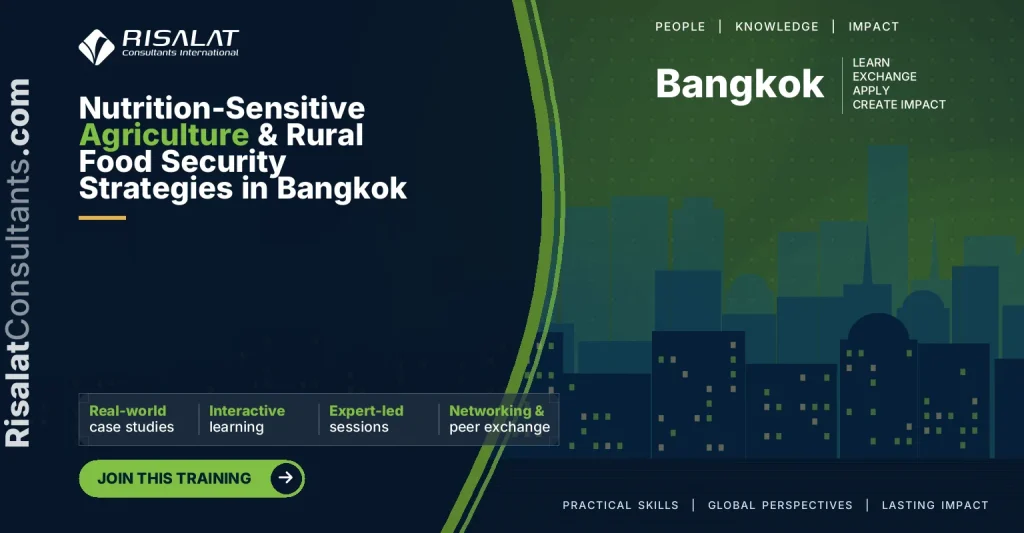
Nutrition-Sensitive Agriculture & Rural Food Security Strategies in Bangkok
Programme Overview
Agricultural development programmes increasingly face the imperative to deliver measurable nutritional improvements alongside traditional production targets. This professional course in Bangkok equips participants to design, implement, and evaluate nutrition-sensitive agricultural interventions. By bridging the gap between agronomy, rural livelihoods, and public health, the programme examines operational methodologies to integrate household nutritional goals directly into national and district-level agricultural extension systems, prioritising the availability, access, and consumption of nutrient-rich foods.
Participants explore practical frameworks established by the Food and Agriculture Organization and international development finance institutions to align food systems with dietary needs. Through applied exercises, attendees will analyse agricultural value chains through a nutrition lens, address seasonal food deficits, and integrate behaviour change communication into routine field extension work. Special emphasis is placed on safeguarding maternal and child nutrition within vulnerable rural communities through diversified smallholder production systems and gender-informed delivery mechanisms.
Delivered by Risalat Consultants International in Bangkok, Thailand, the programme combines expert-led sessions, real cases, and group work, allowing participants to construct robust monitoring and evaluation frameworks and optimise resource allocation within donor-financed investment operations. Rural development initiatives, including operations under the Food Security and Agriculture Productivity Project, increasingly require project management units and public agencies to demonstrate direct linkages between agricultural interventions and household dietary quality.
The programme strengthens institutional capability in:
- Core concepts: Differentiating nutrition-specific interventions from nutrition-sensitive agriculture
- Global frameworks and standards: FAO guidelines for planning nutrition-sensitive agricultural investments
- Pathways from agriculture to nutrition: Food production, agricultural income, and gender dynamics
- Assessing local malnutrition drivers: Integrating agronomic data with public health nutrition baselines
- Group diagnostic workshop: Identifying nutritional deficits and seasonal hunger within rural communities
- Diversifying smallholder farming systems: Nutrient-dense crops, homestead gardens, and indigenous varieties
- Small-scale animal husbandry and aquaculture entry points for improving household protein availability
- Mainstreaming nutrition education and behaviour change communication into farmer field schools
- Climate and environmental risk assessment
- Adaptation and mitigation planning
- Sector strategies for energy, water, and land
- Project design for climate and environmental goals
- Inputs
- Activities
- Outputs
- Outcomes
- Impact
Why this matters now
Organisations increasingly require professionals capable of:
- Assess climate and environmental risks to their services and assets
- Design projects that meet climate and environmental goals
- Prepare proposals that financiers can approve
- Measure and report results credibly
- Work with communities and partners across sectors
Strong climate, environment and natural resources systems help organisations:
- Protect services and infrastructure from climate risks
- Access climate and environmental finance
- Meet national and international commitments
- Use natural resources sustainably
Who Should Attend
This programme is designed for:
- Agricultural extension officers and district agronomy supervisors
- Public health nutrition leads and primary healthcare coordinators
- Agriculture project coordinators managing donor-funded portfolios
- Planning officers from ministries of agriculture and rural development
- Monitoring and evaluation specialists tracking food security metrics
- Project management unit personnel executing rural food productivity initiatives
- Non-governmental organisation programme leads delivering rural livelihoods activities
- Community development officers coordinating cross-sectoral nutrition interventions
- Policy analysts formulating integrated agriculture and food security strategies
- Climate change and environment officers
- Energy, water, and agriculture sector staff
- Planning and policy officers
Tick what your team needs to be able to do.
Programme Objectives
By the end of this programme participants will be able to:
- Analyse the key entry points for integrating nutritional objectives into smallholder agricultural programming
- Formulate monitoring frameworks to track maternal and child dietary diversity indicators alongside production milestones
- Evaluate agricultural value chains to identify opportunities for reducing post-harvest nutrient losses and expanding nutrient-dense crops
- Design nutrition-sensitive agricultural extension modules suitable for deployment by district and community-level field agents
- Incorporate social and behaviour change communication strategies into regular agricultural advisory and farmer field school activities
- Establish cross-sectoral coordination mechanisms between agriculture, health, and local government stakeholders
- Apply international standards and donor requirements to the design and supervision of nutrition-sensitive food security operations
- Explain the main climate and environmental challenges for their sector
- Assess climate and environmental risks to services and assets
- Plan adaptation and mitigation measures
Training Structure & Contents
- Core concepts: Differentiating nutrition-specific interventions from nutrition-sensitive agriculture
- Global frameworks and standards: FAO guidelines for planning nutrition-sensitive agricultural investments
- Pathways from agriculture to nutrition: Food production, agricultural income, and gender dynamics
- Assessing local malnutrition drivers: Integrating agronomic data with public health nutrition baselines
- Group diagnostic workshop: Identifying nutritional deficits and seasonal hunger within rural communities
- Applying foundations to institutional settings and agreeing practical next steps
- Diversifying smallholder farming systems: Nutrient-dense crops, homestead gardens, and indigenous varieties
- Small-scale animal husbandry and aquaculture entry points for improving household protein availability
- Mainstreaming nutrition education and behaviour change communication into farmer field schools
- Preserving nutritional value: Post-harvest handling, storage innovations, and local food processing
- Practical exercise: Redesigning a conventional extension curriculum to embed explicit household nutritional goals
- Institutional application workshop: Formulating field-level integration steps in small groups
- Selecting nutrition-sensitive indicators: Yield versus dietary quality, affordability, and year-round access
- Measuring dietary diversity: Standardised application of the Minimum Dietary Diversity for Women (MDD-W)
- Assessing child nutrition: Operationalising the Infant and Young Child Feeding (IYCF) dietary metrics in projects
- Data collection protocols: Practical survey design, sampling strategies, and seasonal measurement adjustments
- Design clinic: Developing a multi-tier project results framework linking agricultural outputs to dietary outcomes
- Case study analysis: Comparing monitoring and evaluation choices with good practice
- Institutional governance: Mechanisms for inter-ministerial collaboration across agriculture and health sectors
- Donor operational requirements: Aligning project components with World Bank, ADB, and UN food security priorities
- Targeting vulnerable households: Reaching female farmers, disadvantaged social groups, and remote geographies
- Mitigating risks: Assessing potential negative impacts of commercial agricultural commercialisation on nutrition
- Final action planning: Formulating individual institutional strategies for immediate deployment in home country projects
- Capstone exercise: Producing an institutional action plan with priorities, owners, and initial milestones
- Reviewing cross-sectoral coordination mechanisms across agriculture, health, and environment
- Integrating climate, environment, and natural resource priorities into food security interventions
- Refining multi-tier results frameworks for external financiers and government stakeholders
- Peer review and feedback on institutional deployment strategies
- Finalising operational guidelines for district-level field extension systems
Full day-by-day contents
First Day | Foundations of Nutrition-Sensitive Agriculture and Food Systems
- Core concepts: Differentiating nutrition-specific interventions from nutrition-sensitive agriculture
- Global frameworks and standards: FAO guidelines for planning nutrition-sensitive agricultural investments
- Pathways from agriculture to nutrition: Food production, agricultural income, and gender dynamics
- Assessing local malnutrition drivers: Integrating agronomic data with public health nutrition baselines
- Group diagnostic workshop: Identifying nutritional deficits and seasonal hunger within rural communities
- Applying foundations to institutional settings and agreeing practical next steps
Second Day | Field-Level Integration: Extension Services, Biofortification, and Crop Diversification
- Diversifying smallholder farming systems: Nutrient-dense crops, homestead gardens, and indigenous varieties
- Small-scale animal husbandry and aquaculture entry points for improving household protein availability
- Mainstreaming nutrition education and behaviour change communication into farmer field schools
- Preserving nutritional value: Post-harvest handling, storage innovations, and local food processing
- Practical exercise: Redesigning a conventional extension curriculum to embed explicit household nutritional goals
- Institutional application workshop: Formulating field-level integration steps in small groups
Third Day | Monitoring, Evaluation, and Dietary Indicators
- Selecting nutrition-sensitive indicators: Yield versus dietary quality, affordability, and year-round access
- Measuring dietary diversity: Standardised application of the Minimum Dietary Diversity for Women (MDD-W)
- Assessing child nutrition: Operationalising the Infant and Young Child Feeding (IYCF) dietary metrics in projects
- Data collection protocols: Practical survey design, sampling strategies, and seasonal measurement adjustments
- Design clinic: Developing a multi-tier project results framework linking agricultural outputs to dietary outcomes
- Case study analysis: Comparing monitoring and evaluation choices with good practice
Fourth Day | Institutional Coordination, Implementation Planning, and Project Scaling
- Institutional governance: Mechanisms for inter-ministerial collaboration across agriculture and health sectors
- Donor operational requirements: Aligning project components with World Bank, ADB, and UN food security priorities
- Targeting vulnerable households: Reaching female farmers, disadvantaged social groups, and remote geographies
- Mitigating risks: Assessing potential negative impacts of commercial agricultural commercialisation on nutrition
- Final action planning: Formulating individual institutional strategies for immediate deployment in home country projects
- Capstone exercise: Producing an institutional action plan with priorities, owners, and initial milestones
Fifth Day | Strategic Synthesis and Portfolio Integration
- Reviewing cross-sectoral coordination mechanisms across agriculture, health, and environment
- Integrating climate, environment, and natural resource priorities into food security interventions
- Refining multi-tier results frameworks for external financiers and government stakeholders
- Peer review and feedback on institutional deployment strategies
- Finalising operational guidelines for district-level field extension systems
Training Methodology
Delivered through a practical and participatory approach, this programme blends expert-led technical instruction with hands-on application. Participants examine operational methods and real-world examples, translating theoretical guidance into practical field solutions suited to their own working environments.
- Expert technical presentations on international standards and guidelines
- Small group diagnostic sessions and practical redesign exercises
- Case study analyses examining operational challenges and solutions
- Design clinics focused on multi-tier results and monitoring frameworks
- Action planning workshops for immediate institutional deployment
Expected Outcomes
- Enhanced ability to embed maternal and child nutritional outcomes into agricultural operations
- Competence in utilising FAO and international finance institution food system frameworks
- Capability to construct monitoring plans tracking standardised dietary diversity indicators
- Skills to adapt farmer field schools and extension curricula with nutrition education
- Strengthened cross-sectoral coordination between agriculture, public health, and local administration
- Preparedness to align proposals and project portfolios with donor-funded food security priorities
£2,850 per participant · invoice and bank transfer · groups of 5 or more receive a discount
Five or more from one organisation: ask for the group rate on the invoice request.
Ten or more: an in-house version for your institution may cost less per person. Ask for an in-house quote.
Registration closes in 193 days (9 Jun 2027)
Who Will Deliver This Programme
Each date is delivered by a team assigned from Risalat's expert network for this subject. For this programme we assign:
How we choose them: Experience in the region of the participants or comparable settings; Command of the financier rules that apply (World Bank, ADB, AfDB, EU, UN) where relevant; Delivery in English; other languages on request for in-house groups; No conflict of interest with participants' institutions.
Training courses in BangkokAgriculture & Forestry training courses
Why Bangkok for this programme
Bangkok hosts UN regional offices and is a central, good-value hub for South and South-East Asia.
The Nutrition-Sensitive Agriculture & Rural Food Security Strategies in Bangkok programme in July 2027 brings together officials and professionals from across the Asia region and beyond. Sessions combine short inputs, case studies and group work on participants' own files, and the city's institutions can be added as a study visit on request.
Getting there: Suvarnabhumi (BKK).
Check whether you need a visa with the free Visa Checker, and ask for an invitation letter once you are registered.
The same topic in other cities
- Nutrition-Sensitive Interventions & Stunting Reduction Policy in Singapore (Singapore)
- Nutrient-Dense Crop Commercialisation and Agri-Enterprise Incubation in Colombo (Colombo)
Other programmes in Bangkok
- Mini Degree in Monitoring, Evaluation and Learning in Bangkok
- Instructional Design and E-Learning for Institutions in Bangkok
- Public Service Delivery and Citizen Charters in Bangkok
- Prompt Engineering and AI Tools for Professionals Training in Bangkok
- Artificial Intelligence for Public Sector Managers in Bangkok
Questions before you nominate your team? Book a 30-minute call with us, or ask for this programme in-house.
Teams often travel here from Timor-Leste, Maldives, Sri Lanka, Bangladesh, Nepal, Bhutan, Myanmar, Cambodia. Funding, visa letters and group rates are explained on each country page.
Is there agriculture and food security training for government officials in Bangkok in July 2027?
Can "Nutrition-Sensitive Agriculture & Rural Food Security Strategies in Bangkok" be delivered in-house for one organisation?
Which other agriculture and food security programmes does Risalat run?
How do organisations register and pay?
For teams and institutions
Bring your team
Teams that learn together apply more at work. Tell us how many people and how you would like to take part: we reply with a group quote within two working days.
Watch: this programme in short


Other dates and cities for this subject: Agriculture, Value Chains and Food Security training courses (97 upcoming dates).
More training courses in Thailand · All programmes in Asia · Full training calendar
Plan this programme in a roadmap: why it matters, why to approve it, the dates to plan and the career it builds.