Key facts
- Dates
- 12–15 Apr 2027 (4 days)
- Where
- Singapore
- Fee per participant
- £2,350 (GBP)
- Payment
- By invoice and bank transfer
- Registration closes
- 3 Mar 2027
- Format
- 4-day short course: a practical capacity-building programme for government, NGO and project teams in Singapore
- In-house option
- Run it for your team, on your dates
On this page 10 sections
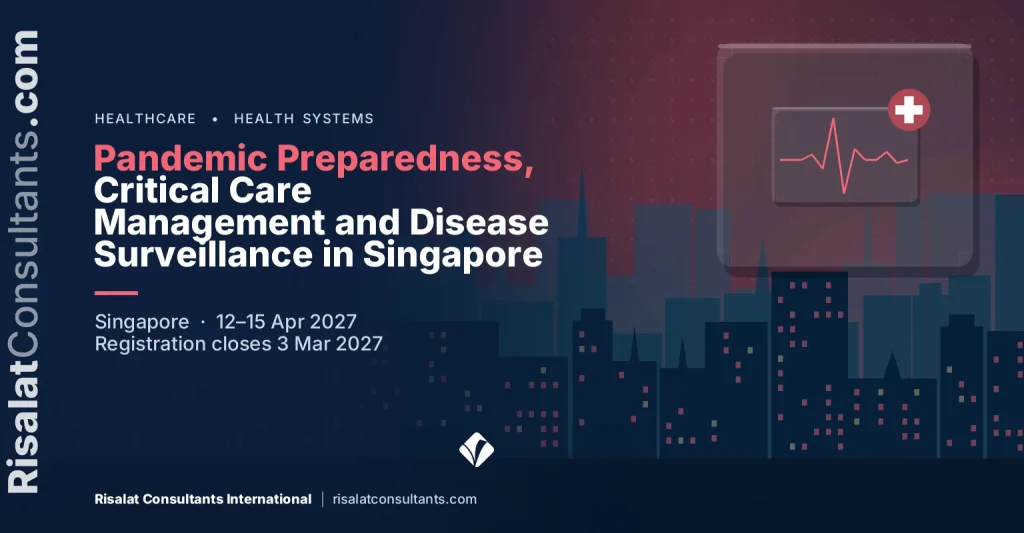
Pandemic Preparedness, Critical Care Management and Disease Surveillance in Singapore
Programme Overview
Health systems globally face the urgent operational challenge of transitioning from ad-hoc emergency actions to structured, institutionalised readiness frameworks. This four-day intensive programme equips public sector health leaders and project teams with actionable systems for national disease surveillance, hospital surge management, and respiratory critical care governance. Based in Singapore, delegates explore robust mechanisms to protect national health security through resilient health facilities, accountable emergency supply logistics, and advanced infectious disease control systems.
Free self-check: the governance self-audit gives a quick check of governance, controls and accountability, in about 10 minutes.
Delegates review established international standards, including the World Health Organisation International Health Regulations (2005) and integrated Early Warning, Alert and Response Systems (EWARS). The syllabus addresses critical gaps between laboratory surveillance data and hospital-level clinical readiness, focusing on scalable triage, hospital infection control, and vital utility management. Sessions emphasise operational decision-making required to modernise secondary and tertiary health facilities into adaptable treatment centres capable of handling unexpected transmission surges.
The curriculum combines technical policy design with practical hospital administration, examining reliable medical oxygen infrastructure, bio-safety safeguards, and supply pipeline management. Participants assess emergency coordination architectures that integrate central ministries, sub-national directorates, and frontline healthcare units into a cohesive network. By benchmarking institutional protocols against proven multi-agency response models, attendees leave equipped to supervise institutional restructuring, safeguard supply continuity, and direct high-consequence disease response projects effectively. Public healthcare authorities face pressing obligations to safeguard continuous public health operations following recent global disruptions. This capacity-building course directly supports the institutional execution and health system reforms associated with major multilateral investments, such as the US$600m Additional Financing for and Restructuring of the COVID-19 Emergency Response and Pandemic Preparedness Project. Strengthening early pathogen detection, securing liquid medical oxygen systems, and reinforcing intensive care surge capacity remain indispensable to absorbing future infectious threats without compromising routine medical services. Delivered by Risalat Consultants International in Singapore, it combines expert-led sessions, real cases and group work, so that participants can apply what they learn in their own institution.
The programme strengthens institutional capability in:
- International Health Regulations (2005) core capacity requirements and indicator-based surveillance frameworks
- Design and deployment of digital Early Warning, Alert and Response Systems (EWARS) across health districts
- Laboratory sentinel network integration, genomic tracking pathways, and diagnostic referral chains
- Cross-border infectious disease data exchange and epidemiological intelligence gathering
- Establishing operational workflows inside national Public Health Emergency Operations Centres (PHEOC)
- Clinical surge capacity mapping: converting general inpatient wards into high-dependency units
- Patient triage protocols and emergency department cohorting during mass respiratory admissions
- Intensive care clinical governance, nurse-to-patient staffing formulas, and bio-safety containment
- Strategic thinking and direction setting
- Leading and developing teams
- Decision making and problem solving
- Communication and influence
Why this matters now
Organisations increasingly require professionals capable of:
- Set clear direction and priorities
- Lead and motivate teams through change
- Communicate and negotiate effectively
- Manage performance fairly
- Make sound decisions under pressure
Strong leadership, management and communication systems help organisations:
- Turn strategies into results
- Build motivated, capable teams
- Manage change with less resistance
- Improve relations with partners and stakeholders
Who Should Attend
This programme is designed for:
- Directors and Deputy Directors of Disease Surveillance and Epidemiology
- Hospital Directors and Chief Medical Officers of Tertiary Care Centres
- Project Coordinators of multilateral and donor-funded health emergency projects
- Critical Care and Intensive Care Unit Clinical Administrators
- Infection Prevention and Control (IPC) Committee Heads
- Medical Supply Chain, Oxygen Infrastructure, and Logistics Managers
- Public Health Laboratory Network Supervisors and Bio-safety Officers
- Emergency Operations Centre (EOC) Planning and Technical Officers
- Public Health Engineers responsible for hospital isolation and mechanical services
- Directors and senior managers
- Heads of department and unit
- Middle managers and team leaders
Tick what your team needs to be able to do.
Programme Objectives
By the end of this programme participants will be able to:
- Analyse national epidemiological alert architectures using World Health Organisation International Health Regulations core capacities
- Design institutional clinical surge plans to scale intensive care unit and high-dependency bed capacity rapidly
- Evaluate medical oxygen distribution systems, including pressure swing adsorption plants and bulk liquid gas storage safety
- Establish structured Incident Command System structures for real-time hospital and ministry-level crisis administration
- Implement comprehensive Infection Prevention and Control and bio-safety protocols to prevent nosocomial pathogen transmission
- Develop resilient medical supply forecasting models for essential emergency pharmaceuticals, consumables, and personal protective equipment
- Formulate integrated public health communication and surveillance data pathways between sub-national sentinel sites and central directorates
- Explain current approaches to leadership in public and private institutions
- Set direction and priorities for their team
- Lead, motivate and develop people
Training Structure & Contents
- International Health Regulations (2005) core capacity requirements and indicator-based surveillance frameworks
- Design and deployment of digital Early Warning, Alert and Response Systems (EWARS) across health districts
- Laboratory sentinel network integration, genomic tracking pathways, and diagnostic referral chains
- Cross-border infectious disease data exchange and epidemiological intelligence gathering
- Establishing operational workflows inside national Public Health Emergency Operations Centres (PHEOC)
- Workshop on applying disease surveillance architecture and integrated early warning systems to participant institutions
- Clinical surge capacity mapping: converting general inpatient wards into high-dependency units
- Patient triage protocols and emergency department cohorting during mass respiratory admissions
- Intensive care clinical governance, nurse-to-patient staffing formulas, and bio-safety containment
- Hospital mechanical ventilation asset management, equipment maintenance cycles, and clinical safety checks
- Managing vulnerable inpatient cohorts, isolation ward engineering, and negative pressure room standards
- Workshop on applying critical care readiness, surge triage, and hospital operations to participant institutions
- Medical gas pipeline systems (MGPS): engineering standards, dual-source manifolds, and pressure regulation
- Assessing on-site Pressure Swing Adsorption (PSA) generation plants versus bulk cryogenic liquid oxygen supply
- Secondary and tertiary back-up oxygen reserves, cylinder manifold management, and pipeline leak audits
- Facility utility resilience: uninterrupted power supply, emergency generators, and medical air continuity
- Oxygen safety governance: fire prevention protocols, staff technical certification, and risk mitigation
- Case study analysing medical oxygen resilience and critical utility security in practice
- Hospital Incident Command System (HICS) hierarchy, job action sheets, and inter-agency coordination
- Public health procurement and supply chain management for essential outbreak pharmaceuticals and consumables
- Strategic stockpiling, cold chain maintenance for biologicals, and last-mile emergency distribution
- Monitoring donor-funded pandemic preparedness investments and multilateral project execution milestones
- Simulation exercise: orchestrating institutional crisis response and operational resource mobilisation
- Capstone exercise: developing an institutional action plan with priorities, owners, and initial steps
Full day-by-day contents
First Day | Disease Surveillance Architecture and Integrated Early Warning Systems
- International Health Regulations (2005) core capacity requirements and indicator-based surveillance frameworks
- Design and deployment of digital Early Warning, Alert and Response Systems (EWARS) across health districts
- Laboratory sentinel network integration, genomic tracking pathways, and diagnostic referral chains
- Cross-border infectious disease data exchange and epidemiological intelligence gathering
- Establishing operational workflows inside national Public Health Emergency Operations Centres (PHEOC)
- Workshop on applying disease surveillance architecture and integrated early warning systems to participant institutions
Second Day | Critical Care Readiness, Surge Triage, and Hospital Operations
- Clinical surge capacity mapping: converting general inpatient wards into high-dependency units
- Patient triage protocols and emergency department cohorting during mass respiratory admissions
- Intensive care clinical governance, nurse-to-patient staffing formulas, and bio-safety containment
- Hospital mechanical ventilation asset management, equipment maintenance cycles, and clinical safety checks
- Managing vulnerable inpatient cohorts, isolation ward engineering, and negative pressure room standards
- Workshop on applying critical care readiness, surge triage, and hospital operations to participant institutions
Third Day | Medical Oxygen Resilience and Critical Utility Security
- Medical gas pipeline systems (MGPS): engineering standards, dual-source manifolds, and pressure regulation
- Assessing on-site Pressure Swing Adsorption (PSA) generation plants versus bulk cryogenic liquid oxygen supply
- Secondary and tertiary back-up oxygen reserves, cylinder manifold management, and pipeline leak audits
- Facility utility resilience: uninterrupted power supply, emergency generators, and medical air continuity
- Oxygen safety governance: fire prevention protocols, staff technical certification, and risk mitigation
- Case study analysing medical oxygen resilience and critical utility security in practice
Fourth Day | Emergency Medical Logistics, Incident Command, and Governance
- Hospital Incident Command System (HICS) hierarchy, job action sheets, and inter-agency coordination
- Public health procurement and supply chain management for essential outbreak pharmaceuticals and consumables
- Strategic stockpiling, cold chain maintenance for biologicals, and last-mile emergency distribution
- Monitoring donor-funded pandemic preparedness investments and multilateral project execution milestones
- Simulation exercise: orchestrating institutional crisis response and operational resource mobilisation
- Capstone exercise: developing an institutional action plan with priorities, owners, and initial steps
Training Methodology
The training employs an applied adult-learning methodology designed for senior health professionals and project leaders. Sessions interlock technical lecture presentations with practical application exercises, real-world case studies, and structured peer collaboration.
- Expert-led presentations focusing on operational standards and regulatory frameworks
- Small-group workshops applying daily technical methods to home institutions
- Case study analysis comparing organisational decisions against international good practice
- Simulation exercises replicating crisis response and resource mobilisation
- Capstone action planning to formulate verifiable organisational priorities and implementation steps
Expected Outcomes
- Strengthened capacity to align national health systems with International Health Regulations (2005) standards
- Operational readiness to deploy digital early warning and disease surveillance tools
- Enhanced hospital administration mechanisms for bed surge, triage, and infection control
- Technical competence in managing medical oxygen systems and facility utility resilience
- Improved procurement, stockpiling, and distribution frameworks for emergency medical supplies
- Established Incident Command System structures for effective crisis coordination
- Concrete institutional action plans ready for implementation within participants’ organisations
£2,350 per participant · invoice and bank transfer · groups of 5 or more receive a discount
Five or more from one organisation: ask for the group rate on the invoice request.
Ten or more: an in-house version for your institution may cost less per person. Ask for an in-house quote.
Registration closes in 95 days (3 Mar 2027)
Who Will Deliver This Programme
Each date is delivered by a team assigned from Risalat's expert network for this subject. For this programme we assign:
How we choose them: Experience in the region of the participants or comparable settings; Command of the financier rules that apply (World Bank, ADB, AfDB, EU, UN) where relevant; Delivery in English; other languages on request for in-house groups; No conflict of interest with participants' institutions.
Training courses in SingaporeHealthcare training courses
Why Singapore for this programme
Singapore is known for efficient public services, e-government and urban planning, all useful for study visits.
The Pandemic Preparedness, Critical Care Management and Disease Surveillance in Singapore programme in April 2027 brings together officials and professionals from across the Asia region and beyond. Sessions combine short inputs, case studies and group work on participants' own files, and the city's institutions can be added as a study visit on request.
Getting there: Changi (SIN).
Check whether you need a visa with the free Visa Checker, and ask for an invitation letter once you are registered.
The same topic in other cities
- Public Health Emergency Operations and Surveillance Logistics in Auckland (Auckland)
- Pandemic Preparedness, Laboratory Systems and Emergency Health Logistics in Bangkok (Bangkok)
Other programmes in Singapore
- Incident Investigation and Root Cause Analysis in Singapore
- Extractive Industries Governance and EITI Implementation in Singapore
- Sovereign Disaster Risk Financing & Contingent Liability Structuring in Singapore
- Procurement of Complex Intelligent Transport and Municipal Civil Works in Singapore
- Hospital Facility Engineering & Medical Equipment Asset Planning in Singapore
Questions before you nominate your team? Book a 30-minute call with us, or ask for this programme in-house.
Teams often travel here from Timor-Leste, Sri Lanka, Bangladesh, Bhutan, Myanmar, Cambodia, Lao PDR, Vietnam. Funding, visa letters and group rates are explained on each country page.
- United Nations Development Programme UNDP
- World Health Organization World Health Organization
Is there health systems training for government officials in Singapore in April 2027?
Can "Pandemic Preparedness, Critical Care Management and Disease Surveillance in Singapore" be delivered in-house for one organisation?
Which other health systems programmes does Risalat run?
How do organisations register and pay?
For teams and institutions
Bring your team
Teams that learn together apply more at work. Tell us how many people and how you would like to take part: we reply with a group quote within two working days.
Watch: this programme in short


More training courses in Singapore · All programmes in Asia · Full training calendar
Plan this programme in a roadmap: why it matters, why to approve it, the dates to plan and the career it builds.