Key facts
- Dates
- 22–26 Feb 2027 (5 days)
- Where
- TBD, Bali, Indonesia
- Fee per participant
- £3,350 (GBP)
- Payment
- By invoice and bank transfer
- Registration closes
- 3 Jan 2027
- Format
- 5-day short course: a practical capacity-building programme for government, NGO and project teams in Bali
- Certificate
- Certificate of completion
- In-house option
- Run it for your team, on your dates
On this page 16 sections
Programme Overview
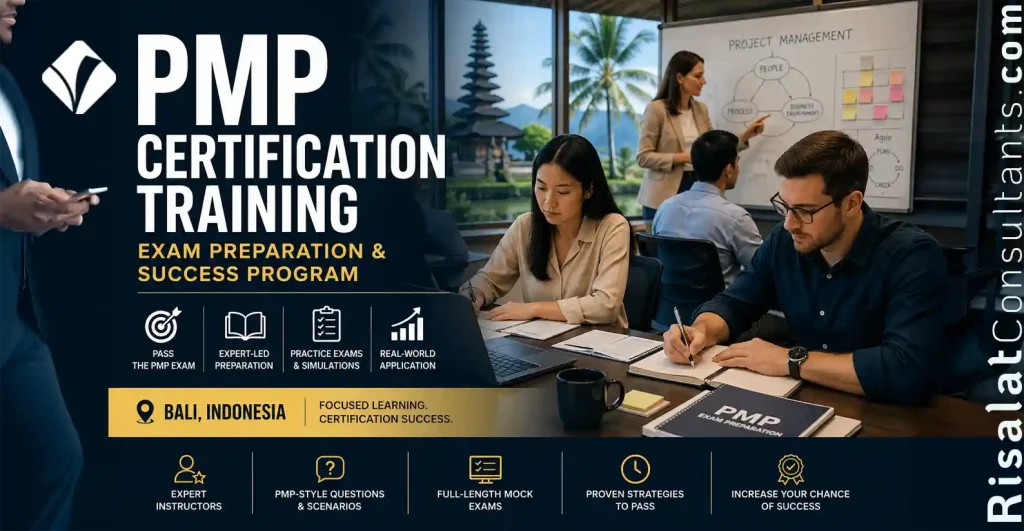
PMP Certification Training in Bali equips professionals with the knowledge, skills, and exam strategies required to successfully pass the Project Management Professional (PMP®) certification and apply project management principles effectively in real-world environments. As project environments evolve globally, organisations increasingly demand project managers who can deliver value, lead teams effectively, and manage projects using predictive, agile, and hybrid approaches. The PMP exam reflects this shift by focusing on real-world application, decision-making, leadership, and business alignment.
Free self-check: the procurement maturity assessment gives 30 questions on planning, tendering, contract management, integrity and e-procurement, with a score per area, in about 10 minutes.
Many candidates struggle with interpreting scenario-based questions, integrating agile and hybrid methodologies, applying project management principles in real contexts, and aligning preparation with the updated PMP exam structure. This PMP Certification Training in Bali addresses these challenges by providing a structured, exam-focused preparation approach aligned with the PMP Exam Content Outline (ECO), covering People, Process, and Business Environment domains. Participants gain hands-on experience with exam simulations, real PMP-style questions, case-based scenarios, and proven exam techniques to improve confidence and success rates.
Strong PMP preparation is essential not only for passing the exam but also for strengthening project leadership, improving decision-making, and delivering successful project outcomes across complex project environments.
The programme strengthens institutional capability in:
Bali provides a focused and distraction-free environment that is ideal for intensive PMP exam preparation and high-performance learning. Its calm setting supports concentration, structured study, and effective knowledge absorption, making it particularly suitable for certification-focused programmes. The environment encourages participants to fully engage in exam preparation, simulations, and revision without typical workplace distractions. Hosting this programme in Bali allows participants to combine structured learning with a balanced environment that enhances focus, productivity, and exam readiness.
Delivered by Risalat Consultants International in Bali, Indonesia, it combines expert-led sessions, real cases and group work, so that participants can apply what they learn in their own institution.
The Programme Strengthens Institutional Capability
- Introduction to PMP certification and PMI standards
- Understanding the PMP Exam Content Outline (ECO)
- Overview of People, Process, and Business Environment domains
- Exam format, question types, and scoring approach
- Introduction to predictive, agile, and hybrid methodologies
- Exercise: PMP baseline assessment and readiness check
- Team leadership and motivation strategies
- Conflict management and stakeholder engagement
- Project initiation and planning
- Scope, schedule and work plans
- Budgeting and cost control
- Risk and issue management
It is designed for project managers and project coordinators, programme managers and portfolio managers, engineers and technical professionals and others who want practical, current skills in project and programme management.
The Growing Importance of PMP Certification Exam Preparation
Many projects fail not for lack of funds but because of weak planning, unclear roles and slow decisions. Financiers and governments expect projects to be delivered on time, within budget and with the agreed results.
Project teams in public bodies and donor-funded projects must combine planning, risk management, procurement, financial control and reporting. Strong project management skills make these parts work together.
Organisations increasingly require professionals capable of:
- Plan projects with clear scope, schedule and budget
- Manage risks and issues before they become delays
- Coordinate procurement, finance and technical work
- Report progress clearly to financiers and management
- Lead teams and manage stakeholders
Strong project and programme management systems help organisations:
- Deliver projects on time and on budget
- Reduce delays and cost overruns
- Meet financier requirements
- Achieve the agreed results
This PMP Certification Exam Preparation programme brings these elements together in a practical format, so that participants understand not only what good practice looks like but also how to introduce it in their own setting, with the people and resources they have.
£3,350 per participant · invoice and bank transfer · groups of 5 or more receive a discount
Five or more from one organisation: ask for the group rate on the invoice request.
Ten or more: an in-house version for your institution may cost less per person. Ask for an in-house quote.
Registration closes in 36 days (3 Jan 2027)
Who Should Attend This PMP Certification Exam Preparation Training?
This programme is designed for:
- Project managers and project coordinators
- Programme managers and portfolio managers
- Engineers and technical professionals
- PMO staff and project support teams
- Consultants working on project-based assignments
- Government and public sector project professionals
- NGO and donor-funded project staff
- Business analysts and operations managers
- Professionals transitioning into project management roles
- Individuals seeking PMP certification for career advancement
- Understand the PMP exam structure and content outline
- Master the People, Process, and Business Environment domains
The programme suits experienced professionals as well as those moving into new responsibilities. Groups that mix institutions and countries are encouraged, because participants learn a great deal from each other’s experience.
Tick what your team needs to be able to do.
PMP Certification Exam Preparation Training Objectives
Upon successful completion of this PMP Certification Exam Preparation Training, participants will be able to:
- Explain the project cycle and the role of each stakeholder
- Prepare a project plan with scope, schedule and budget
- Build a work plan and Gantt chart
- Identify and manage risks and issues
- Coordinate procurement, finance and technical work
- Lead project teams and manage stakeholders
- Monitor progress and report to financiers
- Prepare for supervision missions and reviews
- Close projects and capture lessons
Each objective is practised during the programme through exercises, cases or group work, so that participants leave able to do it, not only to describe it.
Programme Contents and Structure
- Introduction to PMP certification and PMI standards
- Understanding the PMP Exam Content Outline (ECO)
- Overview of People, Process, and Business Environment domains
- Exam format, question types, and scoring approach
- Introduction to predictive, agile, and hybrid methodologies
- Exercise: PMP baseline assessment and readiness check
- Team leadership and motivation strategies
- Conflict management and stakeholder engagement
- Communication and collaboration approaches
- Emotional intelligence in project environments
- Managing cross-functional and virtual teams
- Workshop: Scenario-based leadership questions
- Project planning, execution, and monitoring
- Scope, schedule, cost, and quality management
- Risk management and issue resolution
- Integration of predictive, agile, and hybrid approaches
- Project lifecycle and delivery frameworks
- Case Study: Managing complex project scenarios
- Aligning projects with organizational strategy
- Benefits realization and value delivery
- Governance, compliance, and risk considerations
- Managing change and organizational impact
- Emerging topics: AI, sustainability, and digital transformation
- Workshop: Strategic decision-making scenarios
- Full-length PMP exam simulation
- Advanced scenario-based question practice
- Time management and exam strategy techniques
- Common exam traps and how to avoid them
- Personalized feedback and improvement plan
- Capstone Exercise: PMP exam readiness assessment
Full day-by-day contents
The programme runs over 5 days. Each day combines expert input, practical work and a closing workshop or case study:
- First Day: PMP Framework and Exam Structure
- Second Day: People Domain – Leadership and Team Management
- Third Day: Process Domain – Project Execution and Delivery
- Fourth Day: Business Environment – Strategy and Value Delivery
- Fifth Day: PMP Exam Simulation and Final Preparation
Full day-by-day contents
First Day | PMP Framework and Exam Structure
- Introduction to PMP certification and PMI standards
- Understanding the PMP Exam Content Outline (ECO)
- Overview of People, Process, and Business Environment domains
- Exam format, question types, and scoring approach
- Introduction to predictive, agile, and hybrid methodologies
- Exercise: PMP baseline assessment and readiness check
Workshop: PMP Framework and Exam Structure: Applying It to Your Institution
Working in small groups, participants apply the day's methods to examples from their own institutions and agree practical next steps.
Second Day | People Domain – Leadership and Team Management
- Team leadership and motivation strategies
- Conflict management and stakeholder engagement
- Communication and collaboration approaches
- Emotional intelligence in project environments
- Managing cross-functional and virtual teams
- Workshop: Scenario-based leadership questions
Workshop: People Domain – Leadership and Team Management: Applying It to Your Institution
Working in small groups, participants apply the day's methods to examples from their own institutions and agree practical next steps.
Third Day | Process Domain – Project Execution and Delivery
- Project planning, execution, and monitoring
- Scope, schedule, cost, and quality management
- Risk management and issue resolution
- Integration of predictive, agile, and hybrid approaches
- Project lifecycle and delivery frameworks
- Case Study: Managing complex project scenarios
Case Study: Process Domain – Project Execution and Delivery in Practice
Participants analyse a realistic case, compare the choices made with good practice and draw lessons they can use in their own setting.
Fourth Day | Business Environment – Strategy and Value Delivery
- Aligning projects with organizational strategy
- Benefits realization and value delivery
- Governance, compliance, and risk considerations
- Managing change and organizational impact
- Emerging topics: AI, sustainability, and digital transformation
- Workshop: Strategic decision-making scenarios
Workshop: Business Environment – Strategy and Value Delivery: Applying It to Your Institution
Working in small groups, participants apply the day's methods to examples from their own institutions and agree practical next steps.
Fifth Day | PMP Exam Simulation and Final Preparation
- Full-length PMP exam simulation
- Advanced scenario-based question practice
- Time management and exam strategy techniques
- Common exam traps and how to avoid them
- Personalized feedback and improvement plan
- Capstone Exercise: PMP exam readiness assessment
Capstone Exercise: PMP Certification Exam Preparation Action Plan for Your Institution
Participants bring the week together in an action plan for their own institution, with priorities, owners and first steps, and present it for feedback from peers and facilitators.
PMP Certification Exam Preparation Training Methodology
This PMP Certification Training in Bali uses an applied, exam-focused methodology combining expert-led sessions, real PMP exam simulations, scenario-based learning, and interactive workshops. Participants engage in hands-on exercises focused on exam strategies, case-based questions, domain learning, and mock exams to ensure direct exam readiness.
The programme combines:
- PMP-style scenario-based questions
- Full-length mock exams and simulations
- Domain-focused practice sessions
- Case studies reflecting real project environments
- Interactive discussions and peer learning
- Personalized exam preparation strategies
- Expert-led sessions on current practice
- Regional and international case studies
- Group work and practical exercises
- Simulations and role plays where relevant
Before the programme, a short pre-assessment helps the facilitators understand each participant’s role and priorities, so that examples and exercises can be adjusted to the group. Each day ends with a short reflection in which participants note what they will apply at work.
Certification and Exam Preparation
Where the programme prepares participants for a professional certificate or examination, the sessions follow the published body of knowledge and exam format of the awarding body. Participants practise with exam-style questions, review weak areas with the facilitators and leave with a personal study plan for the weeks before the exam.
- Overview of the certification, its requirements and exam format
- Structured review of the body of knowledge
- Exam-style practice questions with explanations
- Time management and exam technique
- Personal study plan and recommended reading
Expected Outcomes
Upon completion of this PMP Certification Exam Preparation Training, participants will be able to:
- Improve performance in scenario-based exam questions
- Strengthen leadership and stakeholder management skills
- Apply agile, predictive, and hybrid approaches effectively
- Improve exam confidence and time management
- Increase likelihood of passing PMP certification
- Enhance career opportunities in project management
- Plan projects with clear scope, schedule and budget
- Manage risks and issues early
Participants leave with a personal action plan and practical tools they can use in their institution from the first week back. Institutions that send several participants can use the programme to agree shared methods and templates across teams, which makes improvements easier to sustain.
Institutional Application of PMP Certification Exam Preparation Training
This programme supports organisations in strengthening:
- Project planning
- Risk management
- Coordination across functions
- Progress reporting
- Stakeholder management
Participants return with practical tools to improve:
- Work plans
- Risk registers
- Progress reports
- Mission preparation
- Lessons learned
The programme is built so that learning moves from the classroom into the institution. Participants work on their own processes and documents where possible, and leave with an action plan that their managers can review and support.
Regional Relevance & Application
Europe
European institutions apply project and programme management within detailed regulatory frameworks and reform agendas. Participants from Europe can compare their practice with colleagues from other regions and test how established methods work under different conditions.
Africa
Across Africa, ministries, agencies and project teams working in project and programme management increasingly operate alongside donor-financed programmes that expect clear systems and evidence. The programme helps participants adapt good practice to the institutions and resources they work with.
Middle East
In the Middle East, national development strategies and diversification plans place growing demands on project and programme management. Participants explore how to build the capability these plans need inside public bodies and companies.
Asia
Institutions across Asia combine rapid growth with ambitious modernisation programmes. Participants from Asia can share their experience of scaling systems quickly and learn from approaches used elsewhere.
Pacific
Small island and Pacific states face particular constraints of size, distance and capacity. The programme highlights practical, proportionate approaches to project and programme management that suit smaller institutions.
Holding the programme in Bali, Indonesia brings participants together away from their daily pressures, so they can compare how project and programme management is handled in different settings. The same programme can also be delivered in-house for one institution, in its own country or online, with cases taken from its current work.
Host Country Profile – Indonesia
Programmes, Workshops, Exposures, Training Courses in Bali, Indonesia by Risalat Consultants International
Studying away from their own country gives participants time to focus, a fresh view of their own institution and the chance to build a network with colleagues from other countries.
The programme takes place at TBD.
PMP Certification Exam Preparation Training Deliverables
Participants receive support before, during and after the programme, so that preparation, learning and follow-up form one continuous experience.
Before the Programme
- Participant Pre-Assessment
- PMP Certification Exam Preparation Readiness Assessment
- PMP Certification Exam Preparation Resource Pack
- Preparatory Reading Materials
- Complimentary Visa Support & Advisory
During the Programme
- Airport Pickup & Welcome Assistance
- Accommodation with breakfast: 6 nights, check-in Sunday 21 February 2027, check-out Saturday 27 February 2027 (one night before and one night after the programme)
- Welcome Networking Dinner
- Risalat Training Kit (Bag, Bottle, Mug, T-Shirt, Cap, Passport Cover, Pens, Notebook, Magnet & Keychain)
- Comprehensive PMP Certification Exam Preparation Training Manual
- Project Plan Template
- Work Plan and Gantt Template
- Risk Register Template
- Progress Report Template
- Practical Workshops & Simulations
- Group Discussions & Peer Learning
- Daily Lunch and Refreshments
- Full Access to Training Venue Facilities
- Mini Pad / Tablet with Digital Learning Materials
- Field Visit (where applicable)
- Entertaining City Tour
After the Programme
- Certificate of Completion
- Risalat Programme Participation Recognition Award
- Post-Training Reference Materials
- Supervision Mission Preparation Checklist
- Lessons Learned Template
- Post-Training Support & Follow-Up Guidance
- Programme Report
Institutions can also request a tailored in-house version of this programme, delivered at their premises or online. Request a proposal.
Common Challenges in PMP Certification Exam Preparation, And How This Training Helps
How can institutions plan projects with clear scope, schedule and budget?
The programme addresses this directly on the first day (PMP Framework and Exam Structure), where participants practise the methods involved and adapt them to their own institution, then build it into their action plan.
How can institutions manage risks and issues before they become delays?
The programme addresses this directly on the second day (People Domain – Leadership and Team Management), where participants practise the methods involved and adapt them to their own institution, then build it into their action plan.
How can institutions coordinate procurement, finance and technical work?
The programme addresses this directly on the third day (Process Domain – Project Execution and Delivery), where participants practise the methods involved and adapt them to their own institution, then build it into their action plan.
How can institutions report progress clearly to financiers and management?
The programme addresses this directly on the fourth day (Business Environment – Strategy and Value Delivery), where participants practise the methods involved and adapt them to their own institution, then build it into their action plan.
How can institutions lead teams and manage stakeholders?
The programme addresses this directly on the fifth day (PMP Exam Simulation and Final Preparation), where participants practise the methods involved and adapt them to their own institution, then build it into their action plan.
Frequently Asked Questions
When and where does the PMP Certification Exam Preparation programme take place?
It runs from 22 Feb 2027 to 26 Feb 2027, in Bali, Indonesia (TBD). The registration deadline is shown at the top of this page.
Who should attend?
The programme is designed for project managers and project coordinators, programme managers and portfolio managers, engineers and technical professionals, PMO staff and project support teams, and others who want practical skills in project and programme management.
Will I receive a certificate?
Yes. Participants who complete the programme receive a Certificate of Completion from Risalat Consultants International.
Can this programme be delivered for our institution only?
Yes. We can deliver a tailored in-house version at your premises, in another city or online, built around your own cases. Use the proposal request on this page.
Do I need prior experience in project and programme management?
No specialist background is required beyond experience in a related role. A short pre-assessment helps the facilitators adapt the sessions to the group.
Who Will Deliver This Programme
Each date is delivered by a team assigned from Risalat's expert network for this subject. For this programme we assign:
How we choose them: Experience in the region of the participants or comparable settings; Command of the financier rules that apply (World Bank, ADB, AfDB, EU, UN) where relevant; Delivery in English; other languages on request for in-house groups; No conflict of interest with participants' institutions.
Training courses in BaliProject & Contract Management training courses
Why Bali for this programme
Bali offers a retreat setting for leadership and team programmes, with links to tourism and community development.
The PMP Certification Exam Preparation Training in Bali programme in February 2027 brings together officials and professionals from across the Asia region and beyond. Sessions combine short inputs, case studies and group work on participants' own files, and the city's institutions can be added as a study visit on request.
Getting there: Ngurah Rai (DPS).
Check whether you need a visa with the free Visa Checker, and ask for an invitation letter once you are registered.
Other programmes in Bali
- Mangrove Ecosystem Restoration & Blue Carbon Coastal Habitat Management in Bali
- Outer-Island Small Enterprise Tourism Value Chain Development in Bali
- Export Agribusiness Incubation & Smallholder Market Linkages in Bali
- Sub-National Ward Development & Community Infrastructure Planning in Bali
- Coastal Fisheries Co-Management and Marine Protected Area Operations in Bali
Questions before you nominate your team? Book a 30-minute call with us, or ask for this programme in-house.
Teams often travel here from Timor-Leste, Nepal, Myanmar, Vietnam, Philippines, Indonesia, Papua New Guinea, Fiji. Funding, visa letters and group rates are explained on each country page.
- World Bank Projects and Operations World Bank
- ADB Projects and Tenders Asian Development Bank
For teams and institutions
Bring your team
Teams that learn together apply more at work. Tell us how many people and how you would like to take part: we reply with a group quote within two working days.
Watch: this programme in short


More training courses in Indonesia · All programmes in Asia · Full training calendar
Plan this programme in a roadmap: why it matters, why to approve it, the dates to plan and the career it builds.