Key facts
- Dates
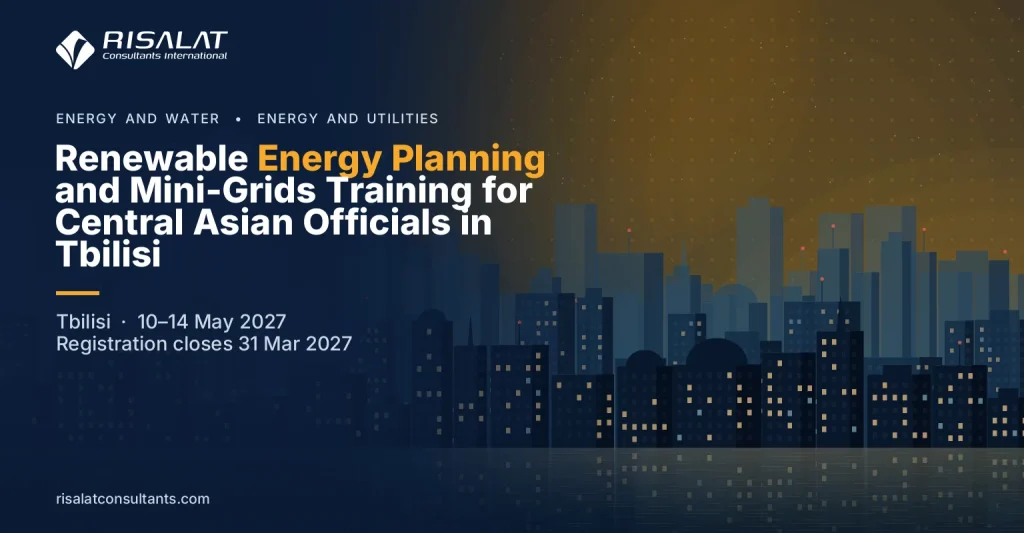
- 10–14 May 2027 (5 days)
- Where
- Tbilisi, Georgia
- Fee per participant
- £3,600 (GBP)
- Payment
- By invoice and bank transfer
- Registration closes
- 31 Mar 2027
- Format
- 5-day short course: a practical capacity-building programme for government, NGO and project teams in Tbilisi
- In-house option
- Run it for your team, on your dates
On this page 13 sections
Programme Overview
This programme gives officials and project teams the practical methods of renewable energy planning and mini-grids, built around real cases from public institutions and donor-financed projects. Delivered by Risalat Consultants International in Tbilisi, Georgia, it combines expert-led sessions, real cases and group work, so that participants can apply what they learn in their own institution.
Climate change, environmental pressure and resource management now shape national plans, budgets and investment decisions. Financiers increasingly expect climate and environmental considerations to be built into projects from the start.
It is designed for participants from Kazakhstan, Uzbekistan, Kyrgyzstan, Tajikistan, Turkmenistan and colleagues from other countries facing the same challenges. It is also designed for climate change and environment officers, energy, water and agriculture sector staff, planning and policy officers and others who want practical, current skills in climate, environment and natural resources.
The programme strengthens institutional capability in:
- Climate and environmental trends for the sector
- National plans and commitments
- Risk and vulnerability assessment
- Roles of government, communities and partners
- Case discussion: a project affected by climate risk
- Adaptation and mitigation options
- Nature-based and engineering solutions
- Sector planning for energy, water and land
- Climate and environmental risk assessment
- Adaptation and mitigation planning
- Sector strategies for energy, water and land
- Project design for climate and environmental goals
Why this matters now
Organisations increasingly require professionals capable of:
- Assess climate and environmental risks to their services and assets
- Design projects that meet climate and environmental goals
- Prepare proposals that financiers can approve
- Measure and report results credibly
- Work with communities and partners across sectors
Strong climate, environment and natural resources systems help organisations:
- Protect services and infrastructure from climate risks
- Access climate and environmental finance
- Meet national and international commitments
- Use natural resources sustainably
- Funds
- Entity
- Project
- Results
- MRV
Who Should Attend
This programme is designed for:
- Climate change and environment officers
- Energy, water and agriculture sector staff
- Planning and policy officers
- Project and programme managers
- Disaster risk management staff
- Local government officials
- Utility managers and engineers
- NGO and community organisation staff
- Researchers and technical advisers
- Proposal and partnership officers
Tick what your team needs to be able to do.
Programme Objectives
By the end of this programme participants will be able to:
- Explain the main climate and environmental challenges for their sector
- Assess climate and environmental risks to services and assets
- Plan adaptation and mitigation measures
- Design projects with clear climate and environmental results
- Understand the main sources of climate and environmental finance
- Prepare the core parts of a funding proposal
- Set up measurement, reporting and verification
- Involve communities and partners effectively
- Prepare an action plan for their institution
Training Structure & Contents
- Climate and environmental trends for the sector
- National plans and commitments
- Risk and vulnerability assessment
- Roles of government, communities and partners
- Case discussion: a project affected by climate risk
- Workshop: Context and risks: Applying It to Your Institution
- Adaptation and mitigation options
- Nature-based and engineering solutions
- Sector planning for energy, water and land
- Costs, benefits and trade-offs
- Exercise: options appraisal
- Workshop: Planning solutions: Applying It to Your Institution
- From problem to project concept
- Results frameworks for climate and environment
- Safeguards and stakeholder involvement
- Implementation arrangements
- Exercise: concept note outline
- Case Study: Project design in Practice
- Sources of climate and environmental finance
- What financiers look for
- Building the climate rationale
- Budgets and co-financing
- Case study: a successful proposal
- Workshop: Finance and proposals: Applying It to Your Institution
- Measurement, reporting and verification basics
- Monitoring results and learning
- Communicating results
- Partnerships for implementation
- Personal action plan for your institution
- Capstone Exercise: Renewable Energy Planning and Mini-Grids Action Plan for Your Institution
Full day-by-day contents
First Day | Context and risks
- Climate and environmental trends for the sector
- National plans and commitments
- Risk and vulnerability assessment
- Roles of government, communities and partners
- Case discussion: a project affected by climate risk
- Workshop: Context and risks: Applying It to Your Institution
Second Day | Planning solutions
- Adaptation and mitigation options
- Nature-based and engineering solutions
- Sector planning for energy, water and land
- Costs, benefits and trade-offs
- Exercise: options appraisal
- Workshop: Planning solutions: Applying It to Your Institution
Third Day | Project design
- From problem to project concept
- Results frameworks for climate and environment
- Safeguards and stakeholder involvement
- Implementation arrangements
- Exercise: concept note outline
- Case Study: Project design in Practice
Fourth Day | Finance and proposals
- Sources of climate and environmental finance
- What financiers look for
- Building the climate rationale
- Budgets and co-financing
- Case study: a successful proposal
- Workshop: Finance and proposals: Applying It to Your Institution
Fifth Day | Measurement, reporting and action planning
- Measurement, reporting and verification basics
- Monitoring results and learning
- Communicating results
- Partnerships for implementation
- Personal action plan for your institution
- Capstone Exercise: Renewable Energy Planning and Mini-Grids Action Plan for Your Institution
Training Methodology
The programme is practical and participatory. Expert facilitators introduce concepts and current practice, and participants apply them straight away through discussion, exercises and work on real cases. Before the programme, a short pre-assessment helps the facilitators understand each participant’s role and priorities, so that examples and exercises can be adjusted to the group. Each day ends with a short reflection in which participants note what they will apply at work.
- Expert-led sessions on current practice
- Regional and international case studies
- Group work and practical exercises
- Simulations and role plays where relevant
- Discussion of participants’ own challenges
- Peer learning across institutions and countries
- Practical tools and templates to take back to work
- Daily reflection and action planning
Expected Outcomes
- Assess climate and environmental risks
- Plan adaptation and mitigation measures
- Design projects with clear results
- Prepare stronger funding proposals
- Measure and report results credibly
- Work effectively with communities and partners
£3,600 per participant · invoice and bank transfer · groups of 5 or more receive a discount
Five or more from one organisation: ask for the group rate on the invoice request.
Ten or more: an in-house version for your institution may cost less per person. Ask for an in-house quote.
Registration closes in 124 days (31 Mar 2027)
Regional Relevance & Application
Europe: European institutions apply climate, environment and natural resources within detailed regulatory frameworks and reform agendas. Participants from Europe can compare their practice with colleagues from other regions and test how established methods work under different conditions.
Africa: Across Africa, ministries, agencies and project teams working in climate, environment and natural resources increasingly operate alongside donor-financed programmes that expect clear systems and evidence. The programme helps participants adapt good practice to the institutions and resources they work with.
Middle East: In the Middle East, national development strategies and diversification plans place growing demands on climate, environment and natural resources. Participants explore how to build the capability these plans need inside public bodies and companies.
Asia: Institutions across Asia combine rapid growth with ambitious modernisation programmes. Participants from Asia can share their experience of scaling systems quickly and learn from approaches used elsewhere.
Pacific: Small island and Pacific states face particular constraints of size, distance and capacity. The programme highlights practical, proportionate approaches to climate, environment and natural resources that suit smaller institutions.
Holding the programme in Tbilisi, Georgia brings participants together away from their daily pressures, so they can compare how climate, environment and natural resources is handled in different settings. The same programme can also be delivered in-house for one institution, in its own country or online, with cases taken from its current work.
Host Country Profile
Programmes, Workshops, Exposures, Training Courses in Tbilisi, Georgia by Risalat Consultants International. Studying away from their own country gives participants time to focus, a fresh view of their own institution and the chance to build a network with colleagues from other countries.
Who Will Deliver This Programme
Each date is delivered by a team assigned from Risalat's expert network for this subject. For this programme we assign:
How we choose them: Experience in the region of the participants or comparable settings; Command of the financier rules that apply (World Bank, ADB, AfDB, EU, UN) where relevant; Delivery in English; other languages on request for in-house groups; No conflict of interest with participants' institutions.
Course Deliverables
Before the Programme
- Participant Pre-Assessment
- Renewable Energy Planning and Mini-Grids Readiness Assessment
- Renewable Energy Planning and Mini-Grids Resource Pack
- Preparatory Reading Materials
- Complimentary Visa Support & Advisory
During the Programme
- Airport Pickup & Welcome Assistance
- Accommodation with breakfast: 6 nights, check-in Sunday 9 May 2027, check-out Saturday 15 May 2027 (one night before and one night after the programme)
- Welcome Networking Dinner
- Risalat Training Kit (Bag, Bottle, Mug, T-Shirt, Cap, Passport Cover, Pens, Notebook, Magnet & Keychain)
- Comprehensive Renewable Energy Planning and Mini-Grids Training Manual
- Climate Risk Screening Checklist
- Options Appraisal Template
- Concept Note Template
- Results Measurement Template
- Practical Workshops & Simulations
- Group Discussions & Peer Learning
- Daily Lunch and Refreshments
- Full Access to Training Venue Facilities
- Mini Pad / Tablet with Digital Learning Materials
- Field Visit (where applicable)
- Entertaining Ci
Training courses in TbilisiEnergy and Water training courses
Why Tbilisi for this programme
Tbilisi is known for public service halls and anti-corruption reforms, and has easy visas for many countries.
The Renewable Energy Planning and Mini-Grids Training for Central Asian Officials in Tbilisi programme in May 2027 brings together officials and professionals from across the Caucasus region and beyond. Sessions combine short inputs, case studies and group work on participants' own files, and the city's institutions can be added as a study visit on request.
Getting there: Tbilisi International (TBS).
Check whether you need a visa with the free Visa Checker, and ask for an invitation letter once you are registered.
The same topic in other cities
- Solar Photovoltaic Operations, Inverter Safety and O&M Standards in Casablanca (Casablanca)
- Solar Hybrid Mini-Grid Contract Oversight and Utility Institutional Setup in Dubai (Dubai)
- Mini-Grid Interconnection and Hybrid Diesel-Solar Control Systems in Dubai (Dubai)
- Off-Grid Solar Electrification and Rural Distribution Networks in Dakar (Dakar)
- Grid Expansion and Power Distribution Operations in Accra (Accra)
- Mini-Grid Concessions and Productive Use Renewable Off-Grid Systems in Kigali (Kigali)
Other programmes in Tbilisi
- Performance Management in Government in Tbilisi
- Irrigation Modernisation and Dam Safety Oversight in Tbilisi
- Disaster-Resilient Rural Road Engineering and Slope Stabilization in Tbilisi
- Agro-Logistics Hub Infrastructure and Regional Value Chain Linkages in Tbilisi
- Early Childhood Development Interventions and Facility Commissioning in Tbilisi
Related: Climate finance and energy programmes · free Climate Finance Proposal Readiness · all programmes
Questions before you nominate your team? Book a 30-minute call with us, or ask for this programme in-house.
Teams often travel here from Azerbaijan, Georgia, Armenia, Ukraine, Moldova, Albania, Serbia, North Macedonia. Funding, visa letters and group rates are explained on each country page.
Free roadmap: Renewable Energy in Afghanistan: a 12-month plan for your team
Is there energy and utilities training for government officials in Tbilisi in May 2027?
Can "Renewable Energy Planning and Mini-Grids Training for Central Asian Officials in Tbilisi" be delivered in-house for one organisation?
Which other energy and utilities programmes does Risalat run?
How do organisations register and pay?
For teams and institutions
Bring your team
Teams that learn together apply more at work. Tell us how many people and how you would like to take part: we reply with a group quote within two working days.
Watch: this programme in short

Other dates and cities for this subject: Energy, Power and Utility Management training courses (118 upcoming dates).
More training courses in Georgia · All programmes in Asia · Full training calendar
Plan this programme in a roadmap: why it matters, why to approve it, the dates to plan and the career it builds.