Key facts
- Dates
- 9–13 Aug 2027 (5 days)
- Where
- Tbilisi, Georgia
- Fee per participant
- £4,200 (GBP)
- Payment
- By invoice and bank transfer
- Registration closes
- 30 Jun 2027
- Format
- 5-day short course: a practical capacity-building programme for government, NGO and project teams in Tbilisi
- In-house option
- Run it for your team, on your dates
On this page 11 sections
Programme Overview
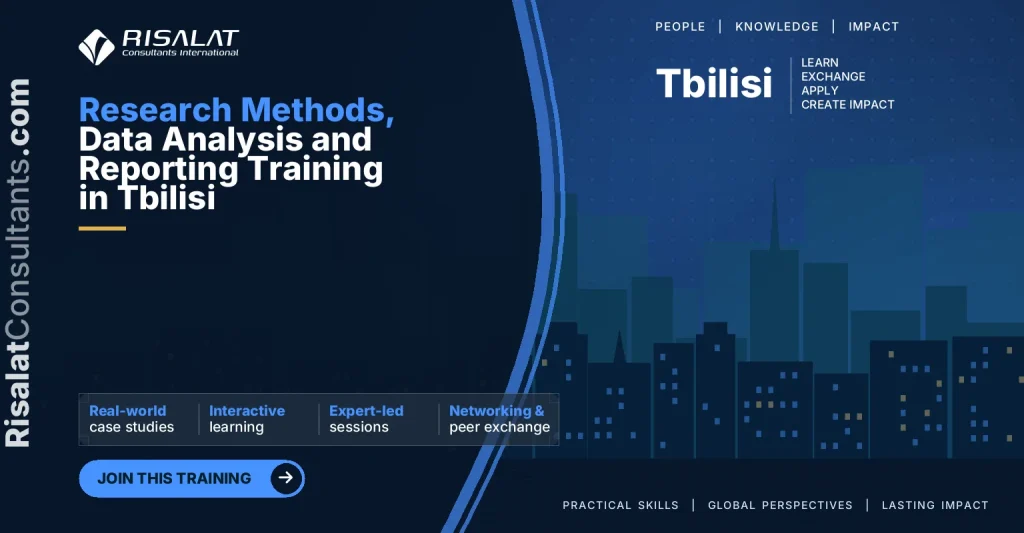
The Research Methods, Data Analysis and Reporting Training in Tbilisi is an applied five-day professional development programme for officials, managers and specialists responsible for decisions, assurance and implementation. It connects technical methods with practical work products that participants can adapt to their own institutions. Delivered by Risalat Consultants International in Tbilisi, Georgia, it combines expert-led sessions, real cases and group work, so that participants can apply what they learn in their own institution.
Free self-check: the digital readiness assessment gives how ready your institution is for digital services, data and AI, in about 10 minutes.
The programme is hosted in Tbilisi, Georgia. It is designed for public institutions, donor-financed project teams, regulators and organisations that need documented decisions and reliable operational controls. The venue is a learning location, not a claim that a local institution is providing a confirmed technical visit. Participants work with realistic but fictional case files covering research questions, mixed-method designs and data quality rules. Exercises distinguish requirements that follow a particular financier or jurisdiction from general good practice, and no project funding or nomination arrangement is implied.
The curriculum develops a continuous workflow from initial assessment and planning to evidence gathering, quality assurance, management reporting and institutional follow-up. It also encourages participants to identify gaps in existing policies before applying any international reference framework. Each participant builds a portfolio of draft tools and a short implementation plan, with responsibilities, verification points and a timetable for management review.
The programme strengthens institutional capability in:
- Digital strategy and transformation planning
- Data governance and data quality
- Data analysis and visualisation
- Cybersecurity basics and risk management
- Defining a decision problem and testable research questions
- Mapping stakeholder information needs and reporting obligations
- Comparing experimental and observational research designs
Why this matters now
Organisations increasingly require professionals capable of:
- Plan digital initiatives that solve real problems
- Manage data quality, protection and sharing
- Analyse data and present it clearly
- Manage cyber and technology risks
- Lead people through digital change
Strong digital government, data and technology systems help organisations:
- Deliver faster and more accessible services
- Make better use of data in decisions
- Protect systems and personal data
- Get value from technology investments
Who Should Attend
This programme is designed for:
- Ministry department directors
- Government policy analysts
- Project implementation unit managers
- Project management unit coordinators
- Technical assistance team leaders
- Internal auditors
- Compliance officers
- Procurement specialists
- Finance managers
- Monitoring and evaluation officers
- Data and reporting analysts
- Programme quality assurance staff
Tick what your team needs to be able to do.
Programme Objectives
By the end of this programme participants will be able to:
- Explain the main trends in digital government and data use
- Plan a digital initiative linked to service goals
- Apply data governance and quality principles
- Analyse and visualise data for decision makers
- Identify and manage cyber and technology risks
- Apply responsible practice when using AI and automation
- Plan the procurement and management of technology
- Lead people through digital change
- Prepare a digital action plan for their institution
Training Structure & Contents
- Define a decision problem and testable research questions
- Map stakeholder information needs and reporting obligations
- Compare experimental and observational research designs
- Choose qualitative, quantitative or mixed methods
- Build a logic model and analytical framework
- Identify selection bias and confounding risks
- Plan ethical consent and safe data handling
- Construct sampling frames and inclusion criteria
- Calculate practical sample sizes and limitations
- Write neutral survey questions and response scales
- Design interview and focus group guides
- Configure digital collection and validation checks
- Develop enumerator instructions and supervision rules
- Plan consent, anonymisation and secure storage
- Inspect missing values, duplicates and outliers
- Create a reproducible cleaning log
- Produce descriptive tables and cross-tabulations
- Distinguish correlation from causation
- Apply confidence intervals with stated assumptions
- Code qualitative interviews and identify themes
- Triangulate numerical and narrative findings
- Turn findings into an answer-first executive summary
- Select honest charts and appropriate denominators
- Write transparent methods and limitations
- Separate evidence, interpretation and recommendation
- Prepare policy briefs for senior decision-makers
- Build an accessible results dashboard outline
- Check consistency between tables and conclusions
- Integrate findings into monitoring and evaluation cycles
- Define data ownership and approval workflows
- Set quality controls for recurring reporting
- Design a research commissioning checklist
- Build an evidence-to-decision tracking log
- Establish feedback loops with programme teams
- Prioritise a feasible institutional research pipeline
Full day-by-day contents
First Day | Research questions and decision use
- Define a decision problem and testable research questions
- Map stakeholder information needs and reporting obligations
- Compare experimental and observational research designs
- Choose qualitative, quantitative or mixed methods
- Build a logic model and analytical framework
- Identify selection bias and confounding risks
- Plan ethical consent and safe data handling
Second Day | Sampling, ethics and field instruments
- Construct sampling frames and inclusion criteria
- Calculate practical sample sizes and limitations
- Write neutral survey questions and response scales
- Design interview and focus group guides
- Configure digital collection and validation checks
- Develop enumerator instructions and supervision rules
- Plan consent, anonymisation and secure storage
Third Day | Data cleaning and statistical analysis
- Inspect missing values, duplicates and outliers
- Create a reproducible cleaning log
- Produce descriptive tables and cross-tabulations
- Distinguish correlation from causation
- Apply confidence intervals with stated assumptions
- Code qualitative interviews and identify themes
- Triangulate numerical and narrative findings
Fourth Day | Interpretation and evidence-based reporting
- Turn findings into an answer-first executive summary
- Select honest charts and appropriate denominators
- Write transparent methods and limitations
- Separate evidence, interpretation and recommendation
- Prepare policy briefs for senior decision-makers
- Build an accessible results dashboard outline
- Check consistency between tables and conclusions
Fifth Day | Institutional research and reporting plans
- Integrate findings into monitoring and evaluation cycles
- Define data ownership and approval workflows
- Set quality controls for recurring reporting
- Design a research commissioning checklist
- Build an evidence-to-decision tracking log
- Establish feedback loops with programme teams
- Prioritise a feasible institutional research pipeline
Training Methodology
Facilitators use short briefings, individual exercises and group-based problem solving. Case data are illustrative, with assumptions made explicit; the exercises do not represent an audit or certification of any real organisation. Before the programme, a short pre-assessment helps the facilitators understand each participant's role and priorities, so that examples and exercises can be adjusted to the group. Each day ends with a short reflection in which participants note what they will apply at work.
- Expert-led sessions on current practice
- Regional and international case studies
- Group work and practical exercises
- Simulations and role plays where relevant
- Discussion of participants' own challenges
- Peer learning across institutions and countries
- Practical tools and templates to take back to work
- Daily reflection and action planning
- Collect
- Clean
- Store
- Analyse
- Decide
Expected Outcomes
- Plan digital initiatives linked to service goals
- Apply data governance and quality principles
- Analyse and present data clearly
- Manage cyber and technology risks
- Use AI and automation responsibly
- Lead digital change in their institution
£4,200 per participant · invoice and bank transfer · groups of 5 or more receive a discount
Five or more from one organisation: ask for the group rate on the invoice request.
Ten or more: an in-house version for your institution may cost less per person. Ask for an in-house quote.
Registration closes in 215 days (30 Jun 2027)
Regional Relevance & Application
- Europe: European institutions apply digital government, data and technology within detailed regulatory frameworks and reform agendas. Participants from Europe can compare their practice with colleagues from other regions and test how established methods work under different conditions.
- Africa: Across Africa, ministries, agencies and project teams working in digital government, data and technology increasingly operate alongside donor-financed programmes that expect clear systems and evidence. The programme helps participants adapt good practice to the institutions and resources they work with.
- Middle East: In the Middle East, national development strategies and diversification plans place growing demands on digital government, data and technology. Participants explore how to build the capability these plans need inside public bodies and companies.
- Asia: Institutions across Asia combine rapid growth with ambitious modernisation programmes. Participants from Asia can share their experience of scaling systems quickly and learn from approaches used elsewhere.
- Pacific: Small island and Pacific states face particular constraints of size, distance and capacity. The programme highlights how to focus effort where it counts most.
Who Will Deliver This Programme
Each date is delivered by a team assigned from Risalat's expert network for this subject. For this programme we assign:
How we choose them: Experience in the region of the participants or comparable settings; Command of the financier rules that apply (World Bank, ADB, AfDB, EU, UN) where relevant; Delivery in English; other languages on request for in-house groups; No conflict of interest with participants' institutions.
Training courses in TbilisiResearch & Statistics training courses
Why Tbilisi for this programme
Tbilisi is known for public service halls and anti-corruption reforms, and has easy visas for many countries.
The Research Methods, Data Analysis and Reporting Training in Tbilisi programme in August 2027 brings together officials and professionals from across the Caucasus region and beyond. Sessions combine short inputs, case studies and group work on participants' own files, and the city's institutions can be added as a study visit on request.
Getting there: Tbilisi International (TBS).
Check whether you need a visa with the free Visa Checker, and ask for an invitation letter once you are registered.
The same topic in other cities
- Mini Degree in Monitoring, Evaluation and Learning in Bangkok (Bangkok)
- Performance Audit for Supreme Audit Institutions in Dubai (Dubai)
- Practical AI Tools for Project Teams and Analysts in Geneva (Geneva)
- AI for Agriculture and Food Security Training in Accra (Accra)
- Prompt Engineering and AI Tools for Professionals Training in Bangkok (Bangkok)
- AI in Monitoring, Evaluation and Learning Training in Nairobi (Nairobi)
Other programmes in Tbilisi
- Performance Management in Government in Tbilisi
- Irrigation Modernisation and Dam Safety Oversight in Tbilisi
- Disaster-Resilient Rural Road Engineering and Slope Stabilization in Tbilisi
- Agro-Logistics Hub Infrastructure and Regional Value Chain Linkages in Tbilisi
- Early Childhood Development Interventions and Facility Commissioning in Tbilisi
Questions before you nominate your team? Book a 30-minute call with us, or ask for this programme in-house.
Teams often travel here from Azerbaijan, Georgia, Armenia, Ukraine, Moldova, Albania, Serbia, North Macedonia. Funding, visa letters and group rates are explained on each country page.
Is there data, ai and analytics training for government officials in Tbilisi in August 2027?
Can "Research Methods, Data Analysis and Reporting Training in Tbilisi" be delivered in-house for one organisation?
Which other data, ai and analytics programmes does Risalat run?
How do organisations register and pay?
For teams and institutions
Bring your team
Teams that learn together apply more at work. Tell us how many people and how you would like to take part: we reply with a group quote within two working days.
Watch: this programme in short

Other dates and cities for this subject: Impact Evaluation and Data Analysis training courses (16 upcoming dates).
More training courses in Georgia · All programmes in Asia · Full training calendar
Plan this programme in a roadmap: why it matters, why to approve it, the dates to plan and the career it builds.