Key facts
- Dates
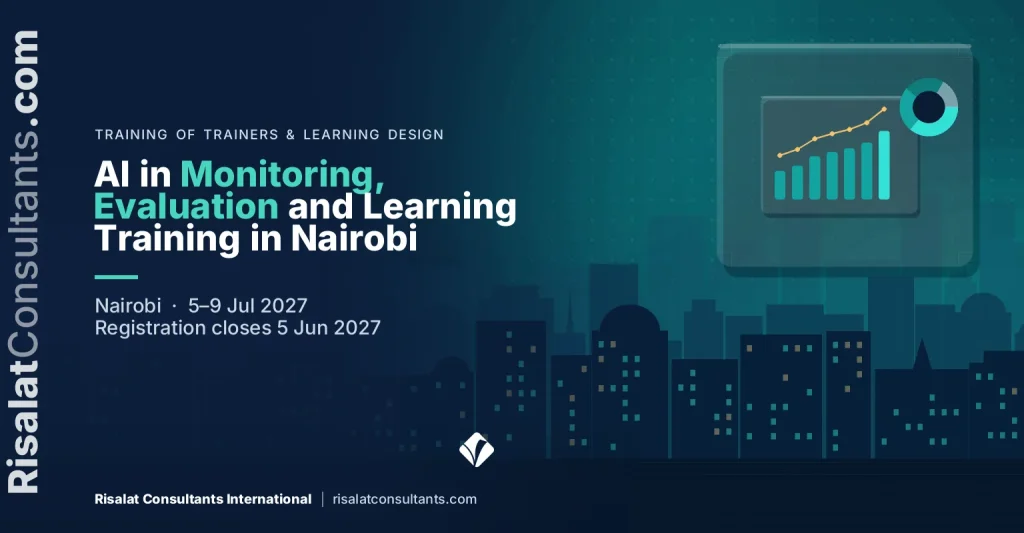
- 5–9 Jul 2027 (5 days)
- Where
- Nairobi, Kenya
- Fee per participant
- £3,350 (GBP)
- Payment
- By invoice and bank transfer
- Registration closes
- 5 Jun 2027
- Certificate
- Certificate of completion
- In-house option
- Run it for your team, on your dates
On this page 16 sections
Programme Overview
The integration of artificial intelligence into development cooperation is transforming monitoring, evaluation, accountability and learning functions. This five-day course equips professionals with practical skills to deploy AI applications across the project cycle. Participants explore how modern machine learning models and large language models process extensive data streams, standardise quantitative indicators, and extract actionable operational insights. The curriculum balances technological adoption with rigorous analytical standards required by international organisations and public sector agencies operating across Africa.
Free self-check: the M&E and MEAL assessment gives a score for your monitoring, evaluation and learning system and the gaps to close first, in about 10 minutes.
Participants engage directly with applied workflows to automate data cleaning, structure messy field datasets, and conduct rapid thematic analysis of qualitative feedback. The programme details methods for prompt engineering, document synthesis, and automated initial drafting of evaluation reports without sacrificing methodological rigor. Emphasis is placed on cross-checking AI outputs against ground truth data, verifying factual accuracy, and mitigating algorithmic biases that can distort baseline surveys, beneficiary selection processes, and outcome assessments in complex environments.
Governance, ethics, and beneficiary data protection form the foundation of this training. Institutional users must navigate the delicate balance between analytical efficiency and the fundamental rights of vulnerable populations. Through guided case exercises, learners apply established international accountability principles to ensure confidentiality, consent, and transparency. By concluding with the design of institutional AI adoption roadmaps, the course prepares teams to introduce compliant, auditable, and secure analytical tools into their everyday results-based management systems.
Held in Nairobi, a major hub for international development, this open-enrolment programme provides a collaborative space for monitoring and evaluation specialists to exchange field realities. Attendees test various accessible, open-source and proprietary platforms under expert guidance. By the end of the week, participants will have the practical tools and governance frameworks necessary to modernise project reporting, improve analytical productivity, and maintain strict data integrity across donor-financed portfolios.
Governments and development institutions across Africa are rapidly scaling up public investments, creating an urgent demand for faster, evidence-informed decision-making. Simultaneously, global frameworks such as the OECD AI Principles, the UNESCO Recommendation on the Ethics of Artificial Intelligence, and the EU AI Act are setting strict new baselines for institutional accountability, privacy, and system transparency. Development partners including the World Bank, the African Development Bank, the European Union, and United Nations agencies now expect robust, real-time results measurement while upholding high standards of data protection. Public institutions and project implementation units must immediately build internal technical competencies to leverage AI tools safely, reduce administrative burdens, and prevent algorithmic harms in community-facing programmes.
Delivered by Risalat Consultants International in Nairobi, Kenya, it combines expert-led sessions, real cases and group work, so that participants can apply what they learn in their own institution.
The Programme Strengthens Institutional Capability
- Core concepts: Machine learning, large language models, and their role in MEAL
- International standards review: OECD AI Principles and UNESCO Ethics Recommendations
- Automating data screening: Identifying anomalies, missing entries, and formatting errors
- Standardising quantitative field survey datasets using advanced algorithmic prompts
- Hands-on lab: Cleaning multi-indicator project datasets using automated workflows
- Natural language processing applications for qualitative project information
- Automated coding of open-ended survey responses and key informant interviews
- Thematic clustering and sentiment analysis for community accountability mechanisms
- Theory of change and results chains
- Logical frameworks and results frameworks
- SMART indicators, baselines and targets
- Data collection methods and tools
It is designed for monitoring and evaluation officers in donor-funded projects, MEAL managers and directors in non-governmental organisations, independent evaluation consultants and research professionals and others who want practical, current skills in monitoring and evaluation.
The Growing Importance of AI in Monitoring, Evaluation and Learning
Governments and financiers want to know what changed, not only what was spent. Results frameworks, indicators and credible evidence now decide how programmes are judged and whether they receive further funding.
Many teams collect large amounts of data but struggle to turn it into decisions. Strong monitoring and evaluation links activities to results, shows progress early and supports learning across the institution.
Organisations increasingly require professionals capable of:
- Design results frameworks with measurable indicators
- Collect and check data that can be trusted
- Analyse progress and explain variances
- Plan and manage evaluations
- Use evidence to adjust plans and report results
Strong monitoring and evaluation systems help organisations:
- Show results clearly to financiers and citizens
- Detect delays and problems early
- Improve the quality of decisions
- Meet reporting and evaluation requirements
This AI in Monitoring, Evaluation and Learning programme brings these elements together in a practical format, so that participants understand not only what good practice looks like but also how to introduce it in their own setting, with the people and resources they have.
Who Should Attend This AI in Monitoring, Evaluation and Learning Training?
This programme is designed for:
- Monitoring and evaluation officers in donor-funded projects
- MEAL managers and directors in non-governmental organisations
- Independent evaluation consultants and research professionals
- Statisticians and data analysts within national statistical offices
- Results-based management specialists in public sector ministries
- Project coordinators managing World Bank, AfDB, EU, or UN grants
- Policy analysts responsible for sector-wide evidence synthesis
- Management information systems and project database officers
- Accountability and beneficiary feedback focal points
- Programme quality and institutional learning specialists
- M&E officers and managers
- Project and programme managers
The programme suits experienced professionals as well as those moving into new responsibilities. Groups that mix institutions and countries are encouraged, because participants learn a great deal from each other’s experience.
Tick what your team needs to be able to do.
AI in Monitoring, Evaluation and Learning Training Objectives
Upon successful completion of this AI in Monitoring, Evaluation and Learning Training, participants will be able to:
- Apply generative and predictive AI tools to clean, transform, and validate quantitative project datasets
- Execute qualitative data coding and thematic extraction on beneficiary interviews and focus group transcripts using natural language processing
- Construct structured prompt workflows to synthesise multi-document evidence bases and produce preliminary evaluation reporting drafts
- Evaluate AI outputs for algorithmic bias, hallucination, and methodological validity using structured verification protocols
- Implement operational safeguards to protect personally identifiable beneficiary data in line with international ethical recommendations
- Design institutional acceptable-use guidelines for machine learning applications within results-based management workflows
- Formulate an organisational roadmap for integrating verified AI utilities into ongoing project performance tracking systems
- Build a theory of change and results chain for a programme
- Design a results framework with SMART indicators
- Set baselines, targets and means of verification
Each objective is practised during the programme through exercises, cases or group work, so that participants leave able to do it, not only to describe it.
Programme Contents and Structure
- Core concepts: Machine learning, large language models, and their role in MEAL
- International standards review: OECD AI Principles and UNESCO Ethics Recommendations
- Automating data screening: Identifying anomalies, missing entries, and formatting errors
- Standardising quantitative field survey datasets using advanced algorithmic prompts
- Hands-on lab: Cleaning multi-indicator project datasets using automated workflows
- Natural language processing applications for qualitative project information
- Automated coding of open-ended survey responses and key informant interviews
- Thematic clustering and sentiment analysis for community accountability mechanisms
- Triangulating automated qualitative summaries with primary field observations
- Practical exercise: Processing multi-lingual community feedback into thematic logs
- Using AI research assistants for rapid evidence syntheses and desk reviews
- Techniques for prompt engineering: Zero-shot, few-shot, and role-based framing
- Drafting standardised sections of evaluation briefs and performance reports
- Maintaining technical voice, methodological neutrality, and attribution accuracy
- Simulation: Generating an evidence-backed annual monitoring narrative from raw metrics
- Identifying and correcting sampling and algorithmic bias in beneficiary selection
- Verification frameworks: Fact-checking AI outputs and mitigating hallucinations
- Data sovereignty, anonymisation techniques, and managing personally identifiable information
- EU AI Act implications and human-in-the-loop requirements for public programmes
- Group audit: Stress-testing an automated evaluation report for factual reliability
- Assessing organisational readiness for AI adoption within project implementation units
- Drafting internal protocols and acceptable-use policies for project personnel
- Evaluating open-source versus proprietary software for institutional deployment
- Establishing continuous monitoring and human oversight for automated systems
- Participant presentations: Individual institutional AI adoption action plans
Full day-by-day contents
The programme runs over 5 days. Each day combines expert input, practical work and a closing workshop or case study:
- First Day: Foundations of AI in Results-Based Management and Data Preparation
- Second Day: Qualitative Analysis, Thematic Coding, and Beneficiary Feedback
- Third Day: Evidence Synthesis, Literature Reviews, and Automated Drafting
- Fourth Day: Validity Testing, Bias Mitigation, and Data Ethics
- Fifth Day: Institutional Integration, Governance, and Action Planning
Full day-by-day contents
First Day | Foundations of AI in Results-Based Management and Data Preparation
- Core concepts: Machine learning, large language models, and their role in MEAL
- International standards review: OECD AI Principles and UNESCO Ethics Recommendations
- Automating data screening: Identifying anomalies, missing entries, and formatting errors
- Standardising quantitative field survey datasets using advanced algorithmic prompts
- Hands-on lab: Cleaning multi-indicator project datasets using automated workflows
Workshop: Foundations of AI in Results-Based Management and Data Preparation: Applying It to Your Institution
Working in small groups, participants apply the day's methods to examples from their own institutions and agree practical next steps.
Second Day | Qualitative Analysis, Thematic Coding, and Beneficiary Feedback
- Natural language processing applications for qualitative project information
- Automated coding of open-ended survey responses and key informant interviews
- Thematic clustering and sentiment analysis for community accountability mechanisms
- Triangulating automated qualitative summaries with primary field observations
- Practical exercise: Processing multi-lingual community feedback into thematic logs
Workshop: Qualitative Analysis, Thematic Coding, and Beneficiary Feedback: Applying It to Your Institution
Working in small groups, participants apply the day's methods to examples from their own institutions and agree practical next steps.
Third Day | Evidence Synthesis, Literature Reviews, and Automated Drafting
- Using AI research assistants for rapid evidence syntheses and desk reviews
- Techniques for prompt engineering: Zero-shot, few-shot, and role-based framing
- Drafting standardised sections of evaluation briefs and performance reports
- Maintaining technical voice, methodological neutrality, and attribution accuracy
- Simulation: Generating an evidence-backed annual monitoring narrative from raw metrics
Case Study: Evidence Synthesis, Literature Reviews, and Automated Drafting in Practice
Participants analyse a realistic case, compare the choices made with good practice and draw lessons they can use in their own setting.
Fourth Day | Validity Testing, Bias Mitigation, and Data Ethics
- Identifying and correcting sampling and algorithmic bias in beneficiary selection
- Verification frameworks: Fact-checking AI outputs and mitigating hallucinations
- Data sovereignty, anonymisation techniques, and managing personally identifiable information
- EU AI Act implications and human-in-the-loop requirements for public programmes
- Group audit: Stress-testing an automated evaluation report for factual reliability
Workshop: Validity Testing, Bias Mitigation, and Data Ethics: Applying It to Your Institution
Working in small groups, participants apply the day's methods to examples from their own institutions and agree practical next steps.
Fifth Day | Institutional Integration, Governance, and Action Planning
- Assessing organisational readiness for AI adoption within project implementation units
- Drafting internal protocols and acceptable-use policies for project personnel
- Evaluating open-source versus proprietary software for institutional deployment
- Establishing continuous monitoring and human oversight for automated systems
- Participant presentations: Individual institutional AI adoption action plans
Capstone Exercise: AI in Monitoring, Evaluation and Learning Action Plan for Your Institution
Participants bring the week together in an action plan for their own institution, with priorities, owners and first steps, and present it for feedback from peers and facilitators.
- Inputs
- Activities
- Outputs
- Outcomes
- Impact
AI in Monitoring, Evaluation and Learning Training Methodology
The training employs a practical, hands-on learning methodology combining interactive presentations, guided tool demonstrations, and individual computer laboratory exercises. Participants work with anonymised, real-world development datasets and evaluation scenarios to simulate authentic project environments. Structured peer reviews, group bias-auditing clinics, and contextual problem-solving exercises ensure that participants critically examine analytical outputs. Each session balances technological application with international regulatory standards, culminating in the individual development of an institutional AI deployment roadmap tailored to the participant's specific operational context.
The programme combines:
- Expert-led sessions on current practice
- Regional and international case studies
- Group work and practical exercises
- Simulations and role plays where relevant
- Discussion of participants' own challenges
- Peer learning across institutions and countries
- Practical tools and templates to take back to work
- Daily reflection and action planning
Before the programme, a short pre-assessment helps the facilitators understand each participant’s role and priorities, so that examples and exercises can be adjusted to the group. Each day ends with a short reflection in which participants note what they will apply at work.
Expected Outcomes
Upon completion of this AI in Monitoring, Evaluation and Learning Training, participants will be able to:
- Proficiency in using AI utilities to accelerate quantitative data screening and pipeline cleaning
- Ability to code large qualitative datasets and extract programmatic themes reliably
- Capability to generate structured, evidence-based draft sections of evaluation reports
- Competence in auditing automated outputs for bias, hallucinations, and analytical errors
- Understanding of compliance requirements under the UNESCO and OECD AI ethical frameworks
- Preparedness to implement institutional data governance protocols for secure AI adoption
- Design results frameworks with measurable indicators
- Set baselines and targets that can be tracked
Participants leave with a personal action plan and practical tools they can use in their institution from the first week back. Institutions that send several participants can use the programme to agree shared methods and templates across teams, which makes improvements easier to sustain.
£3,350 per participant · invoice and bank transfer · groups of 5 or more receive a discount
Five or more from one organisation: ask for the group rate on the invoice request.
Ten or more: an in-house version for your institution may cost less per person. Ask for an in-house quote.
Registration closes in 199 days (5 Jun 2027)
Institutional Application of AI in Monitoring, Evaluation and Learning Training
This programme supports organisations in strengthening:
- Results frameworks
- Indicator systems
- Data quality
- Evaluation planning
- Results reporting
Participants return with practical tools to improve:
- Indicator reference sheets
- Data collection tools
- Progress reports
- Evaluation terms of reference
- Learning reviews
The programme is built so that learning moves from the classroom into the institution. Participants work on their own processes and documents where possible, and leave with an action plan that their managers can review and support.
Regional Relevance & Application
Europe
European institutions apply monitoring and evaluation within detailed regulatory frameworks and reform agendas. Participants from Europe can compare their practice with colleagues from other regions and test how established methods work under different conditions.
Africa
Across Africa, ministries, agencies and project teams working in monitoring and evaluation increasingly operate alongside donor-financed programmes that expect clear systems and evidence. The programme helps participants adapt good practice to the institutions and resources they work with.
Middle East
In the Middle East, national development strategies and diversification plans place growing demands on monitoring and evaluation. Participants explore how to build the capability these plans need inside public bodies and companies.
Asia
Institutions across Asia combine rapid growth with ambitious modernisation programmes. Participants from Asia can share their experience of scaling systems quickly and learn from approaches used elsewhere.
Pacific
Small island and Pacific states face particular constraints of size, distance and capacity. The programme highlights practical, proportionate approaches to monitoring and evaluation that suit smaller institutions.
Holding the programme in Nairobi, Kenya brings participants together away from their daily pressures, so they can compare how monitoring and evaluation is handled in different settings. The same programme can also be delivered in-house for one institution, in its own country or online, with cases taken from its current work.
Host Country Profile – Kenya
Programmes, Workshops, Exposures, Training Courses in Nairobi, Kenya by Risalat Consultants International
Studying away from their own country gives participants time to focus, a fresh view of their own institution and the chance to build a network with colleagues from other countries.
AI in Monitoring, Evaluation and Learning Training Deliverables
Participants receive support before, during and after the programme, so that preparation, learning and follow-up form one continuous experience.
Before the Programme
- Participant Pre-Assessment
- AI in Monitoring, Evaluation and Learning Readiness Assessment
- AI in Monitoring, Evaluation and Learning Resource Pack
- Preparatory Reading Materials
- Complimentary Visa Support & Advisory
During the Programme
- Airport Pickup & Welcome Assistance
- Accommodation with breakfast: 6 nights, check-in Sunday 4 July 2027, check-out Saturday 10 July 2027 (one night before and one night after the programme)
- Welcome Networking Dinner
- Risalat Training Kit (Bag, Bottle, Mug, T-Shirt, Cap, Passport Cover, Pens, Notebook, Magnet & Keychain)
- Comprehensive AI in Monitoring, Evaluation and Learning Training Manual
- Theory of Change Template
- Indicator Reference Sheet Template
- Data Quality Checklist
- Evaluation Terms of Reference Template
- Practical Workshops & Simulations
- Group Discussions & Peer Learning
- Daily Lunch and Refreshments
- Full Access to Training Venue Facilities
- Mini Pad / Tablet with Digital Learning Materials
- Field Visit (where applicable)
- Entertaining City Tour
After the Programme
- Certificate of Completion
- Risalat Programme Participation Recognition Award
- Post-Training Reference Materials
- Results Framework Review Guide
- Progress Report Template
- Post-Training Support & Follow-Up Guidance
- Programme Report
Institutions can also request a tailored in-house version of this programme, delivered at their premises or online. Request a proposal.
Common Challenges in AI in Monitoring, Evaluation and Learning, And How This Training Helps
How can institutions design results frameworks with measurable indicators?
The programme addresses this directly on the first day (Foundations of AI in Results-Based Management and Data Preparation), where participants practise the methods involved and adapt them to their own institution, then build it into their action plan.
How can institutions collect and check data that can be trusted?
The programme addresses this directly on the second day (Qualitative Analysis, Thematic Coding, and Beneficiary Feedback), where participants practise the methods involved and adapt them to their own institution, then build it into their action plan.
How can institutions analyse progress and explain variances?
The programme addresses this directly on the third day (Evidence Synthesis, Literature Reviews, and Automated Drafting), where participants practise the methods involved and adapt them to their own institution, then build it into their action plan.
How can institutions plan and manage evaluations?
The programme addresses this directly on the fourth day (Validity Testing, Bias Mitigation, and Data Ethics), where participants practise the methods involved and adapt them to their own institution, then build it into their action plan.
How can institutions use evidence to adjust plans and report results?
The programme addresses this directly on the fifth day (Institutional Integration, Governance, and Action Planning), where participants practise the methods involved and adapt them to their own institution, then build it into their action plan.
Frequently Asked Questions
When and where does the AI in Monitoring, Evaluation and Learning programme take place?
It runs from 5 Jul 2027 to 9 Jul 2027, in Nairobi, Kenya. The registration deadline is shown at the top of this page.
Who should attend?
The programme is designed for monitoring and evaluation officers in donor-funded projects, MEAL managers and directors in non-governmental organisations, independent evaluation consultants and research professionals, statisticians and data analysts within national statistical offices, and others who want practical skills in monitoring and evaluation.
Will I receive a certificate?
Yes. Participants who complete the programme receive a Certificate of Completion from Risalat Consultants International.
Can this programme be delivered for our institution only?
Yes. We can deliver a tailored in-house version at your premises, in another city or online, built around your own cases. Use the proposal request on this page.
Do I need prior experience in monitoring and evaluation?
No specialist background is required beyond experience in a related role. A short pre-assessment helps the facilitators adapt the sessions to the group.
Who Will Deliver This Programme
Each date is delivered by a team assigned from Risalat's expert network for this subject. For this programme we assign:
How we choose them: Experience in the region of the participants or comparable settings; Command of the financier rules that apply (World Bank, ADB, AfDB, EU, UN) where relevant; Delivery in English; other languages on request for in-house groups; No conflict of interest with participants' institutions.
Names and short CVs of the assigned experts are shared with registered participants and sponsoring organisations before the programme, on request. Are you an expert in this subject? Join our expert network.
Training courses in NairobiM&E & Performance Management training courses
Why Nairobi for this programme
Nairobi hosts UNEP, UN-Habitat and many regional offices, with flights across Africa.
The AI in Monitoring, Evaluation and Learning Training in Nairobi programme in July 2027 brings together officials and professionals from across the Africa region and beyond. Sessions combine short inputs, case studies and group work on participants' own files, and the city's institutions can be added as a study visit on request.
Getting there: Jomo Kenyatta (NBO).
Check whether you need a visa with the free Visa Checker, and ask for an invitation letter once you are registered.
The same topic in other cities
- AI for Human Resources, Payroll and Workforce Planning Training in Amsterdam (Amsterdam)
- AI in Education and Skills Systems Training in Helsinki (Helsinki)
- AI for Agriculture and Food Security Training in Accra (Accra)
- AI for Climate Action, Disaster Risk and Early Warning Training in Copenhagen (Copenhagen)
- AI for Health Systems and Health Data Training in Geneva (Geneva)
- Prompt Engineering and AI Tools for Professionals Training in Bangkok (Bangkok)
Other programmes in Nairobi
- Island Volcanic Aquifer Management and Saline Intrusion Control in Nairobi
- Decentralised Renewable Energy Concessions and Solar Hybrid Systems in Nairobi
- Women Livelihood Grants Administration and GBV Prevention Integration in Nairobi
- Local Governance Planning and Community Sub-Project Fiduciary Controls in Nairobi
- Environmental & Social Management Frameworks for Solar Developments in Nairobi
Related: AI governance for public institutions · free AI Governance Readiness · all programmes
Teams often travel here from Sudan, Somalia, Ethiopia, Kenya, Uganda, Tanzania, Rwanda, South Sudan. Funding, visa letters and group rates are explained on each country page.
For teams and institutions
Bring your team
Teams that learn together apply more at work. Tell us how many people and how you would like to take part: we reply with a group quote within two working days.
Other dates and cities for this subject: Monitoring and Evaluation training courses (58 upcoming dates).
More training courses in Kenya · All programmes in Africa · Full training calendar
Plan this programme in a roadmap: why it matters, why to approve it, the dates to plan and the career it builds.