Key facts
- Dates
- 18–20 Oct 2027 (3 days)
- Where
- Singapore
- Fee per participant
- £2,350 (GBP)
- Payment
- By invoice and bank transfer
- Registration closes
- 8 Sep 2027
- Format
- 3-day short course: a practical capacity-building programme for government, NGO and project teams in Singapore
- In-house option
- Run it for your team, on your dates
On this page 9 sections
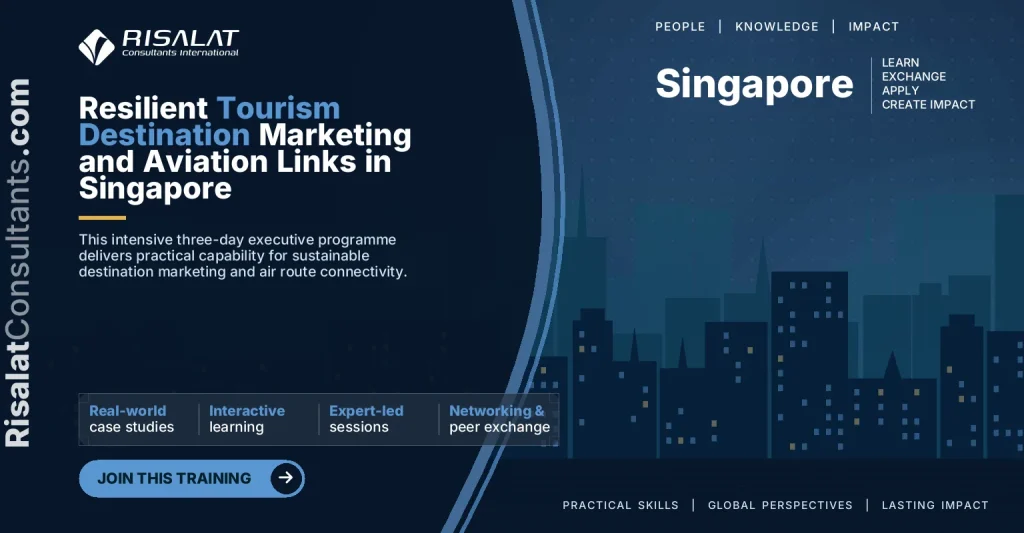
Resilient Tourism Destination Marketing and Aviation Links in Singapore
Programme Overview
This intensive executive programme delivers practical capability for sustainable destination marketing and air route connectivity. Hosted in Singapore, a global benchmark for civil aviation and tourism integration, the course enables public sector leaders to align destination management with international airline operations. Delegates examine evidence-based market diversification strategies, modern source market behaviour, and air service development principles required to secure reliable passenger traffic for peripheral and secondary island destinations.
Aviation access remains the critical lifeline for remote and dispersed island economies seeking economic resilience. This training examines secondary airport route economics, airline network planning models, and seat capacity risk-sharing structures suitable for public sector intervention. Participants analyse air connectivity data, bilateral air services arrangements, and civil aviation regulations to formulate viable airline incentive schemes that comply with international trade rules and multilateral development bank sustainability guidelines.
Strategic communication and proactive crisis preparedness form the final pillar of this programme. Officials will evaluate post-disaster market recovery protocols, reputational risk mitigation, and digital campaign deployment tailored to restoring visitor confidence following climate, economic, or operational shocks. Delivered by Risalat Consultants International in Singapore, the programme combines expert-led sessions, real cases, and group work, addressing initiatives such as the Fiji Tourism Development Programme in Vanua Levu so that participants can apply what they learn in their own institution.
The programme strengthens institutional capability in:
- Global aviation trends, passenger yield shifts, and long-haul source market dynamics
- Evaluating destination vulnerability: High-yield segments versus volume-dependent mass tourism
- Aviation analytics frameworks: Using MIDT, schedules, and catchment demographic data
- Regulatory considerations: Bilateral air services agreements and ICAO air transport policies
- Formulating market diversification strategies for vulnerable island economies
- Aircraft operating economics: Turboprop and narrowbody performance on thin, peripheral routes
- Airport cost recovery, passenger facility charges, and aeronautical revenue structures
- Structuring WTO and donor-compliant airline risk-sharing models and marketing support
- Climate and environmental risk assessment
- Adaptation and mitigation planning
- Sector strategies for energy, water and land
- Project design for climate and environmental goals
Why this matters now
Organisations increasingly require professionals capable of:
- Assess climate and environmental risks to their services and assets
- Design projects that meet climate and environmental goals
- Prepare proposals that financiers can approve
- Measure and report results credibly
- Work with communities and partners across sectors
Strong climate, environment and natural resources systems help organisations:
- Protect services and infrastructure from climate risks
- Access climate and environmental finance
- Meet national and international commitments
- Use natural resources sustainably
- Collect
- Clean
- Store
- Analyse
- Decide
Who Should Attend
This programme is designed for:
- Tourism Fiji marketing and regional development executives
- Airport authority business analysts and route planners
- Trade and investment promotion agency directors
- Ministry of tourism and civil aviation policy makers
- Regional development authority project managers
- National tourism office market research specialists
- Transport planning officers managing donor-funded infrastructure
- Public private partnership project delivery unit specialists
- Chamber of commerce tourism industry liaison directors
- Climate change and environment officers
- Energy, water and agriculture sector staff
- Planning and policy officers
Tick what your team needs to be able to do.
Programme Objectives
By the end of this programme participants will be able to:
- Evaluate international source market trends to identify resilient diversification opportunities for peripheral island economies
- Assess secondary airport route economics, catchment areas, and airline operating cost models using empirical traffic data
- Structure compliant air service incentive mechanisms and collaborative risk-sharing models for scheduled carriers
- Develop evidence-based route development business cases tailored to network carrier fleet and yield requirements
- Formulate crisis response destination marketing campaigns aligned with UN Tourism crisis communications guidelines
- Appraise bilateral air services agreements and traffic rights to identify regulatory barriers to island access
- Design multi-channel recovery marketing programmes that protect local supply chains and accelerate visitor return post-disaster
- Explain the main climate and environmental challenges for their sector
- Assess climate and environmental risks to services and assets
- Plan adaptation and mitigation measures
Training Structure & Contents
- Global aviation trends, passenger yield shifts, and long-haul source market dynamics
- Evaluating destination vulnerability: High-yield segments versus volume-dependent mass tourism
- Aviation analytics frameworks: Using MIDT, schedules, and catchment demographic data
- Regulatory considerations: Bilateral air services agreements and ICAO air transport policies
- Formulating market diversification strategies for vulnerable island economies
- Workshop on destination market diversification and aviation data analytics application
- Aircraft operating economics: Turboprop and narrowbody performance on thin, peripheral routes
- Airport cost recovery, passenger facility charges, and aeronautical revenue structures
- Structuring WTO and donor-compliant airline risk-sharing models and marketing support
- Building the route development pitch: Market size, yield potential, and operational feasibility
- Simulation workshop: Presenting connectivity business cases to network planning teams
- Workshop on secondary airport economics and route pitching application
- Post-disaster destination brand management and rapid impact assessment frameworks
- Designing phased market recovery campaigns using the UN Tourism Crisis Communications Toolbox
- Public-private-community coordination during operational disruptions and natural events
- Digital marketing agility: Dynamic budget reallocation and source market pivoting
- Action planning: Integrating aviation connectivity into national and regional tourism master plans
- Capstone Exercise: Resilient destination marketing and aviation links action plan formulation
- Climate and environmental risk assessment for tourism infrastructure
- Adaptation and mitigation planning across island destinations
- Sector strategies for energy, water, and land resources in tourism hubs
- Project design meeting international financier environmental criteria
- Coordination across multi-sectoral planning and policy units
- Preparing bankable route and infrastructure proposals for financier approval
- Aligning destination initiatives with national and international environmental commitments
- Credible measurement and reporting of environmental and traffic results
- Designing public-private partnership models for airport and destination resilience
- Institutional action plan presentations, peer feedback, and implementation next steps
Full day-by-day contents
First Day | Destination Market Diversification and Aviation Data Analytics
- Global aviation trends, passenger yield shifts, and long-haul source market dynamics
- Evaluating destination vulnerability: High-yield segments versus volume-dependent mass tourism
- Aviation analytics frameworks: Using MIDT, schedules, and catchment demographic data
- Regulatory considerations: Bilateral air services agreements and ICAO air transport policies
- Formulating market diversification strategies for vulnerable island economies
- Workshop on destination market diversification and aviation data analytics application
Second Day | Secondary Airport Economics and Airline Route Pitching
- Aircraft operating economics: Turboprop and narrowbody performance on thin, peripheral routes
- Airport cost recovery, passenger facility charges, and aeronautical revenue structures
- Structuring WTO and donor-compliant airline risk-sharing models and marketing support
- Building the route development pitch: Market size, yield potential, and operational feasibility
- Simulation workshop: Presenting connectivity business cases to network planning teams
- Workshop on secondary airport economics and route pitching application
Third Day | Crisis Preparedness, Post-Disaster Recovery, and Resilient Marketing
- Post-disaster destination brand management and rapid impact assessment frameworks
- Designing phased market recovery campaigns using the UN Tourism Crisis Communications Toolbox
- Public-private-community coordination during operational disruptions and natural events
- Digital marketing agility: Dynamic budget reallocation and source market pivoting
- Action planning: Integrating aviation connectivity into national and regional tourism master plans
- Capstone Exercise: Resilient destination marketing and aviation links action plan formulation
Fourth Day | Environmental and Sector Strategy Integration
- Climate and environmental risk assessment for tourism infrastructure
- Adaptation and mitigation planning across island destinations
- Sector strategies for energy, water, and land resources in tourism hubs
- Project design meeting international financier environmental criteria
- Coordination across multi-sectoral planning and policy units
Fifth Day | Sustainable Project Governance and Finance Access
- Preparing bankable route and infrastructure proposals for financier approval
- Aligning destination initiatives with national and international environmental commitments
- Credible measurement and reporting of environmental and traffic results
- Designing public-private partnership models for airport and destination resilience
- Institutional action plan presentations, peer feedback, and implementation next steps
Training Methodology
The programme employs adult learning methodologies suited to senior public sector officials, blending expert-led technical presentations with applied data analysis and peer review. Delegates work with real-world aviation traffic datasets, regulatory policy templates, and scenario-based simulations. Daily collaborative working groups culminate in practical drafting sessions where participants construct defensible air service development pitches and crisis recovery plans directly applicable to their institutions.
- Expert-led sessions on current practice
- Regional and international case studies
- Group work and practical exercises
- Simulations and role plays where relevant
- Discussion of participants' own challenges
- Peer learning across institutions and countries
- Practical tools and templates to take back to work
- Daily reflection and action planning
Expected Outcomes
- Demonstrated ability to analyse origin-destination traffic and passenger yield datasets for market diversification
- Capability to calculate basic aircraft route economics and load factor thresholds for secondary island airports
- Proficiency in drafting institutionally sound airline incentive programmes that satisfy public finance requirements
- Production of a comprehensive route development pitch and resilient recovery action plan for the participant’s institution
£2,350 per participant · invoice and bank transfer · groups of 5 or more receive a discount
Five or more from one organisation: ask for the group rate on the invoice request.
Ten or more: an in-house version for your institution may cost less per person. Ask for an in-house quote.
Registration closes in 284 days (8 Sep 2027)
Who Will Deliver This Programme
Each date is delivered by a team assigned from Risalat's expert network for this subject. For this programme we assign:
How we choose them: Experience in the region of the participants or comparable settings; Command of the financier rules that apply (World Bank, ADB, AfDB, EU, UN) where relevant; Delivery in English; other languages on request for in-house groups; No conflict of interest with participants' institutions.
Training courses in SingaporeCultural Heritage & Sustainable Tourism training courses
Why Singapore for this programme
Singapore is known for efficient public services, e-government and urban planning, all useful for study visits.
The Resilient Tourism Destination Marketing and Aviation Links in Singapore programme in October 2027 brings together officials and professionals from across the Asia region and beyond. Sessions combine short inputs, case studies and group work on participants' own files, and the city's institutions can be added as a study visit on request.
Getting there: Changi (SIN).
Check whether you need a visa with the free Visa Checker, and ask for an invitation letter once you are registered.
Other programmes in Singapore
- Mini Degree in PPP and Infrastructure Finance in Singapore
- Incident Investigation and Root Cause Analysis in Singapore
- Extractive Industries Governance and EITI Implementation in Singapore
- Emergency Medical Supply Chains & Cold Chain Asset Management in Singapore
- Urban Land Subdivision, Zoning and Hazard-Informed Master Planning in Singapore
Related: Enterprise and SME development programmes · free Training Needs Assessment · all programmes
Questions before you nominate your team? Book a 30-minute call with us, or ask for this programme in-house.
Teams often travel here from Timor-Leste, Sri Lanka, Bangladesh, Bhutan, Myanmar, Cambodia, Lao PDR, Vietnam. Funding, visa letters and group rates are explained on each country page.
- UN Tourism UN Tourism
- UN Office for Disaster Risk Reduction UNDRR
Is there disaster risk management training for government officials in Singapore in October 2027?
Can "Resilient Tourism Destination Marketing and Aviation Links in Singapore" be delivered in-house for one organisation?
Which other disaster risk management programmes does Risalat run?
How do organisations register and pay?
For teams and institutions
Bring your team
Teams that learn together apply more at work. Tell us how many people and how you would like to take part: we reply with a group quote within two working days.
Watch: this programme in short


Other dates and cities for this subject: Climate Resilience and Adaptation training courses (108 upcoming dates).
More training courses in Singapore · All programmes in Asia · Full training calendar
Plan this programme in a roadmap: why it matters, why to approve it, the dates to plan and the career it builds.