Key facts
- Dates
- 19–28 Apr 2027 (10 days)
- Where
- Singapore
- Fee per participant
- £4,950 (GBP)
- Payment
- By invoice and bank transfer
- Registration closes
- 10 Mar 2027
- Format
- 10-day intensive programme (mini degree): a practical capacity-building programme for government, NGO and project teams in Singapore
- Certificate
- Certificate of completion
- In-house option
- Run it for your team, on your dates
On this page 15 sections
About this mini degree: a ten-day intensive programme that combines two related short courses into one complete track, with more practice and a capstone exercise. Participants receive a Risalat certificate of completion; a mini degree is a professional programme, not an academic degree.
Programme Overview
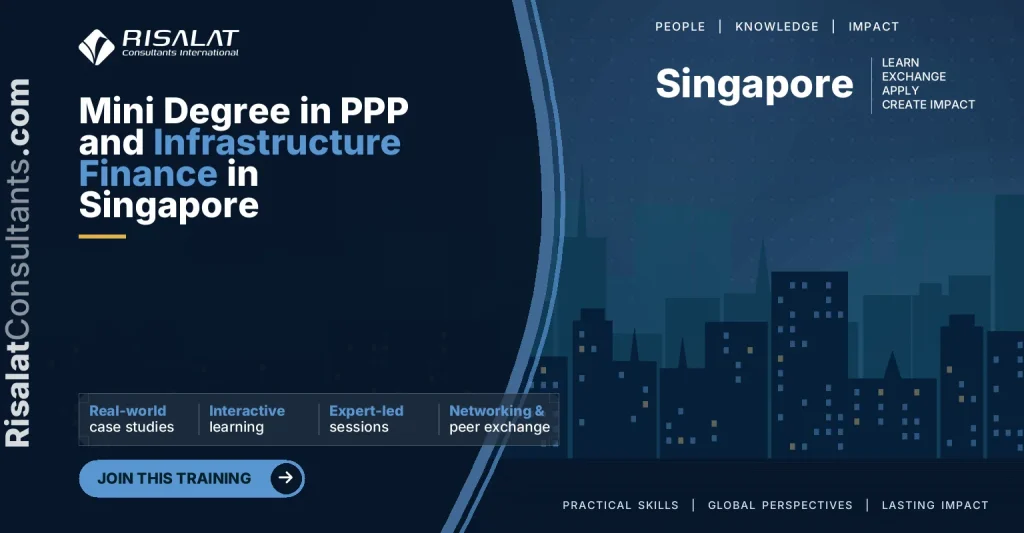
The Mini Degree in PPP and Infrastructure Finance in Singapore delivers an intensive, end to end curriculum for professionals managing complex capital investments. Hosted in a premier global infrastructure hub, this ten-day executive programme combines foundational principles with practical financial engineering. Participants examine the full project lifecycle, from national planning and enabling legislation to sophisticated financial closing. By addressing upstream project development alongside downstream contract management, the course equips public and private sector leaders to negotiate robust partnerships that safeguard public value.
Delivered through a cohesive ten-day structure, this course unites two related five-day programmes into an integrated operational pathway. Participants examine project preparation methodologies, value for money analysis, and risk allocation matrices aligned with multilateral development bank standards. The curriculum then advances into commercial structuring, non-recourse project finance, blended finance solutions, and long-term contract monitoring. The intensive design ensures that attendees move beyond theoretical mechanics into actual financial models, standard legal covenants, and institutional management mechanisms required for bankable transactions.
Singapore provides an instructive setting for this course, showcasing world-class infrastructure assets and transparent regulatory frameworks. Throughout the programme, participants interrogate international case studies, project screening frameworks, and modern procurement systems. Working collaboratively, attendees apply international guidelines to resolve typical balance-sheet, legal, and operational constraints faced by contracting authorities. Successful participants receive a Risalat professional certificate of completion, verifying their capacity to formulate, evaluate, negotiate, and oversee public-private partnership transactions across diverse economic and social infrastructure sectors.
Public authorities, line ministries, and project implementation units face urgent demands to mobilise private capital for infrastructure amidst fiscal consolidation and constrained national budgets. Many programmes financed by development partners encounter severe delivery delays because staff understand isolated components of procurement or engineering, yet lack comprehensive capability across the entire transaction lifecycle. Instead of sending staff to disconnected training events over several years, institutions require unified capability building that bridges economic appraisal, project finance, bankability assessments, and long-term contract administration. This single ten-day programme addresses that gap directly, enabling integrated project teams to standardise preparation, structure sustainable financing, and safeguard public interests across multi-decade contracts.
Delivered by Risalat Consultants International in Singapore, it combines expert-led sessions, real cases and group work, so that participants can apply what they learn in their own institution.
The Programme Strengthens Institutional Capability
- Infrastructure development strategies and the strategic rationale for public-private collaboration
- Enabling environments: legal frameworks, concession acts, and public financial management integration
- Institutional roles: establishing dedicated transaction units and clarifying inter-agency mandates
- Multilateral development bank guidance: review of World Bank, ADB, and AfDB transaction standards
- Project identification systems, pipeline development, and early-stage commercial viability screening
- Conducting comprehensive technical, legal, environmental, and socio-economic feasibility studies
- Public Sector Comparator methodology: quantitative modeling and qualitative project evaluation
- Value for money assessment: criteria, baseline assumptions, and standard sensitivity testing
- Budget preparation and execution
- Financial reporting and accounting standards
- Cash and treasury management
- Internal control over payments and assets
It is designed for officials from ministries of finance, economy, and national planning responsible for capital investment appraisal, staff of dedicated public-private partnership units and infrastructure development agencies, project directors and transaction advisors in line ministries including transport, energy, water, and health and others who want practical, current skills in public financial management and finance.
The Growing Importance of Mini Degree in PPP and Infrastructure Finance in Singapore
- Infrastructure development strategies and the strategic rationale for public-private collaboration
- Enabling environments: legal frameworks, concession acts, and public financial management integration
- Institutional roles: establishing dedicated transaction units and clarifying inter-agency mandates
- Multilateral development bank guidance: review of World Bank, ADB, and AfDB transaction standards
- Project identification systems, pipeline development, and early-stage commercial viability screening
- Conducting comprehensive technical, legal, environmental, and socio-economic feasibility studies
- Public Sector Comparator methodology: quantitative modeling and qualitative project evaluation
- Value for money assessment: criteria, baseline assumptions, and standard sensitivity testing
- Affordability constraints, fiscal accounting, and assessing long-term national budget obligations
- Practical exercise: evaluating feasibility data to determine traditional versus partnership delivery
- Systematic risk classification: political, regulatory, site, construction, and operational perils
- Market and demand hazards: volume risk, tariff collection frameworks, and availability payments
- Designing the project risk register and applying the optimal allocation principle to counterparties
- Structuring direct mitigation mechanisms: government support agreements and sovereign guarantees
- Workshop: drafting a cross-sector project risk allocation matrix for a bulk water asset
- Fundamentals of non-recourse and limited-recourse corporate and project finance structures
- Special Purpose Vehicle setup, equity participation, shareholder agreements, and board governance
- Debt sizing metrics: loan life coverage ratios, project life ratios, and debt service coverage
- Lender perspectives on bankability, step-in rights, and security packages across project assets
- Financial modeling lab: analysing sensitivity of equity returns to revenue and interest volatility
- Optimising the capital stack: senior commercial loans, subordinated debt, and mezzanine facilities
- Blended finance mechanisms: mobilising concessional finance alongside commercial private investment
- Multilateral guarantee products: political risk insurance, partial risk, and partial credit facilities
- Green and sustainability-linked bonds: issuance procedures and climate finance eligibility rules
- Transaction preparation clinic: resolving financing gaps for complex transport investments
- Briefing on Singapore's infrastructure management principles and urban asset coordination
- Site visit: operational logistics hub, reclaimed water facility, or public transport asset
- Field observation: inspecting technological integration, asset maintenance, and performance monitoring
- On-site technical discussion: engagement with asset operators and contract compliance teams
- Debriefing session: distilling practical delivery lessons applicable to home-country environments
- Procurement strategy design: balance between transparency, competitive tension, and transaction speed
- Prequalification documents and criteria: evaluating consortium capabilities and market appetite
- Structuring bid documents: Request for Proposals, output specifications, and bidding timetables
- Evaluating commercial bids: scoring technical innovations, financial bids, and financing models
- Negotiation boundary setting: avoiding post-bid scope drift and anti-competitive practices
- Core anatomy of a concession agreement: term, scope, handover rules, and public obligations
- Designing performance regimes: service key performance indicators and financial deductions
- Intercreditor arrangements, direct agreements, and enforcement of lender step-in provisions
- Relief events, force majeure clauses, compensation events, and material changes in law
- Drafting exercise: negotiating liquidated damages and service credit clauses for availability assets
- Establishing the public contract management team: systems, budgets, and operational oversight
- Monitoring operator compliance: independent engineers, auditing protocols, and service reporting
- Managing contract variations, scope amendments, and requests for financial equilibrium adjustments
- Refinancing mechanisms: sharing capital gains between private sponsors and contracting authorities
- Dispute avoidance, dispute adjudication boards, and international commercial arbitration venues
- Capstone simulation: end to end project appraisal, risk mitigation, and commercial structuring
- Working group formulation: preparing an institutional transaction plan for a target priority project
- Team presentations: pitching capital project plans to a simulated multi-stakeholder panel
- Peer review and panel critique: assessing financial bankability and operational governance
- Course consolidation, issuance of Risalat professional certificates, and closing review
Sound financial management is the basis for credible budgets, timely payments and clean audits. Governments and financiers expect accurate reporting, disciplined budget execution and transparent use of funds.
Changes in reporting standards, digital payment systems and financier requirements mean finance teams must keep their skills current. Strong financial management also frees time and money for the services that matter.
Organisations increasingly require professionals capable of:
- Prepare and execute budgets in line with plans
- Produce accurate, timely financial reports
- Apply controls over payments and assets
- Meet financier financial management requirements
- Use financial information to support decisions
Strong public financial management and finance systems help organisations:
- Improve budget credibility and execution
- Produce reliable reports and clean audits
- Reduce payment delays and errors
- Build trust with financiers and oversight bodies
This Mini Degree in PPP and Infrastructure Finance in Singapore programme brings these elements together in a practical format, so that participants understand not only what good practice looks like but also how to introduce it in their own setting, with the people and resources they have.
Who Should Attend This Mini Degree in PPP and Infrastructure Finance in Singapore Training?
This programme is designed for:
- Officials from ministries of finance, economy, and national planning responsible for capital investment appraisal
- Staff of dedicated public-private partnership units and infrastructure development agencies
- Project directors and transaction advisors in line ministries including transport, energy, water, and health
- Task team leaders, project officers, and procurement specialists from donor-financed programmes
- Commercial, investment, and development bank officers evaluating infrastructure loan applications and credit risks
- Legal advisors, contract managers, and state attorneys drafting concession agreements and commercial contracts
- Municipal leaders, city planners, and state-owned enterprise managers structuring subnational infrastructure transactions
- Regulatory authority personnel monitoring utility performance, service quality, and tariff adjustments
- Private sector infrastructure developers, concessionaires, and equity sponsors preparing commercial tenders
- Finance managers and accountants
- Budget officers and analysts
- Treasury and cash management staff
The programme suits experienced professionals as well as those moving into new responsibilities. Groups that mix institutions and countries are encouraged, because participants learn a great deal from each other’s experience.
Tick what your team needs to be able to do.
Mini Degree in PPP and Infrastructure Finance in Singapore Training Objectives
Upon successful completion of this Mini Degree in PPP and Infrastructure Finance in Singapore Training, participants will be able to:
- Appraise national public-private partnership legal, regulatory, and institutional frameworks using international benchmarks
- Screen infrastructure proposals using multi-criteria prioritisation, public sector comparators, and value for money metrics
- Structure balanced risk allocation matrices aligned with bankability requirements and multilateral lender guidelines
- Construct cash flow projections, debt service coverage ratios, and non-recourse project finance structures for transactions
- Evaluate concession contracts, payment mechanisms, direct agreements, and termination provisions to protect public interests
- Administer post-award contract management protocols, dispute resolution mechanisms, and refinancing reviews during operations
- Formulate an institutional transaction implementation plan to progress capital projects toward commercial and financial close
- Explain the budget cycle and the role of each actor
- Prepare and monitor budgets linked to plans
- Apply the main principles of the relevant reporting standards
Each objective is practised during the programme through exercises, cases or group work, so that participants leave able to do it, not only to describe it.
Programme Contents and Structure
The programme runs over 10 days. Each day combines expert input, practical work and a closing workshop or case study:
- First Day: Day 1: PPP Frameworks, National Strategy, and Institutional Governance
- Second Day: Day 2: Upstream Project Preparation, Feasibility, and Value for Money
- Third Day: Day 3: Comprehensive Risk Identification, Allocation, and Mitigation
- Fourth Day: Day 4: Infrastructure Project Finance and Commercial Bankability
- Fifth Day: Day 5: Capital Structuring, Blended Finance, and Guarantee Instruments
- Sixth Day: Day 6: Infrastructure Delivery and Operations Field Study in Singapore
- Seventh Day: Day 7: Applied Procurement Strategies and Competitive Bidding
- Eighth Day: Day 8: Drafting Concession Agreements and Transaction Documentation
- Ninth Day: Day 9: Long-Term Contract Management, Governance, and Renegotiation
- Tenth Day: Day 10: Capstone Exercise, Institutional Action Planning, and Review
Full day-by-day contents
First Day | Day 1: PPP Frameworks, National Strategy, and Institutional Governance
- Infrastructure development strategies and the strategic rationale for public-private collaboration
- Enabling environments: legal frameworks, concession acts, and public financial management integration
- Institutional roles: establishing dedicated transaction units and clarifying inter-agency mandates
- Multilateral development bank guidance: review of World Bank, ADB, and AfDB transaction standards
- Project identification systems, pipeline development, and early-stage commercial viability screening
Workshop: Day 1: PPP Frameworks, National Strategy, and Institutional Governance: Applying It to Your Institution
Working in small groups, participants apply the day's methods to examples from their own institutions and agree practical next steps.
Second Day | Day 2: Upstream Project Preparation, Feasibility, and Value for Money
- Conducting comprehensive technical, legal, environmental, and socio-economic feasibility studies
- Public Sector Comparator methodology: quantitative modeling and qualitative project evaluation
- Value for money assessment: criteria, baseline assumptions, and standard sensitivity testing
- Affordability constraints, fiscal accounting, and assessing long-term national budget obligations
- Practical exercise: evaluating feasibility data to determine traditional versus partnership delivery
Workshop: Day 2: Upstream Project Preparation, Feasibility, and Value for Money: Applying It to Your Institution
Working in small groups, participants apply the day's methods to examples from their own institutions and agree practical next steps.
Third Day | Day 3: Comprehensive Risk Identification, Allocation, and Mitigation
- Systematic risk classification: political, regulatory, site, construction, and operational perils
- Market and demand hazards: volume risk, tariff collection frameworks, and availability payments
- Designing the project risk register and applying the optimal allocation principle to counterparties
- Structuring direct mitigation mechanisms: government support agreements and sovereign guarantees
- Workshop: drafting a cross-sector project risk allocation matrix for a bulk water asset
Case Study: Day 3: Comprehensive Risk Identification, Allocation, and Mitigation in Practice
Participants analyse a realistic case, compare the choices made with good practice and draw lessons they can use in their own setting.
Fourth Day | Day 4: Infrastructure Project Finance and Commercial Bankability
- Fundamentals of non-recourse and limited-recourse corporate and project finance structures
- Special Purpose Vehicle setup, equity participation, shareholder agreements, and board governance
- Debt sizing metrics: loan life coverage ratios, project life ratios, and debt service coverage
- Lender perspectives on bankability, step-in rights, and security packages across project assets
- Financial modeling lab: analysing sensitivity of equity returns to revenue and interest volatility
Workshop: Day 4: Infrastructure Project Finance and Commercial Bankability: Applying It to Your Institution
Working in small groups, participants apply the day's methods to examples from their own institutions and agree practical next steps.
Fifth Day | Day 5: Capital Structuring, Blended Finance, and Guarantee Instruments
- Optimising the capital stack: senior commercial loans, subordinated debt, and mezzanine facilities
- Blended finance mechanisms: mobilising concessional finance alongside commercial private investment
- Multilateral guarantee products: political risk insurance, partial risk, and partial credit facilities
- Green and sustainability-linked bonds: issuance procedures and climate finance eligibility rules
- Transaction preparation clinic: resolving financing gaps for complex transport investments
Workshop: Day 5: Capital Structuring, Blended Finance, and Guarantee Instruments: Applying It to Your Institution
Working in small groups, participants apply the day's methods to examples from their own institutions and agree practical next steps.
Sixth Day | Day 6: Infrastructure Delivery and Operations Field Study in Singapore
- Briefing on Singapore's infrastructure management principles and urban asset coordination
- Site visit: operational logistics hub, reclaimed water facility, or public transport asset
- Field observation: inspecting technological integration, asset maintenance, and performance monitoring
- On-site technical discussion: engagement with asset operators and contract compliance teams
- Debriefing session: distilling practical delivery lessons applicable to home-country environments
Case Study: Day 6: Infrastructure Delivery and Operations Field Study in Singapore in Practice
Participants analyse a realistic case, compare the choices made with good practice and draw lessons they can use in their own setting.
Seventh Day | Day 7: Applied Procurement Strategies and Competitive Bidding
- Procurement strategy design: balance between transparency, competitive tension, and transaction speed
- Prequalification documents and criteria: evaluating consortium capabilities and market appetite
- Structuring bid documents: Request for Proposals, output specifications, and bidding timetables
- Evaluating commercial bids: scoring technical innovations, financial bids, and financing models
- Negotiation boundary setting: avoiding post-bid scope drift and anti-competitive practices
Workshop: Day 7: Applied Procurement Strategies and Competitive Bidding: Applying It to Your Institution
Working in small groups, participants apply the day's methods to examples from their own institutions and agree practical next steps.
Eighth Day | Day 8: Drafting Concession Agreements and Transaction Documentation
- Core anatomy of a concession agreement: term, scope, handover rules, and public obligations
- Designing performance regimes: service key performance indicators and financial deductions
- Intercreditor arrangements, direct agreements, and enforcement of lender step-in provisions
- Relief events, force majeure clauses, compensation events, and material changes in law
- Drafting exercise: negotiating liquidated damages and service credit clauses for availability assets
Workshop: Day 8: Drafting Concession Agreements and Transaction Documentation: Applying It to Your Institution
Working in small groups, participants apply the day's methods to examples from their own institutions and agree practical next steps.
Ninth Day | Day 9: Long-Term Contract Management, Governance, and Renegotiation
- Establishing the public contract management team: systems, budgets, and operational oversight
- Monitoring operator compliance: independent engineers, auditing protocols, and service reporting
- Managing contract variations, scope amendments, and requests for financial equilibrium adjustments
- Refinancing mechanisms: sharing capital gains between private sponsors and contracting authorities
- Dispute avoidance, dispute adjudication boards, and international commercial arbitration venues
Case Study: Day 9: Long-Term Contract Management, Governance, and Renegotiation in Practice
Participants analyse a realistic case, compare the choices made with good practice and draw lessons they can use in their own setting.
Tenth Day | Day 10: Capstone Exercise, Institutional Action Planning, and Review
- Capstone simulation: end to end project appraisal, risk mitigation, and commercial structuring
- Working group formulation: preparing an institutional transaction plan for a target priority project
- Team presentations: pitching capital project plans to a simulated multi-stakeholder panel
- Peer review and panel critique: assessing financial bankability and operational governance
- Course consolidation, issuance of Risalat professional certificates, and closing review
Capstone Exercise: Mini Degree in PPP and Infrastructure Finance in Singapore Action Plan for Your Institution
Participants bring the week together in an action plan for their own institution, with priorities, owners and first steps, and present it for feedback from peers and facilitators.
Mini Degree in PPP and Infrastructure Finance in Singapore Training Methodology
The training methodology combines instructor-led presentations with adult-learning approaches rooted in actual infrastructure transactions. Participants examine real project studies from both emerging and developed markets, dissecting standard documentation, financial models, and risk allocation schedules. Collaborative group exercises enable peer exchange, while hands-on spreadsheet workshops demystify debt metrics and value for money calculations. The middle of the programme includes an observational study visit in Singapore to review operational best practices on site, followed by interactive transaction simulations. The course concludes with a rigorous capstone exercise where cross-functional teams build and present an end to end project development plan.
The programme combines:
- Expert-led sessions on current practice
- Regional and international case studies
- Group work and practical exercises
- Simulations and role plays where relevant
- Discussion of participants' own challenges
- Peer learning across institutions and countries
- Practical tools and templates to take back to work
- Daily reflection and action planning
Before the programme, a short pre-assessment helps the facilitators understand each participant’s role and priorities, so that examples and exercises can be adjusted to the group. Each day ends with a short reflection in which participants note what they will apply at work.
Expected Outcomes
Upon completion of this Mini Degree in PPP and Infrastructure Finance in Singapore Training, participants will be able to:
- Navigate the legal, regulatory, and institutional requirements necessary to progress national infrastructure transactions
- Perform project prioritisation, value for money reviews, and public sector comparator calculations with accuracy
- Design practical risk allocation matrices that meet lender bankability standards while safeguarding public resources
- Evaluate financial models to verify debt service coverage, internal rates of return, and capital stack resilience
- Negotiate and draft key terms of concession contracts, direct agreements, and performance payment regimes
- Execute comprehensive contract monitoring frameworks to oversee asset operations and handle contract variations effectively
- Prepare and monitor budgets linked to plans
- Produce accurate financial reports
Participants leave with a personal action plan and practical tools they can use in their institution from the first week back. Institutions that send several participants can use the programme to agree shared methods and templates across teams, which makes improvements easier to sustain.
£4,950 per participant · invoice and bank transfer · groups of 5 or more receive a discount
Five or more from one organisation: ask for the group rate on the invoice request.
Ten or more: an in-house version for your institution may cost less per person. Ask for an in-house quote.
Registration closes in 102 days (10 Mar 2027)
Institutional Application of Mini Degree in PPP and Infrastructure Finance in Singapore Training
This programme supports organisations in strengthening:
- Budget preparation and execution
- Financial reporting
- Payment and cash controls
- Donor financial management
- Audit readiness
Participants return with practical tools to improve:
- Budget monitoring
- Interim financial reports
- Reconciliations
- Asset management
- Audit follow-up
The programme is built so that learning moves from the classroom into the institution. Participants work on their own processes and documents where possible, and leave with an action plan that their managers can review and support.
Regional Relevance & Application
Europe
European institutions apply public financial management and finance within detailed regulatory frameworks and reform agendas. Participants from Europe can compare their practice with colleagues from other regions and test how established methods work under different conditions.
Africa
Across Africa, ministries, agencies and project teams working in public financial management and finance increasingly operate alongside donor-financed programmes that expect clear systems and evidence. The programme helps participants adapt good practice to the institutions and resources they work with.
Middle East
In the Middle East, national development strategies and diversification plans place growing demands on public financial management and finance. Participants explore how to build the capability these plans need inside public bodies and companies.
Asia
Institutions across Asia combine rapid growth with ambitious modernisation programmes. Participants from Asia can share their experience of scaling systems quickly and learn from approaches used elsewhere.
Pacific
Small island and Pacific states face particular constraints of size, distance and capacity. The programme highlights practical, proportionate approaches to public financial management and finance that suit smaller institutions.
Holding the programme in Singapore brings participants together away from their daily pressures, so they can compare how public financial management and finance is handled in different settings. The same programme can also be delivered in-house for one institution, in its own country or online, with cases taken from its current work.
Host Country Profile – Singapore
Programmes, Workshops, Exposures, Training Courses in Singapore by Risalat Consultants International
Studying away from their own country gives participants time to focus, a fresh view of their own institution and the chance to build a network with colleagues from other countries.
Mini Degree in PPP and Infrastructure Finance in Singapore Training Deliverables
Participants receive support before, during and after the programme, so that preparation, learning and follow-up form one continuous experience.
Before the Programme
- Participant Pre-Assessment
- Mini Degree in PPP and Infrastructure Finance in Singapore Readiness Assessment
- Mini Degree in PPP and Infrastructure Finance in Singapore Resource Pack
- Preparatory Reading Materials
- Complimentary Visa Support & Advisory
During the Programme
- Airport Pickup & Welcome Assistance
- Accommodation with breakfast: 11 nights, check-in Sunday 18 April 2027, check-out Thursday 29 April 2027 (one night before and one night after the programme)
- Welcome Networking Dinner
- Risalat Training Kit (Bag, Bottle, Mug, T-Shirt, Cap, Passport Cover, Pens, Notebook, Magnet & Keychain)
- Comprehensive Mini Degree in PPP and Infrastructure Finance in Singapore Training Manual
- Budget Monitoring Template
- Interim Financial Report Template
- Reconciliation Checklist
- Audit Preparation Checklist
- Practical Workshops & Simulations
- Group Discussions & Peer Learning
- Daily Lunch and Refreshments
- Full Access to Training Venue Facilities
- Mini Pad / Tablet with Digital Learning Materials
- Field Visit (where applicable)
- Entertaining City Tour
After the Programme
- Certificate of Completion
- Risalat Programme Participation Recognition Award
- Post-Training Reference Materials
- Financial Management Self-Assessment
- Payment Control Checklist
- Post-Training Support & Follow-Up Guidance
- Programme Report
Institutions can also request a tailored in-house version of this programme, delivered at their premises or online. Request a proposal.
Common Challenges in Mini Degree in PPP and Infrastructure Finance in Singapore, And How This Training Helps
How can institutions prepare and execute budgets in line with plans?
The programme addresses this directly on the first day (Day 1: PPP Frameworks, National Strategy, and Institutional Governance), where participants practise the methods involved and adapt them to their own institution, then build it into their action plan.
How can institutions produce accurate, timely financial reports?
The programme addresses this directly on the second day (Day 2: Upstream Project Preparation, Feasibility, and Value for Money), where participants practise the methods involved and adapt them to their own institution, then build it into their action plan.
How can institutions apply controls over payments and assets?
The programme addresses this directly on the third day (Day 3: Comprehensive Risk Identification, Allocation, and Mitigation), where participants practise the methods involved and adapt them to their own institution, then build it into their action plan.
How can institutions meet financier financial management requirements?
The programme addresses this directly on the fourth day (Day 4: Infrastructure Project Finance and Commercial Bankability), where participants practise the methods involved and adapt them to their own institution, then build it into their action plan.
How can institutions use financial information to support decisions?
The programme addresses this directly on the fifth day (Day 5: Capital Structuring, Blended Finance, and Guarantee Instruments), where participants practise the methods involved and adapt them to their own institution, then build it into their action plan.
Frequently Asked Questions
When and where does the Mini Degree in PPP and Infrastructure Finance in Singapore programme take place?
It runs from 19 Apr 2027 to 28 Apr 2027, in Singapore. The registration deadline is shown at the top of this page.
Who should attend?
The programme is designed for officials from ministries of finance, economy, and national planning responsible for capital investment appraisal, staff of dedicated public-private partnership units and infrastructure development agencies, project directors and transaction advisors in line ministries including transport, energy, water, and health, task team leaders, project officers, and procurement specialists from donor-financed programmes, and others who want practical skills in public financial management and finance.
Will I receive a certificate?
Yes. Participants who complete the programme receive a Certificate of Completion from Risalat Consultants International.
Can this programme be delivered for our institution only?
Yes. We can deliver a tailored in-house version at your premises, in another city or online, built around your own cases. Use the proposal request on this page.
Do I need prior experience in public financial management and finance?
No specialist background is required beyond experience in a related role. A short pre-assessment helps the facilitators adapt the sessions to the group.
Who Will Deliver This Programme
Each date is delivered by a team assigned from Risalat's expert network for this subject. For this programme we assign:
How we choose them: Experience in the region of the participants or comparable settings; Command of the financier rules that apply (World Bank, ADB, AfDB, EU, UN) where relevant; Delivery in English; other languages on request for in-house groups; No conflict of interest with participants' institutions.
Training courses in SingaporeInfrastructure, Planning, and Development training courses
Why Singapore for this programme
Singapore is known for efficient public services, e-government and urban planning, all useful for study visits.
The Mini Degree in PPP and Infrastructure Finance in Singapore programme in April 2027 brings together officials and professionals from across the Asia region and beyond. Sessions combine short inputs, case studies and group work on participants' own files, and the city's institutions can be added as a study visit on request.
Getting there: Changi (SIN).
Check whether you need a visa with the free Visa Checker, and ask for an invitation letter once you are registered.
Other programmes in Singapore
- Incident Investigation and Root Cause Analysis in Singapore
- Extractive Industries Governance and EITI Implementation in Singapore
- Sovereign Disaster Risk Financing & Contingent Liability Structuring in Singapore
- Procurement of Complex Intelligent Transport and Municipal Civil Works in Singapore
- Hospital Facility Engineering & Medical Equipment Asset Planning in Singapore
Questions before you nominate your team? Book a 30-minute call with us, or ask for this programme in-house.
Teams often travel here from Timor-Leste, Sri Lanka, Bangladesh, Bhutan, Myanmar, Cambodia, Lao PDR, Vietnam. Funding, visa letters and group rates are explained on each country page.
- Procurement Framework and Regulations for Projects World Bank
- PPP Resource Center World Bank
For teams and institutions
Bring your team
Teams that learn together apply more at work. Tell us how many people and how you would like to take part: we reply with a group quote within two working days.
Watch: this programme in short


Other dates and cities for this subject: Infrastructure, Roads and Transport Projects training courses (162 upcoming dates).
More training courses in Singapore · All programmes in Asia · Full training calendar
Plan this programme in a roadmap: why it matters, why to approve it, the dates to plan and the career it builds.