Key facts
- Dates
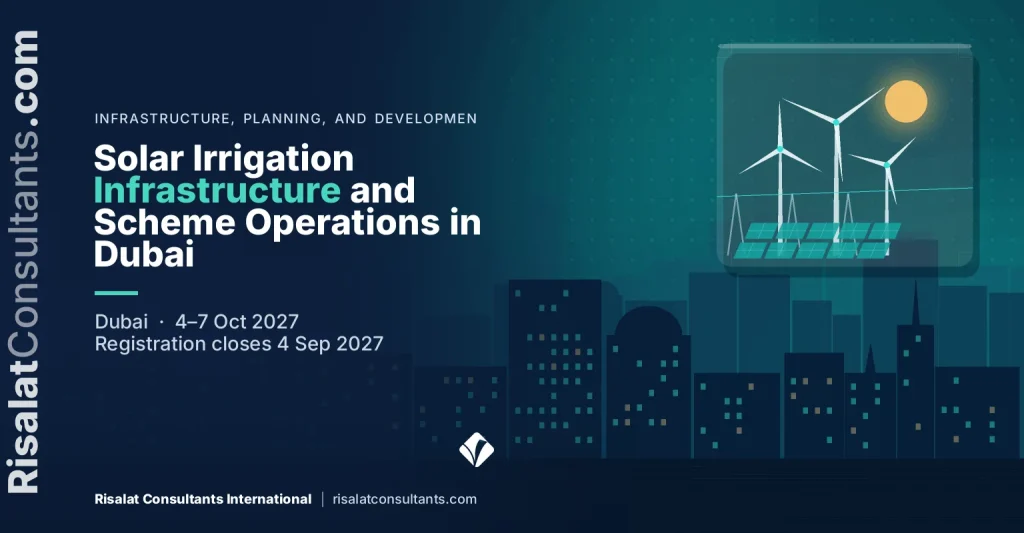
- 4–7 Oct 2027 (4 days)
- Where
- Dubai, United Arab Emirates
- Fee per participant
- £3,000 (GBP)
- Payment
- By invoice and bank transfer
- Registration closes
- 4 Sep 2027
- Certificate
- Certificate of completion
- In-house option
- Run it for your team, on your dates
On this page 14 sections
Programme Overview
Solar-powered irrigation offers a reliable, low-carbon pathway to secure agricultural production against erratic rainfall patterns. This four-day intensive programme equips technical professionals with the competencies required to design, procure, and manage community-scale solar irrigation schemes. Participants examine the intersection of solar photovoltaic engineering and hydraulic distribution networks. The curriculum addresses technical specifications, pumping configurations, sizing methodologies, and quality verification standards essential for public procurement frameworks and donor-funded agricultural water infrastructure initiatives.
Beyond civil and electromechanical works, the long-term operational success of decentralised irrigation infrastructure depends heavily on functional governance models. This course explores farmer-led management arrangements, participatory irrigation design, and sustainable water allocation practices. Practitioners review structural frameworks that align community incentives with asset protection. By linking physical design with field operational realities, the training ensures schemes avoid common failure points associated with unmanaged groundwater extraction, poor tariff collection, and neglected routine servicing.
Delivered in Dubai, a regional logistics and technology hub for renewable utility infrastructure, the course enables participants to formulate complete scheme management instruments. Delegates examine international electromechanical standards, preventive maintenance contracts, and water user association tariff models. Through practical exercises, attendees build actionable tools to balance financial cost recovery with equity in access, ensuring that rural irrigation assets remain viable, productive, and resilient long after construction and commissioning phases conclude.
Public agricultural authorities and development finance institutions are accelerating capital investments into climate-resilient water infrastructure across Sub-Saharan Africa and East Africa. Programmes such as the Irrigation for Climate Resilience Project (ICRP) illustrate the shift towards community-scale, off-grid irrigation assets capable of withstanding climate variability. However, technical shortcomings in pump sizing, inadequate groundwater monitoring, and fragile operation and maintenance frameworks regularly threaten asset longevity. Developing robust engineering specifications, reliable contracting mechanisms, and transparent water user association governance is immediately necessary to safeguard public capital investments and protect rural livelihoods.
Delivered by Risalat Consultants International in Dubai, United Arab Emirates, it combines expert-led sessions, real cases and group work, so that participants can apply what they learn in their own institution.
The Programme Strengthens Institutional Capability
- Solar resource assessment: Solar irradiance mapping, peak sun hours, and crop evapotranspiration calculations
- Electromechanical components: Deep-well submersibles, surface pumps, DC and AC motors, and inverter drive topologies
- International quality frameworks: Applying IEC 62253 standards for photovoltaic pumping system performance evaluation
- System sizing exercise: Matching total dynamic head and daily flow demands with photovoltaic array capacities
- Quality assurance in procurement: Verification checklists for factory acceptance testing and site commissioning
- Hydraulic network configuration: Pipe material selection, friction head loss calculations, and pressure management
- Balancing supply and demand: Sizing elevated storage reservoirs and buffer storage tanks for peak irrigation hours
- Field distribution options: Integrating solar supply with pressurized drip, micro-sprinkler, and gated pipe systems
- Infrastructure planning and prioritisation
- Project appraisal and business cases
- Financing options and public-private partnerships
- Procurement and contracting for works
It is designed for irrigation and drainage engineers from public water agencies, water catchment and basin technical officers, agricultural water resources managers from national ministries and others who want practical, current skills in infrastructure, urban development and partnerships.
The Growing Importance of Solar Irrigation Infrastructure and Scheme Operations in Dubai
- Solar resource assessment: Solar irradiance mapping, peak sun hours, and crop evapotranspiration calculations
- Electromechanical components: Deep-well submersibles, surface pumps, DC and AC motors, and inverter drive topologies
- International quality frameworks: Applying IEC 62253 standards for photovoltaic pumping system performance evaluation
- System sizing exercise: Matching total dynamic head and daily flow demands with photovoltaic array capacities
- Quality assurance in procurement: Verification checklists for factory acceptance testing and site commissioning
- Hydraulic network configuration: Pipe material selection, friction head loss calculations, and pressure management
- Balancing supply and demand: Sizing elevated storage reservoirs and buffer storage tanks for peak irrigation hours
- Field distribution options: Integrating solar supply with pressurized drip, micro-sprinkler, and gated pipe systems
- Groundwater protection: Integrating sensors for dry-run protection, dynamic water level sensors, and flow meters
- Civil and mechanical design clinic: Layout drawing reviews and standard bill of quantities formulation
- Farmer-led governance models: Lessons from decentralised scheme management and legal registration of user groups
- Drafting Water User Association constitutions: Defining user rights, voting rights, and transparent dispute resolution
- Irrigation scheduling and rationing: Managing water turns during peak dry seasons and equitable distribution across tail-enders
- Gender-sensitive and inclusive access: Designing operational rules that safeguard vulnerable smallholder farmers
- Environmental catchment stewardship: Establishing community-level ground monitoring and recharge protection rules
- Cost recovery economics: Computing capital depreciation, operational costs, minor repairs, and major overhaul reserves
- Tariff design models: Structuring volumetric, area-based, and seasonal payment models for smallholder communities
- Drafting service-level agreements: Structuring post-commissioning maintenance contracts with private technology vendors
- Scheme asset management registries: Routine preventive maintenance schedules, tooling, and local spare parts inventory
- Action planning: Formulation of project-specific institutional and technical schemes of work
Infrastructure and urban services shape growth, health and opportunity. Projects are large, complex and long-lived, and weaknesses in planning, financing or delivery are costly to fix later.
Governments increasingly combine public investment, partnerships with the private sector and new technologies. Teams who can plan, appraise, procure and manage these investments deliver better assets and services.
Organisations increasingly require professionals capable of:
- Plan and prioritise infrastructure investments
- Appraise projects and prepare business cases
- Choose financing and delivery models
- Supervise works for time, cost and quality
- Manage assets over their life
Strong infrastructure, urban development and partnerships systems help organisations:
- Select the right investments
- Deliver projects on time and on budget
- Attract financing and partners
- Keep assets working for longer
This Solar Irrigation Infrastructure and Scheme Operations in Dubai programme brings these elements together in a practical format, so that participants understand not only what good practice looks like but also how to introduce it in their own setting, with the people and resources they have.
Who Should Attend This Solar Irrigation Infrastructure and Scheme Operations in Dubai Training?
This programme is designed for:
- Irrigation and drainage engineers from public water agencies
- Water catchment and basin technical officers
- Agricultural water resources managers from national ministries
- Project management unit engineering staff working on donor-funded infrastructure
- Scheme operations and maintenance coordinators
- District agricultural engineers supervising rural civil works
- Technical advisers supporting smallholder water user organisations
- Hydrological monitoring officers responsible for agricultural catchments
- Public procurement specialists handling electromechanical irrigation tenders
- Infrastructure and urban planners
- Engineers and technical managers
- Project and programme managers
The programme suits experienced professionals as well as those moving into new responsibilities. Groups that mix institutions and countries are encouraged, because participants learn a great deal from each other’s experience.
Tick what your team needs to be able to do.
Solar Irrigation Infrastructure and Scheme Operations in Dubai Training Objectives
Upon successful completion of this Solar Irrigation Infrastructure and Scheme Operations in Dubai Training, participants will be able to:
- Appraise solar photovoltaic pumping configurations against diverse crop water requirements and local hydrological profiles
- Formulate robust technical specifications for PV modules, surface pumps, submersible pumps, and variable speed controllers
- Design hydraulic distribution networks that integrate community-scale storage, pressure regulation, and field delivery outlets
- Establish preventive maintenance agreements that clearly define supplier warranties, local service-level contracts, and spare parts supply lines
- Structure farmer-led governance mechanisms and water user association constitutions for equitable operational management
- Develop volumetric and flat-rate water tariff frameworks that secure scheme operational cost recovery without excluding smallholders
- Incorporate environmental safeguard protocols and groundwater monitoring measures to mitigate excessive resource depletion
- Explain how infrastructure is planned and prioritised
- Appraise projects and prepare a business case
- Compare financing and delivery models, including partnerships
Each objective is practised during the programme through exercises, cases or group work, so that participants leave able to do it, not only to describe it.
Programme Contents and Structure
The programme runs over 4 days. Each day combines expert input, practical work and a closing workshop or case study:
- First Day: Day 1: Solar PV Pumping Technology, Resource Sizing, and Quality Standards
- Second Day: Day 2: Hydraulic Infrastructure Design, Water Storage, and Reticulation
- Third Day: Day 3: Institutional Governance, Water User Associations, and Local Management
- Fourth Day: Day 4: Tariff Setting, Preventative Maintenance, and Asset Life-Cycle Management
Full day-by-day contents
First Day | Day 1: Solar PV Pumping Technology, Resource Sizing, and Quality Standards
- Solar resource assessment: Solar irradiance mapping, peak sun hours, and crop evapotranspiration calculations
- Electromechanical components: Deep-well submersibles, surface pumps, DC and AC motors, and inverter drive topologies
- International quality frameworks: Applying IEC 62253 standards for photovoltaic pumping system performance evaluation
- System sizing exercise: Matching total dynamic head and daily flow demands with photovoltaic array capacities
- Quality assurance in procurement: Verification checklists for factory acceptance testing and site commissioning
Workshop: Day 1: Solar PV Pumping Technology, Resource Sizing, and Quality Standards: Applying It to Your Institution
Working in small groups, participants apply the day's methods to examples from their own institutions and agree practical next steps.
Second Day | Day 2: Hydraulic Infrastructure Design, Water Storage, and Reticulation
- Hydraulic network configuration: Pipe material selection, friction head loss calculations, and pressure management
- Balancing supply and demand: Sizing elevated storage reservoirs and buffer storage tanks for peak irrigation hours
- Field distribution options: Integrating solar supply with pressurized drip, micro-sprinkler, and gated pipe systems
- Groundwater protection: Integrating sensors for dry-run protection, dynamic water level sensors, and flow meters
- Civil and mechanical design clinic: Layout drawing reviews and standard bill of quantities formulation
Workshop: Day 2: Hydraulic Infrastructure Design, Water Storage, and Reticulation: Applying It to Your Institution
Working in small groups, participants apply the day's methods to examples from their own institutions and agree practical next steps.
Third Day | Day 3: Institutional Governance, Water User Associations, and Local Management
- Farmer-led governance models: Lessons from decentralised scheme management and legal registration of user groups
- Drafting Water User Association constitutions: Defining user rights, voting rights, and transparent dispute resolution
- Irrigation scheduling and rationing: Managing water turns during peak dry seasons and equitable distribution across tail-enders
- Gender-sensitive and inclusive access: Designing operational rules that safeguard vulnerable smallholder farmers
- Environmental catchment stewardship: Establishing community-level ground monitoring and recharge protection rules
Case Study: Day 3: Institutional Governance, Water User Associations, and Local Management in Practice
Participants analyse a realistic case, compare the choices made with good practice and draw lessons they can use in their own setting.
Fourth Day | Day 4: Tariff Setting, Preventative Maintenance, and Asset Life-Cycle Management
- Cost recovery economics: Computing capital depreciation, operational costs, minor repairs, and major overhaul reserves
- Tariff design models: Structuring volumetric, area-based, and seasonal payment models for smallholder communities
- Drafting service-level agreements: Structuring post-commissioning maintenance contracts with private technology vendors
- Scheme asset management registries: Routine preventive maintenance schedules, tooling, and local spare parts inventory
- Action planning: Formulation of project-specific institutional and technical schemes of work
Capstone Exercise: Solar Irrigation Infrastructure and Scheme Operations in Dubai Action Plan for Your Institution
Participants bring the week together in an action plan for their own institution, with priorities, owners and first steps, and present it for feedback from peers and facilitators.
Solar Irrigation Infrastructure and Scheme Operations in Dubai Training Methodology
The training employs an applied professional format blending technical lectures, engineering design problem-solving, and institutional case simulations. Participants utilise international engineering guidelines and project documentation from donor-financed operations to analyse real design files, equipment data sheets, and water governance charters. Facilitated working sessions challenge delegates to compute hydraulic loads, formulate procurement specifications, and draft operational agreements in peer groups, followed by constructive technical review.
The programme combines:
- Expert-led sessions on current practice
- Regional and international case studies
- Group work and practical exercises
- Simulations and role plays where relevant
- Discussion of participants' own challenges
- Peer learning across institutions and countries
- Practical tools and templates to take back to work
- Daily reflection and action planning
Before the programme, a short pre-assessment helps the facilitators understand each participant’s role and priorities, so that examples and exercises can be adjusted to the group. Each day ends with a short reflection in which participants note what they will apply at work.
Expected Outcomes
Upon completion of this Solar Irrigation Infrastructure and Scheme Operations in Dubai Training, participants will be able to:
- Produce verified engineering specifications for solar irrigation arrays and pump assemblies aligned with international standards
- Calculate hydraulic head losses and storage capacities for communal off-grid agricultural distribution networks
- Draft formal service-level agreements and preventive maintenance schedules with electromechanical vendors
- Formulate viable Water User Association operational guidelines, water distribution rules, and dispute processes
- Design financial cash-flow models and community tariff systems to cover routine maintenance and component replacement
- Implement sustainable water resource monitoring protocols to protect aquifer yields under solar abstraction
- Plan and prioritise infrastructure investments
- Appraise projects and prepare business cases
Participants leave with a personal action plan and practical tools they can use in their institution from the first week back. Institutions that send several participants can use the programme to agree shared methods and templates across teams, which makes improvements easier to sustain.
£3,000 per participant · invoice and bank transfer · groups of 5 or more receive a discount
Five or more from one organisation: ask for the group rate on the invoice request.
Ten or more: an in-house version for your institution may cost less per person. Ask for an in-house quote.
Registration closes in 300 days (4 Sep 2027)
Institutional Application of Solar Irrigation Infrastructure and Scheme Operations in Dubai Training
This programme supports organisations in strengthening:
- Investment planning
- Project appraisal
- Partnership management
- Works supervision
- Asset management
Participants return with practical tools to improve:
- Business cases
- Risk allocation
- Contract management
- Maintenance planning
- Service monitoring
The programme is built so that learning moves from the classroom into the institution. Participants work on their own processes and documents where possible, and leave with an action plan that their managers can review and support.
Regional Relevance & Application
Europe
European institutions apply infrastructure, urban development and partnerships within detailed regulatory frameworks and reform agendas. Participants from Europe can compare their practice with colleagues from other regions and test how established methods work under different conditions.
Africa
Across Africa, ministries, agencies and project teams working in infrastructure, urban development and partnerships increasingly operate alongside donor-financed programmes that expect clear systems and evidence. The programme helps participants adapt good practice to the institutions and resources they work with.
Middle East
In the Middle East, national development strategies and diversification plans place growing demands on infrastructure, urban development and partnerships. Participants explore how to build the capability these plans need inside public bodies and companies.
Asia
Institutions across Asia combine rapid growth with ambitious modernisation programmes. Participants from Asia can share their experience of scaling systems quickly and learn from approaches used elsewhere.
Pacific
Small island and Pacific states face particular constraints of size, distance and capacity. The programme highlights practical, proportionate approaches to infrastructure, urban development and partnerships that suit smaller institutions.
Holding the programme in Dubai, United Arab Emirates brings participants together away from their daily pressures, so they can compare how infrastructure, urban development and partnerships is handled in different settings. The same programme can also be delivered in-house for one institution, in its own country or online, with cases taken from its current work.
Host Country Profile – United Arab Emirates
Programmes, Workshops, Exposures, Training Courses in Dubai, UAE by Risalat Consultants International
Studying away from their own country gives participants time to focus, a fresh view of their own institution and the chance to build a network with colleagues from other countries.
Solar Irrigation Infrastructure and Scheme Operations in Dubai Training Deliverables
Participants receive support before, during and after the programme, so that preparation, learning and follow-up form one continuous experience.
Before the Programme
- Participant Pre-Assessment
- Solar Irrigation Infrastructure and Scheme Operations in Dubai Readiness Assessment
- Solar Irrigation Infrastructure and Scheme Operations in Dubai Resource Pack
- Preparatory Reading Materials
- Complimentary Visa Support & Advisory
During the Programme
- Airport Pickup & Welcome Assistance
- Accommodation with Breakfast
- Welcome Networking Dinner
- Risalat Training Kit (Bag, Bottle, Mug, T-Shirt, Cap, Passport Cover, Pens, Notebook, Magnet & Keychain)
- Comprehensive Solar Irrigation Infrastructure and Scheme Operations in Dubai Training Manual
- Project Appraisal Template
- PPP Risk Allocation Matrix
- Works Supervision Checklist
- Asset Management Plan Template
- Practical Workshops & Simulations
- Group Discussions & Peer Learning
- Daily Lunch and Refreshments
- Full Access to Training Venue Facilities
- Mini Pad / Tablet with Digital Learning Materials
- Field Visit (where applicable)
- Entertaining City Tour
After the Programme
- Certificate of Completion
- Risalat Programme Participation Recognition Award
- Post-Training Reference Materials
- Business Case Review Checklist
- Maintenance Planning Template
- Post-Training Support & Follow-Up Guidance
- Programme Report
Institutions can also request a tailored in-house version of this programme, delivered at their premises or online. Request a proposal.
Common Challenges in Solar Irrigation Infrastructure and Scheme Operations in Dubai, And How This Training Helps
How can institutions plan and prioritise infrastructure investments?
The programme addresses this directly on the first day (Day 1: Solar PV Pumping Technology, Resource Sizing, and Quality Standards), where participants practise the methods involved and adapt them to their own institution, then build it into their action plan.
How can institutions appraise projects and prepare business cases?
The programme addresses this directly on the second day (Day 2: Hydraulic Infrastructure Design, Water Storage, and Reticulation), where participants practise the methods involved and adapt them to their own institution, then build it into their action plan.
How can institutions choose financing and delivery models?
The programme addresses this directly on the third day (Day 3: Institutional Governance, Water User Associations, and Local Management), where participants practise the methods involved and adapt them to their own institution, then build it into their action plan.
How can institutions supervise works for time, cost and quality?
The programme addresses this directly on the fourth day (Day 4: Tariff Setting, Preventative Maintenance, and Asset Life-Cycle Management), where participants practise the methods involved and adapt them to their own institution, then build it into their action plan.
How can institutions manage assets over their life?
The programme addresses this directly on the first day (Day 1: Solar PV Pumping Technology, Resource Sizing, and Quality Standards), where participants practise the methods involved and adapt them to their own institution, then build it into their action plan.
Frequently Asked Questions
When and where does the Solar Irrigation Infrastructure and Scheme Operations in Dubai programme take place?
It runs from 4 Oct 2027 to 7 Oct 2027, in Dubai, United Arab Emirates. The registration deadline is shown at the top of this page.
Who should attend?
The programme is designed for irrigation and drainage engineers from public water agencies, water catchment and basin technical officers, agricultural water resources managers from national ministries, project management unit engineering staff working on donor-funded infrastructure, and others who want practical skills in infrastructure, urban development and partnerships.
Will I receive a certificate?
Yes. Participants who complete the programme receive a Certificate of Completion from Risalat Consultants International.
Can this programme be delivered for our institution only?
Yes. We can deliver a tailored in-house version at your premises, in another city or online, built around your own cases. Use the proposal request on this page.
Do I need prior experience in infrastructure, urban development and partnerships?
No specialist background is required beyond experience in a related role. A short pre-assessment helps the facilitators adapt the sessions to the group.
Training courses in DubaiInfrastructure, Planning, and Development training courses
Why Dubai for this programme
Dubai is a one-flight hub for Africa, Asia and Europe, with simple visas for many nationalities and modern training venues.
The Solar Irrigation Infrastructure and Scheme Operations in Dubai programme in October 2027 brings together officials and professionals from across the Middle East region and beyond. Sessions combine short inputs, case studies and group work on participants' own files, and the city's institutions can be added as a study visit on request.
Getting there: Dubai International (DXB).
Check whether you need a visa with the free Visa Checker, and ask for an invitation letter once you are registered.
The same topic in other cities
- Farmer-Led Smallholder Irrigation Planning and Water Scheme Operations in Kigali (Kigali)
- Climate-Smart Tank Cascade Rehabilitation and Micro-Irrigation in Dubai (Dubai)
- Irrigation Modernisation and Dam Safety Oversight in Tbilisi (Tbilisi)
- Modern Irrigation Automation and Water Users Management in Tbilisi (Tbilisi)
Other programmes in Dubai
- Logistics Park Planning, Multimodal Freight & Corridor Operations in Dubai
- Macro-Fiscal Policy Planning and Counter-Cyclical Buffer Design in Dubai
- Deep-Water Port Modernisation, Berthing and Intermodal Logistics in Dubai
- Bus Rapid Transit Operations, Fleet Management and ITS Integration in Dubai
- Industrial Park Management and Private Investment Catalysis in Dubai
Related: Climate finance and energy programmes · free Climate Finance Proposal Readiness · all programmes
- Procurement Framework and Regulations for Projects World Bank
- MAPS: Methodology for Assessing Procurement Systems MAPS Initiative
- Open Contracting Partnership Open Contracting Partnership
More training courses in United Arab Emirates · All programmes in Middle East · Full training calendar
Plan this programme in a roadmap: why it matters, why to approve it, the dates to plan and the career it builds.