Key facts
- Dates
- 11–14 Oct 2027 (4 days)
- Where
- Istanbul, Türkiye
- Fee per participant
- £3,830 (GBP)
- Payment
- By invoice and bank transfer
- Registration closes
- 1 Sep 2027
- Format
- 4-day short course: a practical capacity-building programme for government, NGO and project teams in Istanbul
- Groups
- Teams of 3 or more qualify for a group discount, offered case by case: ask for a group quote.
- In-house option
- Run it for your team, on your dates
On this page 10 sections
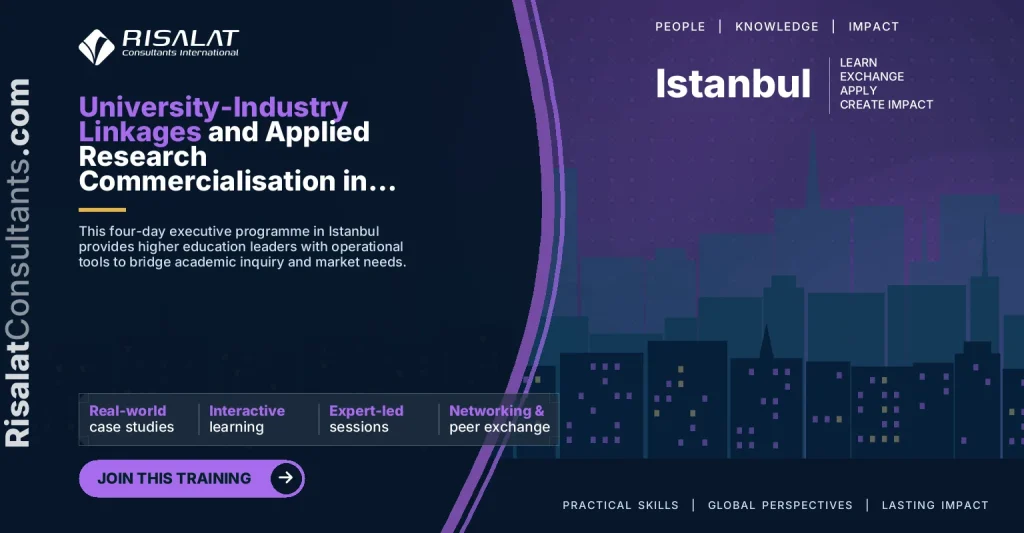
University-Industry Linkages and Applied Research Commercialisation in Istanbul
Programme Overview
This executive programme in Istanbul provides higher education leaders with operational tools to bridge academic inquiry and market needs. Participants examine practical approaches to establish technology transfer offices, negotiate collaborative agreements, and commercialise indigenous research assets. Using regional benchmarks from Turkey’s established technoparks, the course addresses structural impediments that often isolate tertiary institutions from economic development priorities. Delegates evaluate international standards for contract research and laboratory operations to align institutional outputs with regional industrial demand.
The curriculum addresses the requirements of intellectual property governance, spin-off incubation, and private-sector co-investment. Attendees examine mechanisms to balance traditional academic missions with revenue-generating applied research. The modules cover the lifecycle of commercialisation, including invention disclosures, patent valuation, and licensing negotiations. Sessions examine industry advisory boards, workplace-based learning schemes, and public-private consortia, assisting tertiary leaders to build innovation ecosystems that retain talent and attract international donor financing.
Delivered by Risalat Consultants International in Istanbul, Turkey, the programme combines expert-led sessions, real cases, and group work to equip delegations to operationalise university-industry liaison units. Participants review institutional audit systems and quality frameworks that ensure compliance with donor fiduciary standards. Under initiatives like the Higher Education for Economic Transformation Project, institutions examine methods to modernise curricula, upgrade engineering and agricultural laboratories, meet disbursement-linked indicators, and deploy collaborative research grants that support national industrialisation agendas.
The programme strengthens institutional capability in:
- Models of university-industry linkages: Comparative analysis of Turkey technoparks and global systems
- Establishing the Technology Transfer Office (TTO): Mandate, operational structure, and key performance indicators
- National policy alignment: Mapping institutional research agendas to national economic transformation priorities
- Internal university governance: Managing academic incentives, promotion criteria, and consulting policies
- Fiduciary and regulatory compliance under multilateral development bank tertiary education projects
- WIPO-compliant institutional IP policy development: Ownership, patenting procedures, and third-party rights
- Invention disclosure, commercial viability screening, and early-stage technology valuation methodologies
- Licensing negotiations, royalty distribution matrices, and contract research execution
- Service planning and management
- Quality improvement and standards
- Human resources and workforce planning
- Financing and budgeting for services
Why this matters now
Organisations increasingly require professionals capable of:
- Plan and manage services to meet demand
- Improve quality against standards
- Manage staff and resources effectively
- Use data to guide decisions
- Work with communities and partners
Strong health, education and social services systems help organisations:
- Deliver better services to more people
- Use budgets and staff efficiently
- Meet quality standards
- Show results to government and partners
Who Should Attend
This programme is designed for:
- Higher education directors and commissioners from ministries of education
- University deputy vice-chancellors for research, innovation, and academic affairs
- Directors and managers of university technology transfer offices
- Industrial attachment, internship, and career services coordinators
- Managers of university-based business incubators and science parks
- Heads of academic departments in priority engineering, science, and agriculture disciplines
- Directors of central research laboratories and specialised testing facilities
- Project coordinators managing donor-funded tertiary education reforms
- Intellectual property officers and legal counsels serving tertiary institutions
- Service managers and administrators
- Directors and senior officials
- Planning and policy officers
Tick what your team needs to be able to do.
Programme Objectives
By the end of this programme participants will be able to:
- Design institutional governance frameworks and standard operating procedures for technology transfer offices
- Formulate intellectual property management policies covering invention disclosures, valuation, and revenue distribution
- Structure university-industry collaborative research contracts and non-disclosure agreements aligned with global legal practices
- Establish university business incubators, accelerators, and spin-off support mechanisms for academic researchers
- Align tertiary curricula and engineering syllabi with labour market requirements in national priority sectors
- Upgrade research laboratory management systems to comply with ISO/IEC 17025 standards for commercial testing services
- Implement structured student industrial attachment systems and industry advisory boards to enhance graduate employability
- Explain the main challenges facing their sector
- Plan services that match demand and resources
- Apply quality improvement methods
Training Structure & Contents
- Models of university-industry linkages: Comparative analysis of Turkey technoparks and global systems
- Establishing the Technology Transfer Office (TTO): Mandate, operational structure, and key performance indicators
- National policy alignment: Mapping institutional research agendas to national economic transformation priorities
- Internal university governance: Managing academic incentives, promotion criteria, and consulting policies
- Fiduciary and regulatory compliance under multilateral development bank tertiary education projects
- Workshop: Applying institutional governance and technology transfer office architecture to your institution
- WIPO-compliant institutional IP policy development: Ownership, patenting procedures, and third-party rights
- Invention disclosure, commercial viability screening, and early-stage technology valuation methodologies
- Licensing negotiations, royalty distribution matrices, and contract research execution
- Designing university business incubators, accelerators, and seed-funding mechanisms for student and faculty spin-offs
- Mitigating conflict of interest and managing commercial risks in university-owned enterprises
- Workshop: Applying intellectual property management, commercialisation, and incubation to your institution
- Transforming academic laboratories into commercial service hubs: Demand forecasting and cost-recovery pricing
- Implementation of ISO/IEC 17025 requirements for laboratory competence, calibration, and third-party testing
- Procurement, maintenance strategies, and life-cycle asset management for high-value research instrumentation
- Establishing quality assurance protocols and bio-risk management systems in higher education research units
- Designing fee-for-service testing menus to serve agriculture, manufacturing, and extractive industries
- Case Study: Laboratory commercialisation, testing services, and quality standards in practice
- Curriculum co-design frameworks: Institutionalising private-sector participation via Industry Advisory Boards
- Standardising student industrial attachment schemes: Monitoring, tripartite agreements, and assessment protocols
- Structuring collaborative applied research grants, matching funds, and dual-use facility agreements
- Monitoring and evaluation frameworks for research commercialisation and graduate absorption rates
- Action planning: Drafting institutional roadmaps for technology transfer and industry partnership units
- Capstone Exercise: Action plan preparation and peer review for your institution
- Consolidation of technology transfer governance frameworks and regulatory alignment
- Integration of multi-stakeholder feedback into institutional commercialisation strategies
- Refining intellectual property management protocols and valuation frameworks
- Finalising operational procedures for laboratory testing and commercial services
- Establishing long-term monitoring metrics for industry advisory boards and attachments
- Presentation and facilitator review of comprehensive institutional roadmaps
Full day-by-day contents
First Day | Institutional Governance and Technology Transfer Office Architecture
- Models of university-industry linkages: Comparative analysis of Turkey technoparks and global systems
- Establishing the Technology Transfer Office (TTO): Mandate, operational structure, and key performance indicators
- National policy alignment: Mapping institutional research agendas to national economic transformation priorities
- Internal university governance: Managing academic incentives, promotion criteria, and consulting policies
- Fiduciary and regulatory compliance under multilateral development bank tertiary education projects
- Workshop: Applying institutional governance and technology transfer office architecture to your institution
Second Day | Intellectual Property Management, Commercialisation, and Incubation
- WIPO-compliant institutional IP policy development: Ownership, patenting procedures, and third-party rights
- Invention disclosure, commercial viability screening, and early-stage technology valuation methodologies
- Licensing negotiations, royalty distribution matrices, and contract research execution
- Designing university business incubators, accelerators, and seed-funding mechanisms for student and faculty spin-offs
- Mitigating conflict of interest and managing commercial risks in university-owned enterprises
- Workshop: Applying intellectual property management, commercialisation, and incubation to your institution
Third Day | Laboratory Commercialisation, Testing Services, and Quality Standards
- Transforming academic laboratories into commercial service hubs: Demand forecasting and cost-recovery pricing
- Implementation of ISO/IEC 17025 requirements for laboratory competence, calibration, and third-party testing
- Procurement, maintenance strategies, and life-cycle asset management for high-value research instrumentation
- Establishing quality assurance protocols and bio-risk management systems in higher education research units
- Designing fee-for-service testing menus to serve agriculture, manufacturing, and extractive industries
- Case Study: Laboratory commercialisation, testing services, and quality standards in practice
Fourth Day | Industry-Aligned Curricula, Industrial Attachments, and Public-Private Consortia
- Curriculum co-design frameworks: Institutionalising private-sector participation via Industry Advisory Boards
- Standardising student industrial attachment schemes: Monitoring, tripartite agreements, and assessment protocols
- Structuring collaborative applied research grants, matching funds, and dual-use facility agreements
- Monitoring and evaluation frameworks for research commercialisation and graduate absorption rates
- Action planning: Drafting institutional roadmaps for technology transfer and industry partnership units
- Capstone Exercise: Action plan preparation and peer review for your institution
Fifth Day | Strategic Implementation and Institutional Roadmap Integration
- Consolidation of technology transfer governance frameworks and regulatory alignment
- Integration of multi-stakeholder feedback into institutional commercialisation strategies
- Refining intellectual property management protocols and valuation frameworks
- Finalising operational procedures for laboratory testing and commercial services
- Establishing long-term monitoring metrics for industry advisory boards and attachments
- Presentation and facilitator review of comprehensive institutional roadmaps
Training Methodology
The programme combines expert-led sessions, real cases, and practical group work so participants can operationalise the concepts in their home institutions. Practical exercises, diagnostic cases, and interactive reviews are used throughout each module.
- Interactive presentations and expert input
- Small-group practical exercises and institutional application workshops
- Analysis of real-world case studies against international benchmarks
- Development and peer review of an institutional action plan
- Inputs
- Activities
- Outputs
- Outcomes
- Impact
Expected Outcomes
- Established operational frameworks and standard procedures for technology transfer units
- Functional intellectual property policies covering invention disclosure, valuation, and licensing
- Standardised structures for contract research, non-disclosure agreements, and commercial partnerships
- Operational guidelines for business incubators, accelerators, and spin-off ventures
- Updated curricula and syllabi aligned with labour market requirements
- Laboratory management procedures meeting ISO/IEC 17025 testing requirements
- Documented student attachment programmes and active industry advisory boards
- Completed institutional roadmaps ready for execution in home organisations
£3,830 per participant · invoice and bank transfer · groups of 5 or more receive a discount
Five or more from one organisation: ask for the group rate on the invoice request.
Ten or more: an in-house version for your institution may cost less per person. Ask for an in-house quote.
Registration closes in 276 days (1 Sep 2027)
Who Will Deliver This Programme
Each date is delivered by a team assigned from Risalat's expert network for this subject. For this programme we assign:
How we choose them: Experience in the region of the participants or comparable settings; Command of the financier rules that apply (World Bank, ADB, AfDB, EU, UN) where relevant; Delivery in English; other languages on request for in-house groups; No conflict of interest with participants' institutions.
Training courses in IstanbulEducation training courses
Why Istanbul for this programme
Istanbul sits between Europe and Asia, with direct flights from most capitals and easy visas for many delegations.
The University-Industry Linkages and Applied Research Commercialisation in Istanbul programme in October 2027 brings together officials and professionals from across the Europe and Asia region and beyond. Sessions combine short inputs, case studies and group work on participants' own files, and the city's institutions can be added as a study visit on request.
Getting there: Istanbul Airport (IST).
Check whether you need a visa with the free Visa Checker, and ask for an invitation letter once you are registered.
The same topic in other cities
Other programmes in Istanbul
- Mini Degree in Environmental and Social Safeguards in Istanbul
- Risk-Based Internal Audit in the Public Sector in Istanbul
- AI for Public Procurement and Contract Management Training in Istanbul
- Seed Sector Modernisation and Climate-Smart Seed Certification in Istanbul
- Credit Guarantee Scheme Administration and MSME Risk Underwriting in Istanbul
Questions before you nominate your team? Book a 30-minute call with us, or ask for this programme in-house.
Teams often travel here from Pakistan, Mongolia, Kazakhstan, Uzbekistan, Kyrgyzstan, Tajikistan, Turkmenistan, Azerbaijan. Funding, visa letters and group rates are explained on each country page.
Is there education and skills training for government officials in Istanbul in October 2027?
Can "University-Industry Linkages and Applied Research Commercialisation in Istanbul" be delivered in-house for one organisation?
Which other education and skills programmes does Risalat run?
How do organisations register and pay?
For teams and institutions
Bring your team
Teams that learn together apply more at work. Tell us how many people and how you would like to take part: we reply with a group quote within two working days.
Watch: this programme in short

More training courses in Türkiye · All programmes in Europe · Full training calendar
Plan this programme in a roadmap: why it matters, why to approve it, the dates to plan and the career it builds.