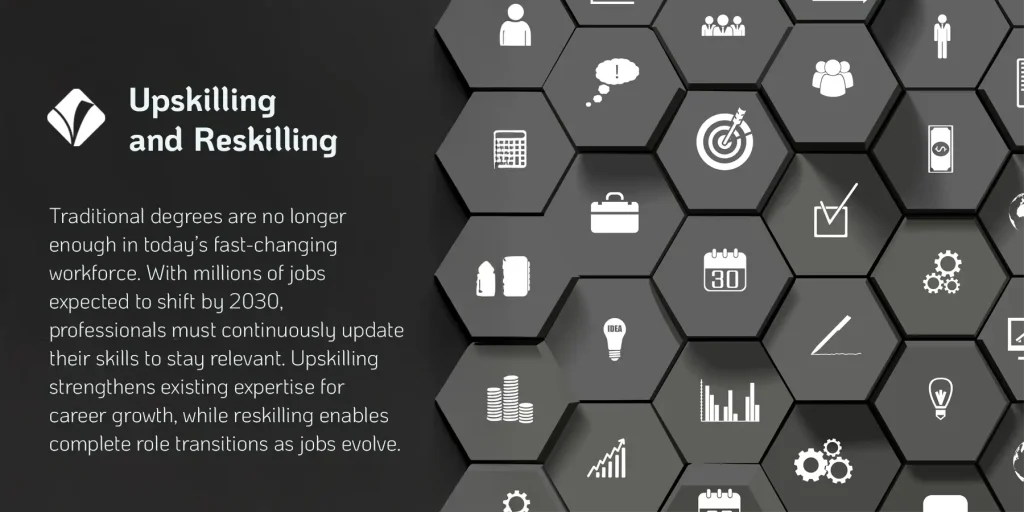
In short: How is upskilling different from traditional education or retraining? Clear definitions, WEF and OECD evidence, and a practical plan for public agencies.
要点总结
Upskilling, reskilling, retraining and traditional education solve different problems, and organisations that confuse them often spend training budgets without changing results.
- Upskilling. builds new skills for the job a person already does.
- Reskilling and retraining. prepare a person for a different role or occupation.
- Traditional education. gives broad knowledge and a recognised qualification, usually over years.
- 技能变化迅速。根据世界经济论坛的数据,雇主预计在2025年至2030年期间,39%的员工技能组合将发生转型或过时。
- Access is unequal. adults with higher education take part in learning far more often than those with less, so employers must plan who is trained.
引言
How is upskilling different from traditional education or retraining? Upskilling adds or updates skills for the job a person already holds, so they can do it better or with new tools. Traditional education builds broad knowledge and leads to a qualification, usually over several years. Retraining, which is one form of reskilling, prepares a person to move into a different job when their current role changes or disappears.
The distinction matters because each option has a different cost, timeframe and result. A ministry that needs its procurement officers to work on a new electronic system needs upskilling, not a new degree. A unit whose paper-based jobs are disappearing needs reskilling for new roles. And a young professional preparing for a career may need formal education first. This guide explains the differences, the latest evidence and how public agencies and project teams can plan skills that change results.
Upskilling, Reskilling, Retraining and Education Compared
| Approach | 目的 | 常规时长 | Typical result |
|---|---|---|---|
| Upskilling | Better performance in the current role | 数天至数月 | New skills used at work, often with a certificate of completion |
| Reskilling | 转至同一机构或部门内的不同岗位 | Weeks to months | Ability to perform a new role |
| Retraining | Move to a new occupation, often after job loss or major change | Months | Entry into a different occupation |
| 传统教育 | Broad knowledge and a formal qualification | Years | 文凭或学位 |
| Professional certification | Proof of competence against an external standard | Weeks to months of preparation | Certificate from an awarding body after an exam |
Upskilling
Upskilling is about doing the current job better. Examples include an accountant learning new reporting standards, a procurement officer learning a new e-procurement system or a manager learning to use data in decisions. It is usually short, practical and tied to tasks the person performs every week.
Reskilling and retraining
Reskilling prepares a person for a different role. Inside an organisation, it might move a records clerk into a data quality role when files become digital. Retraining usually refers to a larger change, such as moving into a new occupation, and often takes longer.
传统教育
学位和文凭奠定了广阔的基础、理论以及雇主认可的资格。它们依然很有价值,但更新速度慢,并非旨在解决下个月的具体工作场所问题。
Why the Difference Matters Now
The World Economic Forum’s Future of Jobs Report 2025 found that employers expect two-fifths, 39 percent, of workers’ existing skill sets to be transformed or become outdated over the 2025 to 2030 period. The same report notes progress: 50 percent of workers had completed training as part of long-term learning strategies, up from 41 percent in the 2023 edition.
When skills change this quickly, waiting for people to gain new qualifications is too slow. Organisations need a mix: short upskilling for current roles, reskilling for roles that are changing, and education for longer-term foundations.
Who Gets Trained, and Who Is Left Out
The OECD Skills Outlook 2025 shows that adult learning is unequal. Around 61 percent of tertiary-educated adults take part in adult learning opportunities, compared with only 19 percent of those without an upper secondary qualification. In practice, the staff who would gain most from upskilling are often the least likely to receive it.
对于雇主而言,这意味着培训应该是有计划的,而不是留给任何志愿参加的人。培训需求评估、明确的选择参与者标准以及对正规教育较少的员工的支持都有助于缩小差距。
When to Choose Upskilling Instead of Another Degree
Upskilling is usually the better choice when:
- The job stays the same but the tools, rules or systems change
- The organisation needs results within months, not years
- The skill can be practised on real work during or after the training
- The person already has the foundation knowledge from earlier education
A degree is the better choice when the person needs a broad foundation they do not yet have, when a qualification is required for a role, or when the goal is a long-term career change.
A Public Sector Example: Moving Procurement Online
Bangladesh made electronic government procurement mandatory for all public procurement. Agencies facing a change like this need all three approaches at once:
- 技能提升:采购官员学习根据新规则在电子政府采购系统上计划、发布和评估投标。
- Reskilling: staff whose paper-handling tasks disappear move into roles such as system support, data quality or contract monitoring.
- Education: a smaller number of staff pursue longer procurement or management qualifications for future leadership roles.
Treating everything as one training course would waste money and leave gaps. Planning each group separately gives each person what they need.
How to Plan Upskilling and Reskilling in Your Organisation
- 从工作出发。列出未来一至三年内预期在规则、系统和服务方面发生的变化。
- Assess current skills. Use a training needs assessment to see who needs upskilling, who needs reskilling and who needs neither.
- Choose the right format. Short practical programmes for upskilling, longer pathways with on-the-job practice for reskilling.
- Select participants fairly. Include staff who are usually left out, not only those who ask.
- Apply learning immediately. Agree a work task for each participant to complete within weeks of the training.
- 衡量结果。在60至90天后检查绩效,而不仅仅关注出勤率和证书。
Can Short Programmes Change Performance?
Short programmes change performance when they are linked to real tasks, when participants practise on their own work and when managers expect and support application afterwards. They rarely change performance when they are chosen from a catalogue without a clear need, attended by people who will not use the skill, or not followed up. The design around the training matters as much as the training itself.
公共部门常见的技能提升形式
Upskilling does not have to mean a classroom course. The right format depends on the skill, the number of people and how quickly the change is needed.
| 形式 | 最适合 | Watch out for |
|---|---|---|
| Short face-to-face programme | New rules, systems or methods that need practice and discussion | No follow-up after participants return |
| 教练辅导 and mentoring | Managers and specialists applying new skills on real work | Coaches without time or authority |
| E-learning modules | Basic knowledge for large numbers of staff | 完成率低且实践较少 |
| On-the-job assignments | 将知识转化为常规实践 | No one checks the quality of the work |
| Exposure and study visits | Seeing a working system in another country or agency | Visits that are not linked to a change plan at home |
| Professional certification | Proving competence against an external standard | Exam preparation that does not match daily tasks |
Most effective plans combine two or three formats: for example, a short programme to learn a new procurement system, followed by on-the-job assignments and coaching for the first live tenders.
Building a Skills Plan for a Financed Project
Many projects financed by development partners include money for capacity building, but the training is often planned late and chosen from catalogues. A simple skills plan prepared early avoids this.
- 列出项目的新任务。新系统、新程序、新报告职责以及保障措施都会产生新的技能需求。
- 明确每个任务的负责人。项目员工、部委对口人员、地方政府官员或承包商。
- Decide upskilling, reskilling or recruitment. Some tasks are best covered by training existing staff, others by moving people into new roles, and some by hiring.
- Schedule training before the task begins. Procurement and financial management skills are needed in the first months, not at mid-term.
- Budget for follow-up. Coaching and refresher sessions often matter more than the first course.
Measuring the Return on Upskilling
Attendance and satisfaction scores show that training took place, not that it worked. Better measures are linked to the work itself:
- Time taken to complete key tasks, such as a procurement process or a monthly report
- Quality of outputs, such as fewer rejected documents or audit observations
- Use of new systems and tools in daily work
- Staff able to train or support colleagues
- Feedback from service users and managers
Agree two or three of these measures before the training and check them again two to three months later. This gives a simple, honest picture of whether the investment paid off.
Common Mistakes to Avoid
- 对所有人采用相同的培训方式。具有不同角色和经验的员工需要不同的内容。
- Choosing courses before defining needs. Start from the work, then choose the training.
- 忽视管理者。如果管理者不知道他们的员工学到了什么,他们就无法支持其应用。
- Treating certificates as results. A certificate shows completion; performance shows impact.
- 忽视重新技能培训。在某些角色正在消失的地方,为旧角色进行技能提升会浪费资金。
Upskilling for Digital Tools
Many current upskilling needs come from new digital systems: e-procurement, financial management information systems, digital records and data dashboards. These skills are best learned on the real system or a close copy of it, with practice on the tasks staff will perform, followed by a help desk or coach during the first weeks of live use. Classroom explanations alone rarely give staff the confidence to use a new system correctly.
Supporting Staff Through Change
New systems and rules can worry staff, especially those who have done the same work for many years. Explaining why the change is happening, involving experienced staff as peer supporters and recognising early progress all make upskilling easier to accept and more likely to stick.
政府和项目负责人应当提出的关键问题
Which of our jobs will change most in the next three years?
Map the reforms, systems and services that will change roles, and plan skills around them.
Are we using upskilling where we actually need reskilling?
If a role is disappearing, short courses for the old role will not help. Plan the new roles and the path into them.
Who is being left out of training?
Check participation by grade, education level, gender and location, and adjust selection.
How do we know training changed anything?
Agree performance measures before training and check them 60 to 90 days afterwards.
Do managers support application?
Brief managers on what participants learned and what they should now be able to do.
Risalat能提供哪些帮助
Risalat designs upskilling and reskilling programmes around real reforms and projects, from open programmes listed under programme categories to in-house pathways. Organisations can start with the free training needs assessment to see where upskilling, reskilling or education is needed.
常见问题
How is upskilling different from traditional education or retraining?
Upskilling builds new skills for the job a person already does. Traditional education gives broad knowledge and a qualification, usually before or alongside a career. Retraining, a form of reskilling, prepares a person for a different job or occupation.
What is the difference between upskilling and reskilling?
Upskilling deepens or updates skills in the current role; reskilling teaches skills for a new role, often because the old role is changing or disappearing.
How fast are job skills changing?
Employers surveyed for the World Economic Forum's Future of Jobs Report 2025 expect 39 percent of workers' existing skill sets to be transformed or become outdated over 2025 to 2030.
Who gets less access to training?
The OECD Skills Outlook 2025 reports that around 61 percent of tertiary-educated adults take part in adult learning, compared with 19 percent of those without an upper secondary qualification.
观看

- 开放合同伙伴关系(Open Contracting Partnership) 开放合同伙伴关系(Open Contracting Partnership)
- 项目采购框架与条例 世界银行
Know people who should read this? Become an Ambassador or write with Risalat.
自2011年以来始终是项目成功的合作伙伴,为政府部委、公共机构和项目团队提供诊断评估、咨询支持与应用型学习。