Key takeaways
- Why degrees alone are no longer enough. Traditional career paths have changed drastically.
- Career and Organizational Benefits of Continuous Learning. Upskilling and reskilling initiatives delivered through professional training programs offer substantial benefits beyond basic requirements.
- Designing a Workforce Development Strategy That Works. A structured approach that addresses both immediate needs and long-term goals will create an effective upskilling and reskilling strategy.
- Real-world upskilling and reskilling examples. Several major companies have shown remarkable success with their large-scale upskilling and reskilling programs.
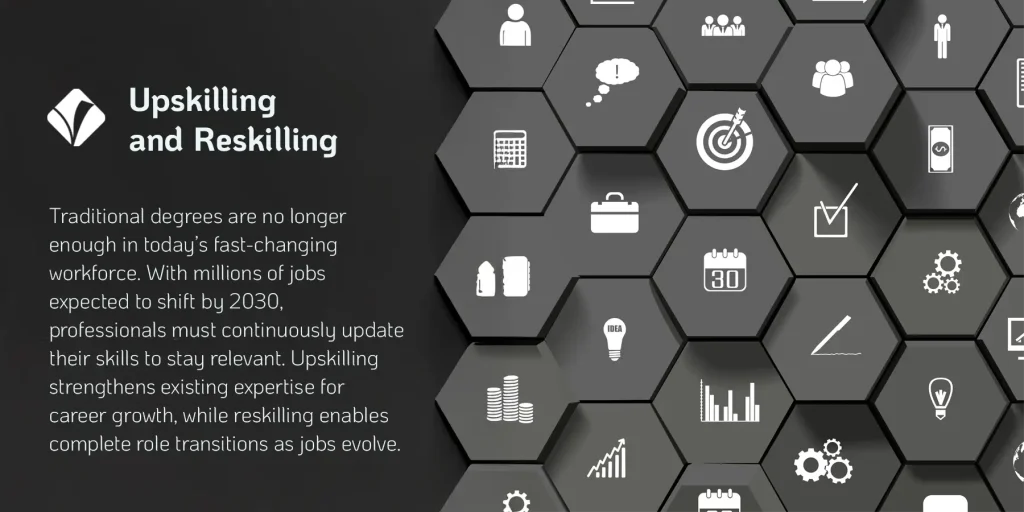
The World Economic Forum predicts that technological advances will change 1.1 billion jobs dramatically over the next decade. Traditional degrees used to be the life-blood of career paths, but today’s workplace moves too fast, meaning we need upskilling and reskilling to stay relevant. McKinsey Global Institute’s research shows that by 2030, about 375 million workers worldwide might have to switch their career paths completely.
These changes are a big deal as it means that by 2025, machines could replace or alter roughly 85 million jobs. The good news is that this technological revolution will create 97 million new roles. This shift expresses the growing gap between upskilling and reskilling approaches, and both have become crucial to career survival. Workers want to grow – 94% say they would stay longer with companies that invest in their career growth. Most people have degrees now, but Korn Ferry sees a different future. They predict that by 2030, companies will just need more skilled workers than they can find, leading to a worldwide talent gap of over 85 million people. The future of work demands more than degrees – continuous learning has become our new professional currency.
What is the difference between upskilling and reskilling?
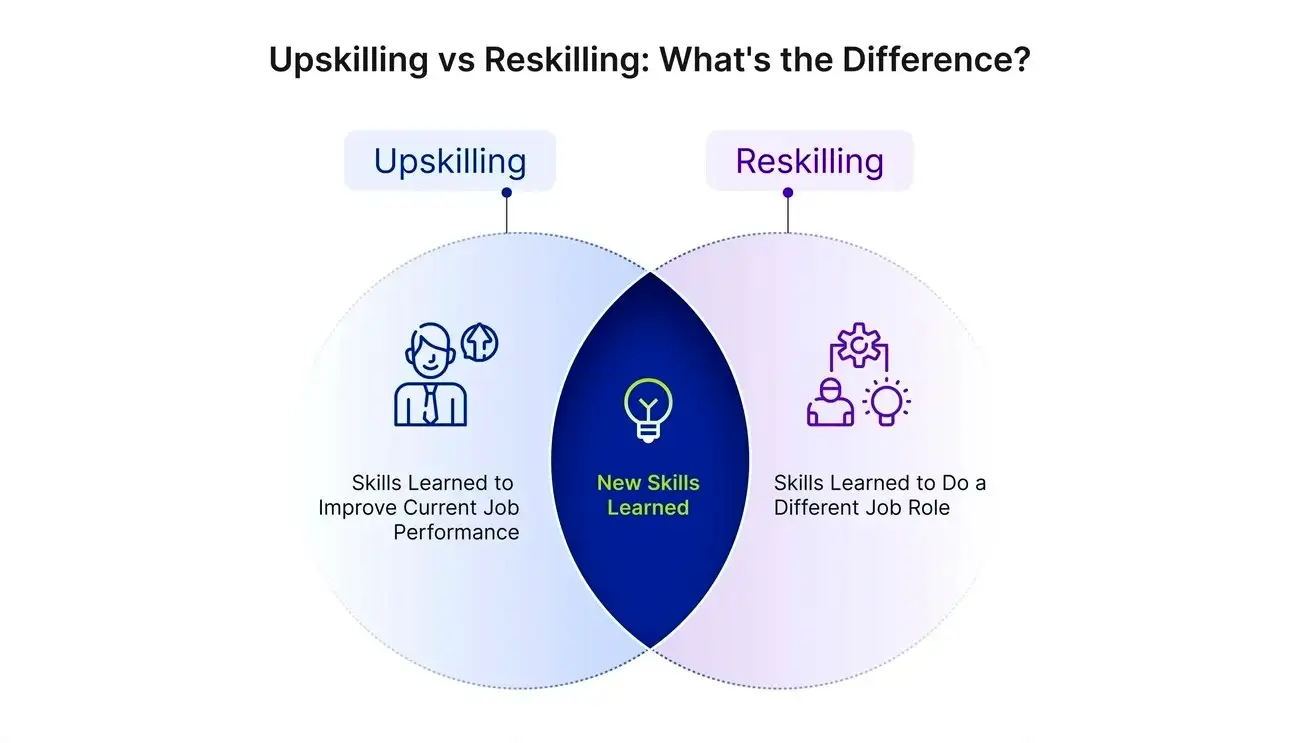
The clarity between upskilling and reskilling helps both people and organizations plan their talent development strategies better. These two approaches to skill development serve different purposes but aim to meet changing workplace needs.
Building Deeper Capability in Existing Roles
Upskilling builds on existing skills to boost performance within a current role or field. Rather than complete career changes, it strengthens the knowledge base employees already have. Stanford University defines upskilling as gaining knowledge, expertise, or capabilities related to your current field or industry to grow your career or adapt to market changes.
You might need upskilling when:
- Your field’s technologies or methodologies evolve
- Your job responsibilities grow
- Career growth needs deeper expertise
A digital marketer who learns advanced data analytics to measure campaign success more effectively shows upskilling in action. Similarly, software developers who master new programming languages to build complex applications stay relevant in their profession.
Upskilling’s main goal focuses on building existing skills to improve performance and productivity in your current position. This creates a clear career growth path that lets employees become more skilled and handle complex tasks within their professional identity.
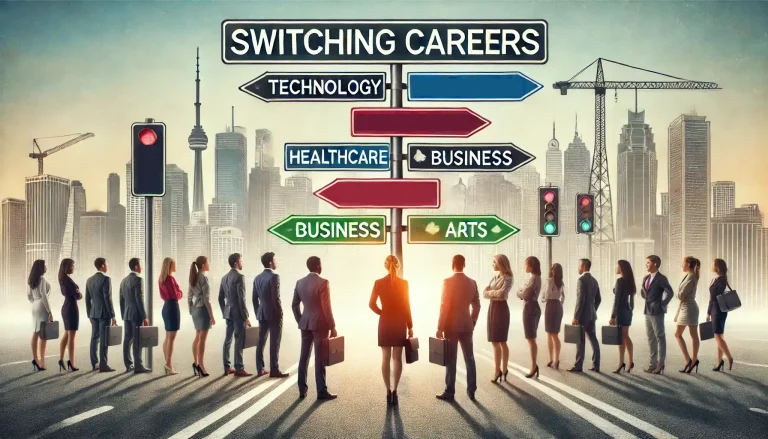
Navigating Career Change in a Disrupted Job Market
Reskilling teaches entirely new skills to help people move into different roles or industries. Many jobs face obsolescence, and some people want major career changes. The World Economic Forum predicts that by 2026, approximately 85 million jobs may be displaced as work shifts between humans and machines.
Reskilling needs more structured learning than upskilling and often requires:
- New degrees or diplomas through formal education
- Boot camps or intensive training programs
- Real experience through internships or volunteering
Examples include retail managers becoming web developers, accountants switching to UX design, or factory workers learning robotics maintenance.
Reskilling leads to career changes or redeployment, often triggered by role changes or business needs. This creates a sideways move rather than upward growth.
Why This Distinction Matters in Today’s Labor Market
This distinction between upskilling and reskilling has never been more vital. Skills become outdated faster than ever. Since 2021, one-third of jobs have seen fundamental skill changes, with 25% of positions experiencing 75% skill transformation in just three years.
Workforce transformation numbers are eye-opening. The World Economic Forum shows that 50% of the global workforce must upskill or reskill to meet employer needs – this number could reach 90% within five years. By 2025, workers staying in their current roles will see 40-50% of their core skills change.
Career paths have changed completely. University of Queensland research suggests today’s workforce entrants will hold 16 to 17 jobs across five to seven different careers. Each move might need new skills.
Organizations need to know whether to use upskilling or reskilling strategies, particularly when implementing region-specific training programs aligned with local labor market needs. Making the right choice directly supports inclusive growth and long-term economic success, particularly in rapidly changing labor markets. This knowledge proves vital for workforce planning, keeping talent, and maintaining business success.
Why degrees alone are no longer enough
Traditional career paths have changed drastically. Educational credentials that once guaranteed a job now serve as basic requirements in today’s complex professional world.
The shrinking shelf life of skills
Professional skills don’t last as long as they used to. Skills stayed relevant for at least a decade forty years ago. Now they only last approximately four years. Technical fields like data science and AI see skills becoming outdated even faster – just two years. Students might find parts of their four-year degree outdated before they graduate.
World Economic Forum research shows that 39% of current skill sets will become outdated between 2025 and 2030. IBM executives expect 40% of their workforce will need new skills because of AI and automation in the next three years. These numbers show why learning new skills has become crucial for survival.
How Automation is Redefining Work
AI has altered the map of workforce requirements in every industry. Companies want candidates who understand AI capabilities and applications – not just technical experts but professionals in all departments. Traditional sectors have adopted this approach as automation changes their operations.
Jobs are evolving rapidly. Machines handle repetitive tasks while roles needing human judgment, creativity, and emotional intelligence grow. Research suggests that by 2025, changes in human-machine work distribution could eliminate 85 million jobs. The same tech changes could create 97 million new positions that need different skills than standard degrees offer. Many of these roles are emerging in sustainability-focused sectors, including green jobs in Kenya, where reskilling is becoming a national priority.
How Hiring Priorities Are Evolving
Companies have radically changed their hiring approach. They now value proven abilities over credentials. Harvard Business School research revealed that between 2017 and 2019, 46% of middle-skill and 31% of high-skill jobs dropped their bachelor’s degree requirements.
Apple, Google, and IBM have publicly announced they care more about skills than formal degrees. This change stands out especially when you have emerging fields:
- AI job posts showed 23% fewer degree requirements from 2018 to 2024
- AI skills earn 23% more pay, beating degrees up to PhD level
- 63% of employers say skill gaps are their biggest obstacle to business transformation
The message is clear – staying employable depends on adaptability and constant learning. Korn Ferry research shows that companies hiring based on skills adapt 57% better to new challenges. This explains why 94% of workers stay longer with employers who help develop their careers.
Career and Organizational Benefits of Continuous Learning
Upskilling and reskilling initiatives delivered through professional training programs offer substantial benefits beyond basic requirements. The evidence shows measurable returns on investment in multiple areas.
Improved job security and mobility
Continuous skill development builds career resilience. McKinsey research shows 87% of executives report skill gaps in their workforce or expect them soon. Employees who match their skills to evolving job requirements are less vulnerable during restructuring periods.
New skills boost digital fluency, adaptability, and problem-solving abilities – key elements to handle technological disruption. These skills prepare professionals to handle technology-driven tasks that now exist in every industry, from data analysis in marketing to automation in manufacturing.
Career opportunities grow substantially. Workers can access higher-level positions and cross-functional roles previously out of reach. Stanford researchers call this “career insurance” – protection against becoming obsolete as fields change faster.
Why Development Investment Improves Retention
Research reveals 94% of employees would stay longer at companies investing in their future. Companies save money since replacing an employee costs between one-half to twice their annual salary. Investment in development pays off through lower turnover.
Companies with upskilling programs see several benefits:
- Increased employee satisfaction and morale
- Strengthened loyalty and commitment
- Higher engagement and productivity
- Smoother succession planning
Employees feel valued and see clear career paths, which leads to these improvements. More than 50% of companies report increases in both employee productivity and loyalty after implementing training and upskilling programs.
Organizational adaptability and innovation
Teams that learn new tools and methods create more value and adapt faster during disruption. This adaptability matters most as companies revolutionize their digital processes – training becomes vital yet often overlooked in these initiatives.
Employees with new skills show more interest in trying new approaches and working together across departments. Different skills coming together encourage breakthroughs through varied problem-solving methods. Companies can respond to market changes quickly without the delays and costs of hiring externally.
McKinsey describes this as “workforce resilience” – the ability to adjust quickly to market demands by using existing talent who already know the company’s culture and goals.
Designing a Workforce Development Strategy That Works
A structured approach that addresses both immediate needs and long-term goals will create an effective upskilling and reskilling strategy. Success depends on careful planning and implementation rather than quick fixes to skill shortages.
1. Identify skill gaps
The foundations of any successful upskilling program start with a full picture of skills gaps. HR teams must work together with business leaders to understand future skill requirements and assess their workforce’s current capabilities. The core team should gather data through employee surveys, interviews, focus groups, and performance reviews. Companies should monitor evolving skill requirements continuously rather than periodically. Organizations can identify areas where skill deficiencies might hurt business success and decide whether to train existing employees or hire new talent. This capability is central to effective workforce performance management, where skills, productivity, and outcomes are continuously aligned.
2. Set clear learning goals
SMART objectives (specific, measurable, achievable, relevant, time-bound) that directly match business outcomes will give a measurable value to training programs. This approach mirrors best project practices, where clearly defined objectives, milestones, and accountability drive successful outcomes. To name just one example, setting targets like “90% of finance staff trained on the new ERP system by Q4, resulting in 20% operational efficiency improvement” gives clear direction. These goals need executive support – CEOs and CFOs must see how upskilling objectives benefit the company to provide resources and funding. Each employee needs individual-specific learning paths that help them build skills with real business value.
3. Use blended learning methods
Modern workforce development works best when online training combines with traditional in-person instruction. This method brings together workshops, classroom sessions, webinars, and mentoring. Employees can learn at their own pace while staying engaged through different training modes like multimedia, presentations, and gamification. Studies show retention rates can improve by 25–60% through eLearning because it’s interactive. Companies that use blended learning design have seen 30% more efficient training.
4. Line up with business objectives
McKinsey research shows only 40% of companies have learning strategies that match their business goals. Training should address the mechanisms of performance gaps instead of offering generic courses. Companies can bridge skills gaps faster and gain competitive advantage in their industry this way. Connected learning initiatives give employees skills to respond quickly to market changes and break down departmental silos through shared understanding of strategic objectives.
5. Promote a culture of continuous learning
Organizations with strong learning cultures are 92% more likely to invent, 52% more productive, and 17% more profitable than their peers. Leaders must model desired behaviors by investing in their own development to build this culture. This is closely linked to team building, goal setting, and motivation programs that reinforce shared purpose, accountability, and sustained performance. Organizations can strengthen workforce readiness through global learning and development programs that focus on practical skills, strategic thinking, and real-life application. Different learning formats make training available to various learning styles, while dedicated development time shows the organization’s steadfast dedication. People feel comfortable acknowledging learning curves and mistakes in a safe environment that encourages growth.
Real-world upskilling and reskilling examples
Several major companies have shown remarkable success with their large-scale upskilling and reskilling programs. These real-world examples demonstrate effective strategies in action.
AT&T’s Workforce 2020 initiative
The rapid changes in telecommunications technology pushed AT&T to launch its Workforce 2020 initiative, later renamed Future Ready. This $1 billion program wanted to prepare 100,000 employees for future roles. The complete initiative featured online courses and partnerships with Udacity and top universities. Employees could access a career center to identify and train for emerging roles. The results were impressive – by 2018, more than half of AT&T’s workforce completed 2.7 million online courses in data science, cybersecurity, and Agile project management. Employees who participated in retraining doubled their chances of landing mission-critical jobs and were four times more likely to advance their careers.
Siemens’ digital skills academy
Siemens’ 3-year old SiTecSkills Academy helps workers adapt to workplace changes. The company invested €280 million in training and education in 2022. Their approach blends digital, in-person, and hybrid learning formats that suit different skill levels. Siemens also introduced bite-sized “nuggets” of learning that worked especially well with shopfloor employees. The academy’s success speaks for itself – about 2,000 employees completed 170 training programs with a 97.8% success rate in 2022.
Zurich UK’s AI-driven learning paths
Zurich UK used the AI analytics platform Faethm to spot 270 potential job openings in robotics, data science, and cybersecurity that might appear by 2024. The company invested nearly £1 million to prepare its workforce for these changes. Their Automation Academy has already built a 40-person AI team from existing employees across different departments. Each retrained team member received a 10% pay raise in their first year. This smart approach should save about £1 million in hiring and severance costs over time.
Partners in project success since 2011, diagnostics, advisory support and applied learning for ministries, public agencies and project teams.
Need help putting this into practice?
Start with a free 10-minute diagnostic or talk to our experts.