Key facts
- Dates
- 19–23 Apr 2027 (5 days)
- Where
- Tokatoka Resort, Nadi, Fiji
- Fee per participant
- £3,670 (GBP)
- Payment
- By invoice and bank transfer
- Registration closes
- 12 Feb 2027
- Format
- 5-day short course: a practical capacity-building programme for government, NGO and project teams in Nadi
- Who it is for
- Ministries of Infrastructure/Public Works, Ministries of Finance, Ministries of ICT & Communications, Ministries of Education, and Ministries o…
- Certificate
- Certificate of completion
- In-house option
- Run it for your team, on your dates
On this page 13 sections
Programme Overview
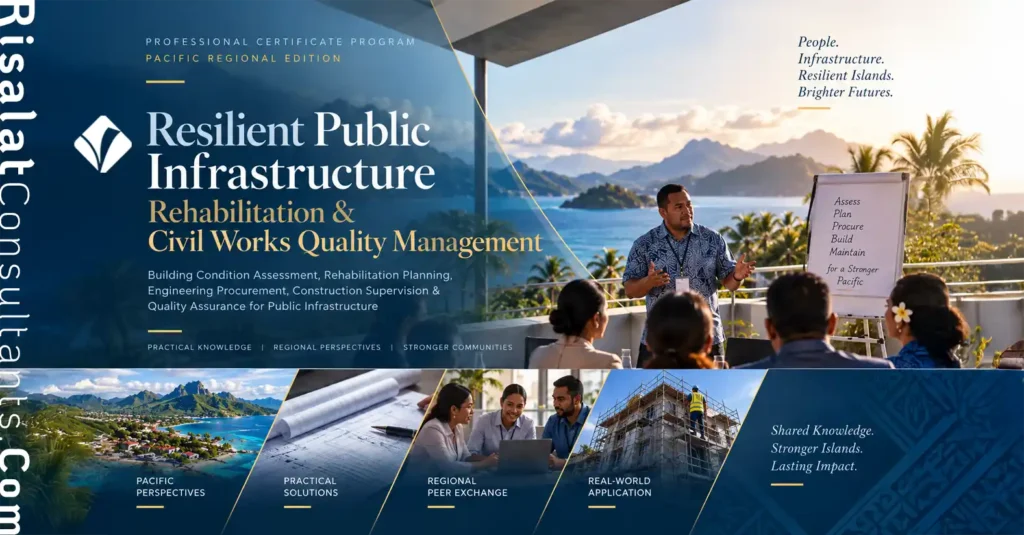
Public Infrastructure Rehabilitation Training is increasingly important for government institutions across the Pacific responsible for maintaining, upgrading and strengthening public buildings and critical infrastructure. This Pacific Regional Professional Certificate in Nadi, Fiji provides a practical approach to building condition assessment, rehabilitation planning, engineering procurement, construction supervision, quality assurance and resilient infrastructure management. Public institutions across the Pacific manage extensive portfolios of government offices, schools, health facilities, ICT and communications facilities, utility buildings, community infrastructure and other public assets requiring continuous maintenance, rehabilitation, adaptation and upgrading.
Managing existing infrastructure presents challenges fundamentally different from constructing new assets. Before rehabilitation works begin, institutions need to understand the physical condition of existing facilities, identify structural and non-structural deficiencies, evaluate safety and functionality, determine appropriate interventions, establish realistic scopes and budgets, prepare technically sound procurement documentation, and ensure that subsequent works meet required standards for quality, safety, resilience and environmental and social performance. These challenges are particularly significant across Pacific Island countries, where infrastructure is exposed to cyclones, intense rainfall, humidity, coastal environments, corrosion, seismic risks, supply-chain constraints and high construction and maintenance costs.
This Public Infrastructure Rehabilitation Training provides participants with a practical framework for managing the complete rehabilitation lifecycle, from initial condition assessment and rehabilitation planning through engineering design, procurement, construction supervision, quality assurance, handover and preventive maintenance. The programme places particular emphasis on government agencies, project implementation units, infrastructure authorities and public-sector technical and procurement teams that commission and oversee engineering consultants and contractors. Participants do not need to be structural engineers to benefit; the programme develops the institutional capability required to plan, procure, review, supervise and manage infrastructure rehabilitation effectively.
The programme strengthens institutional capability in:
Delivered by Risalat Consultants International in Nadi, Fiji, it combines expert-led sessions, real cases and group work, so that participants can apply what they learn in their own institution.
The Programme Strengthens Institutional Capability
- Public infrastructure asset lifecycles, differences between new construction and rehabilitation, and building systems or components
- Functional deficiencies, accessibility, common deterioration mechanisms, deferred maintenance, and safety versus serviceability
- Planning assessments, defining purpose and methodology, reviewing records, and organising inspection teams and checklists
- Photographic records, testing requirements, and establishing needs for specialist investigation
- Identifying defects including cracking, concrete deterioration, corrosion, roof issues, water intrusion, moisture, and drainage faults
- Foundation indicators, building envelope elements, electrical and mechanical deficiencies, accessibility, and fire or life-safety risks
- Applying condition ratings (Critical, Poor, Fair, Good) and risk classifications (Immediate Intervention, Short-Term Rehabilitation, Planned Maintenance, Monitor)
- Translating assessments into rehabilitation strategies, root cause analysis, repair versus replacement, and temporary versus permanent solutions
- Climate and environmental risk assessment
- Adaptation and mitigation planning
- Sector strategies for energy, water and land
- Project design for climate and environmental goals
It is designed for ministries of Infrastructure/Public Works, Ministries of Finance, Ministries of ICT & Communications, Ministries of Education, and Ministries of Health, transport Authorities, Water & Energy Utilities, Municipal Authorities, and Government Property/Asset Management Units, procurement Authorities, Project Implementation Units, Disaster Resilience Agencies, Public Works Departments, and State-Owned Enterprises and others who want practical, current skills in climate, environment and natural resources.
The Growing Importance of Resilient Public Infrastructure Rehabilitation & Civil Works Quality Management
- Public infrastructure asset lifecycles, differences between new construction and rehabilitation, and building systems or components
- Foundation indicators, building envelope elements, electrical and mechanical deficiencies, accessibility, and fire or life-safety risks
- Engineering design stages including design basis, preliminary design, detailed design, site data, and design assumptions
- Climate and environmental trends for the sector
- National plans and commitments
- Risk and vulnerability assessment
- Roles of government, communities and partners
- Functional deficiencies, accessibility, common deterioration mechanisms, deferred maintenance, and safety versus serviceability
- Applying condition ratings (Critical, Poor, Fair, Good) and risk classifications (Immediate Intervention, Short-Term Rehabilitation, Planned Maintenance, Monitor)
- Drawings and technical specifications, constructability reviews, design coordination, cost estimation, and approvals
- Adaptation and mitigation options
- Nature-based and engineering solutions
- Sector planning for energy, water and land
- Costs, benefits and trade-offs
- Planning assessments, defining purpose and methodology, reviewing records, and organising inspection teams and checklists
- Translating assessments into rehabilitation strategies, root cause analysis, repair versus replacement, and temporary versus permanent solutions
- Addressing Pacific climate hazards including cyclones, extreme rainfall, flooding, coastal corrosion, humidity, and seismic risks
- From problem to project concept
- Results frameworks for climate and environment
- Safeguards and stakeholder involvement
- Implementation arrangements
- Photographic records, testing requirements, and establishing needs for specialist investigation
- Evaluating technical feasibility, economic considerations, lifecycle costs, service continuity, prioritisation, and budget constraints
- Incorporating roof resilience, water management, critical facility continuity, disaster recovery, and Build Back Better principles
- Sources of climate and environmental finance
- What financiers look for
- Building the climate rationale
- Budgets and co-financing
- Identifying defects including cracking, concrete deterioration, corrosion, roof issues, water intrusion, moisture, and drainage faults
- Balancing safety, asset criticality, service impact, failure probability, cost, resilience, and urgency in investment decisions
- Measurement, reporting and verification basics
- Monitoring results and learning
- Communicating results
- Partnerships for implementation
- Personal action plan for your institution
Climate change, environmental pressure and resource management now shape national plans, budgets and investment decisions. Financiers increasingly expect climate and environmental considerations to be built into projects from the start.
Institutions that can plan for climate risks, manage natural resources well and prepare sound proposals are better placed to protect services and to access the funding available for this work.
Organisations increasingly require professionals capable of:
- Assess climate and environmental risks to their services and assets
- Design projects that meet climate and environmental goals
- Prepare proposals that financiers can approve
- Measure and report results credibly
- Work with communities and partners across sectors
Strong climate, environment and natural resources systems help organisations:
- Protect services and infrastructure from climate risks
- Access climate and environmental finance
- Meet national and international commitments
- Use natural resources sustainably
This Resilient Public Infrastructure Rehabilitation & Civil Works Quality Management programme brings these elements together in a practical format, so that participants understand not only what good practice looks like but also how to introduce it in their own setting, with the people and resources they have.
Who Should Attend This Resilient Public Infrastructure Rehabilitation & Civil Works Quality Management Training?
This programme is designed for:
- Ministries of Infrastructure/Public Works, Ministries of Finance, Ministries of ICT & Communications, Ministries of Education, and Ministries of Health
- Transport Authorities, Water & Energy Utilities, Municipal Authorities, and Government Property/Asset Management Units
- Procurement Authorities, Project Implementation Units, Disaster Resilience Agencies, Public Works Departments, and State-Owned Enterprises
- Development-Partner-Funded Projects
- Engineers, infrastructure officers, project managers, procurement specialists, and contract managers
- Facilities managers, asset managers, environmental and social specialists, OHS officers, technical officers, and government officials responsible for infrastructure investments
- Understand the complete public-infrastructure rehabilitation lifecycle
- Plan and commission building-condition assessments, and interpret engineering findings
- Recognise common structural and non-structural building defects
- Establish condition-rating and defect-classification systems
- Prioritise rehabilitation interventions according to risk and available resources
- Evaluate rehabilitation, adaptation and replacement options, and incorporate climate and disaster resilience into rehabilitation planning
The programme suits experienced professionals as well as those moving into new responsibilities. Groups that mix institutions and countries are encouraged, because participants learn a great deal from each other’s experience.
Tick what your team needs to be able to do.
Resilient Public Infrastructure Rehabilitation & Civil Works Quality Management Training Objectives
Upon successful completion of this Resilient Public Infrastructure Rehabilitation & Civil Works Quality Management Training, participants will be able to:
- Explain the main climate and environmental challenges for their sector
- Assess climate and environmental risks to services and assets
- Plan adaptation and mitigation measures
- Design projects with clear climate and environmental results
- Understand the main sources of climate and environmental finance
- Prepare the core parts of a funding proposal
- Set up measurement, reporting and verification
- Involve communities and partners effectively
- Prepare an action plan for their institution
Each objective is practised during the programme through exercises, cases or group work, so that participants leave able to do it, not only to describe it.
Programme Contents and Structure
The programme runs over 5 days. Each day combines expert input, practical work and a closing workshop or case study:
- First Day: Context and risks
- Second Day: Planning solutions
- Third Day: Project design
- Fourth Day: Finance and proposals
- Fifth Day: Measurement, reporting and action planning
Full day-by-day contents
First Day | Context and risks
- Public infrastructure asset lifecycles, differences between new construction and rehabilitation, and building systems or components
- Foundation indicators, building envelope elements, electrical and mechanical deficiencies, accessibility, and fire or life-safety risks
- Engineering design stages including design basis, preliminary design, detailed design, site data, and design assumptions
- Climate and environmental trends for the sector
- National plans and commitments
- Risk and vulnerability assessment
- Roles of government, communities and partners
- Case discussion: a project affected by climate risk
Workshop: Context and risks: Applying It to Your Institution
Working in small groups, participants apply the day's methods to examples from their own institutions and agree practical next steps.
Second Day | Planning solutions
- Functional deficiencies, accessibility, common deterioration mechanisms, deferred maintenance, and safety versus serviceability
- Applying condition ratings (Critical, Poor, Fair, Good) and risk classifications (Immediate Intervention, Short-Term Rehabilitation, Planned Maintenance, Monitor)
- Drawings and technical specifications, constructability reviews, design coordination, cost estimation, and approvals
- Adaptation and mitigation options
- Nature-based and engineering solutions
- Sector planning for energy, water and land
- Costs, benefits and trade-offs
- Exercise: options appraisal
Workshop: Planning solutions: Applying It to Your Institution
Working in small groups, participants apply the day's methods to examples from their own institutions and agree practical next steps.
Third Day | Project design
- Planning assessments, defining purpose and methodology, reviewing records, and organising inspection teams and checklists
- Translating assessments into rehabilitation strategies, root cause analysis, repair versus replacement, and temporary versus permanent solutions
- Addressing Pacific climate hazards including cyclones, extreme rainfall, flooding, coastal corrosion, humidity, and seismic risks
- From problem to project concept
- Results frameworks for climate and environment
- Safeguards and stakeholder involvement
- Implementation arrangements
- Exercise: concept note outline
Case Study: Project design in Practice
Participants analyse a realistic case, compare the choices made with good practice and draw lessons they can use in their own setting.
Fourth Day | Finance and proposals
- Photographic records, testing requirements, and establishing needs for specialist investigation
- Evaluating technical feasibility, economic considerations, lifecycle costs, service continuity, prioritisation, and budget constraints
- Incorporating roof resilience, water management, critical facility continuity, disaster recovery, and Build Back Better principles
- Sources of climate and environmental finance
- What financiers look for
- Building the climate rationale
- Budgets and co-financing
- Case study: a successful proposal
Workshop: Finance and proposals: Applying It to Your Institution
Working in small groups, participants apply the day's methods to examples from their own institutions and agree practical next steps.
Fifth Day | Measurement, reporting and action planning
- Identifying defects including cracking, concrete deterioration, corrosion, roof issues, water intrusion, moisture, and drainage faults
- Balancing safety, asset criticality, service impact, failure probability, cost, resilience, and urgency in investment decisions
- Measurement, reporting and verification basics
- Monitoring results and learning
- Communicating results
- Partnerships for implementation
- Personal action plan for your institution
Capstone Exercise: Resilient Public Infrastructure Rehabilitation & Civil Works Quality Management Action Plan for Your Institution
Participants bring the week together in an action plan for their own institution, with priorities, owners and first steps, and present it for feedback from peers and facilitators.
Resilient Public Infrastructure Rehabilitation & Civil Works Quality Management Training Methodology
The training uses practical exercises, applied frameworks, and team-based scenario analysis based on Pacific infrastructure contexts.
The programme combines:
- Practical workshops and group exercises analysing simulated Pacific government facility scenarios
- Development of operational tools including Defect Registers, Condition Ratings, Risk Classifications, and Recommended Actions
- Comparative case evaluations assessing rehabilitation versus replacement strategies considering condition, cost, service, and climate risk
- Expert-led sessions on current practice
- Regional and international case studies
- Group work and practical exercises
- Simulations and role plays where relevant
- Discussion of participants' own challenges
- Peer learning across institutions and countries
- Practical tools and templates to take back to work
Before the programme, a short pre-assessment helps the facilitators understand each participant’s role and priorities, so that examples and exercises can be adjusted to the group. Each day ends with a short reflection in which participants note what they will apply at work.
Expected Outcomes
Upon completion of this Resilient Public Infrastructure Rehabilitation & Civil Works Quality Management Training, participants will be able to:
- Ability to plan, execute, and interpret systematic building condition assessments and defect registers
- Competence in categorising asset risks and establishing defensible rehabilitation priorities
- Enhanced capacity to develop preliminary design strategies that incorporate climate and disaster resilience requirements
- Improved institutional capability to manage engineering consultants, review technical specifications, and oversee infrastructure works
- Alignment of public infrastructure planning with regional resilience standards and lifecycle maintenance demands
- Assess climate and environmental risks
- Plan adaptation and mitigation measures
- Design projects with clear results
Participants leave with a personal action plan and practical tools they can use in their institution from the first week back. Institutions that send several participants can use the programme to agree shared methods and templates across teams, which makes improvements easier to sustain.
£3,670 per participant · invoice and bank transfer · groups of 5 or more receive a discount
Five or more from one organisation: ask for the group rate on the invoice request.
Ten or more: an in-house version for your institution may cost less per person. Ask for an in-house quote.
Registration closes in 82 days (12 Feb 2027)
Institutional Application of Resilient Public Infrastructure Rehabilitation & Civil Works Quality Management Training
This programme supports organisations in strengthening:
- Climate and environmental planning
- Project design
- Access to finance
- Results measurement
- Stakeholder involvement
Participants return with practical tools to improve:
- Risk assessments
- Concept notes
- Results frameworks
- Monitoring systems
- Partnership arrangements
The programme is built so that learning moves from the classroom into the institution. Participants work on their own processes and documents where possible, and leave with an action plan that their managers can review and support.
Regional Relevance & Application
Europe
European institutions apply climate, environment and natural resources within detailed regulatory frameworks and reform agendas. Participants from Europe can compare their practice with colleagues from other regions and test how established methods work under different conditions.
Africa
Across Africa, ministries, agencies and project teams working in climate, environment and natural resources increasingly operate alongside donor-financed programmes that expect clear systems and evidence. The programme helps participants adapt good practice to the institutions and resources they work with.
Middle East
In the Middle East, national development strategies and diversification plans place growing demands on climate, environment and natural resources. Participants explore how to build the capability these plans need inside public bodies and companies.
Asia
Institutions across Asia combine rapid growth with ambitious modernisation programmes. Participants from Asia can share their experience of scaling systems quickly and learn from approaches used elsewhere.
Pacific
Small island and Pacific states face particular constraints of size, distance and capacity. The programme highlights practical, proportionate approaches to climate, environment and natural resources that suit smaller institutions.
Holding the programme in Nadi, Fiji brings participants together away from their daily pressures, so they can compare how climate, environment and natural resources is handled in different settings. The same programme can also be delivered in-house for one institution, in its own country or online, with cases taken from its current work.
Host Country Profile – Fiji
Programmes in Nadi suit professionals, government officials and project teams focused on climate resilience, public sector administration, regional logistics, and environmental protection.
Studying away from their own country gives participants time to focus, a fresh view of their own institution and the chance to build a network with colleagues from other countries.
The programme takes place at Tokatoka Resort.
Resilient Public Infrastructure Rehabilitation & Civil Works Quality Management Training Deliverables
Participants receive support before, during and after the programme, so that preparation, learning and follow-up form one continuous experience.
Before the Programme
- Participant Pre-Assessment
- Resilient Public Infrastructure Rehabilitation & Civil Works Quality Management Readiness Assessment
- Resilient Public Infrastructure Rehabilitation & Civil Works Quality Management Resource Pack
- Preparatory Reading Materials
- Complimentary Visa Support & Advisory
During the Programme
- Airport Pickup & Welcome Assistance
- Accommodation with breakfast: 6 nights, check-in Sunday 18 April 2027, check-out Saturday 24 April 2027 (one night before and one night after the programme)
- Welcome Networking Dinner
- Risalat Training Kit (Bag, Bottle, Mug, T-Shirt, Cap, Passport Cover, Pens, Notebook, Magnet & Keychain)
- Comprehensive Resilient Public Infrastructure Rehabilitation & Civil Works Quality Management Training Manual
- Climate Risk Screening Checklist
- Options Appraisal Template
- Concept Note Template
- Results Measurement Template
- Practical Workshops & Simulations
- Group Discussions & Peer Learning
- Daily Lunch and Refreshments
- Full Access to Training Venue Facilities
- Mini Pad / Tablet with Digital Learning Materials
- Field Visit (where applicable)
- Entertaining City Tour
After the Programme
- Certificate of Completion
- Risalat Programme Participation Recognition Award
- Post-Training Reference Materials
- Funding Readiness Checklist
- Monitoring and Reporting Template
- Post-Training Support & Follow-Up Guidance
- Programme Report
Institutions can also request a tailored in-house version of this programme, delivered at their premises or online. Request a proposal.
Common Challenges in Resilient Public Infrastructure Rehabilitation & Civil Works Quality Management, And How This Training Helps
How can institutions assess climate and environmental risks to their services and assets?
The programme addresses this directly on the first day (Context and risks), where participants practise the methods involved and adapt them to their own institution, then build it into their action plan.
How can institutions design projects that meet climate and environmental goals?
The programme addresses this directly on the second day (Planning solutions), where participants practise the methods involved and adapt them to their own institution, then build it into their action plan.
How can institutions prepare proposals that financiers can approve?
The programme addresses this directly on the third day (Project design), where participants practise the methods involved and adapt them to their own institution, then build it into their action plan.
How can institutions measure and report results credibly?
The programme addresses this directly on the fourth day (Finance and proposals), where participants practise the methods involved and adapt them to their own institution, then build it into their action plan.
How can institutions work with communities and partners across sectors?
The programme addresses this directly on the fifth day (Measurement, reporting and action planning), where participants practise the methods involved and adapt them to their own institution, then build it into their action plan.
Frequently Asked Questions
When and where does the Resilient Public Infrastructure Rehabilitation & Civil Works Quality Management programme take place?
It runs from 19 Apr 2027 to 23 Apr 2027, in Nadi, Fiji (Tokatoka Resort). The registration deadline is shown at the top of this page.
Who should attend?
The programme is designed for ministries of Infrastructure/Public Works, Ministries of Finance, Ministries of ICT & Communications, Ministries of Education, and Ministries of Health, transport Authorities, Water & Energy Utilities, Municipal Authorities, and Government Property/Asset Management Units, procurement Authorities, Project Implementation Units, Disaster Resilience Agencies, Public Works Departments, and State-Owned Enterprises, development-Partner-Funded Projects, and others who want practical skills in climate, environment and natural resources.
Will I receive a certificate?
Yes. Participants who complete the programme receive a Certificate of Completion from Risalat Consultants International.
Can this programme be delivered for our institution only?
Yes. We can deliver a tailored in-house version at your premises, in another city or online, built around your own cases. Use the proposal request on this page.
Do I need prior experience in climate, environment and natural resources?
No specialist background is required beyond experience in a related role. A short pre-assessment helps the facilitators adapt the sessions to the group.
Who Will Deliver This Programme
Each date is delivered by a team assigned from Risalat's expert network for this subject. For this programme we assign:
How we choose them: Experience in the region of the participants or comparable settings; Command of the financier rules that apply (World Bank, ADB, AfDB, EU, UN) where relevant; Delivery in English; other languages on request for in-house groups; No conflict of interest with participants' institutions.
Training courses in NadiConstruction & Engineering training courses
Why Nadi for this programme
Nadi serves as the primary international transport hub for Fiji, offering straightforward flight connections across the Pacific region. Visiting delegations can examine transport infrastructure, regional aviation services, and local municipal operations. The area also provides exposure to coastal environmental management projects and sustainable tourism operations in surrounding districts.
The Resilient Public Infrastructure Rehabilitation & Civil Works Quality Management programme in April 2027 brings together officials and professionals from across the Oceania and the Pacific region and beyond. Sessions combine short inputs, case studies and group work on participants' own files, and the city's institutions can be added as a study visit on request.
Getting there: Nadi International Airport (NAN).
Check whether you need a visa with the free Visa Checker, and ask for an invitation letter once you are registered.
The same topic in other cities
- Road Asset Maintenance Contracts and Community Routine Upkeep in Porto (Porto)
- Commercial Agri-Corridor Road Upgrading and Maintenance Contracts in Dakar (Dakar)
- Secondary City Traffic Engineering and Public Transit Planning in Casablanca (Casablanca)
- District Health Infrastructure Commissioning and Clinical Works in Casablanca (Casablanca)
- Port Infrastructure Rehabilitation and Interisland Terminal Works in Mauritius (Mauritius)
- Smallholder Irrigation Scheme Rehabilitation and Water User Association Setup in Johannesburg (Johannesburg)
Other programmes in Nadi
- Marine Spatial Planning and Inshore Coastal Fisheries Co-Management in Nadi
- Safe School Retrofitting and Resilient Educational Infrastructure in Nadi
- Health Facility Upgrading and Medical Waste System Compliance in Nadi
- Agribusiness Incubator Design and Smallholder Market Linkages in Nadi
- Emergency Bridge and Road Re-Opening Operations in Island States in Nadi
Teams often travel here from Kiribati, Tuvalu, Marshall Islands. Funding, visa letters and group rates are explained on each country page.
- UN Office for Disaster Risk Reduction UNDRR
- Adaptation Fund Adaptation Fund
For teams and institutions
Bring your team
Teams that learn together apply more at work. Tell us how many people and how you would like to take part: we reply with a group quote within two working days.
Watch: this programme in short


Other dates and cities for this subject: Climate Resilience and Adaptation training courses (107 upcoming dates).
More training courses in Fiji · All programmes in Pacific · Full training calendar
Plan this programme in a roadmap: why it matters, why to approve it, the dates to plan and the career it builds.