Programme Overview
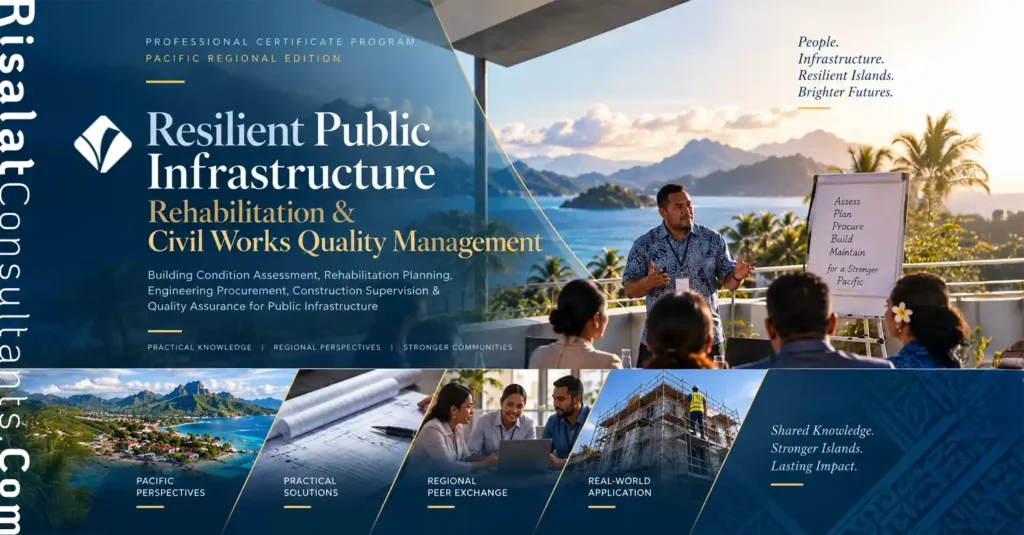
Public Infrastructure Rehabilitation Training is increasingly important for government institutions across the Pacific responsible for maintaining, upgrading and strengthening public buildings and critical infrastructure. This Pacific Regional Professional Certificate in Nadi, Fiji provides a practical approach to building condition assessment, rehabilitation planning, engineering procurement, construction supervision, quality assurance and resilient infrastructure management.
Public institutions across the Pacific manage extensive portfolios of government offices, schools, health facilities, ICT and communications facilities, utility buildings, community infrastructure and other public assets requiring continuous maintenance, rehabilitation, adaptation and upgrading.
Managing existing infrastructure presents challenges fundamentally different from constructing new assets. Before rehabilitation works begin, institutions need to understand the physical condition of existing facilities, identify structural and non-structural deficiencies, evaluate safety and functionality, determine appropriate interventions, establish realistic scopes and budgets, prepare technically sound procurement documentation, and ensure that subsequent works meet required standards for quality, safety, resilience and environmental and social performance.
These challenges are particularly significant across Pacific Island countries, where infrastructure is exposed to cyclones, intense rainfall, humidity, coastal environments, corrosion, seismic risks, supply-chain constraints and high construction and maintenance costs.
This Public Infrastructure Rehabilitation Training provides participants with a practical framework for managing the complete rehabilitation lifecycle, from initial condition assessment and rehabilitation planning through engineering design, procurement, construction supervision, quality assurance, handover and preventive maintenance.
The programme places particular emphasis on government agencies, project implementation units, infrastructure authorities and public-sector technical and procurement teams that commission and oversee engineering consultants and contractors. Participants do not need to be structural engineers to benefit; the programme develops the institutional capability required to plan, procure, review, supervise and manage infrastructure rehabilitation effectively.
The Infrastructure Rehabilitation Lifecycle:
Asset Identification
↓
Building Condition Assessment
↓
Defect & Risk Classification
↓
Rehabilitation Options Analysis
↓
Prioritization & Budgeting
↓
Preliminary Engineering Design
↓
Technical Specifications & Procurement Documentation
↓
Contractor Selection
↓
Construction Supervision
↓
QA/QC + OHS + Environmental & Social Management
↓
Testing, Completion & Handover
↓
Asset Management & Preventive Maintenance
Why Public Infrastructure Rehabilitation Training Matters in the Pacific
- Building Condition Assessment Checklist
- Building Inspection Form
- Photographic Survey Template
- Defect Register
- Condition Rating Matrix
- Infrastructure Risk Matrix
Infrastructure across Pacific Island countries faces a distinctive combination of challenges. Geographic isolation can increase material, equipment and contractor costs. Extreme weather and climate exposure can accelerate asset deterioration. Limited technical resources can make specialist engineering capacity difficult to retain permanently within government institutions.
At the same time, externally financed infrastructure programmes increasingly require stronger engineering documentation, procurement planning, environmental and social management, occupational health and safety, quality assurance, contract administration and reporting.
The result is a growing need not only for engineers, but for institutional teams capable of managing engineers, contractors and infrastructure investments effectively.
Regional approaches are particularly relevant to the Pacific. The World Bank’s FY2026–FY2031 Regional Partnership Framework for nine Pacific Island countries specifically emphasizes resilience, connectivity and regional solutions where they provide scale.
Common Public Infrastructure Rehabilitation Challenges, And How This Training Helps
We know the building needs rehabilitation, but we don’t know the actual extent of the problems.
Participants learn systematic approaches to condition assessment, visual inspection, defect identification, documentation, condition ratings and requirements for specialist investigation.
Everything appears urgent, but our budget is limited.
The programme introduces risk-based prioritization to distinguish immediate safety interventions from short-, medium- and longer-term rehabilitation requirements.
Unexpected problems appear after construction starts.
Participants examine how stronger pre-construction surveys, engineering investigations, design review and documentation can reduce variations, delays and unexpected costs.
Consultants produce highly technical reports that are difficult for project teams to use.
Participants learn how to translate engineering findings into decisions concerning scope, priorities, budgets, procurement and implementation.
Our technical specifications and bidding documents sometimes leave too much room for interpretation.
The programme demonstrates how engineering information should flow into drawings, specifications, scopes, schedules and construction procurement documentation.
Lowest-cost procurement does not always produce quality infrastructure.
Participants examine contractor qualification, technical responsiveness, lifecycle considerations, quality requirements and appropriate risk allocation.
Construction starts, but monitoring quality becomes difficult.
Participants learn practical QA/QC systems including inspection and test plans, material approvals, hold points, site inspections, non-conformance reporting and corrective action.
Rehabilitation must take place while public services continue.
The programme covers construction phasing, temporary arrangements, stakeholder coordination, public safety, access management and continuity of government services.
OHS and environmental and social requirements are addressed too late.
Participants learn how these requirements should be incorporated from assessment and design through procurement and construction supervision.
Buildings are repaired but deteriorate again quickly.
The final part of the programme connects rehabilitation with asset registers, preventive maintenance, lifecycle planning and institutional accountability.
Who Should Attend Public Infrastructure Rehabilitation Training?
The programme is particularly suitable for professionals from:
Ministries of Infrastructure/Public Works • Ministries of Finance • Ministries of ICT & Communications • Ministries of Education • Ministries of Health • Transport Authorities • Water & Energy Utilities • Municipal Authorities • Government Property/Asset Management Units • Procurement Authorities • Project Implementation Units • Disaster Resilience Agencies • Public Works Departments • State-Owned Enterprises • Development-Partner-Funded Projects
Relevant professional roles include engineers, infrastructure officers, project managers, procurement specialists, contract managers, facilities managers, asset managers, environmental and social specialists, OHS officers, technical officers, and government officials responsible for infrastructure investments.
Tick what your team needs to be able to do.
Public Infrastructure Rehabilitation Training Objectives
The programme is designed to strengthen participants’ ability to:
- Understand the complete public-infrastructure rehabilitation lifecycle.
- Plan and commission building-condition assessments, and interpret engineering findings.
- Recognize common structural and non-structural building defects.
- Establish condition-rating and defect-classification systems.
- Prioritize rehabilitation interventions according to risk and available resources.
- Evaluate rehabilitation, adaptation and replacement options, and incorporate climate and disaster resilience into rehabilitation planning.
- Understand preliminary and detailed engineering-design requirements, and review drawings, specifications and technical documentation more effectively.
- Connect engineering designs with construction procurement, and improve scopes of work and technical specifications.
- Identify common sources of variations and construction claims before tendering.
- Establish practical construction QA/QC systems and apply inspection and testing procedures.
- Monitor contractor performance and manage non-conformities.
- Apply occupational health and safety principles, and integrate environmental and social considerations into civil works.
- Improve construction supervision, progress monitoring, and management of time, cost and variations.
- Manage completion, testing, commissioning and handover.
- Establish stronger post-rehabilitation maintenance and asset-management arrangements.
Public Infrastructure Rehabilitation Training: Five-Day Curriculum
Day 1 | Building Condition Assessment & Infrastructure Diagnostics
Module 1: Understanding Existing Public Infrastructure
- Public infrastructure asset lifecycle; differences between new construction and rehabilitation
- Building systems, components, structural and non-structural elements; building services
- Functional deficiencies and accessibility
- Common deterioration mechanisms, deferred maintenance and rehabilitation triggers
- Safety versus serviceability issues
Module 2: Planning a Building Condition Assessment
- Purpose, scope and assessment methodology
- Existing drawings and previous maintenance records
- Inspection teams, site-access arrangements and inspection checklists
- Photographic records and testing requirements
- Requirements for specialist investigation
Module 3: Identifying Building Defects
- Cracking, concrete deterioration and corrosion
- Roof deterioration, water intrusion, moisture and drainage deficiencies
- Foundation-related indications; doors, windows and building envelope
- Electrical and mechanical deficiencies
- Accessibility problems and fire/life-safety observations
Module 4: Condition Rating & Risk Classification
Critical → Poor → Fair → Good
Immediate Intervention → Short-Term Rehabilitation → Planned Maintenance → Monitor
Practical Workshop: Building Condition Assessment Exercise – Working from photographs, drawings and background information for a simulated Pacific government facility, teams develop a Defect Register, Condition Rating, Risk Classification and Recommended Actions.
Day 1 Output: Building Condition Assessment Matrix, Defect Register & Risk Classification
Day 2 | Rehabilitation Planning, Engineering Design & Climate Resilience
Module 5: From Assessment to Rehabilitation Strategy
- Interpreting assessment findings; root cause versus symptoms
- Repair versus replacement; temporary versus permanent interventions
- Technical feasibility, economic considerations and lifecycle costs
- Service continuity, rehabilitation prioritization and budget constraints
Safety + Asset Criticality + Service Impact + Failure Probability + Cost + Resilience + Urgency
Module 6: Engineering Design for Rehabilitation
- Design basis, preliminary design and detailed design
- Site information and design assumptions
- Drawings and technical specifications; constructability and design coordination
- Design review, cost estimates and design approval
Module 7: Climate & Disaster-Resilient Rehabilitation in the Pacific
- Cyclone exposure, extreme rainfall and flooding; drainage
- Coastal exposure, salt-related corrosion and humidity
- Seismic considerations, heat and material durability
- Roof resilience and water management
- Critical facility continuity, disaster recovery and Build Back Better principles
- Climate-resilient rehabilitation decisions
Practical Exercise – Rehabilitate or Replace? Teams receive three infrastructure scenarios with different condition, cost, service and climate-risk characteristics and must recommend an investment strategy.
Day 2 Output: Rehabilitation Prioritization & Preliminary Design Strategy, including a Climate-Resilience Assessment
Day 3 | Engineering Procurement, Bidding Documents & Contract Readiness
Module 8: Connecting Engineering and Procurement
Assessment → Design → Scope → Specifications → Quantities → Procurement → Construction
- Procurement readiness; technical scope, drawings and specifications
- Schedules, bills of quantities and employer requirements
- Site information, qualification requirements and technical evaluation
- Assessing contractor capability
Module 9: Writing Better Technical Specifications
- Performance versus prescriptive specifications; material standards and workmanship
- Testing, inspection and acceptance criteria
- Coordination between drawings and specifications; reducing ambiguity
- Quality, environmental and safety provisions
Module 10: Reducing Variations & Procurement Risk
- Incomplete investigations, poor drawings and ambiguous specifications
- Unforeseen site conditions, scope gaps and quantity errors
- Design changes, poor risk allocation and unrealistic schedules
Module 11: Development-Partner-Financed Infrastructure
A practical introduction to infrastructure procurement considerations within projects supported by organizations such as the World Bank and Asian Development Bank, including the relationship between technical preparation, procurement, environmental/social requirements and contract implementation.
Procurement Workshop – Fix the Tender – Participants receive a deliberately weak rehabilitation procurement package. Teams identify missing information, specification problems, technical risks, potential variations, and QA and safety gaps, then propose corrections before tendering.
Day 3 Output: Procurement-Ready Technical Package and a Corrected Set of Bidding Documents
Day 4 | Construction Supervision, Quality Assurance, OHS & Environmental/Social Management
Module 12: Construction Quality Management (QA versus QC)
- Quality management plans; contractor and consultant/client QA/QC responsibilities
- Inspection and Test Plans, method statements and material submissions
- Samples, testing, hold points and witness points
- Acceptance criteria and quality records
Module 13: Site Inspection & Non-Conformance
- Inspection planning, site observations and documentation
- Defective works and Non-Conformance Reports
- Corrective actions, reinspection and escalation
- Quality records and lessons learned
Accept → Request Information → Correct → Reject → Stop Work
Practical Simulation – Participants inspect a simulated construction situation and decide which of the five responses above applies, and why.
Module 14: Occupational Health & Safety
- Contractor OHS plans, hazard identification and risk assessment
- Working at height, excavation, electrical safety and plant/equipment
- Public safety in occupied buildings and emergency arrangements
- Incident reporting, toolbox talks and OHS inspections
Module 15: Environmental & Social Management
- Environmental/social screening and construction impacts
- Waste, hazardous materials, dust, noise and water contamination
- Traffic/access, workers, communities and vulnerable users
- Stakeholder communication, grievance mechanisms and monitoring
Integrated Exercise – Participants prepare a simplified QA + OHS + Environmental/Social Site Supervision Plan for the case facility used throughout the programme.
Day 4 Output: Integrated QA/QC, OHS and Environmental & Social Site Supervision Plan
Day 5 | Contract Administration, Handover & Public Asset Sustainability
Module 16: Effective Civil Works Supervision
- Roles and responsibilities; pre-construction meetings and contractor mobilization
- Site instructions, technical submittals and requests for information
- Progress monitoring, site meetings, records and reporting; contractor performance
Module 17: Time, Cost & Variation Management
- Baseline programme and progress measurement
- Delays, variations and change control
- Cost implications, payment verification and documentation
- Early-warning indicators and dispute prevention
Module 18: Completion, Testing & Handover
- Inspection before completion; punch/defects lists
- Testing, commissioning and practical/substantial completion
- As-built drawings, O&M manuals and warranties
- Asset information, handover and the defects-liability period
Module 19: From Reactive Repair to Asset Management
- Asset registers and condition databases
- Preventive maintenance schedules and lifecycle planning
- Rehabilitation pipelines and budget forecasting
- Digital asset records and performance indicators
Final Capstone Simulation – The Pacific Public Facility Rehabilitation Challenge – Participants receive a realistic case involving an aging public facility exposed to climate hazards that is required to remain operational. Each team prepares a condensed Condition Assessment, Defect & Risk Register, Rehabilitation Strategy, Prioritization Plan, Preliminary Technical Scope, Procurement Strategy, QA/QC Plan, OHS & E&S Plan, Implementation Schedule, and Handover & Maintenance Strategy – then presents its recommendations to a simulated Government Investment & Procurement Committee.
This is where participants demonstrate that they can connect engineering, procurement, construction and asset management, rather than treating them as separate disciplines.
Day 5 Output: Completed Pacific Public Facility Rehabilitation Capstone Plan – from Condition Assessment to Handover & Maintenance Strategy
Training Methodology
The programme is highly applied – learning by doing, rather than conventional lecture-based training:
30% Expert Instruction • 25% Practical Exercises • 15% Pacific Case Studies • 10% Site/Facility Assessment Exercise • 10% Simulations • 10% Capstone Project
Proposed Field / Institutional Exposure
Where feasible, the programme incorporates a technical visit to an appropriate public facility, infrastructure project, rehabilitation project, engineering organization or asset-management institution in Fiji, demonstrating practical approaches to condition assessment, rehabilitation, resilient design, quality management or asset maintenance. Any specific institutional visit is subject to confirmation and the availability of the host organization.
Pacific Infrastructure Peer Exchange
Participants are encouraged to bring one infrastructure rehabilitation or asset-management challenge from their own institution. Representatives from different Pacific countries compare:
- Climate and disaster risks
- Building deterioration patterns
- Procurement constraints and contractor-market capacity
- Maintenance systems and technical staffing
- Material availability and donor requirements
- Successful rehabilitation practices
What Participants Will Take Back to Their Institutions
Upon completion, participants will be able to assess infrastructure condition systematically; prioritize rehabilitation according to risk, service importance and resources; prepare stronger technical scopes and procurement documentation; establish practical QA/QC mechanisms; supervise civil works effectively; integrate OHS and environmental/social requirements; manage variations, quality problems and contractor performance; plan effective completion and handover; and apply the climate- and disaster-resilience considerations most relevant to Pacific infrastructure.
£3,670 per participant · invoice and bank transfer · groups of 5 or more receive a discount
Five or more from one organisation: ask for the group rate on the invoice request.
Ten or more: an in-house version for your institution may cost less per person. Ask for an in-house quote.
Registration closes in 117 days (12 Feb 2027)
Practical Tools & Templates Participants Receive
This programme is deliberately template-driven, so it is immediately usable back in the office. Every participant receives:
- Building Condition Assessment Checklist
- Building Inspection Form
- Photographic Survey Template
- Defect Register
- Condition Rating Matrix
- Infrastructure Risk Matrix
- Rehabilitation Prioritization Tool
- Rehabilitation Options Assessment Template
- Preliminary Scope of Works Template
- Design Review Checklist
- Technical Specification Checklist
- Procurement Readiness Checklist
- Construction Risk Register
- Contractor Technical Evaluation Checklist
- QA/QC Plan Template
- Inspection & Test Plan Template
- Material Approval Register
- Site Inspection Checklist
- Non-Conformance Report
- Corrective Action Register
- OHS Inspection Checklist
- Environmental & Social Site Checklist
- Contractor Performance Scorecard
- Variation Register
- Progress Monitoring Template
- Practical Completion Checklist
- Handover Checklist
- Preventive Maintenance Planning Template
- Infrastructure Asset Condition Dashboard Template
Training Deliverables
Participants receive a full-service experience covering everything needed before, during and after the programme.
Before the Programme
- Infrastructure Portfolio & Rehabilitation Readiness Briefing (participants asked to bring one real facility challenge for the peer exchange)
- Preparatory reading materials and reference resources
- Complimentary visa support & advisory
- Pre-arrival coordination & travel guidance
During the Programme
- Airport pickup & welcome assistance
- Accommodation with daily breakfast
- Welcome networking dinner
- Risalat Executive Training Kit (bag, water bottle, coffee mug, T-shirt, cap, passport cover, pens, notebook, magnet & keychain)
- Comprehensive training manual and the full 29-item Practical Tools & Templates toolkit
- Site/facility assessment exercise materials and Pacific case studies
- Interactive workshops, simulations and the final capstone exercise
- Executive peer-learning sessions (Pacific Infrastructure Peer Exchange)
- Daily lunch & refreshments
- Full access to training venue facilities
- Digital learning materials on a tablet (participants keep the device)
- Technical visit / institutional exposure activity, where confirmed
- Entertaining city tour
- Certificate of completion and Risalat Programme Participation Recognition Award
After the Programme
- Electronic training materials and editable toolkit templates
- Institutional Action Planning framework, built on each participant’s capstone plan
- Practical recommendations for institutional implementation
- 30-Day Rehabilitation Roadmap Follow-Up, a virtual clinic reviewing early progress on each participant’s capstone plan
- Three (3) months of post-training technical support
- Programme report
- Access to updated learning resources, where available
Certification
Participants who successfully complete the programme receive the Professional Certificate in Resilient Public Infrastructure Rehabilitation & Civil Works Quality Management, issued by Risalat Consultants International.
Competencies covered:
Building Condition Assessment • Rehabilitation Planning • Resilient Infrastructure • Engineering Procurement • Construction Supervision • QA/QC • OHS • Environmental & Social Management • Contract Administration • Asset Management