Programme Overview
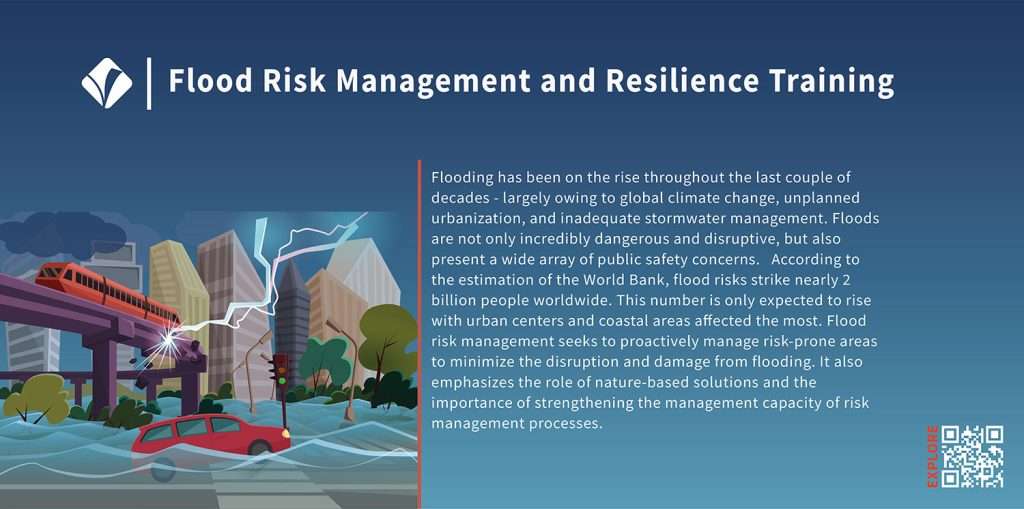
Flooding remains one of the world’s most frequent and costly natural hazards, affecting millions of people each year while causing significant damage to infrastructure, agriculture, ecosystems, and economies. Climate change, rapid urbanization, rising sea levels, changing rainfall patterns, aging infrastructure, and increasing population density have intensified flood risks across both developed and developing countries.
Governments, municipalities, development agencies, infrastructure authorities, humanitarian organizations, and environmental institutions are increasingly investing in integrated flood risk management, climate adaptation, resilient infrastructure, early warning systems, and sustainable urban planning to reduce disaster risks and strengthen community resilience.
This Flood Risk Management Training equips participants with practical knowledge, internationally recognized frameworks, and innovative approaches required to identify, assess, manage, and reduce flood risks while strengthening climate resilience and sustainable development.
Participants will explore flood hazard assessment, climate risk analysis, flood forecasting, GIS applications, remote sensing, resilient infrastructure, nature-based solutions, integrated water resources management, emergency preparedness, recovery planning, and institutional resilience using international best practices.
Professionals seeking stronger capabilities in disaster risk reduction, climate adaptation, environmental resilience, and sustainable infrastructure may also benefit from our Environmental & Social Safeguards (World Bank ESF, IFC & ADB SPS) Training, Climate Risk & Health Security Capacity Building Programme, and Environmental Risk Assessment Training.
This Flood Risk Management Training strengthens institutional capability in:
- Integrated flood risk management
- Climate change adaptation
- Flood resilience planning
- Urban flood management
- Flood hazard and vulnerability assessment
- Flood forecasting and early warning systems
- Geographic Information Systems (GIS)
- Remote sensing applications
- Flood modeling and risk analysis
- Nature-based flood management solutions
- Blue-green infrastructure
- River basin management
- Stormwater management
- Coastal flood resilience
- Infrastructure resilience
- Disaster Risk Reduction (DRR)
- Emergency preparedness and response
- Recovery and Build Back Better strategies
- Climate governance
- Community resilience
- Sustainable urban development
The programme combines internationally recognized flood management frameworks with practical applications relevant to ministries, municipalities, disaster management authorities, environmental agencies, water utilities, infrastructure organizations, humanitarian agencies, development partners, engineering firms, and climate adaptation programmes.
The Growing Importance of Flood Risk Management & Climate Resilience
Floods are becoming more frequent, severe, and unpredictable due to climate change, urban expansion, environmental degradation, and increasing pressure on water systems. As governments and organizations invest in resilient infrastructure and climate adaptation, the demand for professionals capable of managing flood risks and protecting communities continues to grow.
Organizations increasingly require professionals capable of:
- Developing flood resilience strategies
- Conducting flood hazard assessments
- Managing climate-related flood risks
- Applying GIS and flood modelling technologies
- Developing early warning systems
- Strengthening urban flood management
- Integrating nature-based solutions
- Improving stormwater management
- Protecting critical infrastructure
- Supporting community resilience
- Managing disaster preparedness and recovery
- Strengthening climate adaptation planning
Strong flood risk management capabilities help organizations:
- Reduce disaster losses
- Improve public safety
- Protect infrastructure investments
- Strengthen climate resilience
- Improve emergency preparedness
- Support sustainable urban development
- Enhance environmental sustainability
- Improve institutional coordination
- Reduce economic disruption
- Strengthen long-term resilience
- Improve disaster recovery planning
- Build safer and more resilient communities
Weak flood management systems often result in infrastructure damage, economic losses, displacement, environmental degradation, reduced investment confidence, and increasing vulnerability to climate-related disasters.
As climate risks continue to increase, governments worldwide are integrating climate adaptation, resilient infrastructure, nature-based solutions, digital technologies, and community-based resilience into long-term flood risk management strategies.
Who Should Attend This Flood Risk Management Training
This programme is designed for:
- Disaster Risk Management Professionals
- Climate Change Specialists
- Water Resources Engineers
- Environmental Specialists
- Civil Engineers
- Municipal Engineers
- Urban Planners
- Infrastructure Managers
- Emergency Management Officials
- Civil Protection Authorities
- Water Utility Professionals
- Environmental Protection Agencies
- River Basin Authorities
- Coastal Zone Managers
- GIS Specialists
- Humanitarian Organizations
- Development Practitioners
- Climate Adaptation Advisors
- Government Officials
- Public Works Authorities
- Local Government Officials
- Development Bank Professionals
- Infrastructure Consultants
- Environmental Consultants
Tick what your team needs to be able to do.
Programme Objectives
By the end of this programme participants will be able to:
- Apply integrated flood risk management principles
- Conduct flood hazard and vulnerability assessments
- Strengthen climate adaptation planning
- Improve flood forecasting and early warning systems
- Apply GIS and remote sensing technologies
- Develop resilient infrastructure strategies
- Integrate nature-based flood management solutions
- Strengthen disaster preparedness and emergency response
- Improve institutional coordination and governance
- Support community-based resilience initiatives
- Develop recovery and Build Back Better strategies
- Prepare practical institutional flood resilience action plans
This programme strengthens organizational capability in flood risk management, climate resilience, disaster risk reduction, sustainable infrastructure, environmental governance, emergency preparedness, and long-term institutional resilience.
Programme Structure and Contents
- Global flood risk trends and emerging challenges
- Climate change and its impact on flood frequency and severity
- Principles of Integrated Flood Risk Management (IFRM)
- Flood hazard, exposure, vulnerability, and risk assessment
- River basin and watershed management
- Flood governance and institutional coordination
- Flood hazard mapping and spatial analysis
- Geographic Information Systems (GIS) applications
- Remote sensing for flood monitoring
- Hydrological and hydraulic modeling
- Flood forecasting techniques
- Early warning systems
- Urban flooding challenges and solutions
- Climate-resilient urban planning
- Sustainable drainage systems (SuDS)
- Blue-green infrastructure
- Sponge city concepts
- Wetlands restoration and ecosystem-based adaptation
- Flood emergency planning
- Multi-agency coordination and incident management
- Community-based disaster risk reduction
- Public awareness and risk communication
- Flood evacuation planning
- Business continuity and critical infrastructure protection
- Climate adaptation strategies for flood resilience
- Recovery and Build Back Better principles
- Financing climate resilience and flood mitigation
- Institutional governance and policy integration
- Monitoring, evaluation, and resilience indicators
- Cross-sector collaboration and stakeholder engagement
Full day-by-day contents
First Day | Climate Change, Integrated Flood Risk Management & Resilient Planning
- Global flood risk trends and emerging challenges
- Climate change and its impact on flood frequency and severity
- Principles of Integrated Flood Risk Management (IFRM)
- Flood hazard, exposure, vulnerability, and risk assessment
- River basin and watershed management
- Flood governance and institutional coordination
- International frameworks for disaster risk reduction and climate adaptation
- Policy development for resilient communities
- Strategic planning for flood resilience
Exercise: Flood Risk Assessment and Institutional Readiness Analysis
Integrated flood risk management enables governments and organizations to move beyond reactive disaster response toward proactive planning, resilient infrastructure, and long-term climate adaptation.
Second Day | Flood Hazard Assessment, GIS, Remote Sensing & Digital Technologies
- Flood hazard mapping and spatial analysis
- Geographic Information Systems (GIS) applications
- Remote sensing for flood monitoring
- Hydrological and hydraulic modeling
- Flood forecasting techniques
- Early warning systems
- Artificial Intelligence and predictive analytics for flood management
- Digital twins and smart water management
- Climate data and decision-support systems
Workshop: GIS-Based Flood Hazard Mapping and Early Warning System Design
Modern flood management increasingly relies on digital technologies, geospatial intelligence, and predictive analytics to improve preparedness, reduce risks, and strengthen decision-making.
Professionals seeking stronger digital capabilities may also benefit from our GIS & Spatial Data Analysis and Data Analysis & Reporting programmes.
Third Day | Urban Flood Adaptation, Nature-Based Solutions & Infrastructure Resilience
- Urban flooding challenges and solutions
- Climate-resilient urban planning
- Sustainable drainage systems (SuDS)
- Blue-green infrastructure
- Sponge city concepts
- Wetlands restoration and ecosystem-based adaptation
- Flood-resilient transport and utility infrastructure
- Coastal and river flood protection
- Green infrastructure investment
- Asset resilience and maintenance planning
Case Study: Urban Flood Resilience and Nature-Based Flood Management
Nature-based solutions complement traditional engineering approaches by reducing flood risks, improving biodiversity, enhancing water quality, and creating healthier, more resilient urban environments.
Fourth Day | Emergency Preparedness, Early Warning Systems & Community Resilience
- Flood emergency planning
- Multi-agency coordination and incident management
- Community-based disaster risk reduction
- Public awareness and risk communication
- Flood evacuation planning
- Business continuity and critical infrastructure protection
- Humanitarian response coordination
- Recovery planning and rapid damage assessment
- Building resilient communities
Workshop: Flood Emergency Response and Community Resilience Planning
Effective emergency preparedness requires coordinated planning, timely communication, community engagement, and resilient institutions capable of responding quickly before, during, and after flood events.
Fifth Day | Climate Adaptation, Recovery, Governance & Future Flood Management
- Climate adaptation strategies for flood resilience
- Recovery and Build Back Better principles
- Financing climate resilience and flood mitigation
- Institutional governance and policy integration
- Monitoring, evaluation, and resilience indicators
- Cross-sector collaboration and stakeholder engagement
- Future trends in flood risk management
- Innovation in water management
- Developing long-term resilience roadmaps
Capstone Exercise: Institutional Flood Risk Management & Climate Resilience Action Plan
Successful flood risk management requires strong governance, climate-informed planning, resilient infrastructure, innovative technologies, community participation, and sustainable investment. By integrating engineering solutions, nature-based approaches, digital technologies, and institutional collaboration, organizations can reduce disaster risks, strengthen climate resilience, and protect lives, livelihoods, and critical infrastructure for future generations.
Flood Risk Management Training Methodology
This programme uses a highly practical and interactive methodology that combines internationally recognized flood risk management practices with real-world applications from leading climate adaptation, water management, and disaster resilience initiatives.
The programme combines:
- Expert-led technical sessions
- International flood resilience case studies
- Climate adaptation workshops
- Flood risk assessment exercises
- GIS and remote sensing demonstrations
- Flood modeling simulations
- Nature-based solutions planning
- Emergency response scenarios
- Group discussions and peer learning
- Practical problem-solving workshops
- Institutional resilience assessments
- Action planning exercises
Participants develop practical tools, implementation strategies, and institutional action plans that can be immediately applied to strengthen flood resilience, climate adaptation, emergency preparedness, and sustainable water management.
Host Country Profile – Japan
Japan is internationally recognized as a global leader in flood risk management, disaster risk reduction, climate resilience, and emergency preparedness. The country has developed advanced systems for managing typhoons, heavy rainfall, river flooding, coastal hazards, and urban flood risks through strong engineering, digital monitoring, early warning systems, and institutional coordination.
Tokyo has become an international model for urban flood adaptation through its advanced flood control infrastructure, underground flood diversion facilities, smart drainage systems, real-time forecasting, and risk-informed urban planning. Japan’s integrated approach demonstrates how technology, infrastructure, community preparedness, and strong governance can reduce flood impacts and protect lives, assets, and critical services.
Participants will gain valuable exposure to internationally recognized best practices in flood forecasting, urban flood resilience, early warning systems, climate-resilient infrastructure, emergency response coordination, and digital flood monitoring that can be adapted to strengthen flood management initiatives within their own countries and institutions.
Institutional Application
This Flood Risk Management Training supports organizations in strengthening:
- Integrated flood risk management
- Climate adaptation planning
- Flood resilience strategies
- Disaster risk reduction programmes
- Water resources management
- Urban resilience planning
- Infrastructure resilience
- Early warning systems
- Emergency preparedness
- Climate governance
- Community resilience
- Cross-sector coordination
Participants return with practical tools to improve:
- Flood risk assessments
- Climate resilience planning
- Flood forecasting and monitoring
- Infrastructure protection
- Emergency response coordination
- Nature-based flood management
- Institutional preparedness
- Community engagement
- Disaster recovery planning
- Long-term resilience strategies
Strong flood risk management capabilities are increasingly essential for organizations seeking to reduce disaster risks, strengthen climate resilience, protect critical infrastructure, improve public safety, and support sustainable economic and environmental development.
Regional Relevance & Application
Africa
Supporting flood resilience, watershed management, climate adaptation, disaster risk reduction, urban drainage improvement, and community-based resilience across rapidly growing cities and vulnerable rural areas.
South Asia
Strengthening monsoon flood management, river basin planning, climate adaptation, resilient infrastructure, and disaster preparedness in highly flood-prone regions.
Southeast Asia
Supporting coastal resilience, urban flood management, climate-smart infrastructure, early warning systems, and integrated water resources management.
Middle East
Enhancing flash flood management, water security, climate resilience, sustainable urban drainage, and emergency preparedness in water-scarce environments.
Europe & Central Asia
Strengthening integrated flood risk management, climate adaptation, resilient infrastructure, digital water management, and cross-border cooperation for sustainable flood resilience.
Across these regions, governments and organizations increasingly require professionals capable of integrating climate adaptation, resilient infrastructure, digital technologies, sustainable water management, and disaster risk reduction to protect communities, strengthen institutional resilience, and support long-term sustainable development.
Expected Outcomes of this Flood Risk Management Training
Participants will be able to:
- Apply integrated flood risk management principles
- Conduct flood hazard and vulnerability assessments
- Strengthen climate adaptation and resilience planning
- Apply GIS, remote sensing, and digital technologies
- Improve flood forecasting and early warning systems
- Develop resilient infrastructure strategies
- Integrate nature-based solutions into flood management
- Strengthen disaster preparedness and emergency response
- Improve institutional coordination and governance
- Enhance community resilience and stakeholder engagement
- Support recovery and Build Back Better initiatives
- Develop practical institutional flood resilience action plans
Participants leave with practical tools, internationally recognized frameworks, and implementation strategies to strengthen flood risk management systems, improve climate resilience, enhance emergency preparedness, protect critical infrastructure, and support sustainable, resilient communities.
£4,860 per participant · invoice and bank transfer · groups of 5 or more receive a discount
Five or more from one organisation: ask for the group rate on the invoice request.
Ten or more: an in-house version for your institution may cost less per person. Ask for an in-house quote.
Registration closes in 5 days (23 Oct 2026)
Programme Delivery Approach
This programme adopts a highly practical, participant-centered, and implementation-oriented learning approach that combines international best practices with successful flood management, climate adaptation, and resilient infrastructure models from the Netherlands and other leading climate-resilient countries.
The methodology combines:
- Interactive executive presentations
- Flood management case studies
- Climate resilience workshops
- GIS and digital technology demonstrations
- Flood forecasting and early warning exercises
- Infrastructure resilience assessments
- Nature-based solutions planning activities
- Group problem-solving exercises
- Executive peer learning and knowledge exchange
- Institutional self-assessments
- Development of organization-specific flood resilience action plans
- Technical site visits and field learning (where applicable)
Throughout the programme, participants will work on practical scenarios reflecting the challenges commonly faced by governments, municipalities, water authorities, disaster management agencies, infrastructure organizations, humanitarian agencies, and development partners responsible for flood risk management and climate resilience.
By the end of the programme, participants will develop practical institutional action plans outlining priority initiatives to strengthen flood risk governance, improve climate adaptation planning, enhance emergency preparedness, protect critical infrastructure, and build long-term resilience within their organizations and communities.
Course Deliverables
Before the Programme
- Participant Pre-Assessment
- Flood Risk Management & Climate Resilience Readiness Assessment
- Institutional Capacity Self-Assessment
- Programme Briefing & Preparatory Reading Materials
- Flood Risk Management Resource Pack
- Complimentary Visa Support & Advisory
- Pre-Arrival Coordination & Travel Guidance
During the Programme
- Airport Pickup & Welcome Assistance
- Accommodation with Daily Breakfast
- Welcome Networking Dinner
- Risalat Executive Training Kit (Bag, Bottle, Mug, T-Shirt, Cap, Passport Cover, Pens, Notebook, Magnet & Keychain)
- Comprehensive Training Manual
- Flood Risk Management & Climate Resilience Toolkit
- Climate Adaptation Planning Guide
- Flood Hazard Assessment Templates
- GIS & Flood Mapping Reference Materials
- Early Warning System Frameworks
- Nature-Based Solutions Planning Guide
- Infrastructure Resilience Assessment Toolkit
- Emergency Preparedness & Response Templates
- Disaster Recovery & Build Back Better Frameworks
- Practical Case Studies & International Best Practices
- Interactive Workshops & Simulation Exercises
- Group Discussions & Executive Peer Learning
- Daily Lunch & Refreshments
- Full Access to Training Venue Facilities
- Mini Pad / Tablet with Digital Learning Materials
- Access to Climate & Flood Management Resources
- Technical Site Visit / Flood Protection Infrastructure Visit (where applicable)
- Entertaining City Tour
- Certificate of Completion
- Risalat Programme Participation Recognition Award
After the Programme
- Post-Training Reference Materials
- Flood Risk Management & Climate Resilience Toolkit
- Climate Adaptation Planning Templates
- Practical Institutional Recommendations
- Post-Training Support & Follow-Up Guidance
- Programme Report
Organizations seeking customized flood risk management, climate resilience, disaster risk reduction, water resources management, urban resilience, climate adaptation, or institution-specific capacity-building programmes are welcome to contact Risalat Consultants International for tailored solutions aligned with their organizational priorities and long-term resilience objectives.
Risalat Consultants International is committed to supporting governments, municipalities, development organizations, and infrastructure authorities in strengthening their capacity to manage flood risks, enhance climate resilience, and build safer, more sustainable communities.
This programme provides participants with practical knowledge, internationally recognized frameworks, and implementation-focused strategies to improve flood preparedness, strengthen climate adaptation, protect critical infrastructure, enhance institutional coordination, and support sustainable development.
Through exposure to the Netherlands’ internationally recognized expertise in flood risk management, climate adaptation, and innovative water governance, participants will gain valuable insights and practical tools that can be adapted to strengthen resilience initiatives within their own institutions and countries.
Should further customization be required, we would be pleased to tailor the programme content, technical visits, practical workshops, and case studies to align with your organization’s strategic priorities and capacity development needs.
We look forward to partnering with your organization in delivering a high-impact executive learning experience that creates lasting value by strengthening flood resilience, reducing disaster risks, and supporting climate-resilient development for future generations.
Common Challenges in Flood Risk Management & Climate Resilience, and How This Training Helps
How can governments better prepare for increasingly frequent and severe flood events?
Many countries continue to experience more frequent flooding due to climate change, rapid urbanization, and aging infrastructure. This programme provides practical approaches to integrated flood risk management, climate adaptation planning, and resilient infrastructure development that help reduce disaster risks and strengthen long-term preparedness.
How can organizations improve flood forecasting and early warning systems?
Timely and accurate flood forecasting is essential for protecting lives and critical infrastructure. Participants learn practical methods for integrating GIS, remote sensing, hydrological modeling, climate data, and early warning technologies to improve preparedness and decision-making before flood events occur.
How can cities become more resilient to urban flooding?
Urban expansion often increases surface runoff, overwhelms drainage systems, and exposes communities to greater flood risks. This programme explores sustainable urban drainage systems, blue-green infrastructure, nature-based solutions, and climate-resilient urban planning that improve flood resilience while enhancing environmental sustainability.
How can institutions strengthen coordination before, during, and after flood emergencies?
Flood management often requires collaboration across multiple agencies and sectors. Participants learn practical approaches to emergency preparedness, incident management, stakeholder coordination, recovery planning, and institutional governance that improve response effectiveness and organizational resilience.
How can organizations integrate climate adaptation into long-term development planning?
Climate risks increasingly affect infrastructure, economic development, agriculture, and public services. This programme introduces practical strategies for integrating climate adaptation, flood resilience, and disaster risk reduction into policies, infrastructure planning, investment decisions, and institutional frameworks.
How can communities become more resilient to flood disasters?
Building resilience requires more than physical infrastructure. Participants explore community-based disaster risk reduction, public awareness campaigns, stakeholder engagement, evacuation planning, and inclusive resilience strategies that strengthen preparedness and reduce vulnerability.
How can organizations protect critical infrastructure from flood risks?
Flooding can disrupt transportation, utilities, healthcare, communications, and other essential services. This programme examines infrastructure risk assessments, resilient engineering approaches, business continuity planning, and asset protection strategies that improve operational resilience.
How can institutions develop practical flood resilience strategies that deliver measurable results?
Many organizations have flood management policies but struggle with implementation. Participants learn how to prioritize investments, establish governance structures, define resilience indicators, monitor progress, and develop actionable flood resilience roadmaps that support sustainable long-term outcomes.