Key facts
- Dates
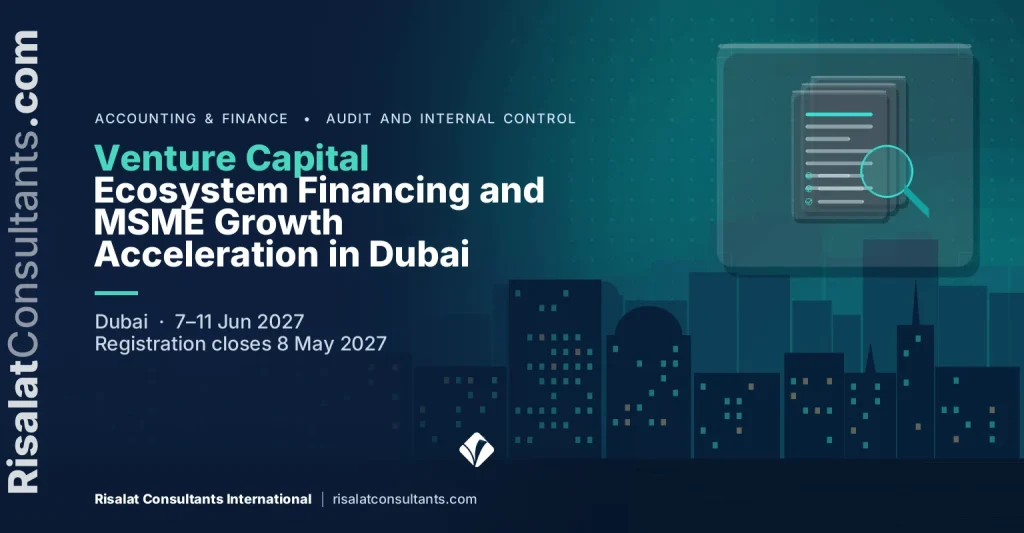
- 7–11 Jun 2027 (5 days)
- Where
- Dubai, United Arab Emirates
- Fee per participant
- £2,850 (GBP)
- Payment
- By invoice and bank transfer
- Registration closes
- 8 May 2027
- Certificate
- Certificate of completion
- In-house option
- Run it for your team, on your dates
On this page 12 sections
Programme Overview
This five-day training programme delivers operational methodologies for financing venture capital ecosystems and accelerating micro, small, and medium enterprise (MSME) expansion. Hosted in Dubai, the course equips public officials and fund managers with practical mechanisms to deploy early-stage capital effectively. Participants examine how public interventions can catalyse private investment through matching funds, angel co-investment frameworks, and targeted risk-sharing instruments, ensuring market-driven capital reaches high-potential enterprises while maintaining robust governance and transparency.
The curriculum addresses the operational hurdles associated with non-bank credit enhancements, early-stage equity structuring, and technical assistance integration. Attendees analyse performance measurement across venture portfolios, exit pathways, and supervisory frameworks required to oversee non-bank financial intermediaries. Through comparative analyses of regional ecosystems, participants study practical approaches to de-risking innovative startups and growth-oriented MSMEs, focusing on sustainable financial architecture that aligns public policy goals with commercial fund management standards.
Special emphasis is placed on structuring pipeline development mechanisms for underserved market segments, particularly youth-led enterprises and tech-enabled businesses. Delegates evaluate fund-of-funds structures, selection criteria for private fund managers, and monitoring frameworks compatible with multilateral development bank standards. By bridging public development objectives and private investment criteria, the programme provides actionable instruments to manage enterprise support facilities, enhance fund governance, and improve systemic access to finance.
Public development institutions and regional authorities are actively operationalising initiatives such as the Catalyzing Entrepreneurship for Job Creation project, requiring public officers to shift from traditional grants toward sophisticated catalytic financing. Expanding labour markets in North Africa and the wider region necessitates rapid enterprise development, yet early-stage ventures face acute financing gaps. By mastering co-investment instruments, non-bank guarantees, and structured portfolio monitoring now, implementing agencies can efficiently mobilise private capital, safeguard public resources, and accelerate high-growth job creation in youth-led sectors.
Delivered by Risalat Consultants International in Dubai, United Arab Emirates, it combines expert-led sessions, real cases and group work, so that participants can apply what they learn in their own institution.
The Programme Strengthens Institutional Capability
- Venture capital market dynamics, capital escalators, and public finance intervention logic
- Structuring public-private matching funds: legal vehicles, pari passu principles, and governance
- Fund manager procurement, selection criteria, and management fee benchmarking
- Managing conflicts of interest and ensuring fiduciary compliance under multilateral guidelines
- Case analysis of matching fund models deployed in emerging enterprise ecosystems
- Developing accredited business angel networks and syndication frameworks
- Angel co-investment fund mechanics: sidecar funds, direct co-investments, and qualifying criteria
- Term sheet design, valuation methodologies for pre-revenue firms, and shareholder agreements
- Fraud risk assessment and fraud risk registers
- Design and testing of internal controls
- The Three Lines model and the role of oversight
- Audit planning, evidence and documentation
It is designed for SME development agency officers and programme directors, enterprise development fund managers and investment officers, microfinance and non-bank financial institution supervisors and others who want practical, current skills in fraud, audit and internal control.
The Growing Importance of Venture Capital Ecosystem Financing and MSME Growth Acceleration in Dubai
Public bodies and donor-financed projects are expected to show that funds are used for their intended purpose. Auditors, oversight bodies and financiers increasingly look beyond the financial statements to the controls, records and behaviours behind them.
Fraud and control weaknesses rarely come from one failure. They grow where roles are unclear, records are incomplete and warning signs are not followed up. Teams that understand how fraud happens, and how controls stop it, protect both their institution and the people it serves.
Organisations increasingly require professionals capable of:
- Identify and rate fraud and control risks in their own processes
- Design controls that are proportionate and testable
- Gather and document reliable audit evidence
- Recognise red flags early and escalate them correctly
- Turn findings into practical, agreed actions
Strong fraud, audit and internal control systems help organisations:
- Reduce losses and ineligible expenditure
- Pass external audits with fewer findings
- Strengthen trust with financiers and citizens
- Respond to allegations in a fair and documented way
This Venture Capital Ecosystem Financing and MSME Growth Acceleration in Dubai programme brings these elements together in a practical format, so that participants understand not only what good practice looks like but also how to introduce it in their own setting, with the people and resources they have.
Who Should Attend This Venture Capital Ecosystem Financing and MSME Growth Acceleration in Dubai Training?
This programme is designed for:
- SME development agency officers and programme directors
- Enterprise development fund managers and investment officers
- Microfinance and non-bank financial institution supervisors
- Central bank and financial regulatory authority specialists
- Public incubation and acceleration facility directors
- National credit guarantee scheme managers
- Ministry of finance and economy technical advisors
- Donor-funded project implementation unit (PIU) personnel
- Public venture fund investment committee members
- Internal auditors and audit managers
- Finance managers and accountants
- Compliance and risk officers
The programme suits experienced professionals as well as those moving into new responsibilities. Groups that mix institutions and countries are encouraged, because participants learn a great deal from each other’s experience.
Tick what your team needs to be able to do.
Venture Capital Ecosystem Financing and MSME Growth Acceleration in Dubai Training Objectives
Upon successful completion of this Venture Capital Ecosystem Financing and MSME Growth Acceleration in Dubai Training, participants will be able to:
- Design early-stage venture capital matching fund architectures aligned with international public finance standards
- Structure angel investor co-investment models that mobilise private equity into seed-stage enterprises
- Appraise non-bank credit guarantee mechanisms to lower collateral requirements for growing MSMEs
- Establish rigorous portfolio performance monitoring systems using standardised venture capital metrics
- Formulate integrated technical assistance packages tailored for youth-led and technology-enabled startups
- Implement effective due diligence and governance protocols for selecting independent fund managers
- Assess regulatory and supervisory frameworks that govern non-bank financing institutions and venture facilities
- Explain how and why fraud happens, using recognised fraud risk models
- Carry out a fraud and control risk assessment for a real process
- Map controls to risks using the Three Lines model
Each objective is practised during the programme through exercises, cases or group work, so that participants leave able to do it, not only to describe it.
Programme Contents and Structure
- Venture capital market dynamics, capital escalators, and public finance intervention logic
- Structuring public-private matching funds: legal vehicles, pari passu principles, and governance
- Fund manager procurement, selection criteria, and management fee benchmarking
- Managing conflicts of interest and ensuring fiduciary compliance under multilateral guidelines
- Case analysis of matching fund models deployed in emerging enterprise ecosystems
- Developing accredited business angel networks and syndication frameworks
- Angel co-investment fund mechanics: sidecar funds, direct co-investments, and qualifying criteria
- Term sheet design, valuation methodologies for pre-revenue firms, and shareholder agreements
- Standard investment instruments: convertible notes, SAFEs, and ordinary equity structures
- Practical workshop on drafting term sheets and setting investor protection clauses
- Principles of partial credit guarantee schemes: individual, portfolio, and capped structures
- Extending guarantee coverage to non-bank financial institutions and venture debt funds
- Pricing risk, guarantee fee setting, and default settlement operational procedures
- Alternative financing mechanisms: revenue-based financing, factoring, and invoice discounting
- Stress testing guarantee portfolios and assessing non-performing asset provisions
- Application of International Private Equity and Venture Capital Valuation (IPEV) Guidelines
- Venture portfolio KPIs: TVPI, DPI, IRR, loss ratios, and operational runway tracking
- Environmental, Social, and Governance (ESG) tracking and reporting for early-stage portfolios
- Structuring exit strategies: strategic sales, secondary buyouts, and founder share repurchases
- Designing management information systems (MIS) for real-time portfolio oversight
- Embedding non-financial business development services alongside capital deployment
- Designing targeted acceleration and investment-readiness interventions for youth-led enterprises
- Supervisory and regulatory compliance for enterprise development and microfinance authorities
- Monitoring development results: employment creation, gender inclusion, and private capital mobilisation
- Action planning: structuring a catalytic financing initiative for institutional implementation
Full day-by-day contents
The programme runs over 5 days. Each day combines expert input, practical work and a closing workshop or case study:
- First Day: Venture Ecosystem Architecture and Public Matching Funds
- Second Day: Angel Co-Investment Facilities and Early-Stage Equity Structuring
- Third Day: Non-Bank SME Credit Guarantees and Alternative Debt Instruments
- Fourth Day: Portfolio Performance Monitoring, Valuation, and Exit Governance
- Fifth Day: Technical Assistance Integration and Youth-Led Startup Acceleration
Full day-by-day contents
First Day | Venture Ecosystem Architecture and Public Matching Funds
- Venture capital market dynamics, capital escalators, and public finance intervention logic
- Structuring public-private matching funds: legal vehicles, pari passu principles, and governance
- Fund manager procurement, selection criteria, and management fee benchmarking
- Managing conflicts of interest and ensuring fiduciary compliance under multilateral guidelines
- Case analysis of matching fund models deployed in emerging enterprise ecosystems
Workshop: Venture Ecosystem Architecture and Public Matching Funds: Applying It to Your Institution
Working in small groups, participants apply the day's methods to examples from their own institutions and agree practical next steps.
Second Day | Angel Co-Investment Facilities and Early-Stage Equity Structuring
- Developing accredited business angel networks and syndication frameworks
- Angel co-investment fund mechanics: sidecar funds, direct co-investments, and qualifying criteria
- Term sheet design, valuation methodologies for pre-revenue firms, and shareholder agreements
- Standard investment instruments: convertible notes, SAFEs, and ordinary equity structures
- Practical workshop on drafting term sheets and setting investor protection clauses
Workshop: Angel Co-Investment Facilities and Early-Stage Equity Structuring: Applying It to Your Institution
Working in small groups, participants apply the day's methods to examples from their own institutions and agree practical next steps.
Third Day | Non-Bank SME Credit Guarantees and Alternative Debt Instruments
- Principles of partial credit guarantee schemes: individual, portfolio, and capped structures
- Extending guarantee coverage to non-bank financial institutions and venture debt funds
- Pricing risk, guarantee fee setting, and default settlement operational procedures
- Alternative financing mechanisms: revenue-based financing, factoring, and invoice discounting
- Stress testing guarantee portfolios and assessing non-performing asset provisions
Case Study: Non-Bank SME Credit Guarantees and Alternative Debt Instruments in Practice
Participants analyse a realistic case, compare the choices made with good practice and draw lessons they can use in their own setting.
Fourth Day | Portfolio Performance Monitoring, Valuation, and Exit Governance
- Application of International Private Equity and Venture Capital Valuation (IPEV) Guidelines
- Venture portfolio KPIs: TVPI, DPI, IRR, loss ratios, and operational runway tracking
- Environmental, Social, and Governance (ESG) tracking and reporting for early-stage portfolios
- Structuring exit strategies: strategic sales, secondary buyouts, and founder share repurchases
- Designing management information systems (MIS) for real-time portfolio oversight
Workshop: Portfolio Performance Monitoring, Valuation, and Exit Governance: Applying It to Your Institution
Working in small groups, participants apply the day's methods to examples from their own institutions and agree practical next steps.
Fifth Day | Technical Assistance Integration and Youth-Led Startup Acceleration
- Embedding non-financial business development services alongside capital deployment
- Designing targeted acceleration and investment-readiness interventions for youth-led enterprises
- Supervisory and regulatory compliance for enterprise development and microfinance authorities
- Monitoring development results: employment creation, gender inclusion, and private capital mobilisation
- Action planning: structuring a catalytic financing initiative for institutional implementation
Capstone Exercise: Venture Capital Ecosystem Financing and MSME Growth Acceleration in Dubai Action Plan for Your Institution
Participants bring the week together in an action plan for their own institution, with priorities, owners and first steps, and present it for feedback from peers and facilitators.
- Transaction
- Record
- Control
- Evidence
- Opinion
Venture Capital Ecosystem Financing and MSME Growth Acceleration in Dubai Training Methodology
The training employs a practical, problem-driven methodology suited to public officials and institutional fund managers. Instruction integrates operational case studies, technical walkthroughs of fund terms, and hands-on portfolio simulation exercises. Participants work with real investment documentation, standard guarantee templates, and monitoring scorecards. Facilitated peer discussions encourage cross-country exchange on regulatory adaptation and ecosystem support, concluding with individual institutional action plans to operationalise investment facilities within their respective home agencies.
The programme combines:
- Expert-led sessions on current practice
- Regional and international case studies
- Group work and practical exercises
- Simulations and role plays where relevant
- Discussion of participants' own challenges
- Peer learning across institutions and countries
- Practical tools and templates to take back to work
- Daily reflection and action planning
Before the programme, a short pre-assessment helps the facilitators understand each participant’s role and priorities, so that examples and exercises can be adjusted to the group. Each day ends with a short reflection in which participants note what they will apply at work.
Expected Outcomes
Upon completion of this Venture Capital Ecosystem Financing and MSME Growth Acceleration in Dubai Training, participants will be able to:
- Capability to structure and launch operational public venture capital matching and co-investment funds
- Proficiency in drafting and negotiating early-stage investment terms, sidecar structures, and equity covenants
- Operational ability to design, price, and monitor non-bank partial credit guarantee schemes for MSMEs
- Mastery of portfolio tracking using IPEV valuation guidelines and international fund performance benchmarks
- Competence in designing blended finance and technical assistance mechanisms targeting youth-led startups
- Enhanced supervisory oversight of non-bank financial intermediaries engaged in MSME financing
- Assess fraud and control risks in their own processes
- Design and test proportionate controls
Participants leave with a personal action plan and practical tools they can use in their institution from the first week back. Institutions that send several participants can use the programme to agree shared methods and templates across teams, which makes improvements easier to sustain.
£2,850 per participant · invoice and bank transfer · groups of 5 or more receive a discount
Five or more from one organisation: ask for the group rate on the invoice request.
Ten or more: an in-house version for your institution may cost less per person. Ask for an in-house quote.
Registration closes in 181 days (8 May 2027)
Institutional Application of Venture Capital Ecosystem Financing and MSME Growth Acceleration in Dubai Training
This programme supports organisations in strengthening:
- Fraud and corruption risk management
- Internal control frameworks
- Audit and oversight arrangements
- Follow-up of audit findings
- Integrity and reporting channels
Participants return with practical tools to improve:
- Risk registers and control maps
- Audit planning and testing
- Evidence and documentation
- Reporting to management and boards
- Prevention of ineligible expenditure
The programme is built so that learning moves from the classroom into the institution. Participants work on their own processes and documents where possible, and leave with an action plan that their managers can review and support.
Regional Relevance & Application
Europe
European institutions apply fraud, audit and internal control within detailed regulatory frameworks and reform agendas. Participants from Europe can compare their practice with colleagues from other regions and test how established methods work under different conditions.
Africa
Across Africa, ministries, agencies and project teams working in fraud, audit and internal control increasingly operate alongside donor-financed programmes that expect clear systems and evidence. The programme helps participants adapt good practice to the institutions and resources they work with.
Middle East
In the Middle East, national development strategies and diversification plans place growing demands on fraud, audit and internal control. Participants explore how to build the capability these plans need inside public bodies and companies.
Asia
Institutions across Asia combine rapid growth with ambitious modernisation programmes. Participants from Asia can share their experience of scaling systems quickly and learn from approaches used elsewhere.
Pacific
Small island and Pacific states face particular constraints of size, distance and capacity. The programme highlights practical, proportionate approaches to fraud, audit and internal control that suit smaller institutions.
Holding the programme in Dubai, United Arab Emirates brings participants together away from their daily pressures, so they can compare how fraud, audit and internal control is handled in different settings. The same programme can also be delivered in-house for one institution, in its own country or online, with cases taken from its current work.
Host Country Profile – United Arab Emirates
Programmes, Workshops, Exposures, Training Courses in Dubai, UAE by Risalat Consultants International
Studying away from their own country gives participants time to focus, a fresh view of their own institution and the chance to build a network with colleagues from other countries.
Venture Capital Ecosystem Financing and MSME Growth Acceleration in Dubai Training Deliverables
Participants receive support before, during and after the programme, so that preparation, learning and follow-up form one continuous experience.
Before the Programme
- Participant Pre-Assessment
- Venture Capital Ecosystem Financing and MSME Growth Acceleration in Dubai Readiness Assessment
- Venture Capital Ecosystem Financing and MSME Growth Acceleration in Dubai Resource Pack
- Preparatory Reading Materials
- Complimentary Visa Support & Advisory
During the Programme
- Airport Pickup & Welcome Assistance
- Accommodation with Breakfast
- Welcome Networking Dinner
- Risalat Training Kit (Bag, Bottle, Mug, T-Shirt, Cap, Passport Cover, Pens, Notebook, Magnet & Keychain)
- Comprehensive Venture Capital Ecosystem Financing and MSME Growth Acceleration in Dubai Training Manual
- Fraud Risk Register Template
- Control Mapping Matrix
- Audit Evidence Checklist
- Findings and Follow-up Tracker
- Practical Workshops & Simulations
- Group Discussions & Peer Learning
- Daily Lunch and Refreshments
- Full Access to Training Venue Facilities
- Mini Pad / Tablet with Digital Learning Materials
- Field Visit (where applicable)
- Entertaining City Tour
After the Programme
- Certificate of Completion
- Risalat Programme Participation Recognition Award
- Post-Training Reference Materials
- Fraud Risk Self-Assessment Guide
- Control Testing Checklist
- Post-Training Support & Follow-Up Guidance
- Programme Report
Institutions can also request a tailored in-house version of this programme, delivered at their premises or online. Request a proposal.
Common Challenges in Venture Capital Ecosystem Financing and MSME Growth Acceleration in Dubai, And How This Training Helps
How can institutions identify and rate fraud and control risks in their own processes?
The programme addresses this directly on the first day (Venture Ecosystem Architecture and Public Matching Funds), where participants practise the methods involved and adapt them to their own institution, then build it into their action plan.
How can institutions design controls that are proportionate and testable?
The programme addresses this directly on the second day (Angel Co-Investment Facilities and Early-Stage Equity Structuring), where participants practise the methods involved and adapt them to their own institution, then build it into their action plan.
How can institutions gather and document reliable audit evidence?
The programme addresses this directly on the third day (Non-Bank SME Credit Guarantees and Alternative Debt Instruments), where participants practise the methods involved and adapt them to their own institution, then build it into their action plan.
How can institutions recognise red flags early and escalate them correctly?
The programme addresses this directly on the fourth day (Portfolio Performance Monitoring, Valuation, and Exit Governance), where participants practise the methods involved and adapt them to their own institution, then build it into their action plan.
How can institutions turn findings into practical, agreed actions?
The programme addresses this directly on the fifth day (Technical Assistance Integration and Youth-Led Startup Acceleration), where participants practise the methods involved and adapt them to their own institution, then build it into their action plan.
Frequently Asked Questions
When and where does the Venture Capital Ecosystem Financing and MSME Growth Acceleration in Dubai programme take place?
It runs from 7 Jun 2027 to 11 Jun 2027, in Dubai, United Arab Emirates. The registration deadline is shown at the top of this page.
Who should attend?
The programme is designed for SME development agency officers and programme directors, enterprise development fund managers and investment officers, microfinance and non-bank financial institution supervisors, central bank and financial regulatory authority specialists, and others who want practical skills in fraud, audit and internal control.
Will I receive a certificate?
Yes. Participants who complete the programme receive a Certificate of Completion from Risalat Consultants International.
Can this programme be delivered for our institution only?
Yes. We can deliver a tailored in-house version at your premises, in another city or online, built around your own cases. Use the proposal request on this page.
Do I need prior experience in fraud, audit and internal control?
No specialist background is required beyond experience in a related role. A short pre-assessment helps the facilitators adapt the sessions to the group.
Training courses in DubaiAccounting & Finance training courses
Why Dubai for this programme
Dubai is a one-flight hub for Africa, Asia and Europe, with simple visas for many nationalities and modern training venues.
The Venture Capital Ecosystem Financing and MSME Growth Acceleration in Dubai programme in June 2027 brings together officials and professionals from across the Middle East region and beyond. Sessions combine short inputs, case studies and group work on participants' own files, and the city's institutions can be added as a study visit on request.
Getting there: Dubai International (DXB).
Check whether you need a visa with the free Visa Checker, and ask for an invitation letter once you are registered.
Other programmes in Dubai
- Cross-Border Transport and Fibre Corridor Infrastructure Management in Dubai
- Urban Sanitation Infrastructure Planning and Faecal Sludge Management in Dubai
- Groundwater Exploration and Small-Scale Irrigation Engineering in Dubai
- MSME Digital Credit Guarantees and Mobile Money Regulatory Supervision in Dubai
- Clean Energy Access Concessions and Private Operator Contracting in Dubai
Related: Enterprise and SME development programmes · free Training Needs Assessment · all programmes
More training courses in United Arab Emirates · All programmes in Middle East · Full training calendar
Plan this programme in a roadmap: why it matters, why to approve it, the dates to plan and the career it builds.