Key takeaways
- Establishing an accessible grievance redress mechanism in Yemen ensures affected communities can safely voice concerns regarding energy installations, land use, and service access.
- Multiple intake channels, systematic case logging, clear turnaround timelines, and formal closure protocols turn grievances into actionable project improvements.
- Preventing systemic risks requires addressing permits, contractor readiness, and operational costs prior to contract award.
- Rigorous readiness reviews before civil or electrical works begin protect public investments and strengthen community trust.
Introduction
Operating a responsive grievance redress mechanism in Yemen is essential for delivering infrastructure and basic services that genuinely serve local populations. Energy operations, including off-grid solar initiatives and transmission network rehabilitations, interact directly with land boundaries, municipal assets, and household access. When community members experience disruption, property encroachment, or unfair access to power services, they require dependable, transparent ways to raise their concerns. A well-designed grievance mechanism is not a mere compliance exercise. It is an operational management system that detects site-level problems early, verifies field conditions, and provides structured solutions before disputes escalate into broader community opposition.
What the money is for
Development financing across Yemen supports vital sectors ranging from social safety nets and primary education to food security, urban transport, municipal infrastructure, and emergency power access. The strategic deployment of these resources focuses heavily on human capital protection, basic public service continuity, and core community infrastructure. The portfolio includes major operations such as the Yemen Emergency Electricity Access Project-Phase II, the Integrated Urban Services Emergency Project II, and road connectivity improvements, alongside substantial emergency social protection and healthcare programmes. Please refer to the table below for the complete project allocations and sectoral breakdown.
| Project | Approved | World Bank financing | Sector |
|---|---|---|---|
| Emergency Social Protection Enhancement and COVID-19 Response Project | 2022 | US$300.0m | Social Protection, Public Administration – Social Protection |
| Emergency Social Protection Enhancement and COVID-19 Response Project AF2 | 2023 | US$207.0m | Social Protection, Public Administration – Social Protection |
| Emergency Social Protection Enhancement and COVID-19 Response Project | 2020 | US$203.9m | Social Protection, Public Administration – Social Protection |
| Yemen Restoring Education and Learning Emergency Project | 2020 | US$152.8m | Other Education, Primary Education |
| Emergency Social Protection Enhancement and COVID-19 Response Project – Third Additional Financing | 2024 | US$150.0m | |
| Second Additional Financing Yemen Emergency Human Capital Project | 2023 | US$150.0m | Health, Health Facilities and Construction |
| AF Yemen Food Security Response and Resilience Project | 2022 | US$150.0m | Public Administration – Agriculture, Fishing & Forestry, Agricultural markets, commercialization and agri-business |
| Yemen: Additional Financing for Emergency Human Capital Project | 2022 | US$150.0m | Health, Public Administration – Health |
Energy and power risk management
Energy interventions, particularly those involving solar systems, transmission lines, and distribution grids, encounter operational challenges when preparatory work is neglected. A frequent problem occurs when land acquisition, wayleaves, and local permits are not secured prior to contractor mobilisation. Unresolved land ownership and unclear access routes inevitably generate local disputes that halt field teams and strain community relationships.
To prevent this, project management units must execute a comprehensive readiness check of all land requirements, site permits, and detailed engineering designs before procurement commences. Assigning a designated responsible officer to each permit with strict delivery dates ensures that disputes do not spill over into the operational phase.
A second vulnerability involves the procurement of complex supply-and-install contracts, which routinely takes far longer than scheduled. Delays arise when technical specifications fail to reflect local supply realities or when evaluation committees lack specialised technical experience. Project teams must establish realistic procurement timelines, conduct early market soundings to understand regional supplier capacity, and ensure that bid evaluation committees receive targeted training before tenders are issued.
Finally, weak utility finances and misaligned tariff frameworks can make newly installed energy assets difficult to maintain and operate over time. If operational expenditure is not planned from the beginning, facilities degrade rapidly once external assistance concludes. Overcoming this requires thorough operating cost and tariff analysis during the initial design stage, accompanied by asset management plans established from day one.
Transport and urban infrastructure risk management
Urban infrastructure, municipal drainage repairs, and transport works frequently encounter friction when physical execution runs ahead of social and technical planning. A primary breakdown occurs when resettlement matters and utility relocations are deferred until after works contracts have been signed. Displaced vendors, severed water pipes, or obstructed municipal pathways cause direct community harm and generate immediate grievances that stall civil works.
Teams must ensure that comprehensive resettlement plans and utility relocation agreements are fully finalised, financed, and verified before the award of any civil works contract. Community liaison structures must be functioning so that affected residents understand what is taking place and where to seek redress.
Cost inflation through uncoordinated contract variations and contractor claims presents another recurring obstacle. Preventing these issues requires robust contract management disciplines: assigning named, accountable contract managers for each works package, enforcing structured monthly operational reports, and maintaining formal variation control protocols. In parallel, inadequate on-site supervision can lead to structural defects and substandard quality. Implementing clear supervision roles, agreed quality control plans, and mandatory independent technical reviews at specified milestones ensures infrastructure is constructed to standard.
Health and nutrition risk management
In the health and nutrition sector, a critical failure mode occurs when medical equipment and supplies arrive at regional clinics before the physical facilities are rehabilitated or before clinical personnel have been trained to use them. This leads to damaged diagnostic machinery, wasted medical consumables, and community dissatisfaction.
Project units must create tightly sequenced operational plans that synchronise equipment procurement, facility refurbishment, staffing allocations, and clinical training schedules so that all elements converge together.
Furthermore, results in public health programmes often prove difficult to verify when monitoring systems depend on fragmented documentation. Overcoming this requires establishing a practical results framework with simple, verifiable indicators and routine data collection protocols embedded into clinic workflows. Finally, health facilities frequently lack long-term operational and maintenance budgets, leaving critical infrastructure unsupported. Early formal agreements on dedicated maintenance budget lines with line ministries are essential to safeguard investments.
Education and skills risk management
Education sector interventions frequently face setbacks when professional development programmes fail to translate into tangible classroom improvements. Teacher training initiatives often deliver lectures without changing instructional delivery because programmes do not address the day-to-day realities of local schools.
To solve this, capacity building must be built upon targeted training needs assessments, pairing initial workshops with structured coaching, clear action plans, and regular follow-up visits. Weak administrative data regarding learning outcomes and teacher attendance poses another major challenge. Project teams must co-design information and assessment systems alongside the headteachers and district inspectors who maintain them daily.
Lastly, physical rehabilitation of school classrooms often falls behind schedule due to fragmented logistics and weak contractor oversight. Establishing clear community oversight arrangements and vetting contractor supply chains before funds flow protects construction quality and ensures safe learning spaces.
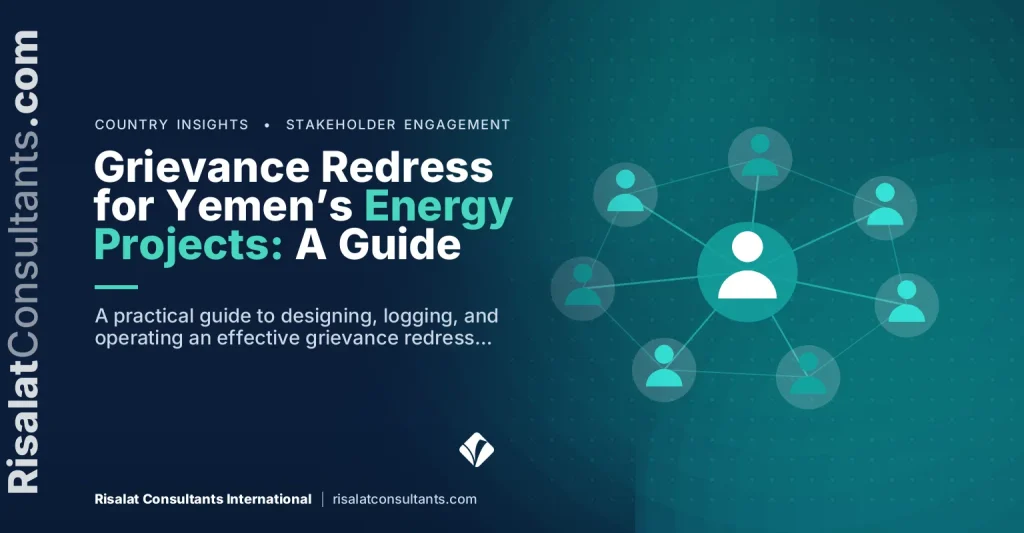
Setting up a functional grievance redress mechanism in Yemen
Operating a credible grievance redress mechanism in Yemen requires clear operating procedures across intake channels, registration, turnaround targets, investigation protocols, and closure documentation.
Accessible intake channels
Community members must have multiple, secure channels to log grievances without fear of retribution or prohibitive travel costs. A single intake channel is never adequate in complex operating environments. Practical options include:
- A dedicated telephone helpline and SMS text system staffed by trained intake operators fluent in local dialects.
- Physical intake points, such as secure suggestion boxes and weekly in-person intake desks situated at local council offices, partner clinics, or project construction offices.
- Community liaison focal points, selecting respected local representatives who are trained to record oral complaints from illiterate individuals, women, and vulnerable community members.
Logging and triage
Every concern, whether received by voice, message, or written submission, must be assigned a unique tracking identifier and entered into a central register within 24 hours. The intake log must record the date, location, complainant profile (with full options for confidentiality and anonymity), nature of the complaint (such as environmental dust, land access, contractor behaviour, or service exclusion), and the assigned risk category.
Strict timelines and investigation
A functional grievance redress mechanism relies on predictable timelines to build local credibility. Project teams should enforce a clear timetable:
- Formal acknowledgement of the complaint sent to the individual within 3 working days.
- Preliminary assessment and site verification completed within 10 working days.
- Proposed corrective action or formal response communicated within 20 working days.
- Escalation to a higher project review committee within 5 working days if the complainant rejects the proposed resolution.
Closure and systematic reporting
A grievance cannot be closed simply because an internal team drafted an explanation. A case is formally closed only when corrective field actions have been carried out and verified, and the affected party has confirmed satisfaction or exhausted the formal appeals procedure. Monthly analytical reports must aggregate grievance data to identify recurring system failures, such as chronic contractor non-compliance or systemic delays in compensation, allowing project directors to adapt operational management before issues multiply.
A readiness check before the first contract
Before issuing bid documents or awarding the first contract on any infrastructure or service delivery project, project directors and task teams should complete this essential readiness check:
- Land access, wayleaves, and legal ownership documents are verified, fully documented, and cleared by local authorities.
- Environmental and social management plans, including community health and safety provisions, are fully budgeted and embedded into tender specifications.
- The grievance redress mechanism is fully operational, with intake channels established, intake focal points trained, and community awareness notices visibly posted.
- Resettlement actions, compensation schedules, and municipal utility relocations are fully funded and executed before physical possession of sites.
- Contract management arrangements are formalized, including named supervision engineers, defined milestone payment triggers, and transparent variation control systems.
- Procurement documents contain detailed, market-tested technical specifications that align with regional logistics and contractor capacity.
- Clear asset maintenance agreements and operational funding commitments are formally concluded with the relevant operating authorities.
How Risalat can help
Risalat supports project implementation units, line ministries, and public sector institutions in building institutional capabilities that ensure development investments succeed across complex field environments. Through structured diagnostic tools, including the Project Health Check and the Procurement Maturity Diagnostic, Risalat assists delivery teams in identifying operational bottlenecks, institutional gaps, and procedural weaknesses before they cause major setbacks.
Our dedicated approach to Environmental and Social Risk Management helps agencies establish responsive, site-level grievance redress mechanisms that protect communities while keeping civil works compliant with international standards. In addition, our work in Procurement Systems and Reform and Project Delivery and Implementation Support provides governments with the frameworks, supervision tools, and contract management disciplines required to avoid delays and maintain quality.
To support comprehensive organisational improvements, Risalat applies its specialised Institutional and Digital Transformation methodologies, alongside targeted Training Needs Assessment and Capacity Development and sound Public Financial Management and Public Investment advisory. Project teams can access structured toolkits via our Workstation for project teams and implement proven operational designs using Risalat’s Transformation blueprints.
Risalat’s practical field expertise is demonstrated across international assignments, including:
- Remote Procurement Verification and Electronic Payment Reconciliation in Dubai
- Municipal Water Network Pipe Leak Repair and Well Disinfection in Istanbul
- Urban Road Patching, Debris Removal and Municipal Drainage Repair in Istanbul
- Teacher Incentive Stipend Administration and Attendance Verification in Amman
- Classroom Rehabilitation and Remote Learning Assessment Delivery in Amman
- Hospital Emergency Triage and Medical Oxygen Supply Assurance in Casablanca
- Agricultural Pest Management and Veterinary Vaccine Cold Storage in Muscat
- Smallholder Terracing, Spate Irrigation and Soil Conservation in Cairo
Source of project data: World Bank project records (projects.worldbank.org), read November 2026.
- Environmental and Social Framework (ESF) World Bank
- Procurement Framework and Regulations for Projects World Bank
- MAPS: Methodology for Assessing Procurement Systems MAPS Initiative
Know people who should read this? Become an Ambassador or write with Risalat.
Partners in project success since 2011, diagnostics, advisory support and applied learning for ministries, public agencies and project teams.
Need help putting this into practice?
Start with a free 10-minute diagnostic or talk to our experts.