Key facts
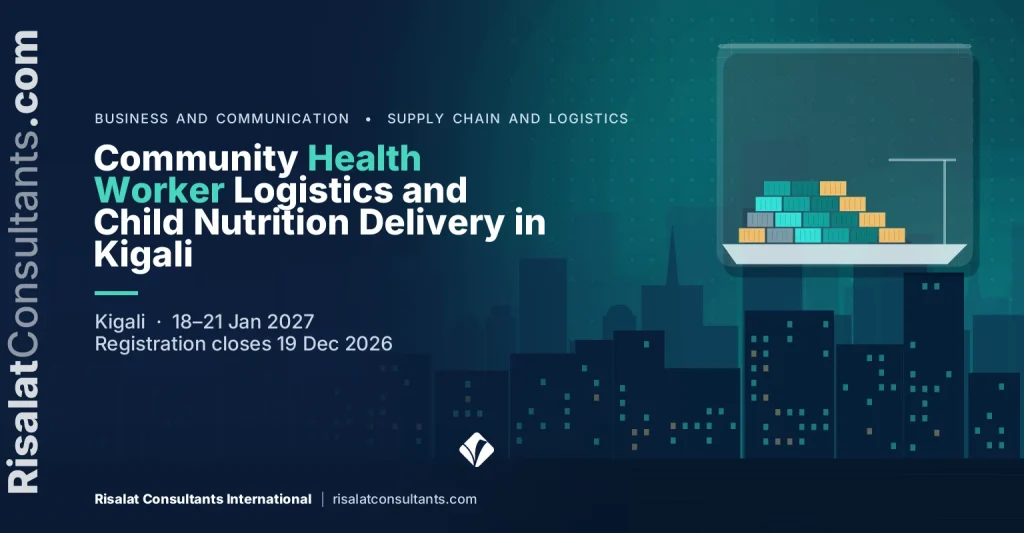
- Dates
- 18–21 Jan 2027 (4 days)
- Where
- Kigali, Rwanda
- Fee per participant
- £1,850 (GBP)
- Payment
- By invoice and bank transfer
- Registration closes
- 19 Dec 2026
- Certificate
- Certificate of completion
- In-house option
- Run it for your team, on your dates
On this page 15 sections
Programme Overview
This intensive four-day professional programme in Kigali addresses the operational complexities of managing community health worker supply chains and decentralized child nutrition delivery. Health systems often falter at the last mile, where transport bottlenecks, stockouts of therapeutic foods, and weak supervision hinder frontline performance. Grounded in established public health logistics, this course examines proven models for maintaining supply continuity, equipping community cadres, and securing essential commodities across remote and dispersed settlements.
Participants explore practical tools for coordinating integrated community case management and frontline nutritional interventions. Through structured technical analysis, the curriculum unpacks inventory management protocols, temperature-sensitive handling for nutritional items, and community-level tracking mechanisms. The course uses Kigali as an operational benchmark, drawing comparative insights from decentralized service delivery models to demonstrate how routine community data, standard operating procedures, and structured supportive supervision reinforce village-level preventive and curative health interventions.
By bridging the gap between national health strategies and village-level delivery points, the programme prepares operations teams to build robust distribution networks. Attendees design tailored monitoring frameworks and rapid replenishment cycles that address geographic isolation. The training focuses on pragmatic, field-ready solutions suitable for multilateral development bank financing and national health directorates, ensuring community health workers receive uninterrupted resources to treat childhood wasting, administer preventive supplementation, and maintain accurate administrative reporting.
Decentralised healthcare delivery remains the most viable pathway to eliminate preventable child mortality in hard-to-reach settlements, yet national programmes continually struggle with logistical breakdowns at the periphery. This programme directly operationalises community health mechanisms aligned with the Guinea-Bissau Strengthening Maternal and Child Health Service Delivery project (US$25m). By reinforcing primary supply channels, inventory visibility, and community nutrition surveillance, health directorates can ensure public investments translate into dependable life-saving care for isolated populations.
Delivered by Risalat Consultants International in Kigali, Rwanda, it combines expert-led sessions, real cases and group work, so that participants can apply what they learn in their own institution.
The Programme Strengthens Institutional Capability
- Principles of decentralized logistics: Moving commodities from central medical stores to villages
- Mapping community distribution nodes, transport barriers, and seasonal access challenges
- Stock management fundamentals: Minimum and maximum inventory levels at the frontline
- Storage requirements and quality assurance for ready-to-use therapeutic foods and micronutrients
- Designing standardized requisition and replenishment cycles for remote primary health workers
- Community Management of Acute Malnutrition guidelines: Operationalizing village-level protocols
- Mid-upper arm circumference screening, growth monitoring, and early detection mechanisms
- Supply forecasting for community-level preventative and therapeutic nutritional commodities
- Procurement planning and market analysis
- Choosing procurement methods and approaches
- Writing specifications and terms of reference
- Bidding documents and evaluation criteria
It is designed for community health coordinators managing district and regional cadres, child survival focal points within national public health directorates, health operations analysts monitoring maternal and child health outcomes and others who want practical, current skills in procurement and contract management.
The Growing Importance of Community Health Worker Logistics and Child Nutrition Delivery in Kigali
Procurement is where public money becomes roads, medicines, systems and services. Delays, weak specifications and poor contract management are among the most common reasons projects fall behind or fail their audits.
Financiers and governments now expect value for money, fair competition and well-documented decisions at every stage, from planning to contract completion. Teams who manage the full cycle well deliver faster and with fewer complaints.
Organisations increasingly require professionals capable of:
- Plan procurement that matches project needs and timelines
- Prepare clear specifications and evaluation criteria
- Evaluate bids consistently and defend the decision
- Manage contracts, variations and performance
- Keep complete records for audit and review
Strong procurement and contract management systems help organisations:
- Reduce procurement delays and failed tenders
- Achieve value for money
- Lower the risk of complaints and audit findings
- Deliver contracts on time and to quality
This Community Health Worker Logistics and Child Nutrition Delivery in Kigali programme brings these elements together in a practical format, so that participants understand not only what good practice looks like but also how to introduce it in their own setting, with the people and resources they have.
Who Should Attend This Community Health Worker Logistics and Child Nutrition Delivery in Kigali Training?
This programme is designed for:
- Community health coordinators managing district and regional cadres
- Child survival focal points within national public health directorates
- Health operations analysts monitoring maternal and child health outcomes
- Supply chain and logistics officers in donor-funded health programmes
- Project implementation unit specialists managing World Bank health portfolios
- District medical officers supervising primary healthcare networks
- Monitoring and evaluation specialists tracking community-level interventions
- Nutrition programme managers leading community management of acute malnutrition
- Field operations coordinators working with frontline health workers
- Procurement officers and managers
- Contract managers and administrators
- Project and programme managers
The programme suits experienced professionals as well as those moving into new responsibilities. Groups that mix institutions and countries are encouraged, because participants learn a great deal from each other’s experience.
Tick what your team needs to be able to do.
Community Health Worker Logistics and Child Nutrition Delivery in Kigali Training Objectives
Upon successful completion of this Community Health Worker Logistics and Child Nutrition Delivery in Kigali Training, participants will be able to:
- Design resilient last-mile distribution networks for essential community child nutrition commodities
- Establish reliable inventory control and replenishment routines for remote community health posts
- Apply integrated community case management protocols to child nutrition surveillance and triage
- Formulate structured supportive supervision frameworks for frontline community health cadres
- Implement standardized data collection routines to track moderate and severe acute malnutrition
- Mitigate supply chain bottlenecks affecting ready-to-use therapeutic food storage and distribution
- Draft targeted operational action plans to reinforce maternal and child health field logistics
- Explain the procurement cycle and the rules that apply to it
- Prepare a procurement plan linked to project timelines
- Choose a suitable method and approach to the market
Each objective is practised during the programme through exercises, cases or group work, so that participants leave able to do it, not only to describe it.
Programme Contents and Structure
- Principles of decentralized logistics: Moving commodities from central medical stores to villages
- Mapping community distribution nodes, transport barriers, and seasonal access challenges
- Stock management fundamentals: Minimum and maximum inventory levels at the frontline
- Storage requirements and quality assurance for ready-to-use therapeutic foods and micronutrients
- Designing standardized requisition and replenishment cycles for remote primary health workers
- Community Management of Acute Malnutrition guidelines: Operationalizing village-level protocols
- Mid-upper arm circumference screening, growth monitoring, and early detection mechanisms
- Supply forecasting for community-level preventative and therapeutic nutritional commodities
- Integration of nutritional commodities into integrated Community Case Management packages
- Establishing reliable referral pathways between community health workers and health centres
- Transitioning from administrative inspection to competency-based supportive supervision
- Developing structured field supervision checklists and direct observation tools
- Addressing frontline retention, motivation, and task management in underserved geographies
- Designing peer-review mechanisms and monthly performance review meetings at cluster level
- Tracking commodity wastage, expiry, and loss at the community health worker interface
- Paper-based and digital community health information systems for routine tracking
- Reconciling community-level service registers with national health management information systems
- Field-level incident management for critical stockouts and sudden nutritional surges
- Developing standard operating procedures for isolated village supply distribution
- Action planning: Finalizing operational strategies for project-financed interventions
Full day-by-day contents
The programme runs over 4 days. Each day combines expert input, practical work and a closing workshop or case study:
- First Day: Day 1: Last-Mile Health Logistics and Community Supply Chain Design
- Second Day: Day 2: Child Nutrition Delivery Protocols and Case Tracking
- Third Day: Day 3: Supportive Supervision and Frontline Operational Monitoring
- Fourth Day: Day 4: Community Data Systems and Operational Planning
Full day-by-day contents
First Day | Day 1: Last-Mile Health Logistics and Community Supply Chain Design
- Principles of decentralized logistics: Moving commodities from central medical stores to villages
- Mapping community distribution nodes, transport barriers, and seasonal access challenges
- Stock management fundamentals: Minimum and maximum inventory levels at the frontline
- Storage requirements and quality assurance for ready-to-use therapeutic foods and micronutrients
- Designing standardized requisition and replenishment cycles for remote primary health workers
Workshop: Day 1: Last-Mile Health Logistics and Community Supply Chain Design: Applying It to Your Institution
Working in small groups, participants apply the day's methods to examples from their own institutions and agree practical next steps.
Second Day | Day 2: Child Nutrition Delivery Protocols and Case Tracking
- Community Management of Acute Malnutrition guidelines: Operationalizing village-level protocols
- Mid-upper arm circumference screening, growth monitoring, and early detection mechanisms
- Supply forecasting for community-level preventative and therapeutic nutritional commodities
- Integration of nutritional commodities into integrated Community Case Management packages
- Establishing reliable referral pathways between community health workers and health centres
Workshop: Day 2: Child Nutrition Delivery Protocols and Case Tracking: Applying It to Your Institution
Working in small groups, participants apply the day's methods to examples from their own institutions and agree practical next steps.
Third Day | Day 3: Supportive Supervision and Frontline Operational Monitoring
- Transitioning from administrative inspection to competency-based supportive supervision
- Developing structured field supervision checklists and direct observation tools
- Addressing frontline retention, motivation, and task management in underserved geographies
- Designing peer-review mechanisms and monthly performance review meetings at cluster level
- Tracking commodity wastage, expiry, and loss at the community health worker interface
Case Study: Day 3: Supportive Supervision and Frontline Operational Monitoring in Practice
Participants analyse a realistic case, compare the choices made with good practice and draw lessons they can use in their own setting.
Fourth Day | Day 4: Community Data Systems and Operational Planning
- Paper-based and digital community health information systems for routine tracking
- Reconciling community-level service registers with national health management information systems
- Field-level incident management for critical stockouts and sudden nutritional surges
- Developing standard operating procedures for isolated village supply distribution
- Action planning: Finalizing operational strategies for project-financed interventions
Capstone Exercise: Community Health Worker Logistics and Child Nutrition Delivery in Kigali Action Plan for Your Institution
Participants bring the week together in an action plan for their own institution, with priorities, owners and first steps, and present it for feedback from peers and facilitators.
Community Health Worker Logistics and Child Nutrition Delivery in Kigali Training Methodology
The training employs a participatory, practitioner-centred methodology grounded in real-world operational challenges. Sessions combine technical presentations with practical diagnostic exercises, comparative case examinations, and collaborative problem-solving. Working in small groups, participants analyse supply pipeline failures, interpret field supervision data, and formulate localized standard operating procedures. Kigali serves as a compelling context for observing structured decentralization, enabling attendees to translate structured principles directly into their own national and project operational environments.
The programme combines:
- Expert-led sessions on current practice
- Regional and international case studies
- Group work and practical exercises
- Simulations and role plays where relevant
- Discussion of participants' own challenges
- Peer learning across institutions and countries
- Practical tools and templates to take back to work
- Daily reflection and action planning
Before the programme, a short pre-assessment helps the facilitators understand each participant’s role and priorities, so that examples and exercises can be adjusted to the group. Each day ends with a short reflection in which participants note what they will apply at work.
Expected Outcomes
Upon completion of this Community Health Worker Logistics and Child Nutrition Delivery in Kigali Training, participants will be able to:
- Improved distribution schedules that minimise stockouts of essential child nutrition commodities
- Standardised operational guidelines for frontline storage and handling of nutritional supplies
- Strengthened supervisory routines that enhance frontline community health worker performance
- Functional monitoring workflows connecting community screening data to district health systems
- Robust contingency plans to maintain supply chain continuity during seasonal logistical disruptions
- A fully developed operational delivery plan tailored to institutional and project requirements
- Plan procurement that fits project needs and timelines
- Prepare clear specifications and evaluation criteria
Participants leave with a personal action plan and practical tools they can use in their institution from the first week back. Institutions that send several participants can use the programme to agree shared methods and templates across teams, which makes improvements easier to sustain.
£1,850 per participant · invoice and bank transfer · groups of 5 or more receive a discount
Five or more from one organisation: ask for the group rate on the invoice request.
Ten or more: an in-house version for your institution may cost less per person. Ask for an in-house quote.
Registration closes in 37 days (19 Dec 2026)
Institutional Application of Community Health Worker Logistics and Child Nutrition Delivery in Kigali Training
This programme supports organisations in strengthening:
- Procurement planning and strategy
- Evaluation practice
- Contract management
- Complaint handling
- Procurement records and audit readiness
Participants return with practical tools to improve:
- Procurement plans and timelines
- Specifications and evaluation criteria
- Evaluation reports
- Contract monitoring
- Variation and claims management
The programme is built so that learning moves from the classroom into the institution. Participants work on their own processes and documents where possible, and leave with an action plan that their managers can review and support.
Regional Relevance & Application
Europe
European institutions apply procurement and contract management within detailed regulatory frameworks and reform agendas. Participants from Europe can compare their practice with colleagues from other regions and test how established methods work under different conditions.
Africa
Across Africa, ministries, agencies and project teams working in procurement and contract management increasingly operate alongside donor-financed programmes that expect clear systems and evidence. The programme helps participants adapt good practice to the institutions and resources they work with.
Middle East
In the Middle East, national development strategies and diversification plans place growing demands on procurement and contract management. Participants explore how to build the capability these plans need inside public bodies and companies.
Asia
Institutions across Asia combine rapid growth with ambitious modernisation programmes. Participants from Asia can share their experience of scaling systems quickly and learn from approaches used elsewhere.
Pacific
Small island and Pacific states face particular constraints of size, distance and capacity. The programme highlights practical, proportionate approaches to procurement and contract management that suit smaller institutions.
Holding the programme in Kigali, Rwanda brings participants together away from their daily pressures, so they can compare how procurement and contract management is handled in different settings. The same programme can also be delivered in-house for one institution, in its own country or online, with cases taken from its current work.
Host Country Profile – Rwanda
Programmes, Workshops, Exposures, Training Courses in Kigali, Rwanda by Risalat Consultants International
Studying away from their own country gives participants time to focus, a fresh view of their own institution and the chance to build a network with colleagues from other countries.
Community Health Worker Logistics and Child Nutrition Delivery in Kigali Training Deliverables
Participants receive support before, during and after the programme, so that preparation, learning and follow-up form one continuous experience.
Before the Programme
- Participant Pre-Assessment
- Community Health Worker Logistics and Child Nutrition Delivery in Kigali Readiness Assessment
- Community Health Worker Logistics and Child Nutrition Delivery in Kigali Resource Pack
- Preparatory Reading Materials
- Complimentary Visa Support & Advisory
During the Programme
- Airport Pickup & Welcome Assistance
- Accommodation with Breakfast
- Welcome Networking Dinner
- Risalat Training Kit (Bag, Bottle, Mug, T-Shirt, Cap, Passport Cover, Pens, Notebook, Magnet & Keychain)
- Comprehensive Community Health Worker Logistics and Child Nutrition Delivery in Kigali Training Manual
- Procurement Plan Template
- Bid Evaluation Scoring Sheet
- Contract Management Plan Template
- Variation and Claims Register
- Practical Workshops & Simulations
- Group Discussions & Peer Learning
- Daily Lunch and Refreshments
- Full Access to Training Venue Facilities
- Mini Pad / Tablet with Digital Learning Materials
- Field Visit (where applicable)
- Entertaining City Tour
After the Programme
- Certificate of Completion
- Risalat Programme Participation Recognition Award
- Post-Training Reference Materials
- Procurement Records Checklist
- Contract Performance Tracker
- Post-Training Support & Follow-Up Guidance
- Programme Report
Institutions can also request a tailored in-house version of this programme, delivered at their premises or online. Request a proposal.
Common Challenges in Community Health Worker Logistics and Child Nutrition Delivery in Kigali, And How This Training Helps
How can institutions plan procurement that matches project needs and timelines?
The programme addresses this directly on the first day (Day 1: Last-Mile Health Logistics and Community Supply Chain Design), where participants practise the methods involved and adapt them to their own institution, then build it into their action plan.
How can institutions prepare clear specifications and evaluation criteria?
The programme addresses this directly on the second day (Day 2: Child Nutrition Delivery Protocols and Case Tracking), where participants practise the methods involved and adapt them to their own institution, then build it into their action plan.
How can institutions evaluate bids consistently and defend the decision?
The programme addresses this directly on the third day (Day 3: Supportive Supervision and Frontline Operational Monitoring), where participants practise the methods involved and adapt them to their own institution, then build it into their action plan.
How can institutions manage contracts, variations and performance?
The programme addresses this directly on the fourth day (Day 4: Community Data Systems and Operational Planning), where participants practise the methods involved and adapt them to their own institution, then build it into their action plan.
How can institutions keep complete records for audit and review?
The programme addresses this directly on the first day (Day 1: Last-Mile Health Logistics and Community Supply Chain Design), where participants practise the methods involved and adapt them to their own institution, then build it into their action plan.
Frequently Asked Questions
When and where does the Community Health Worker Logistics and Child Nutrition Delivery in Kigali programme take place?
It runs from 18 Jan 2027 to 21 Jan 2027, in Kigali, Rwanda. The registration deadline is shown at the top of this page.
Who should attend?
The programme is designed for community health coordinators managing district and regional cadres, child survival focal points within national public health directorates, health operations analysts monitoring maternal and child health outcomes, supply chain and logistics officers in donor-funded health programmes, and others who want practical skills in procurement and contract management.
Will I receive a certificate?
Yes. Participants who complete the programme receive a Certificate of Completion from Risalat Consultants International.
Can this programme be delivered for our institution only?
Yes. We can deliver a tailored in-house version at your premises, in another city or online, built around your own cases. Use the proposal request on this page.
Do I need prior experience in procurement and contract management?
No specialist background is required beyond experience in a related role. A short pre-assessment helps the facilitators adapt the sessions to the group.
Who Will Deliver This Programme
Each date is delivered by a team assigned from Risalat's expert network for this subject. For this programme we assign:
How we choose them: Experience in the region of the participants or comparable settings; Command of the financier rules that apply (World Bank, ADB, AfDB, EU, UN) where relevant; Delivery in English; other languages on request for in-house groups; No conflict of interest with participants' institutions.
Names and short CVs of the assigned experts are shared with registered participants and sponsoring organisations before the programme, on request. Are you an expert in this subject? Join our expert network.
Training courses in KigaliHealthcare training courses
Why Kigali for this programme
Kigali is known for clean, safe streets and public sector reforms, with easy visas for African travellers.
The Community Health Worker Logistics and Child Nutrition Delivery in Kigali programme in January 2027 brings together officials and professionals from across the Africa region and beyond. Sessions combine short inputs, case studies and group work on participants' own files, and the city's institutions can be added as a study visit on request.
Getting there: Kigali International (KGL).
Check whether you need a visa with the free Visa Checker, and ask for an invitation letter once you are registered.
The same topic in other cities
- Frontline Nutrition Screening and Severe Malnutrition Surveillance in Penang (Penang)
- Early Childhood Nutrition Interventions and Stunting Prevention Delivery in Geneva (Geneva)
- Public Works Labour Logistics and Community Asset Verification in Nairobi (Nairobi)
- Nutrition-Sensitive Interventions & Stunting Reduction Policy in Singapore (Singapore)
- Primary Health Nutrition Interventions & Stunting Prevention Strategies in Bali (Bali)
- Maternal and Child Nutrition Service Delivery and Outreach in Istanbul (Istanbul)
Other programmes in Kigali
- Agri-Tech Startup Incubation and Digital Venture Matching in Kigali
- Sub-National Capital Investment Auditing and Municipal Grants in Kigali
- Basic Education Equity Grants and School-Based Management in Kigali
- Rural Electrification Grid Extension and Line Construction in Kigali
- Management of International Technical Assistance Teams and Knowledge Transfer in Kigali
- Procurement Framework and Regulations for Projects World Bank
- MAPS: Methodology for Assessing Procurement Systems MAPS Initiative
- Open Contracting Partnership Open Contracting Partnership
For teams and institutions
Bring your team
Teams that learn together apply more at work. Tell us how many people and how you would like to take part: we reply with a group quote within two working days.
Other dates and cities for this subject: Health Systems and Health Project Management training courses (109 upcoming dates).
More training courses in Rwanda · All programmes in Africa · Full training calendar
Plan this programme in a roadmap: why it matters, why to approve it, the dates to plan and the career it builds.