Key facts
- Dates
- 8–17 Feb 2027 (10 days)
- Where
- Dubai, United Arab Emirates
- Fee per participant
- £5,650 (GBP)
- Payment
- By invoice and bank transfer
- Registration closes
- 30 Dec 2026
- Format
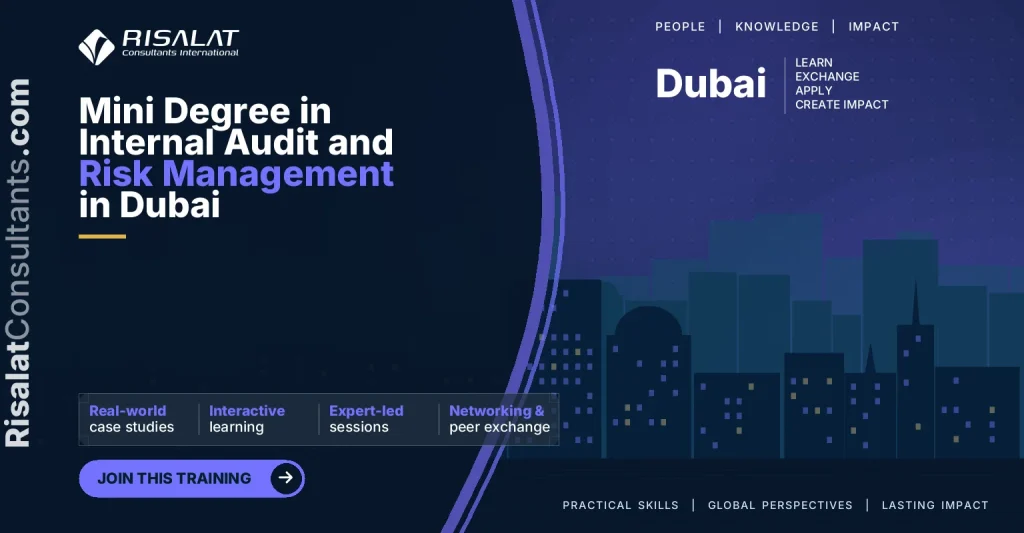
- 10-day intensive programme (mini degree): a practical capacity-building programme for government, NGO and project teams in Dubai
- Certificate
- Certificate of completion
- In-house option
- Run it for your team, on your dates
On this page 17 sections
About this mini degree: a ten-day intensive programme that combines two related short courses into one complete track, with more practice and a capstone exercise. Participants receive a Risalat certificate of completion; a mini degree is a professional programme, not an academic degree.
Free self-check: the governance self-audit gives a quick check of governance, controls and accountability, in about 10 minutes.
Programme Overview
The Mini Degree in Internal Audit and Risk Management in Dubai brings together two essential disciplines into an integrated ten-day executive programme. Public sector institutions, state-owned enterprises and development bodies require robust systems of governance, control and assurance. This course provides practitioners with end-to-end coverage of enterprise risk management, the updated Global Internal Audit Standards issued by the Institute of Internal Auditors, and the COSO Internal Control Integrated Framework, establishing structured working practices across complex operations.
Watch: a short video on this subject
Delivered over ten consecutive days in Dubai, the curriculum addresses the operational demands of government ministries, supreme audit institutions and donor-funded project implementation units. Participants move methodically from fundamental risk identification and control design to advanced risk-based audit planning, fieldwork testing, fraud risk assessment and executive reporting. The structured progression ensures that theoretical concepts translate directly into defensible audit files, systematic risk registers and practical control improvement initiatives across all operational areas.
This intensive programme combines rigorous classroom instruction with extensive practical case work, an institutional study visit, an applied workshop and an integrated capstone exercise. Participants conclude the course by developing and defending a comprehensive action plan for their organisations. Upon successful completion, attendees receive a professional Certificate of Completion from Risalat Consultants International, confirming their mastery of modern audit and risk frameworks. Please note this executive credential is a professional training certificate, not an academic degree qualification.
Public sector entities, line ministries, execution agencies and donor-financed project teams funded by institutions such as the World Bank, Asian Development Bank, African Development Bank, European Union and United Nations face intense scrutiny regarding governance, accountability and fiscal discipline. Rather than sending staff to isolated, fragmented workshops that separate risk assessment from audit execution, organisations now require personnel who understand the entire assurance and oversight lifecycle. A single comprehensive programme enables teams to master international standards, address enterprise and fraud risks systematically, harmonise compliance mechanisms and return with an operational action plan ready for immediate implementation.
Delivered by Risalat Consultants International in Dubai, United Arab Emirates, it combines expert-led sessions, real cases and group work, so that participants can apply what they learn in their own institution.
The Programme Strengthens Institutional Capability
- The evolving governance landscape in public sector entities and international development projects
- The IIA Global Internal Audit Standards: ethics, independence, objectivity and mandate
- The Three Lines Model: distinguishing management control, risk oversight and independent assurance
- COSO Internal Control Integrated Framework: the five components and seventeen principles
- Assessing the control environment: tone at the top, organisational structures and fiduciary accountability
- COSO Enterprise Risk Management Framework: aligning risk with strategy and performance
- Establishing the organisational context, risk governance structures and risk management policies
- Techniques for comprehensive risk identification across operations, finance, compliance and reporting
- Fraud risk assessment and fraud risk registers
- Design and testing of internal controls
- The Three Lines model and the role of oversight
- Audit planning, evidence and documentation
It is designed for internal auditors and audit managers in ministries, departments and public agencies, project directors, finance managers and compliance officers in donor-financed projects, risk management officers and enterprise risk coordinators across public sector bodies and others who want practical, current skills in fraud, audit and internal control.
The Growing Importance of Mini Degree in Internal Audit and Risk Management in Dubai
Public bodies and donor-financed projects are expected to show that funds are used for their intended purpose. Auditors, oversight bodies and financiers increasingly look beyond the financial statements to the controls, records and behaviours behind them.
Fraud and control weaknesses rarely come from one failure. They grow where roles are unclear, records are incomplete and warning signs are not followed up. Teams that understand how fraud happens, and how controls stop it, protect both their institution and the people it serves.
Organisations increasingly require professionals capable of:
- Identify and rate fraud and control risks in their own processes
- Design controls that are proportionate and testable
- Gather and document reliable audit evidence
- Recognise red flags early and escalate them correctly
- Turn findings into practical, agreed actions
Strong fraud, audit and internal control systems help organisations:
- Reduce losses and ineligible expenditure
- Pass external audits with fewer findings
- Strengthen trust with financiers and citizens
- Respond to allegations in a fair and documented way
This Mini Degree in Internal Audit and Risk Management in Dubai programme brings these elements together in a practical format, so that participants understand not only what good practice looks like but also how to introduce it in their own setting, with the people and resources they have.
Who Should Attend This Mini Degree in Internal Audit and Risk Management in Dubai Training?
This programme is designed for:
- Internal auditors and audit managers in ministries, departments and public agencies
- Project directors, finance managers and compliance officers in donor-financed projects
- Risk management officers and enterprise risk coordinators across public sector bodies
- Staff of Supreme Audit Institutions conducting compliance and performance audits
- Inspectors, internal controllers and integrity officers in state-owned enterprises
- Financial controllers and accountants transitioning into operational or performance assurance
- Audit committee members and board secretariat staff seeking technical oversight skills
- Governance, risk and compliance professionals in development bodies and international organisations
- Monitoring and evaluation specialists responsible for fiduciary oversight and risk mitigation
- Internal auditors and audit managers
- Finance managers and accountants
- Compliance and risk officers
The programme suits experienced professionals as well as those moving into new responsibilities. Groups that mix institutions and countries are encouraged, because participants learn a great deal from each other’s experience.
Tick what your team needs to be able to do.
Mini Degree in Internal Audit and Risk Management in Dubai Training Objectives
Upon successful completion of this Mini Degree in Internal Audit and Risk Management in Dubai Training, participants will be able to:
- Apply the IIA Global Internal Audit Standards and COSO Internal Control Framework to institutional operations
- Establish comprehensive enterprise risk management frameworks aligned with operational and strategic objectives
- Conduct thorough fraud risk assessments to protect public and project procurement and financial transactions
- Develop multi-year and annual risk-based internal audit plans prioritising high-risk institutional activities
- Execute structured internal audit engagements from opening meetings to fieldwork testing and evidence gathering
- Formulate impactful, root-cause audit findings and clear recommendations for executive leadership and audit committees
- Design an institutional audit and risk management action plan for immediate post-training implementation
- Explain how and why fraud happens, using recognised fraud risk models
- Carry out a fraud and control risk assessment for a real process
- Map controls to risks using the Three Lines model
Each objective is practised during the programme through exercises, cases or group work, so that participants leave able to do it, not only to describe it.
Programme Contents and Structure
- The evolving governance landscape in public sector entities and international development projects
- The IIA Global Internal Audit Standards: ethics, independence, objectivity and mandate
- The Three Lines Model: distinguishing management control, risk oversight and independent assurance
- COSO Internal Control Integrated Framework: the five components and seventeen principles
- Assessing the control environment: tone at the top, organisational structures and fiduciary accountability
- COSO Enterprise Risk Management Framework: aligning risk with strategy and performance
- Establishing the organisational context, risk governance structures and risk management policies
- Techniques for comprehensive risk identification across operations, finance, compliance and reporting
- Risk taxonomy and categorization: strategic, operational, fiduciary, legal and reputational risks
- Hands-on workshop: conducting departmental risk identification workshops using structured tools
- Qualitative, semi-quantitative and quantitative risk analysis methodologies
- Evaluating likelihood and impact: developing institutional scoring matrices and criteria
- Determining inherent risk, control effectiveness and residual risk levels
- Defining risk appetite and risk tolerance boundaries for public expenditure and projects
- Formulating risk response strategies: avoidance, reduction, sharing, transfer and acceptance
- The fraud triangle, fraud diamond and indicators of institutional vulnerability
- Conducting targeted fraud risk assessments in donor-funded programmes and public procurement
- Recognising red flags in procurement bidding, tender evaluation, contract award and contract management
- Preventive, detective and corrective controls against payroll fraud, asset diversion and false invoicing
- Establishing whistleblowing mechanisms, fraud response plans and initial investigation protocols
- Developing the annual risk-based audit plan: linking audit priorities to the enterprise risk register
- Allocating audit resources, defining audit cycles and securing audit committee approval
- Initial engagement planning: establishing scope, timing, team assignments and engagement objectives
- Designing the Engagement Risk Assessment and preliminary information requests
- Drafting the audit engagement announcement letter and convening effective entrance conferences
- Field briefing: governance, internal control and compliance architecture in leading Dubai institutions
- Site visit to an operational entity: observing enterprise risk reporting and control monitoring systems
- Benchmarking review: examining practical document workflows, approvals and internal oversight mechanisms
- Facilitated group reflection on field observations versus established international standards
- Consolidation session: mapping observed regional practices to home institution operational contexts
- Refresher clinic: addressing technical questions and challenges from week one topics
- Standardising audit working papers: indexing, cross-referencing and audit trail integrity
- Practical laboratory: designing structured audit programmes and substantive testing templates
- Applying analytical review procedures and sampling methods on transactional data extracts
- Peer review exercise: evaluating mock working papers against professional documentation standards
- Executing audit tests of controls: walkthroughs, inquiry, observation and re-performance
- Substantive testing of financial transactions, project disbursements and asset management
- Evaluating audit evidence: sufficiency, reliability, relevance and institutional validity
- Identifying and documenting control deficiencies: condition, criteria, cause, effect and recommendation
- Managing contentious engagement issues, scope limitations and client communication during fieldwork
- Drafting clear, concise and compelling audit reports tailored to executive decision-makers
- Structuring root-cause analysis to support practical and cost-effective recommendations
- Conducting the audit exit conference: presenting findings and managing auditee responses
- Audit committee reporting: dash-boarding, tracking outstanding issues and periodic assurance summaries
- Establishing systematic tracking mechanisms to verify management implementation of agreed actions
- Capstone briefing: briefing on integrated institutional scenario covering risk, fraud and internal audit
- Syndicate working session: developing a multi-year audit and risk improvement action plan
- Team presentations: pitching the audit strategy, risk register and remediation plan to a panel
- Panel evaluation, individual feedback and benchmarking against international best practices
- Programme synthesis, individual learning commitments and presentation of certificates of completion
Full day-by-day contents
The programme runs over 10 days. Each day combines expert input, practical work and a closing workshop or case study:
- First Day: Day 1: Modern Internal Governance, Professional Standards and Control Architecture
- Second Day: Day 2: Enterprise Risk Management Architecture and Risk Identification
- Third Day: Day 3: Risk Assessment, Scoring, Appetite and Mitigation Design
- Fourth Day: Day 4: Fraud Risk Management and Fiduciary Integrity in Procurement and Projects
- Fifth Day: Day 5: Risk-Based Internal Audit Planning and Engagement Scoping
- Sixth Day: Day 6: Study Visit and Institutional Field Observation
- Seventh Day: Day 7: Applied Workshop on Audit Working Papers and Analytical Procedures
- Eighth Day: Day 8: Fieldwork Execution, Evidence Gathering and Audit Testing
- Ninth Day: Day 9: Audit Reporting, Executive Communication and Follow-up Systems
- Tenth Day: Technical Visits, International Practice & Institutional Action Planning
Full day-by-day contents
First Day | Day 1: Modern Internal Governance, Professional Standards and Control Architecture
- The evolving governance landscape in public sector entities and international development projects
- The IIA Global Internal Audit Standards: ethics, independence, objectivity and mandate
- The Three Lines Model: distinguishing management control, risk oversight and independent assurance
- COSO Internal Control Integrated Framework: the five components and seventeen principles
- Assessing the control environment: tone at the top, organisational structures and fiduciary accountability
Workshop: Day 1: Modern Internal Governance, Professional Standards and Control Architecture: Applying It to Your Institution
Working in small groups, participants apply the day's methods to examples from their own institutions and agree practical next steps.
Second Day | Day 2: Enterprise Risk Management Architecture and Risk Identification
- COSO Enterprise Risk Management Framework: aligning risk with strategy and performance
- Establishing the organisational context, risk governance structures and risk management policies
- Techniques for comprehensive risk identification across operations, finance, compliance and reporting
- Risk taxonomy and categorization: strategic, operational, fiduciary, legal and reputational risks
- Hands-on workshop: conducting departmental risk identification workshops using structured tools
Workshop: Day 2: Enterprise Risk Management Architecture and Risk Identification: Applying It to Your Institution
Working in small groups, participants apply the day's methods to examples from their own institutions and agree practical next steps.
Third Day | Day 3: Risk Assessment, Scoring, Appetite and Mitigation Design
- Qualitative, semi-quantitative and quantitative risk analysis methodologies
- Evaluating likelihood and impact: developing institutional scoring matrices and criteria
- Determining inherent risk, control effectiveness and residual risk levels
- Defining risk appetite and risk tolerance boundaries for public expenditure and projects
- Formulating risk response strategies: avoidance, reduction, sharing, transfer and acceptance
Case Study: Day 3: Risk Assessment, Scoring, Appetite and Mitigation Design in Practice
Participants analyse a realistic case, compare the choices made with good practice and draw lessons they can use in their own setting.
Fourth Day | Day 4: Fraud Risk Management and Fiduciary Integrity in Procurement and Projects
- The fraud triangle, fraud diamond and indicators of institutional vulnerability
- Conducting targeted fraud risk assessments in donor-funded programmes and public procurement
- Recognising red flags in procurement bidding, tender evaluation, contract award and contract management
- Preventive, detective and corrective controls against payroll fraud, asset diversion and false invoicing
- Establishing whistleblowing mechanisms, fraud response plans and initial investigation protocols
Workshop: Day 4: Fraud Risk Management and Fiduciary Integrity in Procurement and Projects: Applying It to Your Institution
Working in small groups, participants apply the day's methods to examples from their own institutions and agree practical next steps.
Fifth Day | Day 5: Risk-Based Internal Audit Planning and Engagement Scoping
- Developing the annual risk-based audit plan: linking audit priorities to the enterprise risk register
- Allocating audit resources, defining audit cycles and securing audit committee approval
- Initial engagement planning: establishing scope, timing, team assignments and engagement objectives
- Designing the Engagement Risk Assessment and preliminary information requests
- Drafting the audit engagement announcement letter and convening effective entrance conferences
Workshop: Day 5: Risk-Based Internal Audit Planning and Engagement Scoping: Applying It to Your Institution
Working in small groups, participants apply the day's methods to examples from their own institutions and agree practical next steps.
Sixth Day | Day 6: Study Visit and Institutional Field Observation
- Field briefing: governance, internal control and compliance architecture in leading Dubai institutions
- Site visit to an operational entity: observing enterprise risk reporting and control monitoring systems
- Benchmarking review: examining practical document workflows, approvals and internal oversight mechanisms
- Facilitated group reflection on field observations versus established international standards
- Consolidation session: mapping observed regional practices to home institution operational contexts
Case Study: Day 6: Study Visit and Institutional Field Observation in Practice
Participants analyse a realistic case, compare the choices made with good practice and draw lessons they can use in their own setting.
Seventh Day | Day 7: Applied Workshop on Audit Working Papers and Analytical Procedures
- Refresher clinic: addressing technical questions and challenges from week one topics
- Standardising audit working papers: indexing, cross-referencing and audit trail integrity
- Practical laboratory: designing structured audit programmes and substantive testing templates
- Applying analytical review procedures and sampling methods on transactional data extracts
- Peer review exercise: evaluating mock working papers against professional documentation standards
Workshop: Day 7: Applied Workshop on Audit Working Papers and Analytical Procedures: Applying It to Your Institution
Working in small groups, participants apply the day's methods to examples from their own institutions and agree practical next steps.
Eighth Day | Day 8: Fieldwork Execution, Evidence Gathering and Audit Testing
- Executing audit tests of controls: walkthroughs, inquiry, observation and re-performance
- Substantive testing of financial transactions, project disbursements and asset management
- Evaluating audit evidence: sufficiency, reliability, relevance and institutional validity
- Identifying and documenting control deficiencies: condition, criteria, cause, effect and recommendation
- Managing contentious engagement issues, scope limitations and client communication during fieldwork
Workshop: Day 8: Fieldwork Execution, Evidence Gathering and Audit Testing: Applying It to Your Institution
Working in small groups, participants apply the day's methods to examples from their own institutions and agree practical next steps.
Ninth Day | Day 9: Audit Reporting, Executive Communication and Follow-up Systems
- Drafting clear, concise and compelling audit reports tailored to executive decision-makers
- Structuring root-cause analysis to support practical and cost-effective recommendations
- Conducting the audit exit conference: presenting findings and managing auditee responses
- Audit committee reporting: dash-boarding, tracking outstanding issues and periodic assurance summaries
- Establishing systematic tracking mechanisms to verify management implementation of agreed actions
Case Study: Day 9: Audit Reporting, Executive Communication and Follow-up Systems in Practice
Participants analyse a realistic case, compare the choices made with good practice and draw lessons they can use in their own setting.
Tenth Day | Technical Visits, International Practice & Institutional Action Planning
- Capstone briefing: briefing on integrated institutional scenario covering risk, fraud and internal audit
- Syndicate working session: developing a multi-year audit and risk improvement action plan
- Team presentations: pitching the audit strategy, risk register and remediation plan to a panel
- Panel evaluation, individual feedback and benchmarking against international best practices
- Programme synthesis, individual learning commitments and presentation of certificates of completion
Capstone Exercise: Mini Degree in Internal Audit and Risk Management in Dubai Action Plan for Your Institution
Participants bring the week together in an action plan for their own institution, with priorities, owners and first steps, and present it for feedback from peers and facilitators.
Mini Degree in Internal Audit and Risk Management in Dubai Training Methodology
The programme employs an adult-learning methodology designed specifically for experienced practitioners in governance, risk and assurance functions. Interactive lectures outline core frameworks, which are immediately reinforced through group discussions, procurement and financial case studies, and practical exercises. Day six provides field-based perspective through an institutional study visit in Dubai, followed by an applied documentation workshop on day seven. Throughout the ten days, participants work in syndicates on real-world scenarios, culminating on day ten in a comprehensive capstone exercise where each team defends a fully developed audit and risk action plan.
The programme combines:
- Expert-led sessions on current practice
- Regional and international case studies
- Group work and practical exercises
- Simulations and role plays where relevant
- Discussion of participants' own challenges
- Peer learning across institutions and countries
- Technical visits to institutions and sites
- Daily reflection and action planning
Before the programme, a short pre-assessment helps the facilitators understand each participant’s role and priorities, so that examples and exercises can be adjusted to the group. Each day ends with a short reflection in which participants note what they will apply at work.
- Transaction
- Record
- Control
- Evidence
- Opinion
Technical Visits and Site Programme
The programme includes visits to institutions, projects or sites in and around Dubai where participants see current practice at first hand and meet the professionals responsible. Visits are confirmed with the host organisations before the programme and may change for operational reasons.
- Briefings by host institutions on their approach and results
- Guided site visits with time for questions
- Structured observation notes for each visit
- Group debrief linking what was seen to participants' own institutions
Expected Outcomes
Upon completion of this Mini Degree in Internal Audit and Risk Management in Dubai Training, participants will be able to:
- Establish or update institutional internal audit charters, policies and standard operating procedures
- Construct and maintain an operational enterprise risk register with structured mitigation plans
- Formulate an annual risk-based internal audit plan aligned with organisational priorities and donor mandates
- Design and execute thorough fraud risk assessments across vulnerable procurement and financial cycles
- Produce high-quality audit working papers, clear deficiency findings and actionable audit reports
- Implement an effective remediation tracking system to ensure auditee accountability and timely closure
- Assess fraud and control risks in their own processes
- Design and test proportionate controls
Participants leave with a personal action plan and practical tools they can use in their institution from the first week back. Institutions that send several participants can use the programme to agree shared methods and templates across teams, which makes improvements easier to sustain.
£5,650 per participant · invoice and bank transfer · groups of 5 or more receive a discount
Five or more from one organisation: ask for the group rate on the invoice request.
Ten or more: an in-house version for your institution may cost less per person. Ask for an in-house quote.
Registration closes in 32 days (30 Dec 2026)
Institutional Application of Mini Degree in Internal Audit and Risk Management in Dubai Training
This programme supports organisations in strengthening:
- Fraud and corruption risk management
- Internal control frameworks
- Audit and oversight arrangements
- Follow-up of audit findings
- Integrity and reporting channels
Participants return with practical tools to improve:
- Risk registers and control maps
- Audit planning and testing
- Evidence and documentation
- Reporting to management and boards
- Prevention of ineligible expenditure
The programme is built so that learning moves from the classroom into the institution. Participants work on their own processes and documents where possible, and leave with an action plan that their managers can review and support.
Regional Relevance & Application
Europe
European institutions apply fraud, audit and internal control within detailed regulatory frameworks and reform agendas. Participants from Europe can compare their practice with colleagues from other regions and test how established methods work under different conditions.
Africa
Across Africa, ministries, agencies and project teams working in fraud, audit and internal control increasingly operate alongside donor-financed programmes that expect clear systems and evidence. The programme helps participants adapt good practice to the institutions and resources they work with.
Middle East
In the Middle East, national development strategies and diversification plans place growing demands on fraud, audit and internal control. Participants explore how to build the capability these plans need inside public bodies and companies.
Asia
Institutions across Asia combine rapid growth with ambitious modernisation programmes. Participants from Asia can share their experience of scaling systems quickly and learn from approaches used elsewhere.
Pacific
Small island and Pacific states face particular constraints of size, distance and capacity. The programme highlights practical, proportionate approaches to fraud, audit and internal control that suit smaller institutions.
Holding the programme in Dubai, United Arab Emirates brings participants together away from their daily pressures, so they can compare how fraud, audit and internal control is handled in different settings. The same programme can also be delivered in-house for one institution, in its own country or online, with cases taken from its current work.
Host Country Profile – United Arab Emirates
Programmes, Workshops, Exposures, Training Courses in Dubai, UAE by Risalat Consultants International
Studying away from their own country gives participants time to focus, a fresh view of their own institution and the chance to build a network with colleagues from other countries.
Mini Degree in Internal Audit and Risk Management in Dubai Training Deliverables
Participants receive support before, during and after the programme, so that preparation, learning and follow-up form one continuous experience.
Before the Programme
- Participant Pre-Assessment
- Mini Degree in Internal Audit and Risk Management in Dubai Readiness Assessment
- Mini Degree in Internal Audit and Risk Management in Dubai Resource Pack
- Preparatory Reading Materials
- Complimentary Visa Support & Advisory
During the Programme
- Airport Pickup & Welcome Assistance
- Accommodation with breakfast: 11 nights, check-in Sunday 7 February 2027, check-out Thursday 18 February 2027 (one night before and one night after the programme)
- Welcome Networking Dinner
- Risalat Training Kit (Bag, Bottle, Mug, T-Shirt, Cap, Passport Cover, Pens, Notebook, Magnet & Keychain)
- Comprehensive Mini Degree in Internal Audit and Risk Management in Dubai Training Manual
- Fraud Risk Register Template
- Control Mapping Matrix
- Audit Evidence Checklist
- Findings and Follow-up Tracker
- Practical Workshops & Simulations
- Group Discussions & Peer Learning
- Daily Lunch and Refreshments
- Full Access to Training Venue Facilities
- Mini Pad / Tablet with Digital Learning Materials
- Field Visit (where applicable)
- Entertaining City Tour
After the Programme
- Certificate of Completion
- Risalat Programme Participation Recognition Award
- Post-Training Reference Materials
- Fraud Risk Self-Assessment Guide
- Control Testing Checklist
- Post-Training Support & Follow-Up Guidance
- Programme Report
Institutions can also request a tailored in-house version of this programme, delivered at their premises or online. Request a proposal.
Common Challenges in Mini Degree in Internal Audit and Risk Management in Dubai, And How This Training Helps
How can institutions identify and rate fraud and control risks in their own processes?
The programme addresses this directly on the first day (Day 1: Modern Internal Governance, Professional Standards and Control Architecture), where participants practise the methods involved and adapt them to their own institution, then build it into their action plan.
How can institutions design controls that are proportionate and testable?
The programme addresses this directly on the second day (Day 2: Enterprise Risk Management Architecture and Risk Identification), where participants practise the methods involved and adapt them to their own institution, then build it into their action plan.
How can institutions gather and document reliable audit evidence?
The programme addresses this directly on the third day (Day 3: Risk Assessment, Scoring, Appetite and Mitigation Design), where participants practise the methods involved and adapt them to their own institution, then build it into their action plan.
How can institutions recognise red flags early and escalate them correctly?
The programme addresses this directly on the fourth day (Day 4: Fraud Risk Management and Fiduciary Integrity in Procurement and Projects), where participants practise the methods involved and adapt them to their own institution, then build it into their action plan.
How can institutions turn findings into practical, agreed actions?
The programme addresses this directly on the fifth day (Day 5: Risk-Based Internal Audit Planning and Engagement Scoping), where participants practise the methods involved and adapt them to their own institution, then build it into their action plan.
Frequently Asked Questions
When and where does the Mini Degree in Internal Audit and Risk Management in Dubai programme take place?
It runs from 8 Feb 2027 to 17 Feb 2027, in Dubai, United Arab Emirates. The registration deadline is shown at the top of this page.
Who should attend?
The programme is designed for internal auditors and audit managers in ministries, departments and public agencies, project directors, finance managers and compliance officers in donor-financed projects, risk management officers and enterprise risk coordinators across public sector bodies, staff of Supreme Audit Institutions conducting compliance and performance audits, and others who want practical skills in fraud, audit and internal control.
Will I receive a certificate?
Yes. Participants who complete the programme receive a Certificate of Completion from Risalat Consultants International.
Can this programme be delivered for our institution only?
Yes. We can deliver a tailored in-house version at your premises, in another city or online, built around your own cases. Use the proposal request on this page.
Do I need prior experience in fraud, audit and internal control?
No specialist background is required beyond experience in a related role. A short pre-assessment helps the facilitators adapt the sessions to the group.
Who Will Deliver This Programme
Each date is delivered by a team assigned from Risalat's expert network for this subject. For this programme we assign:
How we choose them: Experience in the region of the participants or comparable settings; Command of the financier rules that apply (World Bank, ADB, AfDB, EU, UN) where relevant; Delivery in English; other languages on request for in-house groups; No conflict of interest with participants' institutions.
Training courses in DubaiAccounting & Finance training courses
Why Dubai for this programme
Dubai is a one-flight hub for Africa, Asia and Europe, with simple visas for many nationalities and modern training venues.
The Mini Degree in Internal Audit and Risk Management in Dubai programme in February 2027 brings together officials and professionals from across the Middle East region and beyond. Sessions combine short inputs, case studies and group work on participants' own files, and the city's institutions can be added as a study visit on request.
Getting there: Dubai International (DXB).
Check whether you need a visa with the free Visa Checker, and ask for an invitation letter once you are registered.
The same topic in other cities
- Mini Degree in PPP and Infrastructure Finance in Singapore (Singapore)
- Mini Degree in Environmental and Social Safeguards in Istanbul (Istanbul)
- Mini Degree in Leadership and Public Policy in London (London)
- Mini Degree in Digital Government and AI in Tallinn (Tallinn)
- Mini Degree in Climate Finance and Resilience in Copenhagen (Copenhagen)
- Mini Degree in Donor-Funded Project Management in Dubai (Dubai)
Other programmes in Dubai
- Blue Economy, Fisheries and Ocean Governance Training for Southern African Officials in Dubai
- Records and Archives Management for Public Institutions in Dubai
- Artificial Intelligence for Public Sector Leaders Training in Dubai
- Performance Audit for Supreme Audit Institutions in Dubai
- Mini Degree in Procurement and Contract Management in Dubai
Questions before you nominate your team? Book a 30-minute call with us, or ask for this programme in-house.
Teams often travel here from Maldives, Sri Lanka, Bangladesh, Nepal, Pakistan, Afghanistan, Kazakhstan, Uzbekistan. Funding, visa letters and group rates are explained on each country page.
- Open Contracting Partnership Open Contracting Partnership
- The Institute of Internal Auditors IIA
For teams and institutions
Bring your team
Teams that learn together apply more at work. Tell us how many people and how you would like to take part: we reply with a group quote within two working days.
Watch: this programme in short


Other dates and cities for this subject: Financial Management for Donor-Funded Projects training courses (67 upcoming dates).
More training courses in the United Arab Emirates · All programmes in Middle East · Full training calendar
Plan this programme in a roadmap: why it matters, why to approve it, the dates to plan and the career it builds.