Key facts
- Dates
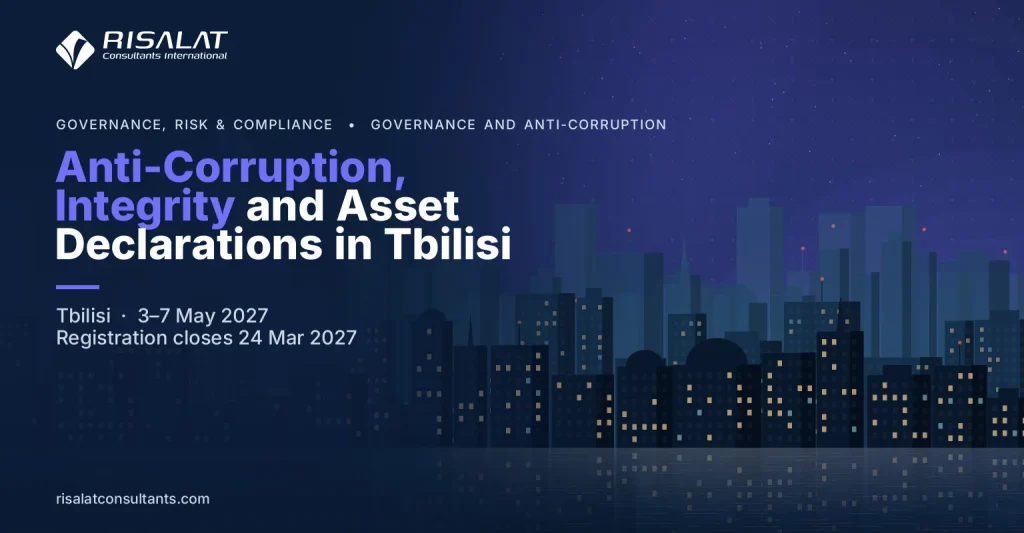
- 3–7 May 2027 (5 days)
- Where
- Tbilisi, Georgia
- Fee per participant
- £3,250 (GBP)
- Payment
- By invoice and bank transfer
- Registration closes
- 24 Mar 2027
- Format
- 5-day short course: a practical capacity-building programme for government, NGO and project teams in Tbilisi
- In-house option
- Run it for your team, on your dates
On this page 12 sections
Anti-Corruption, Integrity and Asset Declarations in Tbilisi
Programme Overview
This programme gives officials and project teams the practical methods of anti-corruption, integrity and asset declarations, built around real cases from public institutions and donor-financed projects. Public bodies and donor-financed projects are expected to show that funds are used for their intended purpose. Auditors, oversight bodies and financiers increasingly look beyond the financial statements to the controls, records and behaviours behind them.
Free self-check: the governance self-audit gives a quick check of governance, controls and accountability, in about 10 minutes.
It is designed for participants from Kazakhstan, Uzbekistan, Kyrgyzstan, Tajikistan, Turkmenistan and colleagues from other countries facing the same challenges. Delivered by Risalat Consultants International in Tbilisi, Georgia, it combines expert-led sessions, real cases and group work, so that participants can apply what they learn in their own institution.
Watch: a short video on this subject
The programme suits internal auditors, audit managers, finance managers, accountants, compliance officers, risk officers and others seeking practical skills in fraud, audit and internal control.
The programme strengthens institutional capability in:
- Fraud, error and corruption definitions and differences
- Understanding why people commit fraud, including pressure, opportunity and rationalisation
- Identifying common fraud schemes in public bodies and projects
- Assessing the cost of fraud to institutions and services
- Reviewing how undetected schemes operate through case discussions
- Identifying fraud risks process by process, rating likelihood and impact, and building risk registers
- Designing and testing internal controls
- Applying the Three Lines model and strengthening the role of oversight
- Conducting audit planning, gathering evidence and maintaining documentation
Why this matters now
Organisations increasingly require professionals capable of:
- Identifying and rating fraud and control risks in their own processes
- Designing controls that are proportionate and testable
- Gathering and documenting reliable audit evidence
- Recognising red flags early and escalating them correctly
- Turning findings into practical, agreed actions
Strong fraud, audit and internal control systems help organisations:
- Reduce losses and ineligible expenditure
- Pass external audits with fewer findings
- Strengthen trust with financiers and citizens
- Respond to allegations in a fair and documented way
- Transaction
- Record
- Control
- Evidence
- Opinion
Who Should Attend
This programme is designed for:
- Internal auditors and audit managers
- Finance managers and accountants
- Compliance and risk officers
- Procurement officers and managers
- Project and programme managers
- Project implementation unit (PIU) staff
- Audit committee and board members
- Inspectors and oversight body staff
- Integrity and anti-corruption officers
- Directors responsible for governance
Tick what your team needs to be able to do.
Programme Objectives
By the end of this programme participants will be able to:
- Explain how and why fraud happens, using recognised fraud risk models
- Carry out a fraud and control risk assessment for a real process
- Map controls to risks using the Three Lines model
- Plan an audit or review and choose suitable tests
- Recognise common red flags in procurement, payments and payroll
- Document evidence that stands up to review
- Write clear findings with agreed management actions
- Set up follow-up so that actions are completed
- Promote an ethical culture and safe reporting channels
Training Structure & Contents
- Fraud, error and corruption: definitions and differences
- Why people commit fraud: pressure, opportunity and rationalisation
- Common fraud schemes in public bodies and projects
- The cost of fraud to institutions and services
- Case discussion: how a scheme went undetected
- Workshop on applying the day’s methods to institutional examples and agreeing practical next steps
- Identifying fraud risks process by process
- Rating likelihood and impact
- Building a fraud risk register
- Linking risks to existing controls
- Group exercise: risk assessment of a payment process
- Workshop on institutional risk assessment and establishing next steps
- Preventive, detective and corrective controls
- Segregation of duties and approval limits
- The Three Lines model in practice
- Testing whether controls work
- Exercise: control design for procurement and payroll
- Case study analysis on controls and the Three Lines model in practice
- Red flags and data analysis for detection
- Audit planning and sampling
- Evidence, documentation and the audit trail
- Handling allegations and investigation basics
- Case study: from red flag to finding
- Workshop on detection, audit and investigation applied to participants’ institutions
- Writing findings that lead to action
- Management responses and follow-up
- Speak-up channels and protection of reporters
- Building an ethical culture
- Personal action plan preparation
- Capstone exercise: presenting institutional action plans for peer and facilitator feedback
Full day-by-day contents
First Day | How fraud happens and why it matters
- Fraud, error and corruption: definitions and differences
- Why people commit fraud: pressure, opportunity and rationalisation
- Common fraud schemes in public bodies and projects
- The cost of fraud to institutions and services
- Case discussion: how a scheme went undetected
- Workshop on applying the day’s methods to institutional examples and agreeing practical next steps
Second Day | Fraud risk assessment
- Identifying fraud risks process by process
- Rating likelihood and impact
- Building a fraud risk register
- Linking risks to existing controls
- Group exercise: risk assessment of a payment process
- Workshop on institutional risk assessment and establishing next steps
Third Day | Controls and the Three Lines model
- Preventive, detective and corrective controls
- Segregation of duties and approval limits
- The Three Lines model in practice
- Testing whether controls work
- Exercise: control design for procurement and payroll
- Case study analysis on controls and the Three Lines model in practice
Fourth Day | Detection, audit and investigation
- Red flags and data analysis for detection
- Audit planning and sampling
- Evidence, documentation and the audit trail
- Handling allegations and investigation basics
- Case study: from red flag to finding
- Workshop on detection, audit and investigation applied to participants’ institutions
Fifth Day | Reporting, follow-up and action planning
- Writing findings that lead to action
- Management responses and follow-up
- Speak-up channels and protection of reporters
- Building an ethical culture
- Personal action plan preparation
- Capstone exercise: presenting institutional action plans for peer and facilitator feedback
Training Methodology
The programme is practical and participatory. Expert facilitators introduce concepts and current practice, and participants apply them straight away through discussion, exercises and work on real cases. A short pre-assessment helps facilitators understand roles and priorities before the programme begins, and each day concludes with a reflection on workplace application.
- Expert-led sessions on current practice
- Regional and international case studies
- Group work and practical exercises
- Simulations and role plays where relevant
- Discussion of participants’ own challenges
- Peer learning across institutions and countries
- Practical tools and templates to take back to work
- Daily reflection and action planning
Expected Outcomes
- Assess fraud and control risks in institutional processes
- Design and test proportionate controls
- Recognise red flags and escalate them correctly
- Document reliable evidence
- Report findings that lead to agreed action
- Lead practical improvements in their institution
- Implement personal action plans and practical tools immediately
- Agree shared methods and templates across teams to sustain institutional improvements
£3,250 per participant · invoice and bank transfer · groups of 5 or more receive a discount
Five or more from one organisation: ask for the group rate on the invoice request.
Ten or more: an in-house version for your institution may cost less per person. Ask for an in-house quote.
Registration closes in 116 days (24 Mar 2027)
Regional Relevance & Application
Holding the programme in Tbilisi, Georgia brings participants together away from daily pressures to compare how fraud, audit and internal control is handled in different settings. The programme can also be delivered in-house for a single institution, in its own country or online, with cases taken from current work.
- Europe: European institutions apply fraud, audit and internal control within detailed regulatory frameworks and reform agendas, allowing participants to compare practice and test established methods under varying conditions.
- Africa: Ministries, agencies and project teams operating alongside donor-financed programmes adapt good practice to their institutions and available resources.
- Middle East: National development strategies and diversification plans place growing demands on fraud, audit and internal control, requiring enhanced capability in public bodies and companies.
- Asia: Rapid growth and ambitious modernisation programmes enable participants to share experiences of scaling systems quickly and learning from other approaches.
- Pacific: Addresses constraints of size, distance and capacity by highlighting practical, proportionate approaches suited to smaller institutions.
Host Country Profile
Delivered in Tbilisi, Georgia by Risalat Consultants International. Studying away from their own country gives participants time to focus, a fresh view of their own institution and the opportunity to build a network with colleagues from other countries.
Who Will Deliver This Programme
Each date is delivered by a team assigned from Risalat's expert network for this subject. For this programme we assign:
How we choose them: Experience in the region of the participants or comparable settings; Command of the financier rules that apply (World Bank, ADB, AfDB, EU, UN) where relevant; Delivery in English; other languages on request for in-house groups; No conflict of interest with participants' institutions.
Training courses in TbilisiGovernance, Risk & Compliance training courses
Why Tbilisi for this programme
Tbilisi is known for public service halls and anti-corruption reforms, and has easy visas for many countries.
The Anti-Corruption, Integrity and Asset Declarations in Tbilisi programme in May 2027 brings together officials and professionals from across the Caucasus region and beyond. Sessions combine short inputs, case studies and group work on participants' own files, and the city's institutions can be added as a study visit on request.
Getting there: Tbilisi International (TBS).
Check whether you need a visa with the free Visa Checker, and ask for an invitation letter once you are registered.
The same topic in other cities
- Anti-Corruption, Integrity and Asset Declarations Training for West African Officials in Accra (Accra)
- Anti-Corruption, Integrity and Asset Declarations Training in Amman (Amman)
- Anti-Corruption, Integrity and Asset Declarations in Singapore (Singapore)
- Anti-Corruption, Integrity and Asset Declarations Training in Istanbul (Istanbul)
Other programmes in Tbilisi
- Performance Management in Government in Tbilisi
- Irrigation Modernisation and Dam Safety Oversight in Tbilisi
- Disaster-Resilient Rural Road Engineering and Slope Stabilization in Tbilisi
- Agro-Logistics Hub Infrastructure and Regional Value Chain Linkages in Tbilisi
- Early Childhood Development Interventions and Facility Commissioning in Tbilisi
Questions before you nominate your team? Book a 30-minute call with us, or ask for this programme in-house.
Teams often travel here from Azerbaijan, Georgia, Armenia, Ukraine, Moldova, Albania, Serbia, North Macedonia. Funding, visa letters and group rates are explained on each country page.
- Open Contracting Partnership Open Contracting Partnership
- UN Convention against Corruption UNODC
Is there governance and anti-corruption training for government officials in Tbilisi in May 2027?
Can "Anti-Corruption, Integrity and Asset Declarations in Tbilisi" be delivered in-house for one organisation?
Which other governance and anti-corruption programmes does Risalat run?
How do organisations register and pay?
For teams and institutions
Bring your team
Teams that learn together apply more at work. Tell us how many people and how you would like to take part: we reply with a group quote within two working days.
Watch: this programme in short


Other dates and cities for this subject: Governance, Risk and Anti-Corruption training courses (103 upcoming dates).
More training courses in Georgia · All programmes in Asia · Full training calendar
Plan this programme in a roadmap: why it matters, why to approve it, the dates to plan and the career it builds.