Key facts
- Dates
- 1–4 Nov 2027 (4 days)
- Where
- Almaty, Kazakhstan
- Fee per participant
- £2,350 (GBP)
- Payment
- By invoice and bank transfer
- Registration closes
- 22 Sep 2027
- Format
- 4-day short course: a practical capacity-building programme for government, NGO and project teams in Almaty
- In-house option
- Run it for your team, on your dates
On this page 10 sections
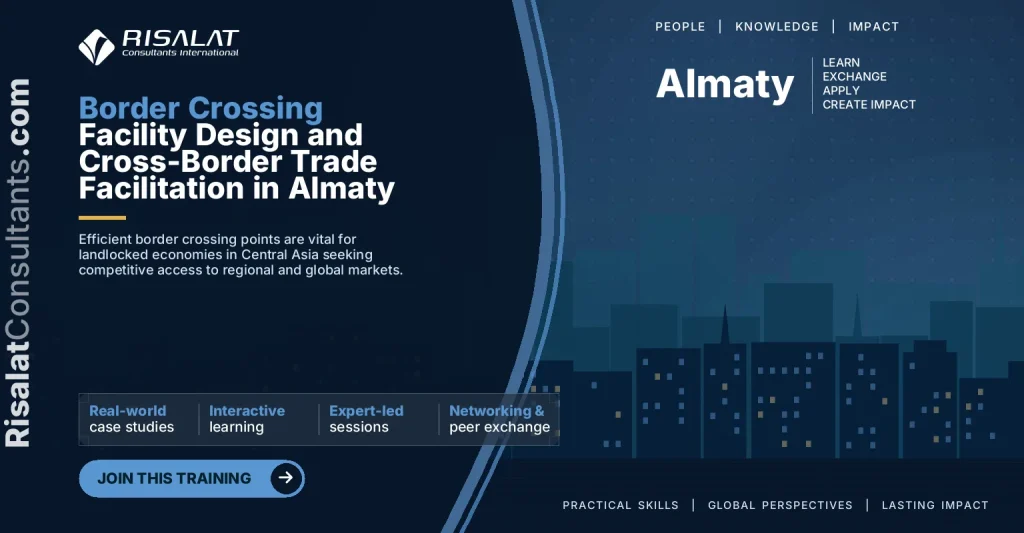
Border Crossing Facility Design and Cross-Border Trade Facilitation in Almaty
Programme Overview
Efficient border crossing points are vital for landlocked economies in Central Asia seeking competitive access to regional and global markets. This professional course in Almaty addresses the physical, institutional, and operational dimensions of modern border infrastructure. Participants examine integrated border management frameworks, trade facilitation instruments, and international design standards that convert congested checkpoints into streamlined multimodal processing nodes. The curriculum combines spatial planning with operational procedure reform to deliver measurable improvements in clearance times.
The programme provides practical methodologies to configure border crossing infrastructure for joint controls, non-intrusive inspection, and separated traffic flows. Delegates study how customs administrations, transport ministries, and cross-border agencies can coordinate procedures to reduce redundant checks and non-physical barriers. Drawing on established global conventions, the modules guide practitioners through practical trade corridor diagnostics, terminal capacity sizing, and the sequencing of civil works alongside customs automation and digital information exchange.
Delivered by Risalat Consultants International in Almaty, Kazakhstan, through interactive technical sessions, the course focuses on practical applications for corridor development across Central Asia. Participants analyse layout alternatives, evaluate inter-agency coordination mechanisms, and map transit inspection workflows to address specific bottleneck locations. By bridging engineering design and trade facilitation policy, the programme prepares public sector specialists to plan, procure, and supervise border post modernization initiatives that align with international good practice and cross-border operational realities.
The programme strengthens institutional capability in:
- Regional corridor connectivity and the institutional drivers of cross-border trade facilitation
- WCO Revised Kyoto Convention and SAFE Framework of Standards applied to border operations
- WTO Trade Facilitation Agreement provisions concerning transit and border agency cooperation
- Assessing physical and administrative bottlenecks using Time Release Study (TRS) methodologies
- Core principles of Integrated Border Management (IBM): intra-service, inter-agency, and international cooperation
- Functional zoning of border posts: administrative, primary inspection, secondary processing, and impound areas
- Traffic engineering at checkpoints: lane multiplication, commercial versus passenger separation, and bypass lanes
- Site selection, terrain constraints, approach road geometry, and queue management systems
- Budget preparation and execution
- Financial reporting and accounting standards
- Cash and treasury management
- Internal control over payments and assets
Why this matters now
Organisations increasingly require professionals capable of:
- Prepare and execute budgets in line with plans
- Produce accurate, timely financial reports
- Apply controls over payments and assets
- Meet financier financial management requirements
- Use financial information to support decisions
Strong public financial management and finance systems help organisations:
- Improve budget credibility and execution
- Produce reliable reports and clean audits
- Reduce payment delays and errors
- Build trust with financiers and oversight bodies
Who Should Attend
This programme is designed for:
- Customs administration modernization and operations officers
- Transport ministry freight and logistics coordinators
- Border infrastructure and trade corridor project engineers
- Border guard service checkpoint operations managers
- Project Implementation Unit (PIU) infrastructure specialists
- National trade facilitation committee technical secretariats
- Cross-border transit regulatory inspectors and specialists
- Public works engineers designing trade terminal facilities
- Transport planning specialists managing regional transit routes
- Finance managers and accountants
- Budget officers and analysts
- Treasury and cash management staff
Tick what your team needs to be able to do.
Programme Objectives
By the end of this programme participants will be able to:
- Analyse integrated border management models to improve inter-agency coordination at road crossing points
- Design border crossing point spatial layouts that segregate commercial, passenger, and dangerous goods traffic
- Map cross-border transit procedures using World Customs Organization (WCO) and WTO Trade Facilitation Agreement standards
- Specify civil works, traffic flow, and non-intrusive inspection facility requirements for high-volume border posts
- Evaluate joint customs inspection protocols and one-stop border post operational arrangements to minimize processing delays
- Apply corridor diagnostic methodologies to identify, measure, and clear logistics bottlenecks at border interfaces
- Formulate border modernization action plans aligned with international transport corridor connectivity frameworks
- Explain the budget cycle and the role of each actor
- Prepare and monitor budgets linked to plans
- Apply the main principles of the relevant reporting standards
Training Structure & Contents
- Regional corridor connectivity and the institutional drivers of cross-border trade facilitation
- WCO Revised Kyoto Convention and SAFE Framework of Standards applied to border operations
- WTO Trade Facilitation Agreement provisions concerning transit and border agency cooperation
- Assessing physical and administrative bottlenecks using Time Release Study (TRS) methodologies
- Core principles of Integrated Border Management (IBM): intra-service, inter-agency, and international cooperation
- Workshop on applying Integrated Border Management and corridor modernization frameworks to participant institutions
- Functional zoning of border posts: administrative, primary inspection, secondary processing, and impound areas
- Traffic engineering at checkpoints: lane multiplication, commercial versus passenger separation, and bypass lanes
- Site selection, terrain constraints, approach road geometry, and queue management systems
- Integration of weighbridges, radiation portal monitors, and non-intrusive inspection (NII) scanning bays
- Architectural programming for joint control offices, cargo verification sheds, and bonded transit parking
- Workshop on applying facility planning and spatial engineering methods to institutional settings
- Developing operating models for One-Stop Border Posts (OSBP) and juxtaposed control facilities
- Risk management architectures: dual-channel clearance, dynamic lane allocation, and post-clearance audit links
- Coordinated border management workflows between customs, border guards, and sanitary and phytosanitary agencies
- Standard operating procedures (SOPs) for joint inspections, shared commercial documentation, and seal verification
- Managing perishable cargo and hazardous materials under the UNECE TIR Convention and trade rules
- Case study on operational streamlining and joint clearance procedures in practice
- Digital border management: pre-arrival processing, electronic single window interfaces, and automated gate systems
- Developing practical business process maps for streamlined inbound, outbound, and transit freight
- Environmental, health, and cross-border safety standards within facility construction and operational management
- Procurement, supervision, and phased execution of civil works without disrupting live border traffic
- Action planning: drafting an operational improvement and infrastructure requirement matrix for selected crossings
- Capstone exercise on formulating an institutional border crossing action plan
- Budget preparation, monitoring, and execution aligned with operational plans
- Financial reporting standards and internal control frameworks over payments and assets
- Cash and treasury management for public institutions and capital projects
- Meeting financier financial management and reporting requirements
- Final review, group presentations, and institutional implementation planning
Full day-by-day contents
First Day | Integrated Border Management and Corridor Modernization Frameworks
- Regional corridor connectivity and the institutional drivers of cross-border trade facilitation
- WCO Revised Kyoto Convention and SAFE Framework of Standards applied to border operations
- WTO Trade Facilitation Agreement provisions concerning transit and border agency cooperation
- Assessing physical and administrative bottlenecks using Time Release Study (TRS) methodologies
- Core principles of Integrated Border Management (IBM): intra-service, inter-agency, and international cooperation
- Workshop on applying Integrated Border Management and corridor modernization frameworks to participant institutions
Second Day | Border Crossing Facility Planning and Spatial Engineering
- Functional zoning of border posts: administrative, primary inspection, secondary processing, and impound areas
- Traffic engineering at checkpoints: lane multiplication, commercial versus passenger separation, and bypass lanes
- Site selection, terrain constraints, approach road geometry, and queue management systems
- Integration of weighbridges, radiation portal monitors, and non-intrusive inspection (NII) scanning bays
- Architectural programming for joint control offices, cargo verification sheds, and bonded transit parking
- Workshop on applying facility planning and spatial engineering methods to institutional settings
Third Day | Operational Streamlining and Joint Clearance Procedures
- Developing operating models for One-Stop Border Posts (OSBP) and juxtaposed control facilities
- Risk management architectures: dual-channel clearance, dynamic lane allocation, and post-clearance audit links
- Coordinated border management workflows between customs, border guards, and sanitary and phytosanitary agencies
- Standard operating procedures (SOPs) for joint inspections, shared commercial documentation, and seal verification
- Managing perishable cargo and hazardous materials under the UNECE TIR Convention and trade rules
- Case study on operational streamlining and joint clearance procedures in practice
Fourth Day | Corridor Bottleneck Clearance, Technology, and Implementation
- Digital border management: pre-arrival processing, electronic single window interfaces, and automated gate systems
- Developing practical business process maps for streamlined inbound, outbound, and transit freight
- Environmental, health, and cross-border safety standards within facility construction and operational management
- Procurement, supervision, and phased execution of civil works without disrupting live border traffic
- Action planning: drafting an operational improvement and infrastructure requirement matrix for selected crossings
- Capstone exercise on formulating an institutional border crossing action plan
Fifth Day | Public Financial Management and Programme Synthesis
- Budget preparation, monitoring, and execution aligned with operational plans
- Financial reporting standards and internal control frameworks over payments and assets
- Cash and treasury management for public institutions and capital projects
- Meeting financier financial management and reporting requirements
- Final review, group presentations, and institutional implementation planning
Training Methodology
The training employs adult learning techniques focused on operational problem-solving for public sector infrastructure and border management. Participants review real-world border station plans, complete process mapping exercises, and evaluate functional layout models. Technical presentations are supplemented with peer exchange sessions, diagnostic workshops, and small-group drafting of border intervention concepts, allowing officials to apply what they learn directly to their institutional environments.
- Interactive technical presentations delivered by subject specialists
- Diagnostic workshops assessing border crossing bottlenecks
- Hands-on business process mapping and layout analysis exercises
- Case study reviews of operational streamlining and joint controls
- Small-group drafting of institutional action plans and peer feedback
Expected Outcomes
- Enhanced institutional capability to implement integrated border management frameworks
- Practical capability to design functional border post layouts with separated traffic flows
- Competence in applying WCO, WTO, and UNECE standards to cross-border transit procedures
- Ability to plan, procure, and sequence border facility civil works and technology systems
- Strengthened skills in public financial management, budgeting, and project execution
- Formulated action plans addressing specific border crossing operational bottlenecks
£2,350 per participant · invoice and bank transfer · groups of 5 or more receive a discount
Five or more from one organisation: ask for the group rate on the invoice request.
Ten or more: an in-house version for your institution may cost less per person. Ask for an in-house quote.
Registration closes in 297 days (22 Sep 2027)
Who Will Deliver This Programme
Each date is delivered by a team assigned from Risalat's expert network for this subject. For this programme we assign:
How we choose them: Experience in the region of the participants or comparable settings; Command of the financier rules that apply (World Bank, ADB, AfDB, EU, UN) where relevant; Delivery in English; other languages on request for in-house groups; No conflict of interest with participants' institutions.
Training courses in AlmatyBusiness and Communication training courses
Why Almaty for this programme
Almaty is a convenient hub for Central Asian delegations with good venues and value.
The Border Crossing Facility Design and Cross-Border Trade Facilitation in Almaty programme in November 2027 brings together officials and professionals from across the Central Asia region and beyond. Sessions combine short inputs, case studies and group work on participants' own files, and the city's institutions can be added as a study visit on request.
Getting there: Almaty International (ALA).
Check whether you need a visa with the free Visa Checker, and ask for an invitation letter once you are registered.
The same topic in other cities
Other programmes in Almaty
- Apprenticeship Systems and Work-Based Learning Frameworks in Almaty
- Modern Pedagogy, Teacher Professional Development and Learning Assessment in Almaty
- Agribusiness Value Chain Aggregation and Post-Harvest Logistics in Almaty
- Small Hydropower Engineering, Grid Interconnection & Feasibility in Almaty
- Sustainable Livestock Value Chains and Veterinary Disease Control in Almaty
Questions before you nominate your team? Book a 30-minute call with us, or ask for this programme in-house.
Teams often travel here from Afghanistan, Mongolia, Kazakhstan, Uzbekistan, Kyrgyzstan, Tajikistan, Turkmenistan. Funding, visa letters and group rates are explained on each country page.
Is there infrastructure and urban development training for government officials in Almaty in November 2027?
Can "Border Crossing Facility Design and Cross-Border Trade Facilitation in Almaty" be delivered in-house for one organisation?
Which other infrastructure and urban development programmes does Risalat run?
How do organisations register and pay?
For teams and institutions
Bring your team
Teams that learn together apply more at work. Tell us how many people and how you would like to take part: we reply with a group quote within two working days.
Watch: this programme in short


More training courses in Kazakhstan · All programmes in Asia · Full training calendar
Plan this programme in a roadmap: why it matters, why to approve it, the dates to plan and the career it builds.