Key facts
- Dates
- 8–11 Nov 2027 (4 days)
- Where
- Istanbul, Türkiye
- Fee per participant
- £3,570 (GBP)
- Payment
- By invoice and bank transfer
- Registration closes
- 29 Sep 2027
- Format
- 4-day short course: a practical capacity-building programme for government, NGO and project teams in Istanbul
- Groups
- Teams of 3 or more qualify for a group discount, offered case by case: ask for a group quote.
- In-house option
- Run it for your team, on your dates
On this page 9 sections
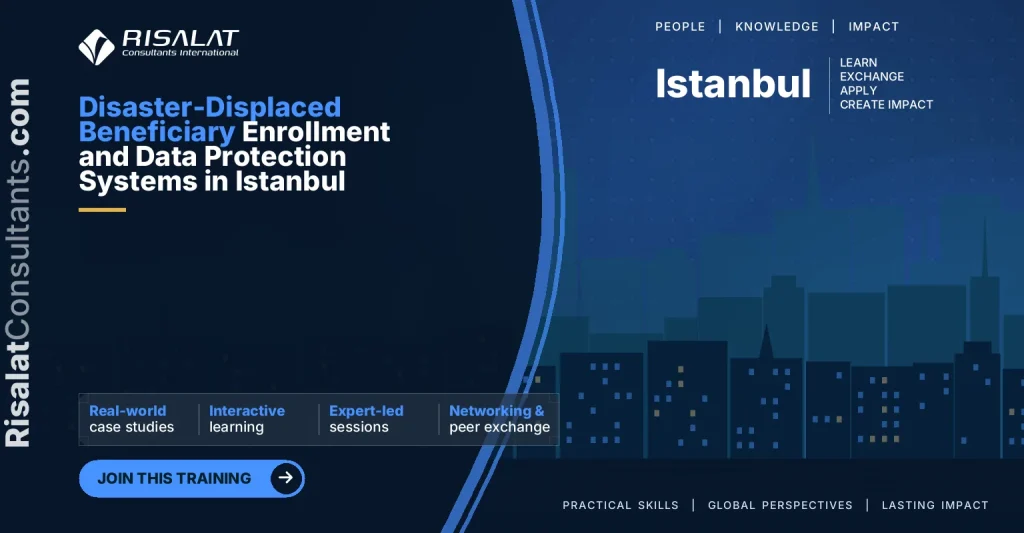
Disaster-Displaced Beneficiary Enrollment and Data Protection Systems in Istanbul
Programme Overview
This intensive four-day professional programme in Istanbul provides practitioners with operational methodologies for designing, deploying, and managing beneficiary registration systems tailored to disaster-displaced populations. Displaced persons often lack standard identity documentation, reside in volatile environments, and require rapid social assistance. Participants examine end-to-end information workflows, from secure offline field intake to centralised database administration, ensuring that vulnerable households receive timely assistance while their sensitive personal information remains protected against unauthorised exposure or misuse throughout the data lifecycle.
Free self-check: the governance self-audit gives a quick check of governance, controls and accountability, in about 10 minutes.
The curriculum addresses data governance and data protection frameworks vital for social registries and management information systems operating in crisis settings. Participants review international standards such as the UN Personal Data Protection and Privacy Principles and the Core Humanitarian Standard on Quality and Accountability. The course analyses secure data exchange architectures, role-based access management, and privacy-by-design concepts, equipping technical teams to mitigate vulnerabilities in hostile operating environments while maintaining operational agility.
Ongoing instability and large-scale population displacement severely challenge the integrity of administrative social registries, heightening the risk of duplicate records, ghost beneficiaries, and excluded vulnerable households. Public institutions and international assistance programmes, including safety net operations aligned with the Sudan SANAD: Emergency Crisis Response Safety Net Project framework, require robust targeting infrastructure and secure registry capabilities. Delivered by Risalat Consultants International in Istanbul, Turkey, the programme combines expert-led sessions, real cases and group work, so that participants can apply what they learn in their own institution.
The programme strengthens institutional capability in:
- Analysis of displacement dynamics and their impact on civil registration and social registries
- Field intake modalities: Paper-to-digital, direct digital entry, and offline-capable mobile tools
- Identity verification mechanisms for undocumented and internally displaced persons (IDPs)
- Addressing registration bottlenecks, vulnerable group accessibility, and remote intake constraints
- Operational mapping of end-to-end intake pipelines from point of collection to staging databases
- Application of the UN Personal Data Protection and Privacy Principles in safety net delivery
- Conducting Data Protection Impact Assessments (DPIAs) for high-risk beneficiary registries
- Data minimization principles, informed consent models, and secondary data use limitations
- Climate and environmental risk assessment
- Adaptation and mitigation planning
- Sector strategies for energy, water and land
- Project design for climate and environmental goals
Why this matters now
Organisations increasingly require professionals capable of:
- Assess climate and environmental risks to their services and assets
- Design projects that meet climate and environmental goals
- Prepare proposals that financiers can approve
- Measure and report results credibly
- Work with communities and partners across sectors
Strong climate, environment and natural resources systems help organisations:
- Protect services and infrastructure from climate risks
- Access climate and environmental finance
- Meet national and international commitments
- Use natural resources sustainably
- Collect
- Clean
- Store
- Analyse
- Decide
Who Should Attend
This programme is designed for:
- Social registry directors and technical managers
- Database administrators managing social protection systems
- Social protection IT coordinators and systems analysts
- Management Information System (MIS) specialists in project implementation units
- Targeting and registration officers from public safety net authorities
- Data protection officers and legal advisors in social ministries
- Monitoring and evaluation specialists responsible for beneficiary data integrity
- Operations officers managing cash transfer management systems
- Donor-funded project technical teams managing humanitarian-development registries
- Climate change and environment officers
- Energy, water and agriculture sector staff
- Planning and policy officers
Tick what your team needs to be able to do.
Programme Objectives
By the end of this programme participants will be able to:
- Design resilient beneficiary registration workflows tailored to displaced populations lacking civil documentation
- Implement international data protection and privacy standards within social protection registry operations
- Apply deterministic and probabilistic deduplication algorithms to resolve duplicate and fragmented beneficiary entries
- Formulate secure data-sharing agreements and technical protocols for inter-agency information exchange
- Establish role-based access controls and cryptographic safeguards for beneficiary databases in crisis contexts
- Conduct comprehensive data protection impact assessments (DPIAs) on social assistance digital intake channels
- Deploy audit trails and automated verification pipelines to maintain registry accuracy, transparency, and accountability
- Explain the main climate and environmental challenges for their sector
- Assess climate and environmental risks to services and assets
- Plan adaptation and mitigation measures
Training Structure & Contents
- Analysis of displacement dynamics and their impact on civil registration and social registries
- Field intake modalities: Paper-to-digital, direct digital entry, and offline-capable mobile tools
- Identity verification mechanisms for undocumented and internally displaced persons (IDPs)
- Addressing registration bottlenecks, vulnerable group accessibility, and remote intake constraints
- Operational mapping of end-to-end intake pipelines from point of collection to staging databases
- Workshop: Registration Architecture and Intake Workflows for Displaced Populations: Applying It to Your Institution
- Application of the UN Personal Data Protection and Privacy Principles in safety net delivery
- Conducting Data Protection Impact Assessments (DPIAs) for high-risk beneficiary registries
- Data minimization principles, informed consent models, and secondary data use limitations
- Institutional governance models: Defining data controllers, data processors, and data custodians
- Risk mitigation strategies for handling sensitive displacement and socioeconomic vulnerability data
- Workshop: Data Governance, Protection Frameworks, and Regulatory Safeguards: Applying It to Your Institution
- Database design architectures for social registries and emergency assistance registries
- Deterministic record linkage using administrative identifiers, phone numbers, and demographics
- Probabilistic record matching algorithms for resolving transliteration and phonetic variations
- Managing registry reconciliation: Resolving false positives, disputes, and unresolved linkages
- Automating audit trails, versioning protocols, and continuous registry cleansing workflows
- Case Study: Database Integrity, Identity Resolution, and Deduplication Systems in Practice
- Architectures for secure data sharing: APIs, tokenisation, SFTP, and centralised clearinghouses
- Drafting robust Data Sharing Agreements (DSAs) and inter-agency Standard Operating Procedures
- Role-based access control (RBAC), multi-factor authentication, and database encryption at rest
- Incident response protocols: Managing data breaches, leakages, and technical infrastructure outages
- Action planning: Upgrading institutional registration systems for emergency crisis response projects
- Capstone Exercise: Disaster-Displaced Beneficiary Enrollment and Data Protection Systems in Istanbul Action Plan for Your Institution
- Review of system architecture walkthroughs and data auditing techniques
- Evaluation of deterministic and probabilistic identity matching methods
- Consolidation of privacy-by-design concepts and role-based access controls
- Finalisation of inter-agency data sharing protocols and regulatory safeguards
- Institutional delivery mechanisms for resilient, accountable social protection systems
Full day-by-day contents
First Day | Registration Architecture and Intake Workflows for Displaced Populations
- Analysis of displacement dynamics and their impact on civil registration and social registries
- Field intake modalities: Paper-to-digital, direct digital entry, and offline-capable mobile tools
- Identity verification mechanisms for undocumented and internally displaced persons (IDPs)
- Addressing registration bottlenecks, vulnerable group accessibility, and remote intake constraints
- Operational mapping of end-to-end intake pipelines from point of collection to staging databases
- Workshop: Registration Architecture and Intake Workflows for Displaced Populations: Applying It to Your Institution
Second Day | Data Governance, Protection Frameworks, and Regulatory Safeguards
- Application of the UN Personal Data Protection and Privacy Principles in safety net delivery
- Conducting Data Protection Impact Assessments (DPIAs) for high-risk beneficiary registries
- Data minimization principles, informed consent models, and secondary data use limitations
- Institutional governance models: Defining data controllers, data processors, and data custodians
- Risk mitigation strategies for handling sensitive displacement and socioeconomic vulnerability data
- Workshop: Data Governance, Protection Frameworks, and Regulatory Safeguards: Applying It to Your Institution
Third Day | Database Integrity, Identity Resolution, and Deduplication Systems
- Database design architectures for social registries and emergency assistance registries
- Deterministic record linkage using administrative identifiers, phone numbers, and demographics
- Probabilistic record matching algorithms for resolving transliteration and phonetic variations
- Managing registry reconciliation: Resolving false positives, disputes, and unresolved linkages
- Automating audit trails, versioning protocols, and continuous registry cleansing workflows
- Case Study: Database Integrity, Identity Resolution, and Deduplication Systems in Practice
Fourth Day | Secure Inter-Agency Data Exchange and System Resilience
- Architectures for secure data sharing: APIs, tokenisation, SFTP, and centralised clearinghouses
- Drafting robust Data Sharing Agreements (DSAs) and inter-agency Standard Operating Procedures
- Role-based access control (RBAC), multi-factor authentication, and database encryption at rest
- Incident response protocols: Managing data breaches, leakages, and technical infrastructure outages
- Action planning: Upgrading institutional registration systems for emergency crisis response projects
- Capstone Exercise: Disaster-Displaced Beneficiary Enrollment and Data Protection Systems in Istanbul Action Plan for Your Institution
Fifth Day | System Consolidation and Framework Integration
- Review of system architecture walkthroughs and data auditing techniques
- Evaluation of deterministic and probabilistic identity matching methods
- Consolidation of privacy-by-design concepts and role-based access controls
- Finalisation of inter-agency data sharing protocols and regulatory safeguards
- Institutional delivery mechanisms for resilient, accountable social protection systems
Training Methodology
The training employs an applied, operational methodology grounded in real-world social assistance deployments. Participants engage in hands-on technical labs, case study reviews, and guided policy design sessions. Database administrators and IT coordinators test deduplication scripts and data workflows, combining expert input and practical group exercises.
- System architecture walkthroughs
- Data auditing techniques and practical exercises
- Deterministic and probabilistic deduplication labs
- Real-world case study analysis
- Interactive group workshops and peer reviews
- Individual institutional action planning
Expected Outcomes
- Strengthened capacity to design and manage resilient intake workflows for disaster-displaced populations
- Practical ability to execute deterministic and probabilistic deduplication algorithms
- Competence in conducting Data Protection Impact Assessments (DPIAs) for high-risk beneficiary registries
- Enhanced skills in drafting inter-agency Data Sharing Agreements and operational protocols
- Implementation of robust role-based access controls, multi-factor authentication, and encryption safeguards
- Tailored institutional action plans ready for deployment within emergency crisis response operations
£3,570 per participant · invoice and bank transfer · groups of 5 or more receive a discount
Five or more from one organisation: ask for the group rate on the invoice request.
Ten or more: an in-house version for your institution may cost less per person. Ask for an in-house quote.
Registration closes in 304 days (29 Sep 2027)
Who Will Deliver This Programme
Each date is delivered by a team assigned from Risalat's expert network for this subject. For this programme we assign:
How we choose them: Experience in the region of the participants or comparable settings; Command of the financier rules that apply (World Bank, ADB, AfDB, EU, UN) where relevant; Delivery in English; other languages on request for in-house groups; No conflict of interest with participants' institutions.
Training courses in IstanbulHumanitarians training courses
Why Istanbul for this programme
Istanbul sits between Europe and Asia, with direct flights from most capitals and easy visas for many delegations.
The Disaster-Displaced Beneficiary Enrollment and Data Protection Systems in Istanbul programme in November 2027 brings together officials and professionals from across the Europe and Asia region and beyond. Sessions combine short inputs, case studies and group work on participants' own files, and the city's institutions can be added as a study visit on request.
Getting there: Istanbul Airport (IST).
Check whether you need a visa with the free Visa Checker, and ask for an invitation letter once you are registered.
Other programmes in Istanbul
- Mini Degree in Environmental and Social Safeguards in Istanbul
- Risk-Based Internal Audit in the Public Sector in Istanbul
- AI for Public Procurement and Contract Management Training in Istanbul
- Seed Sector Modernisation and Climate-Smart Seed Certification in Istanbul
- Credit Guarantee Scheme Administration and MSME Risk Underwriting in Istanbul
Questions before you nominate your team? Book a 30-minute call with us, or ask for this programme in-house.
Teams often travel here from Pakistan, Mongolia, Kazakhstan, Uzbekistan, Kyrgyzstan, Tajikistan, Turkmenistan, Azerbaijan. Funding, visa letters and group rates are explained on each country page.
Is there data, ai and analytics training for government officials in Istanbul in November 2027?
Can "Disaster-Displaced Beneficiary Enrollment and Data Protection Systems in Istanbul" be delivered in-house for one organisation?
Which other data, ai and analytics programmes does Risalat run?
How do organisations register and pay?
For teams and institutions
Bring your team
Teams that learn together apply more at work. Tell us how many people and how you would like to take part: we reply with a group quote within two working days.
Watch: this programme in short

Other dates and cities for this subject: Resettlement and Livelihood Restoration training courses (21 upcoming dates).
More training courses in Türkiye · All programmes in Europe · Full training calendar
Plan this programme in a roadmap: why it matters, why to approve it, the dates to plan and the career it builds.