Key facts
- Dates
- 21–24 Jun 2027 (4 days)
- Where
- Almaty, Kazakhstan
- Fee per participant
- £2,450 (GBP)
- Payment
- By invoice and bank transfer
- Registration closes
- 12 May 2027
- Format
- 4-day short course: a practical capacity-building programme for government, NGO and project teams in Almaty
- In-house option
- Run it for your team, on your dates
On this page 10 sections
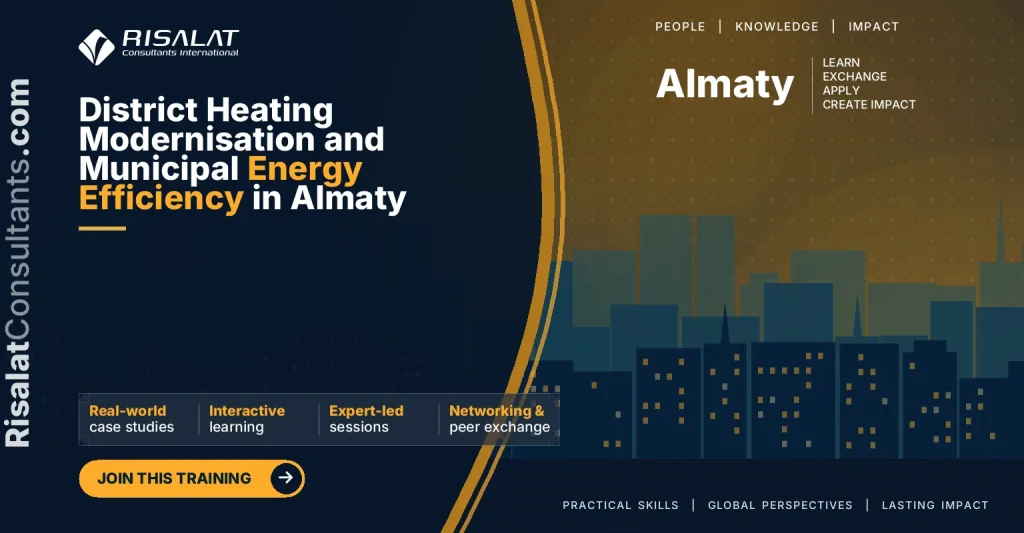
District Heating Modernisation and Municipal Energy Efficiency in Almaty
Programme Overview
Municipal energy systems across Central Asia face operational challenges arising from ageing infrastructure, high transmission losses, and inefficient open-loop configurations. This four-day professional training programme in Almaty delivers comprehensive technical guidance on transitioning to modern closed-loop district heating networks. Participants examine engineering best practice, advanced thermal insulation standards, and variable-speed pumping systems designed to improve municipal energy efficiency. The curriculum specifically addresses the technical demands of rehabilitating legacy public assets in accordance with international quality benchmarks.
The course focuses on practical interventions across generation interfaces, distribution networks, and building-level substations. Participants analyse hydraulic balancing, the installation of individual heat substations (IHS), modern consumer metering protocols, and demand-side energy conservation measures. Delivered through structured modules, the programme provides municipal heating enterprise managers, utility engineers, and urban project coordinators with the analytical tools required to identify network bottlenecks, calculate thermal losses accurately, and implement commercially viable efficiency upgrades across public infrastructure and residential estates.
Targeted primarily at municipal practitioners and utility professionals from Uzbekistan and the wider region, the training grounds technical concepts in actionable implementation planning. Attendees engage in rigorous planning exercises to evaluate capital upgrade alternatives, calculate lifecycle costs, and structure procurement packages suitable for donor-financed municipal infrastructure initiatives. By the conclusion of the workshop, participants produce operational plans for substation retrofitting and heat network loss reduction tailored to their home municipal utilities.
The programme strengthens institutional capability in:
- Assessment of legacy municipal heating infrastructure and baseline performance indicators
- Principles and engineering requirements of closed-loop district heating network design
- Hydraulic balancing methods and integration of variable-speed distribution pumping
- Application of EN 253 and EN 448 standards for pre-insulated bonded pipe networks
- Case analysis of municipal network hydraulic optimisation and operational safety
- Decommissioning central heat substations and sizing individual heat substations (IHS)
- Plate heat exchanger selection, temperature control loops, and pressure regulation
- Ultrasonic consumer heat metering, automated meter reading (AMR), and billing integration
- Climate and environmental risk assessment
- Adaptation and mitigation planning
- Sector strategies for energy, water and land
- Project design for climate and environmental goals
- Funds
- Entity
- Project
- Results
- MRV
Why this matters now
Organisations increasingly require professionals capable of:
- Assess climate and environmental risks to their services and assets
- Design projects that meet climate and environmental goals
- Prepare proposals that financiers can approve
- Measure and report results credibly
- Work with communities and partners across sectors
Strong climate, environment and natural resources systems help organisations:
- Protect services and infrastructure from climate risks
- Access climate and environmental finance
- Meet national and international commitments
- Use natural resources sustainably
Who Should Attend
This programme is designed for:
- Municipal district heating utility directors and chief engineers
- Urban energy efficiency project coordinators from municipal administrations
- Technical specialists from utility project implementation units (PIUs)
- Engineers managing heat distribution networks and pumping stations
- Energy management officers from public infrastructure departments
- Utility procurement and technical specifications specialists
- Supervisory engineers overseeing substation rehabilitation works
- Municipal asset managers evaluating heating network modernisation
- Energy auditors focused on municipal and public building efficiency
- Climate change and environment officers
- Energy, water and agriculture sector staff
- Planning and policy officers
Tick what your team needs to be able to do.
Programme Objectives
By the end of this programme participants will be able to:
- Evaluate the hydraulic, thermal, and economic performance of existing municipal district heating networks
- Design migration pathways from open-loop systems to modern closed-loop network architectures
- Formulate implementation plans for individual heat substation (IHS) retrofits and automated controls
- Specify accurate consumer metering and supervisory control data acquisition (SCADA) requirements
- Apply international technical standards for pre-insulated pipe installation and network loss reduction
- Appraise building-envelope and demand-side thermal efficiency measures for public infrastructure
- Structure capital investment packages and technical specifications compliant with donor procurement guidelines
- Explain the main climate and environmental challenges for their sector
- Assess climate and environmental risks to services and assets
- Plan adaptation and mitigation measures
Training Structure & Contents
- Assessment of legacy municipal heating infrastructure and baseline performance indicators
- Principles and engineering requirements of closed-loop district heating network design
- Hydraulic balancing methods and integration of variable-speed distribution pumping
- Application of EN 253 and EN 448 standards for pre-insulated bonded pipe networks
- Case analysis of municipal network hydraulic optimisation and operational safety
- Workshop on applying network architecture and transition methods to participant institutions
- Decommissioning central heat substations and sizing individual heat substations (IHS)
- Plate heat exchanger selection, temperature control loops, and pressure regulation
- Ultrasonic consumer heat metering, automated meter reading (AMR), and billing integration
- Implementation of SCADA systems for real-time monitoring and municipal heat dispatch
- Practical design session on individual heat substation layout and equipment scheduling
- Workshop on applying substation modernisation, metering, and automation to participant institutions
- Diagnostic protocols for locating physical leakage and assessing distribution heat losses
- Thermal efficiency measures for public sector buildings and residential building envelopes
- Integration of thermostatic radiator valves (TRVs) and building-level balancing valves
- Calculation of avoided thermal losses and greenhouse gas emission reduction profiles
- Technical audit methodologies compliant with ISO 50002 for public heating systems
- Case study analysis on practical implementation of thermal loss reduction and demand-side building efficiency
- Lifecycle costing (LCC) and economic appraisal of network modernisation options
- Structuring technical specifications for donor-financed heating infrastructure tenders
- Risk management and contract administration during urban network excavation and retrofitting
- Quality assurance protocols, factory acceptance testing, and on-site commissioning standards
- Participant presentation of operational plans for substation retrofits and loss reduction
- Capstone exercise to produce a district heating modernisation action plan for participant institutions
- Climate and environmental risk assessment for municipal energy infrastructure
- Adaptation and mitigation planning across municipal utility assets
- Sector strategies for the integration of energy, water, and land resources
- Project design standards targeting international climate and environmental goals
- Structuring proposals for climate and environmental financiers
- Monitoring, reporting, and credible measurement of resource efficiency outcomes
Full day-by-day contents
First Day | District Heating Network Architecture and Transition to Closed Systems
- Assessment of legacy municipal heating infrastructure and baseline performance indicators
- Principles and engineering requirements of closed-loop district heating network design
- Hydraulic balancing methods and integration of variable-speed distribution pumping
- Application of EN 253 and EN 448 standards for pre-insulated bonded pipe networks
- Case analysis of municipal network hydraulic optimisation and operational safety
- Workshop on applying network architecture and transition methods to participant institutions
Second Day | Substation Modernisation, Metering, and Automation
- Decommissioning central heat substations and sizing individual heat substations (IHS)
- Plate heat exchanger selection, temperature control loops, and pressure regulation
- Ultrasonic consumer heat metering, automated meter reading (AMR), and billing integration
- Implementation of SCADA systems for real-time monitoring and municipal heat dispatch
- Practical design session on individual heat substation layout and equipment scheduling
- Workshop on applying substation modernisation, metering, and automation to participant institutions
Third Day | Thermal Loss Reduction and Demand-Side Building Efficiency
- Diagnostic protocols for locating physical leakage and assessing distribution heat losses
- Thermal efficiency measures for public sector buildings and residential building envelopes
- Integration of thermostatic radiator valves (TRVs) and building-level balancing valves
- Calculation of avoided thermal losses and greenhouse gas emission reduction profiles
- Technical audit methodologies compliant with ISO 50002 for public heating systems
- Case study analysis on practical implementation of thermal loss reduction and demand-side building efficiency
Fourth Day | Capital Investment Planning, Procurement, and Project Execution
- Lifecycle costing (LCC) and economic appraisal of network modernisation options
- Structuring technical specifications for donor-financed heating infrastructure tenders
- Risk management and contract administration during urban network excavation and retrofitting
- Quality assurance protocols, factory acceptance testing, and on-site commissioning standards
- Participant presentation of operational plans for substation retrofits and loss reduction
- Capstone exercise to produce a district heating modernisation action plan for participant institutions
Fifth Day | Sector Strategies and Climate Investment Integration
- Climate and environmental risk assessment for municipal energy infrastructure
- Adaptation and mitigation planning across municipal utility assets
- Sector strategies for the integration of energy, water, and land resources
- Project design standards targeting international climate and environmental goals
- Structuring proposals for climate and environmental financiers
- Monitoring, reporting, and credible measurement of resource efficiency outcomes
Training Methodology
The training combines technical lectures with applied engineering exercises, practical calculation clinics, and structured implementation planning. Participants work with real municipal baseline data to calculate network losses, evaluate substation configurations, and draft technical specifications. Peer-to-peer review sessions allow utility engineers and municipal managers to cross-examine proposed modernisation strategies against operational conditions in Central Asian cities, supported by detailed analysis of international donor-funded project delivery frameworks.
- Expert-led sessions on current practice
- Regional and international case studies
- Group work and practical exercises
- Simulations and role play
Expected Outcomes
- Production of operational plans for substation retrofitting and heat network loss reduction tailored to home municipal utilities
- Capacity to transition legacy open-loop district heating networks to modern closed-loop systems
- Proficiency in applying EN 253 and EN 448 standards to pre-insulated piping and distribution infrastructure
- Ability to structure procurement packages and technical specifications compliant with donor-financed project requirements
- Enhanced capability to evaluate lifecycle costs and baseline network losses using municipal data
£2,450 per participant · invoice and bank transfer · groups of 5 or more receive a discount
Five or more from one organisation: ask for the group rate on the invoice request.
Ten or more: an in-house version for your institution may cost less per person. Ask for an in-house quote.
Registration closes in 164 days (12 May 2027)
Who Will Deliver This Programme
Each date is delivered by a team assigned from Risalat's expert network for this subject. For this programme we assign:
How we choose them: Experience in the region of the participants or comparable settings; Command of the financier rules that apply (World Bank, ADB, AfDB, EU, UN) where relevant; Delivery in English; other languages on request for in-house groups; No conflict of interest with participants' institutions.
Training courses in AlmatyEnergy and Water training courses
Why Almaty for this programme
Almaty is a convenient hub for Central Asian delegations with good venues and value.
The District Heating Modernisation and Municipal Energy Efficiency in Almaty programme in June 2027 brings together officials and professionals from across the Central Asia region and beyond. Sessions combine short inputs, case studies and group work on participants' own files, and the city's institutions can be added as a study visit on request.
Getting there: Almaty International (ALA).
Check whether you need a visa with the free Visa Checker, and ask for an invitation letter once you are registered.
The same topic in other cities
- Urban Air Pollution Abatement and Low-Emission Source Control in Vienna (Vienna)
- Urban Clean Heating and District Energy Decarbonisation in Vienna (Vienna)
- Infection Prevention and Healthcare Facility Upgrading in Cold Climates in Seoul (Seoul)
- District Heating Network Rehabilitation and Thermal Efficiency Management in Almaty (Almaty)
Other programmes in Almaty
- Power Transmission Asset Reliability and SCADA Modernisation in Almaty
- Agribusiness Value Chain Aggregation and Post-Harvest Logistics in Almaty
- Modern Pedagogy, Teacher Professional Development and Learning Assessment in Almaty
- Apprenticeship Systems and Work-Based Learning Frameworks in Almaty
- Small Hydropower Engineering, Grid Interconnection & Feasibility in Almaty
Related: Climate finance and energy programmes · free Climate Finance Proposal Readiness · all programmes
Questions before you nominate your team? Book a 30-minute call with us, or ask for this programme in-house.
Teams often travel here from Afghanistan, Mongolia, Kazakhstan, Uzbekistan, Kyrgyzstan, Tajikistan, Turkmenistan. Funding, visa letters and group rates are explained on each country page.
Is there energy and utilities training for government officials in Almaty in June 2027?
Can "District Heating Modernisation and Municipal Energy Efficiency in Almaty" be delivered in-house for one organisation?
Which other energy and utilities programmes does Risalat run?
How do organisations register and pay?
For teams and institutions
Bring your team
Teams that learn together apply more at work. Tell us how many people and how you would like to take part: we reply with a group quote within two working days.
Watch: this programme in short


Other dates and cities for this subject: Energy, Power and Utility Management training courses (118 upcoming dates).
More training courses in Kazakhstan · All programmes in Asia · Full training calendar
Plan this programme in a roadmap: why it matters, why to approve it, the dates to plan and the career it builds.