Datos clave
- Fechas
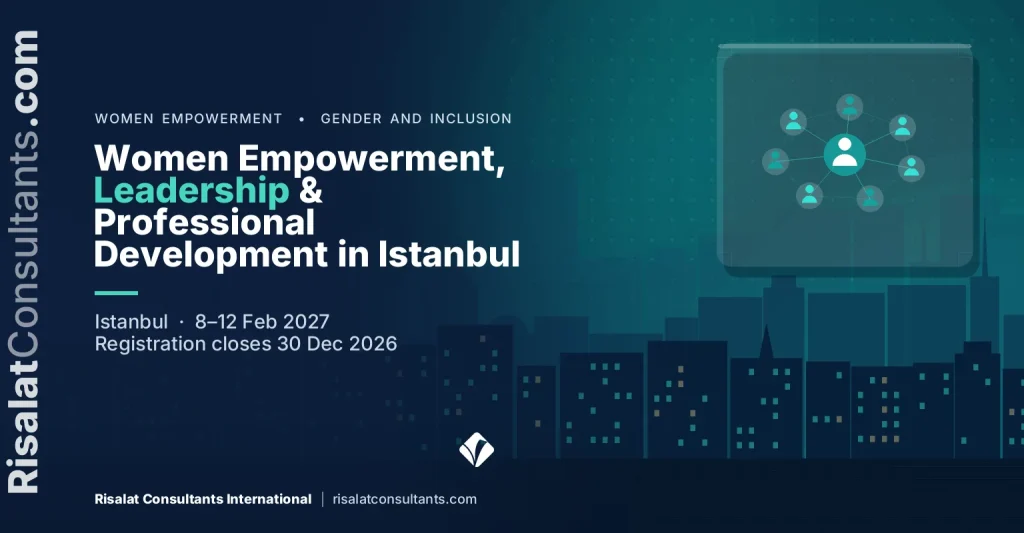
- 8–12 feb 2027 (5 días)
- Dónde
- Radisson Hotel President Beyazit Istanbul, Istanbul, Türkiye
- Tarifa por participante
- 3.960 £ (GBP)
- Pago
- Mediante factura y transferencia bancaria
- Cierre de inscripciones
- 30 dic 2026
- Formato
- 5-day short course: a practical capacity-building programme for government, NGO and project teams in Istanbul
- Certificado
- Certificado de finalización
- Opción interna
- Impártalo para su equipo, en sus fechas
En esta página 16 secciones
Descripción del programa
Women’s empowerment and leadership are now treated as core questions of institutional performance, not only of fairness. Organisations that recruit, develop and promote women effectively draw on a wider pool of talent, make better-informed decisions and serve their communities more fully. This programme in Istanbul combines gender-responsive leadership, professional development and practical tools for advancing women’s participation in public institutions, development projects and businesses.
Progress remains slow. The World Economic Forum’s Global Gender Gap Report 2025 finds that 68.8% of the global gender gap has been closed across 148 economies and estimates that full parity is about 123 years away at the current pace. UN data reported for SDG 5 show that women held 30% of management positions in 2023, only 2.4 percentage points more than in 2015.
The host country illustrates both the challenge and the policy response. Official statistics published by the Turkish Statistical Institute (TurkStat) and UN Women show a labour force participation rate of 36.8% for women in 2024, compared with 72% for men. At the same time, Türkiye has adopted a Women’s Empowerment Strategy Document and Action Plan for 2024–2028, and the EBRD, the EU and the Turkish government have financed a dedicated Women in Business programme combining credit lines, advice and mentoring for women-led firms.
The programme is designed for women leaders and emerging leaders, and for the gender specialists, managers and safeguards staff who support them. It covers gender concepts and frameworks, leadership identity and style, communication and negotiation, economic empowerment and entrepreneurship, career development, mentoring and board readiness.
Each day ends with an applied exercise, and on the final day every participant presents a personal leadership development plan and one institutional action to advance women’s participation in her or his organisation.
The Programme Strengthens Institutional Capability
- Gender equality concepts, terms and data
- International frameworks including SDG 5 and CEDAW
- Análisis de género de políticas, proyectos y lugares de trabajo
- Liderazgo y gestión con perspectiva de género
- Leadership identity, values and personal vision
- Comunicación estratégica y oratoria
- Negotiation and influencing skills
- Conflict management and difficult conversations
- Decision-making and problem-solving
- Advocacy, networking and coalition building
- Programas de mentoría, patrocinio y entrenamiento (coaching)
- Women’s economic empowerment and entrepreneurship
- Access to finance for women-led enterprises
- Career planning and professional development
- Board readiness and governance roles
- Prevention of and response to gender-based violence and harassment
- Work-life balance and wellbeing
- Monitoring progress with gender-disaggregated indicators
The programme respects participants’ different cultural and institutional contexts and focuses on practical steps that each organisation can adopt within its own rules.
La creciente importancia del empoderamiento de la mujer y el liderazgo y desarrollo profesional
Gender gaps in leadership persist in every region. The WEF Global Gender Gap Report 2025 shows that the political empowerment gap is the widest of its four dimensions, with less than a quarter of it closed worldwide. As of January 2025, women held 27.2% of seats in national parliaments, according to the UN’s 2025 SDG 5 factsheet, and on the current trend it would take almost a century to reach parity in management roles.
Evidence on business performance adds to the case. An IFC study of more than 1,000 listed companies in China and six ASEAN countries found that firms with more than 30% women on their boards reported higher average returns on equity and assets than firms with all-male boards. The OECD SME and Entrepreneurship Outlook 2023 also notes that only 11% of women-led SMEs exported in 2022, against 19% of men-led SMEs, a gap that skills, networks and finance can help to narrow.
Los gobiernos y los financiadores responden con estrategias, cuotas, líneas de crédito y planes de acción de género. La estrategia 2024–2028 de Türkiye establece cinco objetivos que abarcan la educación, la salud, la economía, el liderazgo y la toma de decisiones, y el medio ambiente y el cambio climático. Traducir tales compromisos en resultados depende de líderes, directmanagers y especialistas que puedan aplicarlos en sus propias organizaciones.
Las organizaciones necesitan cada vez más profesionales capaces de:
- Explaining gender equality concepts accurately and constructively
- Applying SDG 5 and national gender strategies in practice
- Conducting gender analysis of policies, budgets and projects
- Liderar equipos de manera inclusiva y con perspectiva de género
- Communicating with confidence to boards, ministers and the public
- Negotiating salaries, resources and project terms effectively
- Managing conflict and resistance to change
- Designing mentoring and sponsorship schemes
- Supporting women entrepreneurs to access finance and markets
- Preventing and responding to harassment and gender-based violence
- Building networks and coalitions for change
- Tracking progress with sex-disaggregated data
Strong women’s empowerment and leadership systems help organisations:
- Widen their talent pool and retain skilled staff
- Improve the quality and legitimacy of decisions
- Meet financier and government gender requirements
- Design services and projects that reach women and men equally
- Reduce the risk of harassment and its costs
- Fortalecer la gobernanza a través de juntas directivas más diversas
- Support women-led enterprises in their value chains
- Report credibly on gender commitments
Este programa conecta el crecimiento del liderazgo personal con el cambio institucional. Las organizaciones que deseen identificar las habilidades prioritarias antes de nominar al personal pueden utilizar la evaluación de necesidades de capacitación gratuita de Risalat.
¿Quién debería asistir a esta formación en liderazgo para mujeres?
Este programa está dirigido a:
- Women managers and heads of department in public institutions
- Women leaders in state-owned enterprises and companies
- Emerging women leaders preparing for senior roles
- Women entrepreneurs and business owners
- Gender officers, specialists and consultants
- Gender focal points in ministries and agencies
- Social safeguards and social development specialists
- Project and programme managers in development projects
- Human resources and diversity managers
- Members of boards and audit committees
- Staff of NGOs and women’s organisations
- Officials of intergovernmental and donor organisations
- Investigadores y analistas de género
- Trainers and coaches working on leadership development
Men in management and HR roles who sponsor or support women’s advancement are also welcome, as institutional change depends on leadership from all staff.
Marque lo que su equipo necesita ser capaz de hacer.
Women’s Leadership Training Objectives
Upon successful completion of this Women’s Leadership Training, participants will be able to:
- Explain key gender equality concepts and the patterns behind gender gaps
- Apply SDG 5, CEDAW and national strategies to their own context
- Analyse how stereotypes and bias affect careers and decisions
- Define a personal leadership vision, values and style
- Comunicarse con claridad y presencia en entornos de alta exigencia
- Preparar y llevar a cabo negociaciones basadas en principios
- Manage conflict and resistance constructively
- Utilizar la promoción y el trabajo en red para avanzar en los objetivos institucionales
- Identify finance and support options for women-led enterprises
- Design a mentoring or sponsorship scheme for their organisation
- Recognise and respond appropriately to harassment and gender-based violence
- Prepare a personal leadership development plan with measurable milestones
Objectives are reviewed against each participant’s pre-assessment so that examples reflect the sectors and countries represented.
Fuente: TurkStat y ONU Mujeres, Mujeres en Türkiye: Una perspectiva estadística 2024
1. According to the WEF Global Gender Gap Report 2025, about how many years will it take to close the global gender gap at the current pace?
The WEF Global Gender Gap Report 2025 estimates full parity is about 123 years away, with 68.8% of the gap closed across 148 economies.
2. What share of management positions did women hold worldwide in 2023?
The UN's 2025 SDG 5 factsheet reports that women held 30% of management positions in 2023, up only 2.4 points since 2015.
3. What was women's labour force participation rate in Türkiye in 2024?
TurkStat and UN Women's statistical overview reports 36.8% for women in 2024, compared with 72% for men.
Contenido y estructura del programa
- Gender, sex and key definitions
- Gender roles, stereotypes and unconscious bias
- Patterns of the gender gap: economy, education, health and politics
- SDG 5 targets and indicators
- CEDAW and international commitments
- Reading the WEF Global Gender Gap Report
- Estrategias nacionales y planes de acción de género
- Developing self-awareness and a leadership vision
- Values, strengths and leadership competencies
- Transformational and inclusive leadership
- Leading in male-dominated environments
- Confidence, presence and personal brand
- Dealing with bias and double standards
- Building and leading high-performing teams
- Strategic communication with senior stakeholders
- Public speaking and media appearances
- Assertive communication and saying no
- Principles of interest-based negotiation
- Negotiating pay, promotion and resources
- Gestión de conflictos y conversaciones difíciles
- Influencing without formal authority
- Participación económica de las mujeres y sus impulsores
- Barriers in finance, markets, skills and networks
- Pymes lideradas por mujeres, exportaciones y crecimiento
- Acceso a financiación: líneas de crédito, garantías y apoyo de asesoramiento
- Gender-responsive procurement and value chains
- Care responsibilities and workplace policies
- Women’s economic empowerment in development projects
- Planificación de la carrera y vías de progresión
- Mentoring, coaching and sponsorship
- Designing an organisational mentoring scheme
- Preparación de la junta directiva y responsabilidades de gobernanza
- Evidence on gender diversity on boards
- Construcción de planes de acción de género institucionales
- Gender accountability and reporting
Contenido completo día a día
The five days move from understanding gender equality, through personal leadership skills, to economic empowerment and long-term career and institutional change.
- Day 1: gender equality concepts, frameworks and data
- Day 2: leadership identity, styles and vision
- Día 3: comunicación, negociación e influencia
- Day 4: economic empowerment and women’s entrepreneurship
- Day 5: careers, mentoring, boards and the leadership plan
Contenido completo día a día
First Day | Gender Equality Concepts, Frameworks and Data
- Gender, sex and key definitions
- Gender roles, stereotypes and unconscious bias
- Patterns of the gender gap: economy, education, health and politics
- SDG 5 targets and indicators
- CEDAW and international commitments
- Reading the WEF Global Gender Gap Report
- Estrategias nacionales y planes de acción de género
- Gender-based violence and workplace harassment: prevention and response
- Using sex-disaggregated data in decisions
Workshop: Reading a Gender Profile
Using published TurkStat and UN Women statistics for Türkiye and data participants bring from their own countries, teams compare labour force participation, employment and representation in decision-making. Each team identifies the two gaps most relevant to its institution and proposes one indicator it could track.
Segundo Día | Identidad de Liderazgo, Estilos y Visión
- Developing self-awareness and a leadership vision
- Values, strengths and leadership competencies
- Transformational and inclusive leadership
- Leading in male-dominated environments
- Confidence, presence and personal brand
- Dealing with bias and double standards
- Building and leading high-performing teams
- Delegation and empowering others
- Resilience, wellbeing and work-life balance
Workshop: Leadership Profile and Vision
Participants complete a structured self-assessment of strengths and development areas, gather peer feedback in small groups and write a one-paragraph leadership vision. They then test it with a partner by describing how the vision would change a real decision they face at work.
Third Day | Communication, Negotiation and Influence
- Strategic communication with senior stakeholders
- Public speaking and media appearances
- Assertive communication and saying no
- Principles of interest-based negotiation
- Negotiating pay, promotion and resources
- Gestión de conflictos y conversaciones difíciles
- Influencing without formal authority
- Incidencia política y cabildeo para el cambio normativo
- Networking and coalition building
Taller: Simulación de negociación
In pairs and small teams, participants negotiate a realistic scenario, such as securing budget for a gender action plan or agreeing a promotion and pay package. Observers score preparation, interests explored, options created and the agreement reached, and the group reviews which tactics worked and why.
Fourth Day | Economic Empowerment and Women’s Entrepreneurship
- Women’s economic participation and its drivers
- Barriers in finance, markets, skills and networks
- Pymes lideradas por mujeres, exportaciones y crecimiento
- Acceso a financiación: líneas de crédito, garantías y apoyo de asesoramiento
- Gender-responsive procurement and value chains
- Care responsibilities and workplace policies
- Women’s economic empowerment in development projects
- Gender lens investing principles
- Measuring economic empowerment outcomes
Case Study: Women in Business in Türkiye
Participants study the EBRD Women in Business programme in Türkiye, supported by the EU and the Turkish government, which combined credit lines through partner banks with advice, mentoring and training for women-led firms. Teams assess what made the model work, what risks it addressed and how a similar approach could be adapted at home.
Fifth Day | Careers, Mentoring, Boards and the Leadership Plan
- Planificación de la carrera y vías de progresión
- Mentoring, coaching and sponsorship
- Designing an organisational mentoring scheme
- Preparación de la junta directiva y responsabilidades de gobernanza
- Evidence on gender diversity on boards
- Construcción de planes de acción de género institucionales
- Gender accountability and reporting
- Sostenimiento del cambio después del programa
- Personal leadership development planning
Capstone Exercise: Personal and Institutional Leadership Plan
Cada participante presenta un plan de desarrollo de liderazgo personal con hitos a 6 y 12 meses, junto con una acción institucional, como un plan de tutoría, una revisión de la política de promoción o un indicador de género para la presentación de informes. Los compañeros y el formador ofrecen comentarios estructurados sobre la ambición, la viabilidad y el apoyo necesario.
Women’s Leadership Training Methodology
The programme uses a highly participatory and action-oriented approach. Participants share their own experience, test tools in a supportive group and adapt them to their organisations and cultural settings.
El programa combina:
- Presentaciones breves de expertos
- Case studies from published programmes and reports
- Escenarios ilustrativos claramente identificados como tales
- Self-assessment and peer feedback
- Simulaciones de negociación y comunicación
- Role plays for difficult conversations
- Group work on gender analysis and data
- Personal reflection and journalling
- Peer coaching in small groups
- Guest perspectives on the host country’s gender profile, where available
- Action planning and presentation of commitments
The trainer gathers feedback at the end of each day and adjusts the next sessions. Discussions follow agreed ground rules on confidentiality and mutual respect.
Resultados esperados
Upon completion of this Women’s Leadership Training, participants will be able to:
- Lidere con mayor confianza y una visión personal clara
- Present data-based arguments for gender equality
- Negotiate more effectively for themselves and their teams
- Handle conflict and resistance constructively
- Contribute to gender action plans and strategies
- Support women entrepreneurs and women-led suppliers
- Design or improve a mentoring scheme
- Prepare for board and senior leadership roles
- Track progress using sex-disaggregated indicators
Participants leave with a personal leadership plan and an institutional action they have already tested with peers, together with follow-up guidance from Risalat.
3.960 £ por participante · factura y transferencia bancaria · descuento para grupos de 5 o más personas
Cinco o más personas de una misma organización: solicite la tarifa de grupo al pedir la factura.
Ten or more: an in-house version for your institution may cost less per person. Ask for an in-house quote.
La inscripción cierra en 37 días (30 dic 2026)
Institutional Application of Women’s Leadership Training
Este programa ayuda a las organizaciones a fortalecer:
- Gender equality policies and action plans
- Recruitment and promotion practices
- Leadership pipelines and succession planning
- Programas de tutoría y patrocinio
- Board and committee composition
- Prevención del acoso y de la violencia de género
- Family-friendly workplace policies
- Gender mainstreaming in projects and services
- Support for women-led enterprises
- Datos e informes desglosados por género
- Inclusive organisational culture
Los participantes regresan con herramientas prácticas para mejorar:
- Perfil de género y plantilla de datos
- Leadership self-assessment
- Negotiation preparation sheet
- Mapa de partes interesadas e influencia
- Esquema de diseño del programa de tutoría
- Gender action plan template
- Indicator set for tracking women’s participation
- Plan personal de desarrollo del liderazgo
Institutions can combine these tools with Risalat’s institutional capacity assessment to set a baseline before agreeing priorities.
Pertinencia y aplicación regionales
Europa
UN Women and TurkStat data put the average share of women in EU national parliaments at 33.6% in 2024, well above many neighbouring countries but still short of parity. European institutions continue to use targets, transparency rules and leadership programmes to close the remaining gaps.
Middle East and Central Asia
Several economies in these regions have low female labour force participation alongside rising education levels among women. Development banks, including the EBRD, have supported women-led businesses through credit lines and advisory programmes, creating demand for leaders who can design and manage such initiatives.
África
Women are highly active in small enterprise and agriculture but under-represented in senior management and boards. Donor-financed projects increasingly include gender action plans and safeguards on gender-based violence, which require trained staff to implement.
Asia
IFC research on listed companies in China and six ASEAN countries found that firms with more than 30% women on their boards recorded higher average returns than those with all-male boards, while nearly 40% of the ASEAN companies surveyed had no women directors.
Across all regions, the same skills matter: understanding the data, leading with confidence, negotiating effectively and building institutions that open doors for others.
Perfil del país anfitrión: Türkiye
Istanbul is Türkiye’s largest city and its main commercial, financial and cultural centre, linking Europe and Asia across the Bosphorus. It hosts many national and international companies, banks, universities and civil society organisations, making it a practical and stimulating venue for a leadership programme.
Türkiye offers a frank benchmark for this topic. The WEF Global Gender Gap Report 2025 ranked it 135th of 148 economies with an overall score of 63.3%, and TurkStat data show that women’s labour force participation rises sharply with education, reaching 68.9% among women with higher education in 2023. The national Women’s Empowerment Strategy Document and Action Plan 2024–2028 and the EBRD, EU and government-backed Women in Business programme provide concrete reforms and financing models that participants can study.
Istanbul is served by two major international airports with direct flights to most regions. Many nationalities can obtain an electronic visa through Türkiye’s official e-Visa system, while others apply through a consulate. Risalat provides visa support letters and advice for every registered participant.
Women’s Leadership Training Deliverables
Participants receive a full package of preparation, learning resources and follow-up so the week in Istanbul translates into progress at work.
Antes del programa
- Evaluación previa del participante
- Evaluación de preparación para el liderazgo de las mujeres
- Women’s Leadership Resource Pack
- Materiales de lectura preparatoria
- Apoyo y asesoramiento gratuitos para el visado
Durante el programa
- Recogida en el aeropuerto y asistencia de bienvenida
- Accommodation with breakfast: 6 nights, check-in Sunday 7 February 2027, check-out Saturday 13 February 2027 (one night before and one night after the programme)
- Cena de bienvenida y networking
- Kit de formación de Risalat (bolsa, botella, taza, camiseta, gorra, funda de pasaporte, bolígrafos, cuaderno, imán y llavero)
- Comprehensive Women’s Leadership Training Manual
- Gender Profile and Data Template
- Leadership Self-Assessment Tool
- Hoja de preparación de negociaciones
- Mapa de partes interesadas e influencia
- Mentoring Scheme Design Outline
- Gender Action Plan Template
- Talleres prácticos y simulaciones
- Debates en grupo y aprendizaje entre pares
- Almuerzo y refrigerios diarios
- Acceso completo a las instalaciones de la sede de formación
- Mini Pad / tableta con materiales didácticos digitales
- Visita de campo (cuando proceda)
- Recorrido turístico por la ciudad
Después del programa
- Certificado de finalización
- Reconocimiento a la participación en programas de Risalat
- Materiales de consulta posteriores a la formación
- Plan personal de desarrollo del liderazgo
- Institutional Action Commitment
- Peer Mentoring Network Contacts
- Apoyo posterior a la formación y orientación de seguimiento
- Informe del programa
Institutions that want to develop a cohort of women leaders, or train gender focal points across a ministry or project, can request a tailored in-house version of this programme. Please request a proposal, or explore related courses in our programme categories.
Common Challenges in Women’s Empowerment and Leadership, And How This Training Helps
How can women leaders build confidence in male-dominated settings?
Day 2 works on leadership identity, presence and dealing with bias, and Day 3 gives participants practice in assertive communication and public speaking in a supportive group.
How can organisations move from gender commitments to measurable results?
El Día 1 muestra cómo leer datos de género y elegir indicadores, y el proyecto integrador del Día 5 pide a cada participante que defina una acción institucional con hitos y una forma de informar sobre el progreso.
How can women negotiate more effectively for pay, promotion and resources?
The Day 3 negotiation simulation uses interest-based methods and a preparation sheet that participants can reuse before real negotiations.
¿Cómo pueden las instituciones construir una cantera más sólida de mujeres líderes?
Day 5 covers career pathways, mentoring and sponsorship, and participants outline a mentoring scheme suited to their organisation’s size and rules.
How can women entrepreneurs gain better access to finance and markets?
Day 4 examines barriers to finance and exports, and the Türkiye Women in Business case shows how credit lines, advice and mentoring were combined to reach women-led firms.
How can workplaces prevent harassment and respond well when it happens?
Day 1 includes a session on gender-based violence and workplace harassment, covering prevention measures, reporting channels and survivor-centred responses.
How can women prepare for board and governance roles?
Day 5 explains board responsibilities, reviews evidence on gender-diverse boards from IFC research and helps participants plan the experience and networks they need.
Preguntas frecuentes
Who should attend this women's leadership programme in Istanbul?
Women managers and emerging leaders, women entrepreneurs, gender officers and focal points, safeguards specialists, HR managers and project managers. Men who sponsor women's advancement are also welcome.
What topics does the programme cover?
Gender concepts and data, SDG 5 and national strategies, leadership identity, communication, negotiation, economic empowerment, mentoring, board readiness and prevention of harassment.
¿El programa utiliza material de casos reales?
Yes. It draws on published sources such as the WEF Global Gender Gap Report 2025, TurkStat and UN Women statistics and the EBRD Women in Business programme in Türkiye.
¿Qué se llevarán los participantes a casa?
A personal leadership development plan, an institutional action commitment and templates for gender data, negotiation preparation, mentoring schemes and gender action plans.
¿Puede impartirse de forma interna?
Sí. Risalat puede adaptar el programa para un ministerio, organismo, proyecto o empresa, por ejemplo, para formar a un grupo de mujeres líderes o capacitar a puntos focales de género.
Who Will Deliver This Programme
Each date is delivered by a team assigned from Risalat's expert network for this subject. For this programme we assign:
How we choose them: Experience in the region of the participants or comparable settings; Command of the financier rules that apply (World Bank, ADB, AfDB, EU, UN) where relevant; Delivery in English; other languages on request for in-house groups; No conflict of interest with participants' institutions.
Training courses in IstanbulWomen Empowerment training courses
Por qué Estambul para este programa
Estambul se encuentra entre Europa y Asia, con vuelos directos desde la mayoría de las capitales y facilidades de visado para muchas delegaciones.
The Women Empowerment, Leadership & Professional Development in Istanbul programme in February 2027 brings together officials and professionals from across the Europe and Asia region and beyond. Sessions combine short inputs, case studies and group work on participants' own files, and the city's institutions can be added as a study visit on request.
Cómo llegar: Aeropuerto de Estambul (IST).
Compruebe si necesita visado con el Verificador de visados gratuito y solicite una carta de invitación una vez inscrito.
El mismo tema en otras ciudades
- Estrategias de retención educativa para niñas y sistemas de medios de vida para jóvenes en Kigali (Kigali)
- Women Economic Empowerment and Smallholder Enterprise Incubation in Kigali (Kigali)
- Dynamics of Leadership Training in Skopje (Skopje)
- Formación en adaptación al cambio climático con enfoque de género transformador (Hanói)
Otros programas en Estambul
- Mini Degree in Environmental and Social Safeguards in Istanbul
- AI for Public Procurement and Contract Management Training in Istanbul
- Risk-Based Internal Audit in the Public Sector in Istanbul
- AI Governance, Ethics and Risk in Istanbul
- Social Registry Dynamic Expansion and Shock-Triggered Cash Delivery in Istanbul
Relacionado: Liderazgo y desarrollo de personas · Autoevaluación de competencias de coaching gratuita · todos los programas
Teams often travel here from Pakistan, Afghanistan, Mongolia, Kazakhstan, Uzbekistan, Kyrgyzstan, Tajikistan, Turkmenistan. Funding, visa letters and group rates are explained on each country page.
- ONU Mujeres ONU Mujeres
- UN News Naciones Unidas
For teams and institutions
Bring your team
Teams that learn together apply more at work. Tell us how many people and how you would like to take part: we reply with a group quote within two working days.
Watch: this programme in short


Other dates and cities for this subject: Leadership and Change in the Public Sector training courses (45 upcoming dates).
Más cursos de formación en Türkiye · Todos los programas en Europa · Calendario de formación completo
Planificar este programa en una hoja de ruta: por qué es importante, por qué aprobarlo, las fechas a planificar y la carrera que construye.