Key facts
- Dates
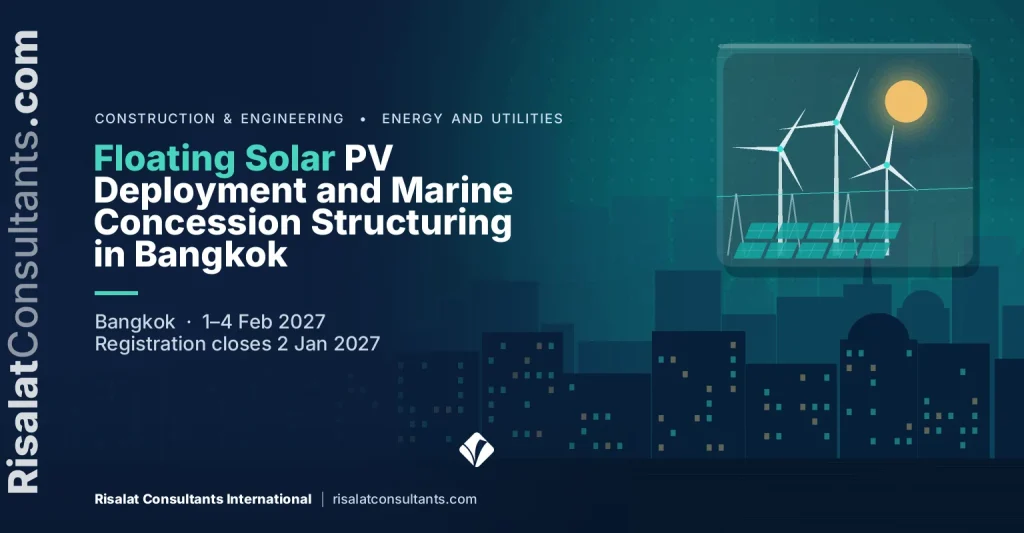
- 1–4 Feb 2027 (4 days)
- Where
- Bangkok, Thailand
- Fee per participant
- £2,600 (GBP)
- Payment
- By invoice and bank transfer
- Registration closes
- 2 Jan 2027
- Certificate
- Certificate of completion
- In-house option
- Run it for your team, on your dates
On this page 12 sections
Programme Overview
Rapid transition towards renewable energy requires innovative spatial solutions, particularly for island and coastal developing nations facing acute land scarcity. This four-day intensive programme in Bangkok provides public officials and transaction advisors with the technical and commercial competencies needed to procure, structure, and regulate near-shore and lagoon-based floating solar photovoltaic installations. Participants examine real-world engineering specifications alongside public-private partnership models tailored to marine environments.
Delegates analyse the complete project lifecycle, from bathymetric assessments and anchoring designs to bankable concession agreements. The curriculum addresses critical engineering challenges unique to marine settings, including saltwater corrosion, tidal variations, and wave dynamics. Furthermore, the programme equips infrastructure specialists to conduct rigorous environmental and social impact assessments, ensuring that aquatic ecosystems, coral reefs, and artisanal fishing zones remain fully protected throughout the project life.
Focusing on commercial viability, the course dissects competitive tendering procedures, risk allocation frameworks, and power purchase agreement negotiations under international procurement guidelines. Officials explore de-risking mechanisms, such as viability gap funding and political risk guarantees, which are vital for attracting private capital to nascent marine solar sectors. Bangkok serves as an ideal setting to review operational water-based solar deployment and regional marine infrastructure best practice.
Small island developing states and low-lying coastal nations face urgent imperatives to reduce their reliance on expensive imported diesel while achieving national decarbonisation commitments. As land availability severely restricts utility-scale ground-mounted solar, marine and lagoon-based floating photovoltaic systems offer an indispensable route to energy security. With multilateral development finance increasingly directed toward sustainable infrastructure mobilisation, public institutions must urgently build internal capacity to tender bankable marine concessions, deploy de-risking instruments, and negotiate power purchase agreements that align with the implementation targets of major initiatives such as the Accelerating Sustainable Private Investment in Renewable Energy Project.
Delivered by Risalat Consultants International in Bangkok, Thailand, it combines expert-led sessions, real cases and group work, so that participants can apply what they learn in their own institution.
The Programme Strengthens Institutional Capability
- Global trends in floating solar PV: Transitioning from inland water bodies to marine and lagoon environments
- Hydrodynamic site selection: Bathymetry, wave climate, wind load analysis, and tidal current assessment
- Technical components: Marine-grade photovoltaic modules, floating pontoons, inverter solutions, and balance of system
- Engineering mooring and anchoring systems: Bottom-mounted, shore-line, and elastic tethering systems for changing water levels
- Degradation and durability: Managing saltwater corrosion, biofouling, humidity, and high ultraviolet exposure
- International standards for aquatic impact assessment: Applying IFC Performance Standards and World Bank ESS
- Protecting marine ecosystems: Managing benthic shading, dissolved oxygen variations, and coral reef interactions
- Marine spatial planning: Navigational safety, integration with artisanal fisheries, and port authority clearances
- Procurement planning and market analysis
- Choosing procurement methods and approaches
- Writing specifications and terms of reference
- Bidding documents and evaluation criteria
It is designed for energy sector policy planners and directors from ministries of energy and environment, infrastructure transaction advisors and public-private partnership unit specialists, investment board officers and national development authority representatives and others who want practical, current skills in procurement and contract management.
The Growing Importance of Floating Solar PV Deployment and Marine Concession Structuring in Bangkok
Procurement is where public money becomes roads, medicines, systems and services. Delays, weak specifications and poor contract management are among the most common reasons projects fall behind or fail their audits.
Financiers and governments now expect value for money, fair competition and well-documented decisions at every stage, from planning to contract completion. Teams who manage the full cycle well deliver faster and with fewer complaints.
Organisations increasingly require professionals capable of:
- Plan procurement that matches project needs and timelines
- Prepare clear specifications and evaluation criteria
- Evaluate bids consistently and defend the decision
- Manage contracts, variations and performance
- Keep complete records for audit and review
Strong procurement and contract management systems help organisations:
- Reduce procurement delays and failed tenders
- Achieve value for money
- Lower the risk of complaints and audit findings
- Deliver contracts on time and to quality
This Floating Solar PV Deployment and Marine Concession Structuring in Bangkok programme brings these elements together in a practical format, so that participants understand not only what good practice looks like but also how to introduce it in their own setting, with the people and resources they have.
Who Should Attend This Floating Solar PV Deployment and Marine Concession Structuring in Bangkok Training?
This programme is designed for:
- Energy sector policy planners and directors from ministries of energy and environment
- Infrastructure transaction advisors and public-private partnership unit specialists
- Investment board officers and national development authority representatives
- Engineers and technical officers from national power utilities and distribution companies
- Environmental protection agency regulators and coastal zone management officers
- Project procurement officers from international donor-financed project implementation units
- Maritime transport and port authority officials managing near-shore spatial planning
- State legal counsels and contract negotiators managing sovereign power purchase agreements
- Municipal and local council administrators responsible for island utility infrastructure
- Procurement officers and managers
- Contract managers and administrators
- Project and programme managers
The programme suits experienced professionals as well as those moving into new responsibilities. Groups that mix institutions and countries are encouraged, because participants learn a great deal from each other’s experience.
Tick what your team needs to be able to do.
Floating Solar PV Deployment and Marine Concession Structuring in Bangkok Training Objectives
Upon successful completion of this Floating Solar PV Deployment and Marine Concession Structuring in Bangkok Training, participants will be able to:
- Evaluate the technical feasibility of lagoon and near-shore floating solar PV installations under varying marine and tidal conditions
- Design robust mooring and anchoring configurations based on site-specific geotechnical and bathymetric data
- Formulate marine environmental and social management frameworks in alignment with international finance institution standards
- Structure balanced, bankable marine concession agreements and long-term power purchase agreements
- Appraise private sector bids using structured competitive tendering procedures and qualification criteria
- Integrate sovereign de-risking instruments and donor-backed guarantees to enhance private capital mobilisation
- Supervise project commissioning, marine spatial compliance, and long-term asset management protocols
- Explain the procurement cycle and the rules that apply to it
- Prepare a procurement plan linked to project timelines
- Choose a suitable method and approach to the market
Each objective is practised during the programme through exercises, cases or group work, so that participants leave able to do it, not only to describe it.
Programme Contents and Structure
- Global trends in floating solar PV: Transitioning from inland water bodies to marine and lagoon environments
- Hydrodynamic site selection: Bathymetry, wave climate, wind load analysis, and tidal current assessment
- Technical components: Marine-grade photovoltaic modules, floating pontoons, inverter solutions, and balance of system
- Engineering mooring and anchoring systems: Bottom-mounted, shore-line, and elastic tethering systems for changing water levels
- Degradation and durability: Managing saltwater corrosion, biofouling, humidity, and high ultraviolet exposure
- International standards for aquatic impact assessment: Applying IFC Performance Standards and World Bank ESS
- Protecting marine ecosystems: Managing benthic shading, dissolved oxygen variations, and coral reef interactions
- Marine spatial planning: Navigational safety, integration with artisanal fisheries, and port authority clearances
- Subsea cabling and grid interconnection: Route design, landing stations, and power transmission stability
- Intermittency, curtailment, and hybridisation: Coupling marine floating solar with battery storage or diesel mini-grids
- Public-private partnership delivery models: Build-Own-Operate-Transfer versus sovereign asset ownership
- Marine concession drafting: Water surface rights, seabed leasing protocols, and interface risk allocation
- Bankable Power Purchase Agreements: Off-taker creditworthiness, deemed generation, and take-or-pay structures
- Termination and force majeure clauses: Marine-specific risks, extreme weather events, and sovereign indemnities
- Financial modelling parameters: Levelised cost of energy for marine floating solar versus land-based alternatives
- Structuring competitive tenders under multilateral development bank procurement regulations
- Designing developer qualification criteria, performance bonds, and technical evaluation scorecards
- Applying sovereign and multilateral de-risking tools: Partial risk guarantees, liquidity support, and viability gap funds
- Contract administration: Managing engineering, procurement, and construction milestones and factory acceptance tests
- Simulation exercise: Interactive tender negotiation and bid evaluation for a near-shore island concession
Full day-by-day contents
The programme runs over 4 days. Each day combines expert input, practical work and a closing workshop or case study:
- First Day: Marine Solar PV Technology, Hydrodynamics, and Site Feasibility
- Second Day: Environmental Governance, Marine Spatial Planning, and Grid Integration
- Third Day: Concession Structuring, Bankability, and PPA Negotiation
- Fourth Day: Donor Procurement, Tendering Execution, and De-risking Mechanisms
Full day-by-day contents
First Day | Marine Solar PV Technology, Hydrodynamics, and Site Feasibility
- Global trends in floating solar PV: Transitioning from inland water bodies to marine and lagoon environments
- Hydrodynamic site selection: Bathymetry, wave climate, wind load analysis, and tidal current assessment
- Technical components: Marine-grade photovoltaic modules, floating pontoons, inverter solutions, and balance of system
- Engineering mooring and anchoring systems: Bottom-mounted, shore-line, and elastic tethering systems for changing water levels
- Degradation and durability: Managing saltwater corrosion, biofouling, humidity, and high ultraviolet exposure
Workshop: Marine Solar PV Technology, Hydrodynamics, and Site Feasibility: Applying It to Your Institution
Working in small groups, participants apply the day's methods to examples from their own institutions and agree practical next steps.
Second Day | Environmental Governance, Marine Spatial Planning, and Grid Integration
- International standards for aquatic impact assessment: Applying IFC Performance Standards and World Bank ESS
- Protecting marine ecosystems: Managing benthic shading, dissolved oxygen variations, and coral reef interactions
- Marine spatial planning: Navigational safety, integration with artisanal fisheries, and port authority clearances
- Subsea cabling and grid interconnection: Route design, landing stations, and power transmission stability
- Intermittency, curtailment, and hybridisation: Coupling marine floating solar with battery storage or diesel mini-grids
Workshop: Environmental Governance, Marine Spatial Planning, and Grid Integration: Applying It to Your Institution
Working in small groups, participants apply the day's methods to examples from their own institutions and agree practical next steps.
Third Day | Concession Structuring, Bankability, and PPA Negotiation
- Public-private partnership delivery models: Build-Own-Operate-Transfer versus sovereign asset ownership
- Marine concession drafting: Water surface rights, seabed leasing protocols, and interface risk allocation
- Bankable Power Purchase Agreements: Off-taker creditworthiness, deemed generation, and take-or-pay structures
- Termination and force majeure clauses: Marine-specific risks, extreme weather events, and sovereign indemnities
- Financial modelling parameters: Levelised cost of energy for marine floating solar versus land-based alternatives
Case Study: Concession Structuring, Bankability, and PPA Negotiation in Practice
Participants analyse a realistic case, compare the choices made with good practice and draw lessons they can use in their own setting.
Fourth Day | Donor Procurement, Tendering Execution, and De-risking Mechanisms
- Structuring competitive tenders under multilateral development bank procurement regulations
- Designing developer qualification criteria, performance bonds, and technical evaluation scorecards
- Applying sovereign and multilateral de-risking tools: Partial risk guarantees, liquidity support, and viability gap funds
- Contract administration: Managing engineering, procurement, and construction milestones and factory acceptance tests
- Simulation exercise: Interactive tender negotiation and bid evaluation for a near-shore island concession
Capstone Exercise: Floating Solar PV Deployment and Marine Concession Structuring in Bangkok Action Plan for Your Institution
Participants bring the week together in an action plan for their own institution, with priorities, owners and first steps, and present it for feedback from peers and facilitators.
Floating Solar PV Deployment and Marine Concession Structuring in Bangkok Training Methodology
The training combines technical lectures, international case review, and practical transaction simulations. Participants engage in hands-on bid evaluation workshops, contract clause redlining exercises, and site-selection case studies focused on island geography. Peer-to-peer exchanges allow infrastructure specialists to evaluate real donor-financed project templates, with facilitators guiding practical application to national policy environments.
The programme combines:
- Expert-led sessions on current practice
- Regional and international case studies
- Group work and practical exercises
- Simulations and role plays where relevant
- Discussion of participants' own challenges
- Peer learning across institutions and countries
- Practical tools and templates to take back to work
- Daily reflection and action planning
Before the programme, a short pre-assessment helps the facilitators understand each participant’s role and priorities, so that examples and exercises can be adjusted to the group. Each day ends with a short reflection in which participants note what they will apply at work.
Expected Outcomes
Upon completion of this Floating Solar PV Deployment and Marine Concession Structuring in Bangkok Training, participants will be able to:
- Technical competence to review engineering designs, mooring schematics, and equipment specifications for marine PV projects
- Capacity to develop environmental screening and monitoring frameworks compliant with multilateral lender requirements
- Ability to draft and negotiate key provisions within marine water concessions and solar power purchase agreements
- Skill to design international competitive bidding documentation and execute transparent tender evaluations
- Practical knowledge of blended finance and de-risking instruments to attract private developers to emerging island markets
- Preparedness to manage contract execution, stakeholder coordination, and regulatory compliance during project delivery
- Plan procurement that fits project needs and timelines
- Prepare clear specifications and evaluation criteria
Participants leave with a personal action plan and practical tools they can use in their institution from the first week back. Institutions that send several participants can use the programme to agree shared methods and templates across teams, which makes improvements easier to sustain.
£2,600 per participant · invoice and bank transfer · groups of 5 or more receive a discount
Five or more from one organisation: ask for the group rate on the invoice request.
Ten or more: an in-house version for your institution may cost less per person. Ask for an in-house quote.
Registration closes in 55 days (2 Jan 2027)
Institutional Application of Floating Solar PV Deployment and Marine Concession Structuring in Bangkok Training
This programme supports organisations in strengthening:
- Procurement planning and strategy
- Evaluation practice
- Contract management
- Complaint handling
- Procurement records and audit readiness
Participants return with practical tools to improve:
- Procurement plans and timelines
- Specifications and evaluation criteria
- Evaluation reports
- Contract monitoring
- Variation and claims management
The programme is built so that learning moves from the classroom into the institution. Participants work on their own processes and documents where possible, and leave with an action plan that their managers can review and support.
Regional Relevance & Application
Europe
European institutions apply procurement and contract management within detailed regulatory frameworks and reform agendas. Participants from Europe can compare their practice with colleagues from other regions and test how established methods work under different conditions.
Africa
Across Africa, ministries, agencies and project teams working in procurement and contract management increasingly operate alongside donor-financed programmes that expect clear systems and evidence. The programme helps participants adapt good practice to the institutions and resources they work with.
Middle East
In the Middle East, national development strategies and diversification plans place growing demands on procurement and contract management. Participants explore how to build the capability these plans need inside public bodies and companies.
Asia
Institutions across Asia combine rapid growth with ambitious modernisation programmes. Participants from Asia can share their experience of scaling systems quickly and learn from approaches used elsewhere.
Pacific
Small island and Pacific states face particular constraints of size, distance and capacity. The programme highlights practical, proportionate approaches to procurement and contract management that suit smaller institutions.
Holding the programme in Bangkok, Thailand brings participants together away from their daily pressures, so they can compare how procurement and contract management is handled in different settings. The same programme can also be delivered in-house for one institution, in its own country or online, with cases taken from its current work.
Host Country Profile – Thailand
Explore expert-led training in Bangkok. Join Risalat’s professional courses to enhance your skills in leadership, finance, governance, and development.
Studying away from their own country gives participants time to focus, a fresh view of their own institution and the chance to build a network with colleagues from other countries.
Floating Solar PV Deployment and Marine Concession Structuring in Bangkok Training Deliverables
Participants receive support before, during and after the programme, so that preparation, learning and follow-up form one continuous experience.
Before the Programme
- Participant Pre-Assessment
- Floating Solar PV Deployment and Marine Concession Structuring in Bangkok Readiness Assessment
- Floating Solar PV Deployment and Marine Concession Structuring in Bangkok Resource Pack
- Preparatory Reading Materials
- Complimentary Visa Support & Advisory
During the Programme
- Airport Pickup & Welcome Assistance
- Accommodation with Breakfast
- Welcome Networking Dinner
- Risalat Training Kit (Bag, Bottle, Mug, T-Shirt, Cap, Passport Cover, Pens, Notebook, Magnet & Keychain)
- Comprehensive Floating Solar PV Deployment and Marine Concession Structuring in Bangkok Training Manual
- Procurement Plan Template
- Bid Evaluation Scoring Sheet
- Contract Management Plan Template
- Variation and Claims Register
- Practical Workshops & Simulations
- Group Discussions & Peer Learning
- Daily Lunch and Refreshments
- Full Access to Training Venue Facilities
- Mini Pad / Tablet with Digital Learning Materials
- Field Visit (where applicable)
- Entertaining City Tour
After the Programme
- Certificate of Completion
- Risalat Programme Participation Recognition Award
- Post-Training Reference Materials
- Procurement Records Checklist
- Contract Performance Tracker
- Post-Training Support & Follow-Up Guidance
- Programme Report
Institutions can also request a tailored in-house version of this programme, delivered at their premises or online. Request a proposal.
Common Challenges in Floating Solar PV Deployment and Marine Concession Structuring in Bangkok, And How This Training Helps
How can institutions plan procurement that matches project needs and timelines?
The programme addresses this directly on the first day (Marine Solar PV Technology, Hydrodynamics, and Site Feasibility), where participants practise the methods involved and adapt them to their own institution, then build it into their action plan.
How can institutions prepare clear specifications and evaluation criteria?
The programme addresses this directly on the second day (Environmental Governance, Marine Spatial Planning, and Grid Integration), where participants practise the methods involved and adapt them to their own institution, then build it into their action plan.
How can institutions evaluate bids consistently and defend the decision?
The programme addresses this directly on the third day (Concession Structuring, Bankability, and PPA Negotiation), where participants practise the methods involved and adapt them to their own institution, then build it into their action plan.
How can institutions manage contracts, variations and performance?
The programme addresses this directly on the fourth day (Donor Procurement, Tendering Execution, and De-risking Mechanisms), where participants practise the methods involved and adapt them to their own institution, then build it into their action plan.
How can institutions keep complete records for audit and review?
The programme addresses this directly on the first day (Marine Solar PV Technology, Hydrodynamics, and Site Feasibility), where participants practise the methods involved and adapt them to their own institution, then build it into their action plan.
Frequently Asked Questions
When and where does the Floating Solar PV Deployment and Marine Concession Structuring in Bangkok programme take place?
It runs from 1 Feb 2027 to 4 Feb 2027, in Bangkok, Thailand. The registration deadline is shown at the top of this page.
Who should attend?
The programme is designed for energy sector policy planners and directors from ministries of energy and environment, infrastructure transaction advisors and public-private partnership unit specialists, investment board officers and national development authority representatives, engineers and technical officers from national power utilities and distribution companies, and others who want practical skills in procurement and contract management.
Will I receive a certificate?
Yes. Participants who complete the programme receive a Certificate of Completion from Risalat Consultants International.
Can this programme be delivered for our institution only?
Yes. We can deliver a tailored in-house version at your premises, in another city or online, built around your own cases. Use the proposal request on this page.
Do I need prior experience in procurement and contract management?
No specialist background is required beyond experience in a related role. A short pre-assessment helps the facilitators adapt the sessions to the group.
Training courses in BangkokConstruction & Engineering training courses
Why Bangkok for this programme
Bangkok hosts UN regional offices and is a central, good-value hub for South and South-East Asia.
The Floating Solar PV Deployment and Marine Concession Structuring in Bangkok programme in February 2027 brings together officials and professionals from across the Asia region and beyond. Sessions combine short inputs, case studies and group work on participants' own files, and the city's institutions can be added as a study visit on request.
Getting there: Suvarnabhumi (BKK).
Check whether you need a visa with the free Visa Checker, and ask for an invitation letter once you are registered.
Other programmes in Bangkok
- Island Solid Waste Logistics, Marine Transfer and Regional Disposal in Bangkok
- Integrated River Basin Modelling and Flood Risk Reduction in Bangkok
- Rural Water Quality Monitoring and Sanitation Scheme Upgrades in Bangkok
- Commercial Agribusiness Matching Grants and Export Compliance in Bangkok
- Agri-Nutrition Strategy, Extension Delivery and Value Addition in Bangkok
Related: Climate finance and energy programmes · free Climate Finance Proposal Readiness · all programmes
- Procurement Framework and Regulations for Projects World Bank
- MAPS: Methodology for Assessing Procurement Systems MAPS Initiative
- Open Contracting Partnership Open Contracting Partnership
More training courses in Thailand · All programmes in Asia · Full training calendar
Plan this programme in a roadmap: why it matters, why to approve it, the dates to plan and the career it builds.