Key facts
- Dates
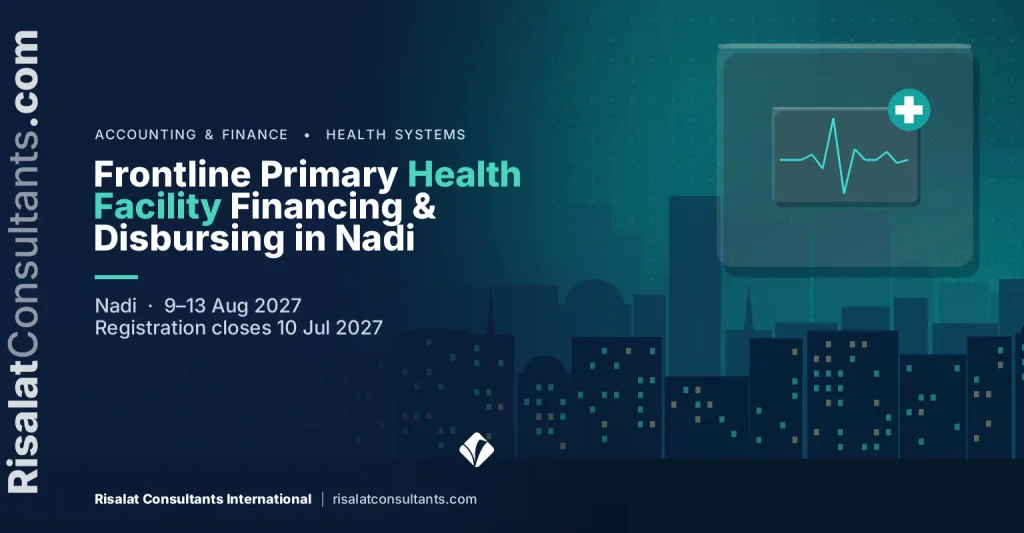
- 9–13 Aug 2027 (5 days)
- Where
- Nadi, Fiji
- Fee per participant
- £2,900 (GBP)
- Payment
- By invoice and bank transfer
- Registration closes
- 10 Jul 2027
- Certificate
- Certificate of completion
- In-house option
- Run it for your team, on your dates
On this page 14 sections
Programme Overview
Frontline primary health facilities in remote provinces face persistent operational bottlenecks that compromise service delivery. This five-day executive programme in Nadi provides an intensive analysis of direct facility financing, fund flow mechanisms, and devolved financial administration. Participants examine how to transition from centralised, rigid disbursement models to transparent direct operational funding that enables health centres and aid posts to respond swiftly to community requirements while complying with statutory public finance legislation.
Delegates will explore practical treasury interface procedures, cash-flow forecasting, and multi-tier bank account structures designed for decentralised health networks. The curriculum addresses internal controls, expenditure verifications, and compliance monitoring needed to protect donor funds and public allocations. Participants review standard chart of accounts structures, facility-level acquittal routines, and accountability frameworks required to bridge administrative gaps between provincial health authorities, national line agencies, and frontline healthcare clinical staff.
The course also focuses on aligning financial disbursements with operational supply chains, specifically clinical consumables and essential medicine distribution. Delegates assess methods to link facility operational budgets to stock availability metrics, mitigating stockouts in hard-to-reach rural locations. Through case assessments and structured problem-solving, attendees acquire tools to design accountable, efficient disbursement systems that improve the reliability of frontline primary care delivery across diverse geographic settings.
Health systems in the Pacific region, particularly within Papua New Guinea, are reforming public financial governance to channel operational funds directly to frontline service providers. Initiated to support reforms aligned with operations such as the Improving Access to and Value from Health Services in PNG: Financing the Frontlines project, this course addresses systemic implementation bottlenecks. Without robust financial governance, direct facility financing risks delays, poor acquittals, and stockouts of essential clinical supplies in remote communities.
Delivered by Risalat Consultants International in Nadi, Fiji, it combines expert-led sessions, real cases and group work, so that participants can apply what they learn in their own institution.
The Programme Strengthens Institutional Capability
- Architecture of direct facility financing: Principles, legal foundations, and international evidence
- Public financial management frameworks and devolved health authority structures in the Pacific
- Assessing facility bank account modalities, electronic transfers, and cash management in remote areas
- Determining equitable facility operational grant allocations using standard capitation and workload indicators
- Practical exercise: Mapping fund disbursement bottlenecks between national treasuries and rural clinics
- Aligning facility operational planning with provincial health authority medium-term expenditure frameworks
- Treasury cash warrant processes, quarterly release sequencing, and commitment control routines
- Standardised Chart of Accounts (CoA) integration for subnational health units and primary clinics
- Service planning and management
- Quality improvement and standards
- Human resources and workforce planning
- Financing and budgeting for services
It is designed for provincial health authority financial controllers and senior accountants, primary health service managers and district health coordinators, department of Treasury and Ministry of Finance health liaison officers and others who want practical, current skills in health, education and social services.
The Growing Importance of Frontline Primary Health Facility Financing & Disbursing in Nadi
Health, education and social services reach people directly, and their quality depends on planning, management and the use of evidence. Governments and partners expect better results from limited budgets.
Leaders and managers in these sectors face rising demand, staff shortages and new technologies. Strong management skills help institutions plan services, use resources well and show results.
Organisations increasingly require professionals capable of:
- Plan and manage services to meet demand
- Improve quality against standards
- Manage staff and resources effectively
- Use data to guide decisions
- Work with communities and partners
Strong health, education and social services systems help organisations:
- Deliver better services to more people
- Use budgets and staff efficiently
- Meet quality standards
- Show results to government and partners
This Frontline Primary Health Facility Financing & Disbursing in Nadi programme brings these elements together in a practical format, so that participants understand not only what good practice looks like but also how to introduce it in their own setting, with the people and resources they have.
Who Should Attend This Frontline Primary Health Facility Financing & Disbursing in Nadi Training?
This programme is designed for:
- Provincial health authority financial controllers and senior accountants
- Primary health service managers and district health coordinators
- Department of Treasury and Ministry of Finance health liaison officers
- Project implementation unit accountants managing multilateral health grants
- Public expenditure and financial accountability compliance monitors
- Internal auditors assigned to subnational health service delivery
- Health facility operations supervisors and rural hospital administrators
- Procurement officers responsible for decentralised medical supplies
- Donor-funded project finance specialists and programme officers
- Service managers and administrators
- Directors and senior officials
- Planning and policy officers
The programme suits experienced professionals as well as those moving into new responsibilities. Groups that mix institutions and countries are encouraged, because participants learn a great deal from each other’s experience.
Tick what your team needs to be able to do.
Frontline Primary Health Facility Financing & Disbursing in Nadi Training Objectives
Upon successful completion of this Frontline Primary Health Facility Financing & Disbursing in Nadi Training, participants will be able to:
- Analyse modern direct facility financing models to improve operational cash flows in remote primary health clinics
- Formulate transparent budget decentralisation mechanisms compliant with provincial finance management legislation
- Establish clear disbursement schedules that link treasury releases to verifiable primary healthcare milestones
- Design facility-level acquittal templates that simplify accounting burden while maintaining rigorous fiduciary audit trails
- Integrate financial disbursement protocols with pharmaceutical supply chain tracking to reduce clinic-level stockouts
- Implement statutory internal control frameworks to mitigate fiduciary risk across decentralised rural facilities
- Construct multi-agency coordination processes between treasury departments, provincial health authorities, and frontline staff
- Explain the main challenges facing their sector
- Plan services that match demand and resources
- Apply quality improvement methods
Each objective is practised during the programme through exercises, cases or group work, so that participants leave able to do it, not only to describe it.
Programme Contents and Structure
- Architecture of direct facility financing: Principles, legal foundations, and international evidence
- Public financial management frameworks and devolved health authority structures in the Pacific
- Assessing facility bank account modalities, electronic transfers, and cash management in remote areas
- Determining equitable facility operational grant allocations using standard capitation and workload indicators
- Practical exercise: Mapping fund disbursement bottlenecks between national treasuries and rural clinics
- Aligning facility operational planning with provincial health authority medium-term expenditure frameworks
- Treasury cash warrant processes, quarterly release sequencing, and commitment control routines
- Standardised Chart of Accounts (CoA) integration for subnational health units and primary clinics
- Managing operational operational advances, petty cash systems, and electronic payment instruments
- Workshop: Formulating a province-wide disbursement timetable aligned with statutory fiscal cycles
- Simplified bookkeeping and financial record maintenance for non-accountant clinical facility managers
- Standard operating procedures for expenditure verification, receipt management, and acquittals
- Internal audit techniques for remote health centres: Risk-based sampling and spot checks
- Meeting multilateral development bank fiduciary standards (World Bank, ADB) in subnational financing
- Simulation: Conducting a desk audit of frontline primary health facility expenditure acquittals
- The interface between facility financial liquidity and local essential medicine procurement
- Monitoring clinical consumption, standard order books, and inventory register maintenance
- Last-mile distribution logistics: Linking operational transport budgets to medical delivery schedules
- Preventing leakage and stockouts through coordinated administrative and clinical audits
- Case review: Establishing financial trigger mechanisms for emergency pharmaceutical restocking
- Establishing effective Health Facility Management Committees and local oversight bodies
- Public financial disclosure models and community engagement in clinic expenditure tracking
- Developing performance-linked operational disbursements and value-for-money monitoring
- Drafting institutional risk management matrices for subnational health funding streams
- Participant presentations: Individual institutional action plans for frontline disbursement reform
Full day-by-day contents
The programme runs over 5 days. Each day combines expert input, practical work and a closing workshop or case study:
- First Day: Decentralised Health Financing and Direct Facility Allocation Frameworks
- Second Day: Budget Formulation, Treasury Interfacing, and Release Mechanisms
- Third Day: Frontline Financial Verification, Reporting, and Audit Compliance
- Fourth Day: Aligning Operational Disbursements with Essential Medicine and Supply Chains
- Fifth Day: Governance, Community Accountability, and Action Planning
Full day-by-day contents
First Day | Decentralised Health Financing and Direct Facility Allocation Frameworks
- Architecture of direct facility financing: Principles, legal foundations, and international evidence
- Public financial management frameworks and devolved health authority structures in the Pacific
- Assessing facility bank account modalities, electronic transfers, and cash management in remote areas
- Determining equitable facility operational grant allocations using standard capitation and workload indicators
- Practical exercise: Mapping fund disbursement bottlenecks between national treasuries and rural clinics
Workshop: Decentralised Health Financing and Direct Facility Allocation Frameworks: Applying It to Your Institution
Working in small groups, participants apply the day's methods to examples from their own institutions and agree practical next steps.
Second Day | Budget Formulation, Treasury Interfacing, and Release Mechanisms
- Aligning facility operational planning with provincial health authority medium-term expenditure frameworks
- Treasury cash warrant processes, quarterly release sequencing, and commitment control routines
- Standardised Chart of Accounts (CoA) integration for subnational health units and primary clinics
- Managing operational operational advances, petty cash systems, and electronic payment instruments
- Workshop: Formulating a province-wide disbursement timetable aligned with statutory fiscal cycles
Workshop: Budget Formulation, Treasury Interfacing, and Release Mechanisms: Applying It to Your Institution
Working in small groups, participants apply the day's methods to examples from their own institutions and agree practical next steps.
Third Day | Frontline Financial Verification, Reporting, and Audit Compliance
- Simplified bookkeeping and financial record maintenance for non-accountant clinical facility managers
- Standard operating procedures for expenditure verification, receipt management, and acquittals
- Internal audit techniques for remote health centres: Risk-based sampling and spot checks
- Meeting multilateral development bank fiduciary standards (World Bank, ADB) in subnational financing
- Simulation: Conducting a desk audit of frontline primary health facility expenditure acquittals
Case Study: Frontline Financial Verification, Reporting, and Audit Compliance in Practice
Participants analyse a realistic case, compare the choices made with good practice and draw lessons they can use in their own setting.
Fourth Day | Aligning Operational Disbursements with Essential Medicine and Supply Chains
- The interface between facility financial liquidity and local essential medicine procurement
- Monitoring clinical consumption, standard order books, and inventory register maintenance
- Last-mile distribution logistics: Linking operational transport budgets to medical delivery schedules
- Preventing leakage and stockouts through coordinated administrative and clinical audits
- Case review: Establishing financial trigger mechanisms for emergency pharmaceutical restocking
Workshop: Aligning Operational Disbursements with Essential Medicine and Supply Chains: Applying It to Your Institution
Working in small groups, participants apply the day's methods to examples from their own institutions and agree practical next steps.
Fifth Day | Governance, Community Accountability, and Action Planning
- Establishing effective Health Facility Management Committees and local oversight bodies
- Public financial disclosure models and community engagement in clinic expenditure tracking
- Developing performance-linked operational disbursements and value-for-money monitoring
- Drafting institutional risk management matrices for subnational health funding streams
- Participant presentations: Individual institutional action plans for frontline disbursement reform
Capstone Exercise: Frontline Primary Health Facility Financing & Disbursing in Nadi Action Plan for Your Institution
Participants bring the week together in an action plan for their own institution, with priorities, owners and first steps, and present it for feedback from peers and facilitators.
Frontline Primary Health Facility Financing & Disbursing in Nadi Training Methodology
The training employs adult learning techniques comprising interactive lecture sessions, analytical policy reviews, and technical workshop exercises. Delegates analyse real-world primary healthcare financing cases, examine statutory public finance rules, and work collaboratively to resolve liquidity and reporting challenges. Facilitated peer discussions enable participants to benchmark provincial practices, while structured simulation exercises guide them in the design and refinement of practical financial management tools.
The programme combines:
- Expert-led sessions on current practice
- Regional and international case studies
- Group work and practical exercises
- Simulations and role plays where relevant
- Discussion of participants' own challenges
- Peer learning across institutions and countries
- Practical tools and templates to take back to work
- Daily reflection and action planning
Before the programme, a short pre-assessment helps the facilitators understand each participant’s role and priorities, so that examples and exercises can be adjusted to the group. Each day ends with a short reflection in which participants note what they will apply at work.
Expected Outcomes
Upon completion of this Frontline Primary Health Facility Financing & Disbursing in Nadi Training, participants will be able to:
- Improved competence in designing direct operational funding mechanisms for rural primary health centres
- Enhanced capacity to prepare statutory financial acquittals that satisfy provincial treasuries and external donors
- Strengthened oversight frameworks that effectively mitigate fiduciary risks in remote health facilities
- Standardised operational workflows that link facility cash disbursements directly to clinical supply chain requirements
- Institutionalised procedures for transparent coordination between provincial health authorities and finance ministries
- Tailored practical action plans ready for immediate deployment in subnational health administrations
- Plan services to meet demand
- Improve quality against standards
Participants leave with a personal action plan and practical tools they can use in their institution from the first week back. Institutions that send several participants can use the programme to agree shared methods and templates across teams, which makes improvements easier to sustain.
£2,900 per participant · invoice and bank transfer · groups of 5 or more receive a discount
Five or more from one organisation: ask for the group rate on the invoice request.
Ten or more: an in-house version for your institution may cost less per person. Ask for an in-house quote.
Registration closes in 244 days (10 Jul 2027)
Institutional Application of Frontline Primary Health Facility Financing & Disbursing in Nadi Training
This programme supports organisations in strengthening:
- Service planning
- Quality management
- Workforce management
- Data use
- Partnerships
Participants return with practical tools to improve:
- Service plans
- Quality reviews
- Workforce plans
- Performance reports
- Supply planning
The programme is built so that learning moves from the classroom into the institution. Participants work on their own processes and documents where possible, and leave with an action plan that their managers can review and support.
Regional Relevance & Application
Europe
European institutions apply health, education and social services within detailed regulatory frameworks and reform agendas. Participants from Europe can compare their practice with colleagues from other regions and test how established methods work under different conditions.
Africa
Across Africa, ministries, agencies and project teams working in health, education and social services increasingly operate alongside donor-financed programmes that expect clear systems and evidence. The programme helps participants adapt good practice to the institutions and resources they work with.
Middle East
In the Middle East, national development strategies and diversification plans place growing demands on health, education and social services. Participants explore how to build the capability these plans need inside public bodies and companies.
Asia
Institutions across Asia combine rapid growth with ambitious modernisation programmes. Participants from Asia can share their experience of scaling systems quickly and learn from approaches used elsewhere.
Pacific
Small island and Pacific states face particular constraints of size, distance and capacity. The programme highlights practical, proportionate approaches to health, education and social services that suit smaller institutions.
Holding the programme in Nadi, Fiji brings participants together away from their daily pressures, so they can compare how health, education and social services is handled in different settings. The same programme can also be delivered in-house for one institution, in its own country or online, with cases taken from its current work.
- Transaction
- Record
- Control
- Evidence
- Opinion
Host Country Profile – Fiji
Programmes in Nadi suit professionals, government officials and project teams focused on climate resilience, public sector administration, regional logistics, and environmental protection.
Studying away from their own country gives participants time to focus, a fresh view of their own institution and the chance to build a network with colleagues from other countries.
Frontline Primary Health Facility Financing & Disbursing in Nadi Training Deliverables
Participants receive support before, during and after the programme, so that preparation, learning and follow-up form one continuous experience.
Before the Programme
- Participant Pre-Assessment
- Frontline Primary Health Facility Financing & Disbursing in Nadi Readiness Assessment
- Frontline Primary Health Facility Financing & Disbursing in Nadi Resource Pack
- Preparatory Reading Materials
- Complimentary Visa Support & Advisory
During the Programme
- Airport Pickup & Welcome Assistance
- Accommodation with Breakfast
- Welcome Networking Dinner
- Risalat Training Kit (Bag, Bottle, Mug, T-Shirt, Cap, Passport Cover, Pens, Notebook, Magnet & Keychain)
- Comprehensive Frontline Primary Health Facility Financing & Disbursing in Nadi Training Manual
- Service Planning Template
- Quality Improvement Plan Template
- Workforce Planning Template
- Performance Dashboard Template
- Practical Workshops & Simulations
- Group Discussions & Peer Learning
- Daily Lunch and Refreshments
- Full Access to Training Venue Facilities
- Mini Pad / Tablet with Digital Learning Materials
- Field Visit (where applicable)
- Entertaining City Tour
After the Programme
- Certificate of Completion
- Risalat Programme Participation Recognition Award
- Post-Training Reference Materials
- Service Review Checklist
- Improvement Tracking Sheet
- Post-Training Support & Follow-Up Guidance
- Programme Report
Institutions can also request a tailored in-house version of this programme, delivered at their premises or online. Request a proposal.
Common Challenges in Frontline Primary Health Facility Financing & Disbursing in Nadi, And How This Training Helps
How can institutions plan and manage services to meet demand?
The programme addresses this directly on the first day (Decentralised Health Financing and Direct Facility Allocation Frameworks), where participants practise the methods involved and adapt them to their own institution, then build it into their action plan.
How can institutions improve quality against standards?
The programme addresses this directly on the second day (Budget Formulation, Treasury Interfacing, and Release Mechanisms), where participants practise the methods involved and adapt them to their own institution, then build it into their action plan.
How can institutions manage staff and resources effectively?
The programme addresses this directly on the third day (Frontline Financial Verification, Reporting, and Audit Compliance), where participants practise the methods involved and adapt them to their own institution, then build it into their action plan.
How can institutions use data to guide decisions?
The programme addresses this directly on the fourth day (Aligning Operational Disbursements with Essential Medicine and Supply Chains), where participants practise the methods involved and adapt them to their own institution, then build it into their action plan.
How can institutions work with communities and partners?
The programme addresses this directly on the fifth day (Governance, Community Accountability, and Action Planning), where participants practise the methods involved and adapt them to their own institution, then build it into their action plan.
Frequently Asked Questions
When and where does the Frontline Primary Health Facility Financing & Disbursing in Nadi programme take place?
It runs from 9 Aug 2027 to 13 Aug 2027, in Nadi, Fiji. The registration deadline is shown at the top of this page.
Who should attend?
The programme is designed for provincial health authority financial controllers and senior accountants, primary health service managers and district health coordinators, department of Treasury and Ministry of Finance health liaison officers, project implementation unit accountants managing multilateral health grants, and others who want practical skills in health, education and social services.
Will I receive a certificate?
Yes. Participants who complete the programme receive a Certificate of Completion from Risalat Consultants International.
Can this programme be delivered for our institution only?
Yes. We can deliver a tailored in-house version at your premises, in another city or online, built around your own cases. Use the proposal request on this page.
Do I need prior experience in health, education and social services?
No specialist background is required beyond experience in a related role. A short pre-assessment helps the facilitators adapt the sessions to the group.
Training courses in NadiAccounting & Finance training courses
Why Nadi for this programme
Nadi serves as the primary international transport hub for Fiji, offering straightforward flight connections across the Pacific region. Visiting delegations can examine transport infrastructure, regional aviation services, and local municipal operations. The area also provides exposure to coastal environmental management projects and sustainable tourism operations in surrounding districts.
The Frontline Primary Health Facility Financing & Disbursing in Nadi programme in August 2027 brings together officials and professionals from across the Oceania and the Pacific region and beyond. Sessions combine short inputs, case studies and group work on participants' own files, and the city's institutions can be added as a study visit on request.
Getting there: Nadi International Airport (NAN).
Check whether you need a visa with the free Visa Checker, and ask for an invitation letter once you are registered.
The same topic in other cities
- Primary Healthcare Subsidies & Primary Care Network Resilience in Dubai (Dubai)
- Primary Healthcare NCD Screening and Clinical Pathway Design in Brisbane (Brisbane)
- Strengthening Commune-Level Primary Healthcare Delivery & Clinic Networks in Kuala Lumpur (Kuala Lumpur)
- Pandemic Preparedness, Laboratory Systems and Emergency Health Logistics in Bangkok (Bangkok)
- Maternal and Child Nutrition Service Delivery and Outreach in Istanbul (Istanbul)
- Maternal, Newborn & Child Health Clinical Quality & Protocols in Bangkok (Bangkok)
Other programmes in Nadi
- Marine Spatial Planning and Inshore Coastal Fisheries Co-Management in Nadi
- Safe School Retrofitting and Resilient Educational Infrastructure in Nadi
- Health Facility Upgrading and Medical Waste System Compliance in Nadi
- Agribusiness Incubator Design and Smallholder Market Linkages in Nadi
- Emergency Bridge and Road Re-Opening Operations in Island States in Nadi
More training courses in Fiji · All programmes in Pacific · Full training calendar
Plan this programme in a roadmap: why it matters, why to approve it, the dates to plan and the career it builds.