Key facts
- Dates
- 22–26 Feb 2027 (5 days)
- Where
- TBD, Vilnius, Lithuania
- Fee per participant
- £4,360 (GBP)
- Payment
- By invoice and bank transfer
- Registration closes
- 3 Jan 2027
- Certificate
- Certificate of completion
- In-house option
- Run it for your team, on your dates
On this page 14 sections
Programme Overview
Research and Innovation Grant Compliance Training in Vilnius is a practice-based professional programme for public agencies, development project teams and organisations responsible for research and innovation grant compliance. The course uses operational examples, guided analysis and templates to connect policy expectations with daily decisions.
The European Commission’s 2025 annotated grant agreement guidance clarifies cost eligibility, reporting and audit obligations for EU-funded projects, requiring disciplined records and consortium controls.
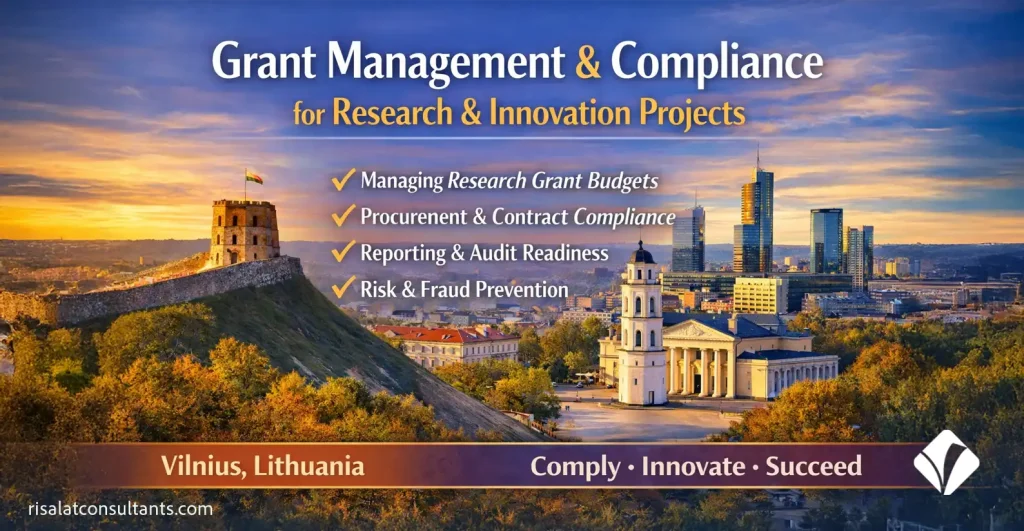
The learning programme takes place in Vilnius, Lithuania. The host city is a venue for structured peer learning and comparative analysis; participation does not imply endorsement by any public institution or access to restricted systems.
Participants examine the complete institutional workflow, from identifying a problem and defining responsibilities to applying controls, monitoring performance and documenting improvements. They work on examples adapted to their own mandates, financing agreements and national rules.
Official guidance is treated as a starting point for professional judgement. Participants are asked to verify which legal provisions, project requirements and internal policies apply to their own organisation before using any template.
The Programme Strengthens Institutional Capability
- Applying grant agreement obligations to real institutional work
- Applying eligible costs to real institutional work
- Applying time records to real institutional work
- Applying subcontracting controls to real institutional work
- Applying consortium reporting to real institutional work
- Applying audit trail to real institutional work
- Applying financial reconciliation to real institutional work
- Applying grant closure to real institutional work
- Documenting decisions involving grant agreement obligations
- Documenting decisions involving eligible costs
- Documenting decisions involving time records
- Documenting decisions involving subcontracting controls
- Documenting decisions involving consortium reporting
- Documenting decisions involving audit trail
- Documenting decisions involving financial reconciliation
- Documenting decisions involving grant closure
- Identifying roles, accountabilities and approval points
- Planning corrective actions and tracking implementation
- Connecting technical decisions to measurable public outcomes
- Maintaining records suitable for internal review
Each participant develops an action-oriented working pack rather than a generic set of presentation notes.
The Growing Importance of Research and Innovation Grant Compliance
The European Commission’s 2025 annotated grant agreement guidance clarifies cost eligibility, reporting and audit obligations for EU-funded projects, requiring disciplined records and consortium controls.
Implementation teams often work across policy, technical, procurement and finance functions. Without agreed evidence requirements and escalation routes, even a well-designed strategy can be difficult to implement consistently.
The programme therefore treats risk, inclusion, documentation and continuous improvement as linked management responsibilities rather than separate compliance exercises.
Organisations increasingly require professionals capable of:
- Assessing grant agreement obligations against organisational requirements
- Assessing eligible costs against organisational requirements
- Assessing time records against organisational requirements
- Assessing subcontracting controls against organisational requirements
- Assessing consortium reporting against organisational requirements
- Assessing audit trail against organisational requirements
- Assessing financial reconciliation against organisational requirements
- Assessing grant closure against organisational requirements
- Translating policy into operational decisions
- Communicating risks to senior management
- Checking the quality of supporting evidence
- Coordinating across institutional boundaries
Strong research and innovation grant compliance systems help organisations:
- Improve consistency in grant agreement obligations
- Improve consistency in eligible costs
- Improve consistency in time records
- Improve consistency in subcontracting controls
- Improve consistency in consortium reporting
- Improve consistency in audit trail
- Make review decisions traceable
- Respond earlier to delivery problems
- Build credible institutional learning
- Protect public resources and service quality
The practical emphasis is on choosing proportionate tools, establishing ownership and verifying results. A method is only useful when staff can apply it with the data, authority and resources actually available.
Who Should Attend This Research and Innovation Grant Compliance Training?
This programme is designed for:
- Programme directors and senior managers
- Government ministry and agency officers
- Project implementation unit managers
- Technical specialists and advisers
- Monitoring and evaluation officers
- Procurement and contract managers
- Finance and compliance officers
- Institutional capacity development staff
- Quality assurance and audit officers
- Development partner programme teams
- Regional and municipal government officers
- Non-governmental organisation programme leads
- Policy and planning specialists
- Data and reporting coordinators
- Consultants supporting public institutions
Participants from different functions are encouraged to attend together so that decisions and responsibilities can be tested across the whole delivery chain.
Tick what your team needs to be able to do.
Research and Innovation Grant Compliance Training Objectives
Upon successful completion of this Research and Innovation Grant Compliance Training, participants will be able to:
- Explain the role of grant agreement obligations in institutional performance
- Explain the role of eligible costs in institutional performance
- Explain the role of time records in institutional performance
- Explain the role of subcontracting controls in institutional performance
- Explain the role of consortium reporting in institutional performance
- Prepare a working template for audit trail
- Prepare a working template for financial reconciliation
- Prepare a working template for grant closure
- Assess implementation risks and propose proportionate controls
- Use evidence to prioritise corrective action
- Communicate findings to decision-makers
- Design a practical institutional improvement roadmap
Objectives are assessed through the daily practical tasks and the final applied action plan, not by attendance alone.
1. What is the best first step when improving grant agreement obligations?
The course emphasises checking applicable guidance and assessing the institution’s existing grant agreement obligations practice before selecting controls.
2. What is the best first step when improving eligible costs?
The course emphasises checking applicable guidance and assessing the institution’s existing eligible costs practice before selecting controls.
3. What is the best first step when improving time records?
The course emphasises checking applicable guidance and assessing the institution’s existing time records practice before selecting controls.
Programme Contents and Structure
- Overview of research and innovation funding mechanisms
- Types of grants: research, innovation, capacity building, collaborative grants
- Roles and responsibilities of grant recipients and implementing partners
- Understanding grant agreements, schedules, and donor expectations
- Key compliance principles: accountability, transparency, value for money
- Applying grant agreement obligations to a realistic institutional case
- Applying eligible costs to a realistic institutional case
- Grant budgeting and financial planning
- Eligible vs. ineligible costs
- Direct and indirect costs in research projects
- Cost allocation, cost sharing, and matching funds
- Financial controls, documentation, and record keeping
- Managing currency, advances, and cash flow under grants
- Applying time records to a realistic institutional case
- Procurement rules commonly applied to donor-funded grants
- Goods, services, and consulting procurement in research projects
- Supplier selection, documentation, and compliance risks
- Contract management for laboratories, IT systems, and research services
- Managing variations, amendments, and delivery delays
- Avoiding conflicts of interest and procurement irregularities
- Applying consortium reporting to a realistic institutional case
- Technical and financial reporting requirements
- Results frameworks, outputs, and performance indicators
- Managing milestones, deliverables, and timelines
- Internal controls and audit preparation
- Handling audits, reviews, and donor supervision missions
- Responding to audit findings and corrective action plans
- Applying financial reconciliation to a realistic institutional case
- Common compliance risks in research and innovation projects
- Fraud, misrepresentation, and ethical risks
- Managing changes, extensions, and grant restructuring
- Grant close-out procedures and final reporting
- Sustainability of research outcomes after grant completion
- Action planning for participants’ institutions and projects
- Applying grant agreement obligations to a realistic institutional case
Full day-by-day contents
The programme follows a progressive learning journey from diagnosis to implementation and institutional follow-up.
- First day: Grant agreements and consortium responsibilities
- Second day: Cost eligibility budgeting and documentation
- Third day: Procurement subcontracting and third parties
- Fourth day: Technical reporting audit and verification
- Fifth day: Grant risk management and closure
Full day-by-day contents
First Day | Grant agreements and consortium responsibilities
- Overview of research and innovation funding mechanisms
- Types of grants: research, innovation, capacity building, collaborative grants
- Roles and responsibilities of grant recipients and implementing partners
- Understanding grant agreements, schedules, and donor expectations
- Key compliance principles: accountability, transparency, value for money
- Applying grant agreement obligations to a realistic institutional case
- Applying eligible costs to a realistic institutional case
- Applying time records to a realistic institutional case
Workshop: Grant agreements and consortium responsibilities in practice
Participants use a fictional but realistic case dossier to work through grant agreements and consortium responsibilities. They identify decision points, assign responsibilities, document the evidence needed for approval and produce a usable template. On the final day they combine their work into a sequenced institutional action plan with owners, milestones and review criteria.
Second Day | Cost eligibility budgeting and documentation
- Grant budgeting and financial planning
- Eligible vs. ineligible costs
- Direct and indirect costs in research projects
- Cost allocation, cost sharing, and matching funds
- Financial controls, documentation, and record keeping
- Managing currency, advances, and cash flow under grants
- Applying time records to a realistic institutional case
- Applying subcontracting controls to a realistic institutional case
Workshop: Cost eligibility budgeting and documentation in practice
Participants use a fictional but realistic case dossier to work through cost eligibility budgeting and documentation. They identify decision points, assign responsibilities, document the evidence needed for approval and produce a usable template. On the final day they combine their work into a sequenced institutional action plan with owners, milestones and review criteria.
Third Day | Procurement subcontracting and third parties
- Procurement rules commonly applied to donor-funded grants
- Goods, services, and consulting procurement in research projects
- Supplier selection, documentation, and compliance risks
- Contract management for laboratories, IT systems, and research services
- Managing variations, amendments, and delivery delays
- Avoiding conflicts of interest and procurement irregularities
- Applying consortium reporting to a realistic institutional case
- Applying audit trail to a realistic institutional case
Workshop: Procurement subcontracting and third parties in practice
Participants use a fictional but realistic case dossier to work through procurement subcontracting and third parties. They identify decision points, assign responsibilities, document the evidence needed for approval and produce a usable template. On the final day they combine their work into a sequenced institutional action plan with owners, milestones and review criteria.
Fourth Day | Technical reporting audit and verification
- Technical and financial reporting requirements
- Results frameworks, outputs, and performance indicators
- Managing milestones, deliverables, and timelines
- Internal controls and audit preparation
- Handling audits, reviews, and donor supervision missions
- Responding to audit findings and corrective action plans
- Applying financial reconciliation to a realistic institutional case
- Applying grant closure to a realistic institutional case
Workshop: Technical reporting audit and verification in practice
Participants use a fictional but realistic case dossier to work through technical reporting audit and verification. They identify decision points, assign responsibilities, document the evidence needed for approval and produce a usable template. On the final day they combine their work into a sequenced institutional action plan with owners, milestones and review criteria.
Fifth Day | Grant risk management and closure
- Common compliance risks in research and innovation projects
- Fraud, misrepresentation, and ethical risks
- Managing changes, extensions, and grant restructuring
- Grant close-out procedures and final reporting
- Sustainability of research outcomes after grant completion
- Action planning for participants’ institutions and projects
- Applying grant agreement obligations to a realistic institutional case
- Applying eligible costs to a realistic institutional case
Capstone Exercise: Grant risk management and closure in practice
Participants use a fictional but realistic case dossier to work through grant risk management and closure. They identify decision points, assign responsibilities, document the evidence needed for approval and produce a usable template. On the final day they combine their work into a sequenced institutional action plan with owners, milestones and review criteria.
- Transaction
- Record
- Control
- Evidence
- Opinion
Research and Innovation Grant Compliance Training Methodology
The learning approach combines short technical explanations with practical exercises. Participants are encouraged to bring anonymised policies, templates or operational questions where disclosure is permitted.
The programme combines:
- Facilitated technical briefings
- Participant needs assessment
- Document review using official guidance
- Small-group problem diagnosis
- Case-based decision exercises
- Template development workshops
- Peer review and feedback
- Role-based scenario simulations
- Risk and control mapping
- Daily learning checks
- Facilitated action planning
- Post-session reflection
Case material distinguishes internationally recognised principles from requirements that depend on a particular country, donor agreement or organisational mandate.
The facilitator reviews learning needs at the outset and adjusts examples to participants’ functions without promising access to confidential project documents or third-party systems.
Expected Outcomes
Upon completion of this Research and Innovation Grant Compliance Training, participants will be able to:
- A practical checklist for grant agreement obligations
- A practical checklist for eligible costs
- A practical checklist for time records
- A practical checklist for subcontracting controls
- A practical checklist for consortium reporting
- A practical checklist for audit trail
- A documented risk and escalation register
- A concise management briefing
- A 30, 60 and 90-day implementation roadmap
- An evidence and follow-up schedule
The intended outcome is stronger organisational capability. Individual outputs require review and adaptation before they become approved institutional procedures.
£4,360 per participant · invoice and bank transfer · groups of 5 or more receive a discount
Five or more from one organisation: ask for the group rate on the invoice request.
Ten or more: an in-house version for your institution may cost less per person. Ask for an in-house quote.
Registration closes in 57 days (3 Jan 2027)
Institutional Application of Research and Innovation Grant Compliance Training
This programme supports organisations in strengthening:
- Governance and oversight of grant agreement obligations
- Governance and oversight of eligible costs
- Governance and oversight of time records
- Governance and oversight of subcontracting controls
- Governance and oversight of consortium reporting
- Governance and oversight of audit trail
- Governance and oversight of financial reconciliation
- Governance and oversight of grant closure
- Documented decision-making
- Internal coordination and escalation
- Assurance and quality review
- Staff capability development
Participants return with practical tools to improve:
- Grant agreement obligations workflows
- Eligible costs workflows
- Time records workflows
- Subcontracting controls workflows
- Consortium reporting workflows
- Audit trail workflows
- Financial reconciliation workflows
- Grant closure workflows
- Management reporting
- Follow-up and accountability
Teams can adapt these tools for annual plans, project implementation manuals, internal controls and operational review meetings. For a broader organisational baseline, the <a href=”https://risalatconsultants.com/diagnostics/institutional-capacity-assessment/”>institutional capacity diagnostic</a> offers a structured starting point.
Regional Relevance & Application
Asia and the Pacific
Government and development teams across Asia and the Pacific can apply research and innovation grant compliance to multi-agency projects, local service delivery and donor reporting. Specific financing rules must be checked against each project agreement.
Africa
Public institutions and implementation units can use the course tools to improve implementation readiness, evidence quality and operational controls across geographically dispersed programmes.
Europe and Central Asia
Participants can compare domestic procedures with relevant European and international guidance while keeping legal and contractual obligations distinct.
Middle East
Large infrastructure and public transformation programmes benefit from clear roles, contract controls, performance indicators and transparent management decisions.
Examples are selected to support cross-regional learning without assuming that one country’s legal or operational model can be transferred unchanged.
Host Country Profile – Lithuania
Vilnius is the host city for this international programme. Its role is to provide a setting for concentrated technical learning, peer exchange and comparative discussion among participating organisations.
The host setting in Lithuania supports comparative discussion of institutional practice. The course relies on published international guidance rather than unverified claims about host institutions.
International participants should verify visa eligibility, entry rules and travel arrangements with the relevant authorities before departure. Risalat provides administrative visa guidance but cannot guarantee entry or visa issuance.
Research and Innovation Grant Compliance Training Deliverables
The programme includes coordinated learning and participant support before, during and after the course.
Before the Programme
- Participant Pre-Assessment
- Research and Innovation Grant Compliance Readiness Assessment
- Research and Innovation Grant Compliance Resource Pack
- Preparatory Reading Materials
- Complimentary Visa Support & Advisory
During the Programme
- Airport Pickup & Welcome Assistance
- Accommodation with Breakfast
- Welcome Networking Dinner
- Risalat Training Kit (Bag, Bottle, Mug, T-Shirt, Cap, Passport Cover, Pens, Notebook, Magnet & Keychain)
- Comprehensive Research and Innovation Grant Compliance Training Manual
- Grant Agreement Obligations Template
- Eligible Costs Template
- Time Records Template
- Subcontracting Controls Template
- Consortium Reporting Template
- Practical Workshops & Simulations
- Group Discussions & Peer Learning
- Daily Lunch and Refreshments
- Full Access to Training Venue Facilities
- Mini Pad / Tablet with Digital Learning Materials
- Field Visit (where applicable)
- Entertaining City Tour
After the Programme
- Certificate of Completion
- Risalat Programme Participation Recognition Award
- Post-Training Reference Materials
- Grant Agreement Obligations Action Checklist
- Eligible Costs Review Template
- Institutional Action Plan
- Post-Training Support & Follow-Up Guidance
- Programme Report
Institutions requiring a tailored delivery can request an in-house programme proposal with cases and exercises aligned to their operating context.
Common Challenges in Research and Innovation Grant Compliance, And How This Training Helps
How can our organisation improve grant agreement obligations without adding unnecessary bureaucracy?
The first day examines grant agreement obligations through a practical exercise. Participants define the minimum evidence required, agree responsible officers, test exceptions and identify an improvement that can be introduced through existing decision-making processes.
How can our organisation improve eligible costs without adding unnecessary bureaucracy?
The first day examines eligible costs through a practical exercise. Participants define the minimum evidence required, agree responsible officers, test exceptions and identify an improvement that can be introduced through existing decision-making processes.
How can our organisation improve time records without adding unnecessary bureaucracy?
The second day examines time records through a practical exercise. Participants define the minimum evidence required, agree responsible officers, test exceptions and identify an improvement that can be introduced through existing decision-making processes.
How can our organisation improve subcontracting controls without adding unnecessary bureaucracy?
The second day examines subcontracting controls through a practical exercise. Participants define the minimum evidence required, agree responsible officers, test exceptions and identify an improvement that can be introduced through existing decision-making processes.
How can our organisation improve consortium reporting without adding unnecessary bureaucracy?
The third day examines consortium reporting through a practical exercise. Participants define the minimum evidence required, agree responsible officers, test exceptions and identify an improvement that can be introduced through existing decision-making processes.
How can our organisation improve audit trail without adding unnecessary bureaucracy?
The third day examines audit trail through a practical exercise. Participants define the minimum evidence required, agree responsible officers, test exceptions and identify an improvement that can be introduced through existing decision-making processes.
How can our organisation improve financial reconciliation without adding unnecessary bureaucracy?
The fourth day examines financial reconciliation through a practical exercise. Participants define the minimum evidence required, agree responsible officers, test exceptions and identify an improvement that can be introduced through existing decision-making processes.
How can our organisation improve grant closure without adding unnecessary bureaucracy?
The fourth day examines grant closure through a practical exercise. Participants define the minimum evidence required, agree responsible officers, test exceptions and identify an improvement that can be introduced through existing decision-making processes.
Explore further professional training categories or use the training needs assessment to prioritise staff development.
Frequently Asked Questions
Who should attend research and innovation grant compliance training?
Government officials, technical specialists, project implementation teams, managers and advisers with responsibilities relevant to the subject.
Does the programme include practical exercises?
Yes. Each day includes a structured exercise, and the final day produces a practical action plan.
Are donor rules and national requirements treated as identical?
No. The programme distinguishes international guidance from requirements specific to each agreement, regulator and institution.
Will participants receive templates and follow-up materials?
Yes. Participants work with editable checklists, planning tools, reference materials and a programme report.
Is travel or a technical visit in Vilnius guaranteed?
The programme is hosted in the stated city. External technical visits depend on host confirmation and may be replaced with an equivalent case exercise.
Training courses in VilniusAccounting & Finance training courses
Why Vilnius for this programme
Vilnius, Lithuania, was chosen for this programme because it is easy to reach for the participants we expect and has suitable venues for practical, interactive training.
The Research and Innovation Grant Compliance Training in Vilnius programme in February 2027 brings together officials and professionals. Sessions combine short inputs, case studies and group work on participants' own files, and the city's institutions can be added as a study visit on request.
Check whether you need a visa with the free Visa Checker, and ask for an invitation letter once you are registered.
Other programmes in Vilnius
- United Nations Development Programme UNDP
- Open Contracting Partnership Open Contracting Partnership
- The Institute of Internal Auditors IIA
More training courses in Lithuania · All programmes in Europe · Full training calendar