Key facts
- Dates
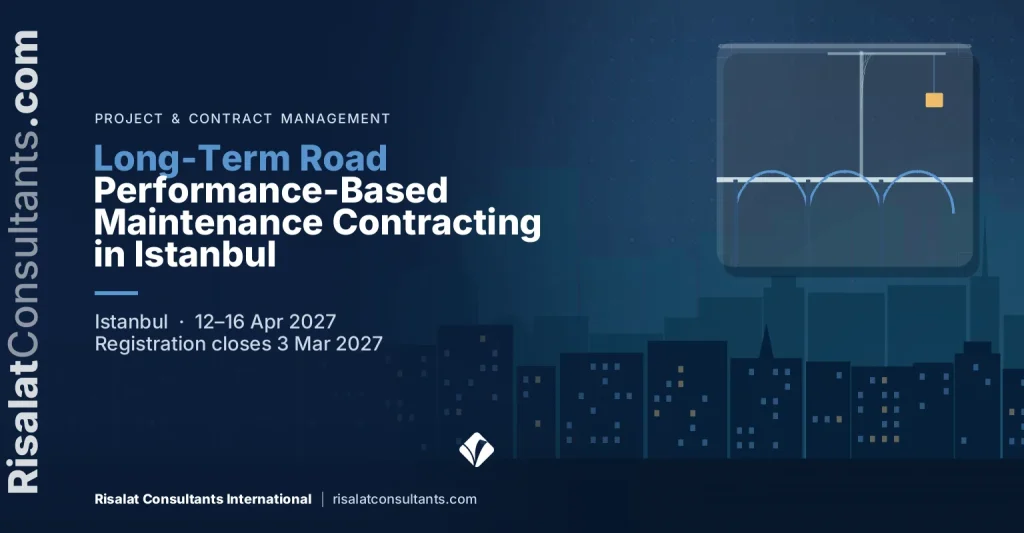
- 12–16 Apr 2027 (5 days)
- Where
- Istanbul, Türkiye
- Fee per participant
- £3,800 (GBP)
- Payment
- By invoice and bank transfer
- Registration closes
- 3 Mar 2027
- Format
- 5-day short course: a practical capacity-building programme for government, NGO and project teams in Istanbul
- In-house option
- Run it for your team, on your dates
On this page 10 sections
Long-Term Road Performance-Based Maintenance Contracting in Istanbul
Programme Overview
This five-day professional training programme provides highway maintenance managers and engineers with practical tools to implement long-term performance-based maintenance contracts (PBC). Participants explore contractual mechanisms, risk allocation strategies, and multi-year planning models designed to shift highway asset management from traditional input-based methods to modern service-level standards. Drawing on established World Bank standard procurement documents for output- and performance-based road contracts, the curriculum equips practitioners to procure, monitor, and enforce contracts that preserve strategic inter-urban transport corridors efficiently and transparently.
Delegates will examine the definition and practical application of level-of-service indicators across key highway infrastructure assets. Key topics include technical condition standards for carriageways, road safety furniture, drainage systems, and earthwork stability. The course delivers comprehensive guidance on establishing robust monthly performance verification regimes, field inspection methodologies, and structured payment reduction systems. Through rigorous technical reviews, participants master the technical oversight procedures necessary to safeguard public expenditure and ensure contractor accountability on long-term national network maintenance schemes.
Watch: a short video on this subject
The programme also addresses the financial and legal frameworks essential for sustainable asset preservation. Attendees review cost-containment measures, lifecycle budgeting, emergency repair provisions, and dispute avoidance mechanisms aligned with international contracting standards such as FIDIC conditions of contract. By analysing real-world operational challenges, highway authority personnel gain the institutional competence required to manage complex multi-year contractual arrangements, mitigate fiscal risks, and sustain critical infrastructure assets under changing climatic and operational traffic conditions across major regional freight networks. Substantial capital investments across major national arteries, including corridor modernisation works under the East-West Highway and Kakheti Connectivity schemes, require robust asset preservation mechanisms to protect asset lifespans. Shifting from traditional input measurement to long-term performance-based contracts prevents premature infrastructure degradation, stabilises maintenance fiscal commitments, and meets the governance criteria established by international financing institutions supporting regional transport connectivity. Delivered by Risalat Consultants International in Istanbul, Turkey, it combines expert-led sessions, real cases and group work, so that participants can apply what they learn in their own institution.
The programme strengthens institutional capability in:
- Transitioning from input-based measurement to Output- and Performance-Based Road Contracts (OPRC)
- Review of international standard bidding documents and World Bank procurement guidelines
- Risk allocation profiles: balancing public client exposure and contractor operational obligations
- Defining contract scope: routine maintenance, periodic renewal, and emergency repair works
- Legal considerations, warranty clauses, and interface management under FIDIC terms
- Establishing level-of-service (LOS) criteria for international and inter-urban corridors
- Pavement performance indicators: roughness (IRI), rutting, skid resistance, and cracking limits
- Service standards for road safety furniture, horizontal markings, and vertical signage
- Infrastructure planning and prioritisation
- Project appraisal and business cases
- Financing options and public-private partnerships
- Procurement and contracting for works
Why this matters now
Organisations increasingly require professionals capable of:
- Plan and prioritise infrastructure investments
- Appraise projects and prepare business cases
- Choose financing and delivery models
- Supervise works for time, cost and quality
- Manage assets over their life
Strong infrastructure, urban development and partnerships systems help organisations:
- Select the right investments
- Deliver projects on time and on budget
- Attract financing and partners
- Keep assets working for longer
Who Should Attend
This programme is designed for:
- Highway maintenance managers and network asset leads
- Road concession monitors and contract compliance auditors
- Highway authority engineers and project implementation unit specialists
- National roads department regional maintenance directors
- Transport procurement officers managing donor-funded infrastructure
- Supervision consultant team leaders and resident engineers
- Government transport ministry technical advisors and planners
- Bridge and pavement preservation inspection engineers
- Road safety infrastructure and corridor operations specialists
- Infrastructure and urban planners
- Engineers and technical managers
- Project and programme managers
Tick what your team needs to be able to do.
Programme Objectives
By the end of this programme participants will be able to:
- Assess performance-based contract frameworks using standard international specifications
- Formulate measurable level-of-service criteria for pavement, structures, and roadside assets
- Establish rigorous monthly performance verification systems and site inspection protocols
- Calculate payment deductions and financial penalties in accordance with contractual formulas
- Execute effective contractor oversight mechanisms without relieving contractors of design obligations
- Implement life-cycle cost-containment measures within multi-year road maintenance budgets
- Design risk-sharing schedules that address unexpected traffic growth, inflation, and severe weather
- Explain how infrastructure is planned and prioritised
- Appraise projects and prepare a business case
- Compare financing and delivery models, including partnerships
Training Structure & Contents
- Transitioning from input-based measurement to Output- and Performance-Based Road Contracts (OPRC)
- Review of international standard bidding documents and World Bank procurement guidelines
- Risk allocation profiles: balancing public client exposure and contractor operational obligations
- Defining contract scope: routine maintenance, periodic renewal, and emergency repair works
- Legal considerations, warranty clauses, and interface management under FIDIC terms
- Workshop: Applying Principles of Performance-Based Road Contracts and Legal Frameworks to Your Institution
- Establishing level-of-service (LOS) criteria for international and inter-urban corridors
- Pavement performance indicators: roughness (IRI), rutting, skid resistance, and cracking limits
- Service standards for road safety furniture, horizontal markings, and vertical signage
- Inspection requirements for drainage networks, culverts, side slopes, and structural integrity
- Environmental mitigation and roadside clearance standards on heavy freight corridors
- Workshop: Applying Level-of-Service Standards and Technical Asset Indicators to Your Institution
- Designing the monthly verification and self-monitoring submission procedures
- Formal road inspection methodologies: random sampling, drive-through checks, and joint audits
- Structuring the payment deduction formula for non-compliance and delayed response times
- Managing the rectification period: calculation models for repeated or chronic asset defects
- Verification audit trails, documentation control, and dispute avoidance during inspections
- Case Study: Monthly Verification Regimes and Payment Reduction Calculations in Practice
- Structuring lump-sum payment mechanisms against verifiable physical service standards
- Cost-containment strategies and managing unit-rate items for emergency and unforeseen works
- Multi-year budgeting methods and indexation formulas for material and labour inflation
- Financial modelling for initial improvement works versus regular periodic maintenance
- Ensuring audit compliance and expenditure accountability under donor financing rules
- Workshop: Applying Financial Governance, Cost Containment, and Lifecycle Budgeting to Your Institution
- Setting up Project Implementation Unit (PIU) structures for multi-year monitoring
- Supervision consultant roles, conflict management, and independent audit integration
- Contractor claims management, time extension requests, and extraordinary climatic events
- Contract completion procedures, asset hand-back inspections, and residual life criteria
- Drafting individual institutional action plans for inter-urban road network implementation
- Capstone Exercise: Long-Term Road Performance-Based Maintenance Contracting Action Plan for Your Institution
Full day-by-day contents
First Day | Principles of Performance-Based Road Contracts and Legal Frameworks
- Transitioning from input-based measurement to Output- and Performance-Based Road Contracts (OPRC)
- Review of international standard bidding documents and World Bank procurement guidelines
- Risk allocation profiles: balancing public client exposure and contractor operational obligations
- Defining contract scope: routine maintenance, periodic renewal, and emergency repair works
- Legal considerations, warranty clauses, and interface management under FIDIC terms
- Workshop: Applying Principles of Performance-Based Road Contracts and Legal Frameworks to Your Institution
Second Day | Level-of-Service Standards and Technical Asset Indicators
- Establishing level-of-service (LOS) criteria for international and inter-urban corridors
- Pavement performance indicators: roughness (IRI), rutting, skid resistance, and cracking limits
- Service standards for road safety furniture, horizontal markings, and vertical signage
- Inspection requirements for drainage networks, culverts, side slopes, and structural integrity
- Environmental mitigation and roadside clearance standards on heavy freight corridors
- Workshop: Applying Level-of-Service Standards and Technical Asset Indicators to Your Institution
Third Day | Monthly Verification Regimes and Payment Reduction Calculations
- Designing the monthly verification and self-monitoring submission procedures
- Formal road inspection methodologies: random sampling, drive-through checks, and joint audits
- Structuring the payment deduction formula for non-compliance and delayed response times
- Managing the rectification period: calculation models for repeated or chronic asset defects
- Verification audit trails, documentation control, and dispute avoidance during inspections
- Case Study: Monthly Verification Regimes and Payment Reduction Calculations in Practice
Fourth Day | Financial Governance, Cost Containment, and Lifecycle Budgeting
- Structuring lump-sum payment mechanisms against verifiable physical service standards
- Cost-containment strategies and managing unit-rate items for emergency and unforeseen works
- Multi-year budgeting methods and indexation formulas for material and labour inflation
- Financial modelling for initial improvement works versus regular periodic maintenance
- Ensuring audit compliance and expenditure accountability under donor financing rules
- Workshop: Applying Financial Governance, Cost Containment, and Lifecycle Budgeting to Your Institution
Fifth Day | Contract Administration, Institutional Supervision, and Transition Management
- Setting up Project Implementation Unit (PIU) structures for multi-year monitoring
- Supervision consultant roles, conflict management, and independent audit integration
- Contractor claims management, time extension requests, and extraordinary climatic events
- Contract completion procedures, asset hand-back inspections, and residual life criteria
- Drafting individual institutional action plans for inter-urban road network implementation
- Capstone Exercise: Long-Term Road Performance-Based Maintenance Contracting Action Plan for Your Institution
Training Methodology
The training combines expert input, practical work, and interactive sessions so that participants can apply what they learn in their own institutions.
- Expert-led presentations and interactive technical reviews
- Small group workshops applying methods to institutional examples
- Analysis of realistic case studies against good practice
- Capstone action planning exercises with peer and facilitator feedback
- Transaction
- Record
- Control
- Evidence
- Opinion
Expected Outcomes
- Capability to transition road network management from input to performance-based maintenance contracts
- Application of World Bank procurement guidelines and FIDIC contracting terms
- Proficiency in establishing and inspecting technical level-of-service indicators across highway corridors
- Ability to implement structured verification regimes and execute contractual payment deduction formulas
- Competence in managing multi-year maintenance budgets, fiscal risks, and cost-containment measures
- Formulation of practical institutional action plans for road network implementation
£3,800 per participant · invoice and bank transfer · groups of 5 or more receive a discount
Five or more from one organisation: ask for the group rate on the invoice request.
Ten or more: an in-house version for your institution may cost less per person. Ask for an in-house quote.
Registration closes in 94 days (3 Mar 2027)
Who Will Deliver This Programme
Each date is delivered by a team assigned from Risalat's expert network for this subject. For this programme we assign:
How we choose them: Experience in the region of the participants or comparable settings; Command of the financier rules that apply (World Bank, ADB, AfDB, EU, UN) where relevant; Delivery in English; other languages on request for in-house groups; No conflict of interest with participants' institutions.
Training courses in IstanbulProject & Contract Management training courses
Why Istanbul for this programme
Istanbul sits between Europe and Asia, with direct flights from most capitals and easy visas for many delegations.
The Long-Term Road Performance-Based Maintenance Contracting in Istanbul programme in April 2027 brings together officials and professionals from across the Europe and Asia region and beyond. Sessions combine short inputs, case studies and group work on participants' own files, and the city's institutions can be added as a study visit on request.
Getting there: Istanbul Airport (IST).
Check whether you need a visa with the free Visa Checker, and ask for an invitation letter once you are registered.
The same topic in other cities
- Commercial Agri-Corridor Road Upgrading and Maintenance Contracts in Dakar (Dakar)
- Agri-Food Logistics Hubs and Post-Harvest Processing Infrastructure in Kigali (Kigali)
- Rural Agricultural Corridor Road Maintenance and Feeder Logistics in Dakar (Dakar)
- Urban Bus Rapid Transit Operations and Corridor Traffic Integration in Cape Town (Cape Town)
- Urban Transit Operations and Public Transport Fleet Management in Dubai (Dubai)
- Heavy-Haul Highway Asset Preservation and Tolling Systems in Istanbul (Istanbul)
Other programmes in Istanbul
- Mini Degree in Environmental and Social Safeguards in Istanbul
- Risk-Based Internal Audit in the Public Sector in Istanbul
- AI for Public Procurement and Contract Management Training in Istanbul
- Self-Employment Support and Microenterprise Incubation in Istanbul
- Preschool Quality Standards and Pedagogical Assessment Frameworks in Istanbul
Related: Procurement and contract management · free Procurement Maturity diagnostic · all programmes
Questions before you nominate your team? Book a 30-minute call with us, or ask for this programme in-house.
Teams often travel here from Pakistan, Afghanistan, Mongolia, Kazakhstan, Uzbekistan, Kyrgyzstan, Tajikistan, Turkmenistan. Funding, visa letters and group rates are explained on each country page.
- Open Contracting Partnership Open Contracting Partnership
- OECD (Organisation for Economic Co-operation and Development) OECD
Is there infrastructure and urban development training for government officials in Istanbul in April 2027?
Can "Long-Term Road Performance-Based Maintenance Contracting in Istanbul" be delivered in-house for one organisation?
Which other infrastructure and urban development programmes does Risalat run?
How do organisations register and pay?
For teams and institutions
Bring your team
Teams that learn together apply more at work. Tell us how many people and how you would like to take part: we reply with a group quote within two working days.
Watch: this programme in short


Other dates and cities for this subject: Infrastructure, Roads and Transport Projects training courses (162 upcoming dates).
More training courses in Türkiye · All programmes in Europe · Full training calendar
Plan this programme in a roadmap: why it matters, why to approve it, the dates to plan and the career it builds.