Key facts
- Dates
- 18–22 Oct 2027 (5 days)
- Where
- Singapore
- Fee per participant
- £4,200 (GBP)
- Payment
- By invoice and bank transfer
- Registration closes
- 8 Sep 2027
- Format
- 5-day short course: a practical capacity-building programme for government, NGO and project teams in Singapore
- In-house option
- Run it for your team, on your dates
On this page 9 sections
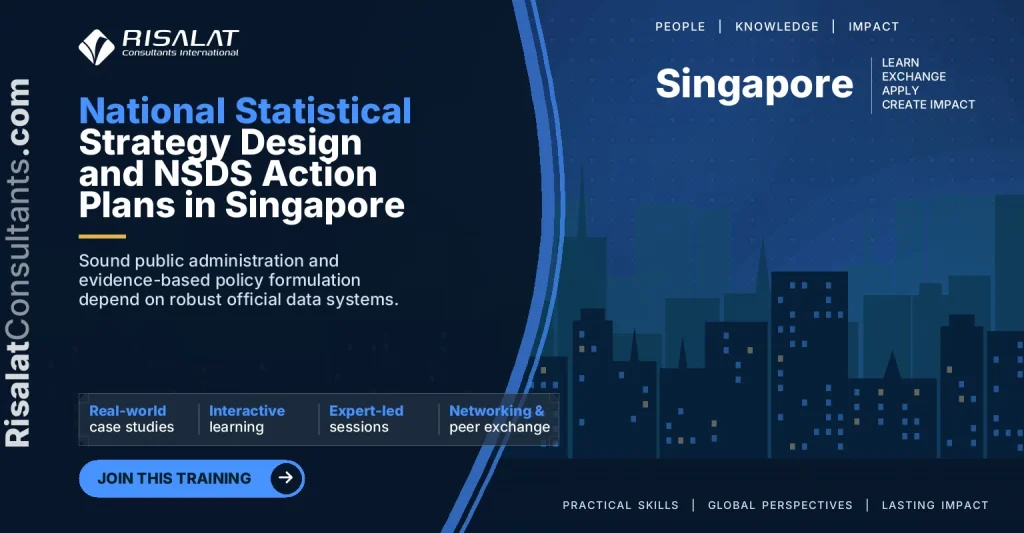
National Statistical Strategy Design and NSDS Action Plans in Singapore
Programme Overview
Sound public administration and evidence-based policy formulation depend on robust official data systems. National statistical offices and central planning authorities must coordinate complex data production across line ministries, central banks, and subnational bodies. This five-day executive programme in Singapore provides statistical leaders with the specialised methodologies required to evaluate institutional capacity, modernise data governance, and design comprehensive National Strategies for the Development of Statistics (NSDS). Participants gain direct exposure to internationally recognised diagnostic tools and modern statistical legislation frameworks.
Free self-check: the governance self-audit gives a quick check of governance, controls and accountability, in about 10 minutes.
The course delivers practical instruction on aligning national data priorities with global standards, including the PARIS21 NSDS guidelines and the United Nations Fundamental Principles of Official Statistics. Participants examine how to transition from fragmented sectoral data collection to an integrated national statistical system (NSS). Through structured exercises, attendees analyse institutional mandates, establish inter-agency coordination mechanisms, and develop monitoring matrices. The curriculum addresses the operational realities of resource-constrained environments, ensuring that strategic statistical roadmaps remain realistic, sustainable, and responsive to macro-critical policy information requirements.
Watch: a short video on this subject
Delivered through a sequence of technical workshops, the programme guides participants through the practical drafting of agency-level statistical output frameworks and sequenced implementation plans. Attendees learn to formulate comprehensive financing strategies, cost statistical operations systematically, and establish transparent risk mitigation protocols. By examining Singapore’s advanced statistical coordination and digital data infrastructure as an institutional reference model, delegates leave equipped with actionable blueprints to guide statistical reforms, manage donor-supported statistical capacity operations, and strengthen the integrity of their domestic statistical reporting systems.
The programme strengthens institutional capability in:
- PARIS21 NSDS principles and the UN Fundamental Principles of Official Statistics
- Assessing the national statistical architecture and identifying institutional data bottlenecks
- Reviewing statistical legislation, institutional autonomy, and official data mandates
- Conducting national statistical system capacity assessments across sector agencies
- Diagnosing institutional and technical capacity gaps
- Defining the multi-year strategic vision and core development priorities for national statistics
- Designing inter-institutional coordination mechanisms and high-level statistical councils
- Drafting memoranda of understanding and formal data-exchange protocols between agencies
- Strategic thinking and direction setting
- Leading and developing teams
- Decision making and problem solving
- Communication and influence
Why this matters now
Public agencies and national development programmes face urgent requirements to modernise their national statistical architectures to inform recovery plans, structural reforms, and national development visions. In environments undergoing significant transition, such as Myanmar, establishing an updated National Strategy for the Development of Statistics is vital to address critical data gaps, resolve inter-institutional coordination bottlenecks, and rebuild trust in socio-economic indicators. With international development partners requiring rigorous monitoring frameworks for technical assistance and financing, official statisticians must urgently acquire the operational capabilities to formulate sequenced, bankable NSDS action plans aligned with international standards.
Organisations increasingly require professionals capable of:
- Setting clear direction and priorities
- Leading and motivating teams through change
- Communicating and negotiating effectively
- Managing performance fairly
- Making sound decisions under pressure
Strong leadership, management and communication systems help organisations:
- Turn strategies into results
- Build motivated, capable teams
- Manage change with less resistance
- Improve relations with partners and stakeholders
Who Should Attend
This programme is designed for:
- Directors and strategic planners from national statistical offices
- Statisticians and data analysts from ministries of planning and finance
- Central bank economists managing monetary and balance of payments statistics
- Monitoring and evaluation specialists from sector line ministries
- Policy analysts responsible for national development indicator reporting
- Statistical unit heads from agriculture, health, and education departments
- Coordinators of donor-funded statistical capacity development projects
- Subnational statistical coordinators and regional data administrators
- Technical advisors supporting statistical modernisation programmes
- Directors and senior managers
- Heads of department and unit
- Middle managers and team leaders
Tick what your team needs to be able to do.
Programme Objectives
By the end of this programme participants will be able to:
- Assess national statistical architectures using international diagnostic frameworks and capacity assessment guidelines
- Formulate sequenced NSDS development roadmaps aligned with the PARIS21 guidelines and the United Nations Fundamental Principles of Official Statistics
- Draft formal inter-institutional coordination agreements and data-sharing protocols across national statistical system entities
- Design agency-level statistical output frameworks linking national indicators to sectoral data production routines
- Construct multi-year, activity-based costing matrices for national statistical operations and census programmes
- Establish institutional data governance standards and quality assurance frameworks following international best practice
- Develop monitoring and evaluation mechanisms to track strategic plan implementation and manage operational risks
- Explain current approaches to leadership in public and private institutions
- Set direction and priorities for their team
- Lead, motivate and develop people
Training Structure & Contents
- PARIS21 NSDS principles and the UN Fundamental Principles of Official Statistics
- Assessing the national statistical architecture and identifying institutional data bottlenecks
- Reviewing statistical legislation, institutional autonomy, and official data mandates
- Conducting national statistical system capacity assessments across sector agencies
- Practical exercise: Diagnosing institutional and technical capacity gaps
- Workshop: Institutional diagnostics and legal foundations application to institutions
- Defining the multi-year strategic vision and core development priorities for national statistics
- Designing inter-institutional coordination mechanisms and high-level statistical councils
- Drafting memoranda of understanding and formal data-exchange protocols between agencies
- Sequencing reform roadmaps: Balancing foundational infrastructure with short-term data needs
- Practical exercise: Formulating an inter-agency data coordination agreement
- Workshop: Strategic visioning, roadmapping, and inter-agency coordination practical steps
- Integrating sector ministries into the broader national strategy for statistics
- Designing agency-level statistical output frameworks aligned with national policy targets
- Standardising administrative data systems and civil registration inputs for statistical use
- Establishing national statistical classifications and harmonised indicator registries
- Practical exercise: Structuring a sector-specific statistical output framework
- Case Study: Sectoral statistical strategies and output frameworks in practice
- Methodologies for activity-based costing of statistical surveys, censuses, and routine systems
- Developing multi-year statistical financing strategies and capital expenditure plans
- Aligning statistical budgets with medium-term expenditure frameworks and national treasuries
- Managing donor financing mechanisms and multi-partner statistical capacity trust funds
- Practical exercise: Developing an activity-based operational budget for an NSDS action plan
- Workshop: Costing, financing, and resource mobilisation application to home institutions
- Applying the IMF Data Quality Assessment Framework and generic statistical business models
- Designing the NSDS monitoring, evaluation, and annual progress reporting architecture
- Identifying institutional, operational, and financial risks to statistical implementation
- Establishing data dissemination standards and open data policies for public transparency
- Practical exercise: Presenting and defending a comprehensive NSDS action plan
- Review of institutional implementation strategies and capstone practical exercise
Full day-by-day contents
First Day | Institutional Diagnostics and Legal Foundations of the NSS
- PARIS21 NSDS principles and the UN Fundamental Principles of Official Statistics
- Assessing the national statistical architecture and identifying institutional data bottlenecks
- Reviewing statistical legislation, institutional autonomy, and official data mandates
- Conducting national statistical system capacity assessments across sector agencies
- Practical exercise: Diagnosing institutional and technical capacity gaps
- Workshop: Institutional diagnostics and legal foundations application to institutions
Second Day | Strategic Visioning, Roadmapping, and Inter-Agency Coordination
- Defining the multi-year strategic vision and core development priorities for national statistics
- Designing inter-institutional coordination mechanisms and high-level statistical councils
- Drafting memoranda of understanding and formal data-exchange protocols between agencies
- Sequencing reform roadmaps: Balancing foundational infrastructure with short-term data needs
- Practical exercise: Formulating an inter-agency data coordination agreement
- Workshop: Strategic visioning, roadmapping, and inter-agency coordination practical steps
Third Day | Sectoral Statistical Strategies and Output Frameworks
- Integrating sector ministries into the broader national strategy for statistics
- Designing agency-level statistical output frameworks aligned with national policy targets
- Standardising administrative data systems and civil registration inputs for statistical use
- Establishing national statistical classifications and harmonised indicator registries
- Practical exercise: Structuring a sector-specific statistical output framework
- Case Study: Sectoral statistical strategies and output frameworks in practice
Fourth Day | Costing, Financing, and Resource Mobilisation for the NSDS
- Methodologies for activity-based costing of statistical surveys, censuses, and routine systems
- Developing multi-year statistical financing strategies and capital expenditure plans
- Aligning statistical budgets with medium-term expenditure frameworks and national treasuries
- Managing donor financing mechanisms and multi-partner statistical capacity trust funds
- Practical exercise: Developing an activity-based operational budget for an NSDS action plan
- Workshop: Costing, financing, and resource mobilisation application to home institutions
Fifth Day | Quality Assurance, Risk Management, and Monitoring Frameworks
- Applying the IMF Data Quality Assessment Framework and generic statistical business models
- Designing the NSDS monitoring, evaluation, and annual progress reporting architecture
- Identifying institutional, operational, and financial risks to statistical implementation
- Establishing data dissemination standards and open data policies for public transparency
- Practical exercise: Presenting and defending a comprehensive NSDS action plan
- Review of institutional implementation strategies and capstone practical exercise
Training Methodology
Delivered by Risalat Consultants International in Singapore, the programme combines expert-led sessions, real cases, and group work, so that participants can apply what they learn in their own institution. Each objective and method is practised through exercises, cases, or group work, allowing attendees to understand what good practice looks like and how to introduce it in their own setting.
- Small group work applying methods to examples from participants’ own institutions
- Analysis of realistic case studies comparing practical choices with established good practice
- Practical exercises in drafting agreements, output frameworks, budgets, and action plans
- Closing daily workshops to agree actionable next steps
- Collect
- Clean
- Store
- Analyse
- Decide
Expected Outcomes
- Ability to apply diagnostic tools and international frameworks to national statistical architectures
- Completed blueprints for agency-level statistical output frameworks and sequenced reform roadmaps
- Practical capacity to draft inter-agency data-sharing protocols and coordination agreements
- Competence in formulating activity-based operational budgets and multi-year financing strategies
- Implementation of quality assurance frameworks, open data standards, and operational risk mitigation plans
- Enhanced capacity to lead statistical reforms, manage donor-supported capacity operations, and guide institutional teams
£4,200 per participant · invoice and bank transfer · groups of 5 or more receive a discount
Five or more from one organisation: ask for the group rate on the invoice request.
Ten or more: an in-house version for your institution may cost less per person. Ask for an in-house quote.
Registration closes in 284 days (8 Sep 2027)
Who Will Deliver This Programme
Each date is delivered by a team assigned from Risalat's expert network for this subject. For this programme we assign:
How we choose them: Experience in the region of the participants or comparable settings; Command of the financier rules that apply (World Bank, ADB, AfDB, EU, UN) where relevant; Delivery in English; other languages on request for in-house groups; No conflict of interest with participants' institutions.
Training courses in SingaporeResearch & Statistics training courses
Why Singapore for this programme
Singapore is known for efficient public services, e-government and urban planning, all useful for study visits.
The National Statistical Strategy Design and NSDS Action Plans in Singapore programme in October 2027 brings together officials and professionals from across the Asia region and beyond. Sessions combine short inputs, case studies and group work on participants' own files, and the city's institutions can be added as a study visit on request.
Getting there: Changi (SIN).
Check whether you need a visa with the free Visa Checker, and ask for an invitation letter once you are registered.
Other programmes in Singapore
- Incident Investigation and Root Cause Analysis in Singapore
- Extractive Industries Governance and EITI Implementation in Singapore
- Sovereign Disaster Risk Financing & Contingent Liability Structuring in Singapore
- Procurement of Complex Intelligent Transport and Municipal Civil Works in Singapore
- Hospital Facility Engineering & Medical Equipment Asset Planning in Singapore
Questions before you nominate your team? Book a 30-minute call with us, or ask for this programme in-house.
Teams often travel here from Timor-Leste, Sri Lanka, Bangladesh, Bhutan, Myanmar, Cambodia, Lao PDR, Vietnam. Funding, visa letters and group rates are explained on each country page.
Is there data, ai and analytics training for government officials in Singapore in October 2027?
Can "National Statistical Strategy Design and NSDS Action Plans in Singapore" be delivered in-house for one organisation?
Which other data, ai and analytics programmes does Risalat run?
How do organisations register and pay?
For teams and institutions
Bring your team
Teams that learn together apply more at work. Tell us how many people and how you would like to take part: we reply with a group quote within two working days.
Watch: this programme in short

Other dates and cities for this subject: Impact Evaluation and Data Analysis training courses (16 upcoming dates).
More training courses in Singapore · All programmes in Asia · Full training calendar
Plan this programme in a roadmap: why it matters, why to approve it, the dates to plan and the career it builds.