Key Takeaways
Livelihood restoration is one of the most challenging requirements to implement effectively under the World Bank Environmental and Social Framework (ESF). While compensation for lost assets often receives significant attention, restoring people’s ability to earn sustainable incomes after project-related displacement remains a persistent challenge across infrastructure and development projects worldwide.
- Compensation alone is not livelihood restoration – Paying for lost land, buildings, crops, or other assets does not automatically restore household income, employment, business activity, or long-term economic security.
- Early planning determines long-term success – Effective livelihood restoration begins during project preparation through robust socioeconomic surveys, livelihood analysis, market assessments, and meaningful stakeholder engagement.
- Institutional coordination is often the weakest link – Successful implementation may require collaboration among government agencies, project implementation units, contractors, local authorities, employers, financial institutions, service providers, and community organizations.
- Monitoring must measure outcomes, not simply activities – Delivering training, grants, agricultural inputs, or financial assistance is insufficient unless affected households demonstrate sustainable livelihood recovery.
- Livelihood restoration can become a development opportunity – When implemented effectively, livelihood restoration can strengthen resilience, improve employment opportunities, support local economies, and connect affected communities with benefits created by major infrastructure investments.
Without adequate institutional capacity, financing, community participation, and continuous monitoring, livelihood restoration programs risk becoming short-term compensation exercises rather than sustainable development interventions.
Governments that integrate livelihood restoration into broader project implementation and local economic development strategies are better positioned to reduce social risks, strengthen community resilience, and achieve sustainable project outcomes.
Introduction
Large infrastructure investments continue transforming transportation networks, energy systems, water infrastructure, urban development, and public services across developing and emerging economies.
While these investments generate significant economic and social benefits, they can also affect people whose homes, businesses, agricultural land, employment, or other sources of income are disrupted by project implementation.
The World Bank’s Environmental and Social Standard 5 (ESS5) establishes requirements concerning land acquisition, restrictions on land use, and involuntary resettlement. Among the most important implementation challenges is livelihood restoration under World Bank ESS5, particularly where projects cause economic displacement.
Too often, project progress is measured by the completion of compensation payments rather than whether affected households actually recover their livelihoods and standards of living.
Compensation may replace the value of a physical asset, but it does not necessarily restore customer networks, employment opportunities, agricultural productivity, access to markets, business relationships, or the economic resilience communities developed over many years.
Many livelihood restoration programs consequently encounter difficulties after compensation has been completed. Skills training may be delivered without employment opportunities. Business grants may be provided without market access. Farmers may receive replacement land without adequate irrigation, infrastructure, inputs, or technical assistance. Monitoring may focus on activities completed rather than economic outcomes achieved.
As infrastructure investment expands through World Bank-financed projects, livelihood restoration should therefore be understood not simply as a safeguard requirement, but as an important component of sustainable development, social risk management, and successful project delivery.
This article examines the practical challenges surrounding livelihood restoration under World Bank ESS5 and explores how governments and project implementation units can move from compensation-focused approaches toward sustainable economic recovery.
Understanding Livelihood Restoration Under World Bank ESS5
What World Bank ESS5 Actually Requires
One common misconception surrounding involuntary resettlement is that compensation represents the primary objective.
In reality, compensation is only one part of a broader process.
World Bank ESS5 seeks to avoid involuntary resettlement where feasible. Where displacement cannot be avoided, projects are expected to minimize it, mitigate adverse social and economic impacts, and support affected people in improving or at least restoring their livelihoods and standards of living.
This represents an important shift from purely compensation-based approaches toward outcome-focused implementation.
In practical terms, successful ESS5 implementation requires project teams to look beyond whether compensation has been paid and consider more important questions:
- Have affected households recovered their livelihoods?
- Can displaced businesses operate sustainably?
- Have farmers regained productive capacity?
- Are affected workers able to access sustainable employment?
- Have vulnerable households recovered from project-related economic impacts?
- Are affected communities economically resilient after displacement?
These questions move livelihood restoration under World Bank ESS5 beyond administrative compliance and toward measurable socioeconomic recovery.
Compensation is Not Livelihood Restoration
One of the most common mistakes in implementing livelihood restoration under World Bank ESS5 is assuming that compensation alone fulfills project obligations.
Financial compensation may replace the value of lost assets, but it rarely replaces the economic systems that supported affected households.
A family losing agricultural land does not simply lose property. It may lose irrigation infrastructure, established soil productivity, market relationships, location-specific knowledge, seasonal production patterns, and future income.
Similarly, relocating a roadside business may compensate for a physical structure while failing to restore customer traffic, supplier relationships, commercial visibility, or access to its original market.
This distinction helps explain why projects can complete compensation successfully while affected households continue experiencing economic deterioration.
Livelihood restoration measures may therefore involve combinations of:
- productive replacement land;
- agricultural extension and technical assistance;
- employment opportunities;
- vocational and skills development;
- business development support;
- access to finance;
- market linkages;
- financial literacy;
- transitional assistance; and
- ongoing technical support.
The objective is not simply to replace what people lost. It is to enable affected people to rebuild sustainable livelihoods under their post-displacement economic conditions.
Physical and Economic Displacement Require Different Solutions
Projects sometimes concentrate heavily on households that physically relocate while giving less attention to people experiencing economic displacement.
However, economic displacement can occur even when a person never moves from their home.
Physical displacement generally involves relocation and may require replacement housing, infrastructure, services, and associated assistance.
Economic displacement can occur when people lose land, assets, access to resources, businesses, employment, customers, fishing areas, grazing routes, or other means of generating income because of project-related land acquisition or restrictions on land use.
Examples can include:
- farmers losing productive agricultural land;
- market vendors relocated from commercially valuable locations;
- small businesses affected by access restrictions;
- fishing communities losing access to fishing areas;
- pastoral communities losing access to grazing resources;
- informal workers dependent on roadside commerce; and
- enterprises whose customers or supply chains are disrupted.
Each livelihood source presents different risks.
A standardized compensation package cannot adequately address such diverse economic circumstances.
Why Livelihood Restoration Programs Fail
Despite extensive international experience with involuntary resettlement, many livelihood restoration programs struggle to achieve sustainable outcomes.
The problem is not necessarily the absence of policies or plans.
Failures frequently emerge during baseline assessment, program design, institutional coordination, financing, implementation, monitoring, and follow-up.
Several recurring challenges explain why livelihood restoration under World Bank ESS5 can fall short of its intended outcomes.
Compensation Without Economic Recovery
Projects can unintentionally equate successful compensation with successful livelihood restoration.
Compensation may be completed, administrative records closed, and implementation targets reported while household income continues declining months or years afterward.
Cash compensation cannot automatically recreate:
- customer relationships;
- agricultural productivity;
- employment opportunities;
- supplier networks;
- local economic ecosystems;
- occupational skills; or
- business reputation.
Without complementary livelihood restoration measures, compensation may provide temporary financial relief without establishing a sustainable pathway toward economic recovery.
This is particularly important where affected households have limited experience managing large lump-sum payments or face debt, inflation, immediate household expenses, or limited investment opportunities.
Weak Socioeconomic Baselines
Effective livelihood restoration begins before displacement.
Yet socioeconomic surveys sometimes collect demographic and asset information without adequately examining how households actually generate income.
Important questions can remain unanswered:
- Which income sources are seasonal?
- How diversified are household livelihoods?
- Which household members generate income?
- Which businesses depend heavily on their current location?
- Which agricultural activities depend on particular land or water conditions?
- What informal economic activities may not appear in official records?
- Which households are least able to absorb economic shocks?
Without reliable baseline information, project teams may later struggle to determine whether livelihoods have actually been restored.
Monitoring then risks measuring activities because there is no meaningful economic baseline against which outcomes can be assessed.
Limited Community Participation
Livelihood restoration programs sometimes rely on standardized interventions rather than solutions developed with affected communities.
Vocational training may be offered without considering labor-market demand.
Agricultural programs may ignore soil conditions, water availability, input costs, or market access.
Business grants may be distributed without understanding whether sufficient demand exists for the businesses being created.
Communities themselves possess valuable information about local markets, seasonal income patterns, employment opportunities, social networks, risks, and barriers.
Meaningful stakeholder engagement therefore improves not only community acceptance but also the economic quality of livelihood restoration interventions.
Short-Term Project Thinking
Infrastructure projects naturally operate within defined construction schedules.
Livelihood recovery does not.
A farming household may require several growing seasons before agricultural productivity stabilizes.
A relocated enterprise may need considerable time to rebuild its customer base.
A person completing vocational training may need months before securing sustainable employment.
Yet livelihood monitoring may weaken once compensation has been completed or construction nears completion.
This creates a fundamental mismatch between infrastructure delivery and socioeconomic recovery.
Successful livelihood restoration under World Bank ESS5 therefore requires adequate implementation periods, adaptive management, monitoring, and institutional support beyond the immediate displacement process.
From Compensation to Sustainable Economic Recovery
The central challenge is not identifying activities to deliver. It is designing a credible pathway through which affected people can sustainably recover their livelihoods.
This requires understanding how livelihoods function before displacement, how project impacts will disrupt them, and which realistic economic opportunities will exist afterward.
A livelihood restoration program should therefore begin with the affected population and local economy rather than a predetermined list of interventions.
For agricultural households, project teams may need to examine land productivity, water availability, input costs, transportation, market access, extension services, and the time required for replacement land to become productive.
For businesses, analysis may need to consider location, customer flows, supplier relationships, working capital, licensing, competition, market access, and commercial visibility.
For wage earners and informal workers, priorities may include employment matching, skills development, certification, transportation, childcare, or access to project-generated employment opportunities.
Different households may therefore require substantially different restoration pathways.
Livelihood Restoration Must Reflect Economic Reality
One of the easiest mistakes is designing livelihood interventions around what a project can conveniently provide rather than what affected people can realistically sustain.
Training provides a good example.
A project may report that hundreds of affected people completed vocational training. But if there is little local demand for those skills, training completion does not necessarily translate into livelihood restoration.
The same principle applies to enterprise development.
Providing many households with grants to establish similar businesses can create excessive local competition and ultimately reduce the viability of each enterprise.
Effective livelihood restoration therefore requires market assessment alongside socioeconomic assessment.
Project teams should understand where demand exists, which sectors are expanding, what employers require, what barriers prevent affected people from accessing opportunities, and whether proposed businesses can remain commercially viable after project support ends.
Institutional Coordination: The Hidden Implementation Challenge
Livelihood restoration rarely falls entirely within the responsibility of one organization.
A major infrastructure project may involve:
- a project implementation unit;
- sector ministries;
- local governments;
- land authorities;
- contractors;
- consultants;
- financial institutions;
- training providers;
- agricultural agencies;
- employers;
- community organizations; and
- development partners.
Each institution may perform its assigned activity while the overall program still fails.
A training provider, for example, may successfully train affected people while nobody is responsible for connecting graduates with employers.
A contractor may have employment opportunities while no mechanism connects eligible project-affected people with those jobs.
Agricultural agencies may provide extension support while replacement land lacks reliable irrigation.
Business grants may be distributed while entrepreneurs struggle to obtain operating permits or appropriate commercial space.
Successful livelihood restoration under World Bank ESS5 therefore requires clearly defined institutional responsibilities, coordination mechanisms, budgets, implementation schedules, escalation procedures, and accountability for livelihood outcomes.
The Role of Project Implementation Units
For many World Bank-financed investments, the Project Implementation Unit (PIU) occupies a critical coordinating position.
The PIU requires sufficient environmental and social capacity to oversee implementation rather than treating the Livelihood Restoration Plan as primarily a document required for project approval.
Effective oversight may require:
- experienced environmental and social specialists;
- livelihood restoration expertise;
- clearly assigned responsibilities;
- implementation schedules linked to displacement;
- sufficient multi-year financing;
- coordination with contractors and government agencies;
- accessible grievance mechanisms;
- socioeconomic monitoring systems; and
- mechanisms for identifying households whose livelihoods are not recovering.
Where institutional capacity is limited, technical assistance and capacity development should begin before displacement rather than after livelihood problems emerge.
Designing Livelihood Restoration Measures That Work
There is no universal livelihood restoration package.
Effective programs combine interventions according to the livelihoods, vulnerabilities, capabilities, and economic opportunities of affected people.
Land-Based Livelihood Restoration
Where households depend substantially on agriculture, livestock, fisheries, forestry, or other natural-resource-based activities, restoring productive capacity is particularly important.
Cash compensation alone can expose these households to substantial long-term livelihood risks.
Depending on the project context, interventions may include:
- productive replacement land;
- irrigation;
- soil improvement;
- agricultural inputs;
- extension services;
- improved production techniques;
- livestock support;
- storage infrastructure;
- access roads;
- producer organizations; and
- stronger connections with agricultural markets.
The objective should be measurable productive recovery rather than simply distributing agricultural inputs.
Business and Enterprise Restoration
Small enterprises can be particularly vulnerable to economic displacement because much of their economic value may exist outside their physical assets.
Location, customer traffic, supplier relationships, reputation, licenses, market access, and working capital can determine whether a business survives relocation.
Business restoration may therefore require combinations of relocation assistance, transitional support, improved commercial locations, enterprise development services, access to finance, financial management support, equipment, formalization assistance, and connections with new markets.
Employment and Skills Development
Skills development can support livelihood recovery when it is connected to genuine labor demand.
Infrastructure projects themselves may create employment through construction, operations, maintenance, logistics, transportation, administration, catering, security, and supply chains.
Where feasible and consistent with applicable requirements, livelihood programs can establish mechanisms that help affected people compete for or access appropriate opportunities.
However, training should respond to labor-market demand rather than course availability.
Programs should consider employer requirements, existing skills, barriers to employment, certification needs, and whether opportunities will remain viable after construction.
Vulnerable Groups Require More Than Equal Treatment
People who are disadvantaged or vulnerable may experience displacement differently and may require differentiated assistance.
Providing everyone with identical support does not necessarily produce equitable livelihood outcomes.
Female-headed households, older people, persons with disabilities, landless households, informal workers, extremely poor families, minority communities, and households highly dependent on natural resources may face barriers that standardized interventions overlook.
For example, offering identical vocational training to everyone may appear equitable while effectively excluding people who cannot travel, afford childcare, meet literacy requirements, or access formal employment.
Effective livelihood programs should therefore identify vulnerability during socioeconomic assessment and incorporate appropriate differentiated measures.
The objective is not merely equal participation.
It is ensuring that vulnerable households have a realistic opportunity to restore or improve their livelihoods and living standards.
Monitoring Livelihood Restoration: Activities Are Not Outcomes
Monitoring is one of the areas where otherwise well-designed programs can become weak.
Projects frequently report indicators such as:
- number of people trained;
- number of grants distributed;
- number of agricultural inputs provided;
- number of enterprises relocated; or
- number of households receiving assistance.
These indicators measure implementation progress.
They do not necessarily demonstrate livelihood restoration.
A participant can complete vocational training and remain unemployed.
A relocated business can receive equipment while losing much of its customer base.
A farmer can receive agricultural inputs while household income remains below its pre-displacement level.
Outcome monitoring should therefore examine whether sustainable economic recovery is occurring.
Relevant indicators may include:
- household income;
- income diversification;
- employment stability;
- business revenue;
- agricultural productivity;
- food security;
- productive asset ownership;
- market access;
- household debt; and
- vulnerability and resilience.
These indicators should be assessed against credible baseline conditions and monitored over sufficient time to distinguish temporary improvement from sustainable recovery.
Identify Households That Are Not Recovering
Aggregate statistics can hide serious problems.
Average household income may appear to have recovered while particular groups continue experiencing substantial economic deterioration.
Monitoring systems should therefore identify households whose livelihood trajectories remain below baseline conditions or agreed restoration objectives.
Those households may require further assessment and corrective measures.
This transforms monitoring from a reporting exercise into an active management tool.
Livelihood Restoration Should Be Adaptive
Livelihood restoration plans should not be treated as static documents.
Markets change. Construction schedules shift. Replacement land may perform differently than anticipated. Enterprises may struggle after relocation. Training programs may produce lower employment rates than expected.
Effective programs establish mechanisms for identifying these problems and adjusting interventions.
Adaptive measures might involve changing training programs, introducing additional agricultural assistance, strengthening enterprise support, extending transitional measures, developing new market partnerships, or redirecting resources toward interventions producing stronger results.
Adaptive management is particularly important because livelihood recovery may continue well beyond the initial displacement period.
Grievance Mechanisms Can Reveal Livelihood Problems Early
A functioning grievance mechanism provides more than a means of resolving individual complaints.
It can also become an important source of management information.
Repeated grievances concerning loss of customers, delayed replacement land, market access, contractor recruitment, agricultural productivity, or inadequate transitional assistance can reveal systemic problems before they become visible in formal monitoring reports.
Project teams should therefore analyze grievance patterns rather than simply counting how many complaints have been closed.
Recurring grievances may indicate that a livelihood intervention requires broader corrective action.
When Is Livelihood Restoration Actually Complete?
One of the most difficult questions for governments and project teams is determining when livelihood restoration obligations have genuinely been achieved.
Completion should not be defined merely by spending the livelihood restoration budget or delivering every activity contained in a plan.
The more important question is whether affected people have restored or improved their livelihoods and standards of living in accordance with project commitments and applicable ESS5 requirements.
This requires credible evidence.
Depending on project scale and risk, completion assessment may examine:
- socioeconomic monitoring results;
- household livelihood recovery;
- business sustainability;
- agricultural productivity;
- employment outcomes;
- vulnerable household outcomes;
- unresolved grievances; and
- outstanding corrective measures.
For projects involving significant resettlement impacts, completion audits can provide important evidence about whether planned measures translated into sustainable outcomes.
Building Government Capacity for ESS5 Implementation
Many livelihood restoration difficulties ultimately reflect institutional capacity constraints rather than shortcomings in individual plans.
Government agencies may have extensive experience with land acquisition and compensation while having considerably less institutional experience with socioeconomic restoration, economic displacement, livelihood analysis, market assessment, stakeholder engagement, outcome monitoring, and adaptive management.
Building implementation capacity therefore requires more than occasional safeguards training.
Governments and PIUs can strengthen practical capabilities in:
- socioeconomic baseline design;
- livelihood risk assessment;
- economic displacement analysis;
- Resettlement Action Plan implementation;
- Livelihood Restoration Plan implementation;
- stakeholder engagement;
- livelihood program design;
- labor-market and value-chain assessment;
- monitoring and evaluation;
- grievance management;
- contractor coordination;
- vulnerable-group support; and
- practical implementation of the World Bank ESF.
Institutional capacity becomes particularly valuable where governments are implementing multiple infrastructure investments financed by international development institutions.
Systems, templates, monitoring approaches, lessons learned, and experienced personnel developed through one project can strengthen future investments across a broader national portfolio.
Turning Livelihood Restoration Into a Development Opportunity
The strongest livelihood restoration programs do more than mitigate negative project impacts.
They use infrastructure investment as an opportunity to strengthen local economic systems.
A major transport, water, energy, urban development, or other infrastructure project can generate new markets, employment, transportation connections, commercial activity, supply chains, and demand for local services.
Livelihood restoration can help connect affected communities with these opportunities.
Instead of asking only:
“How can the project replace what people lost?”
project leaders can ask a more ambitious question:
“How can affected communities participate in the economic opportunities the project itself creates?”
This changes livelihood restoration from a compensation exercise into a potential local economic development strategy.
It can strengthen community resilience, reduce grievances, improve project-community relationships, and create benefits that continue after construction.
A Practical Framework for Livelihood Restoration Under World Bank ESS5
Successful livelihood restoration under World Bank ESS5 can be approached as a continuous process:
Understand → Avoid and Minimize → Plan → Restore → Monitor → Adapt → Verify
Understand – Establish robust socioeconomic baselines and determine how affected households actually generate their livelihoods.
Avoid and Minimize – Reduce physical and economic displacement through project design wherever feasible.
Plan – Develop livelihood measures based on household circumstances, vulnerability, market conditions, and realistic economic opportunities.
Restore – Implement coordinated interventions with sufficient financing, technical assistance, institutional responsibility, and community participation.
Monitor – Measure livelihood outcomes against baseline conditions rather than merely counting completed activities.
Adapt – Modify interventions when evidence shows that affected households are not recovering.
Verify – Establish whether livelihood restoration objectives have been achieved and whether outstanding corrective measures remain necessary.
This approach places sustainable economic recovery rather than administrative completion at the center of livelihood restoration.
Critical Questions Government and Project Leaders Should Be Asking
Are affected households actually recovering their livelihoods, or has the project only completed compensation?
Compensation completion is an important administrative milestone, but livelihood restoration requires evidence that affected households can sustainably generate income and restore or improve their living standards.
Does the project have sufficient socioeconomic baseline data to demonstrate livelihood recovery?
Without reliable baseline information, project teams may be unable to determine whether household income, agricultural productivity, employment, businesses, and vulnerability have genuinely recovered.
Are livelihood interventions connected to real markets and employment opportunities?
Training, enterprise assistance, agricultural support, and other interventions should respond to demonstrated economic opportunities. Programs designed without adequate market analysis risk creating activities that cannot survive after project support ends.
Who is responsible when a household’s livelihood does not recover?
Institutional accountability should be clear. Monitoring should identify households experiencing continuing economic deterioration and enable investigation, corrective action, and additional assistance where required.
Is livelihood restoration integrated into project implementation early enough?
Livelihood planning should begin during project preparation and before displacement occurs. Waiting until compensation or construction is underway can significantly reduce the range of viable restoration options.
Is the project measuring livelihood restoration or merely implementation activity?
The number of training courses, grants, consultations, or agricultural packages delivered does not demonstrate sustainable recovery. Outcome indicators are essential for determining whether interventions actually work.
Can the livelihood program adapt when the original intervention fails?
Not every intervention will succeed as planned. Effective management requires evidence-based adjustments when businesses, agricultural programs, training initiatives, or employment measures fail to produce the expected outcomes.
Conclusion
Livelihood restoration under World Bank ESS5 requires much more than compensation for affected assets.
It requires governments and project implementing agencies to understand how people earn their livelihoods, anticipate how displacement will affect those economic systems, design context-specific restoration measures, coordinate multiple institutions, provide adequate resources, and monitor whether sustainable recovery actually occurs.
The difference between a compliant plan and a successful livelihood restoration program is ultimately visible in household outcomes.
Have farmers regained productive capacity? Are relocated businesses commercially viable? Have affected workers secured sustainable employment? Are vulnerable households recovering? Have communities been connected to economic opportunities created by the project?
These are the questions that ultimately determine whether livelihood restoration has succeeded.
For governments managing major infrastructure and development portfolios, strengthening institutional capacity in ESS5, resettlement, economic displacement, stakeholder engagement, livelihood restoration, and outcome monitoring can also generate benefits far beyond an individual project.
It creates institutional knowledge and implementation capacity that can improve the preparation and delivery of future investments.
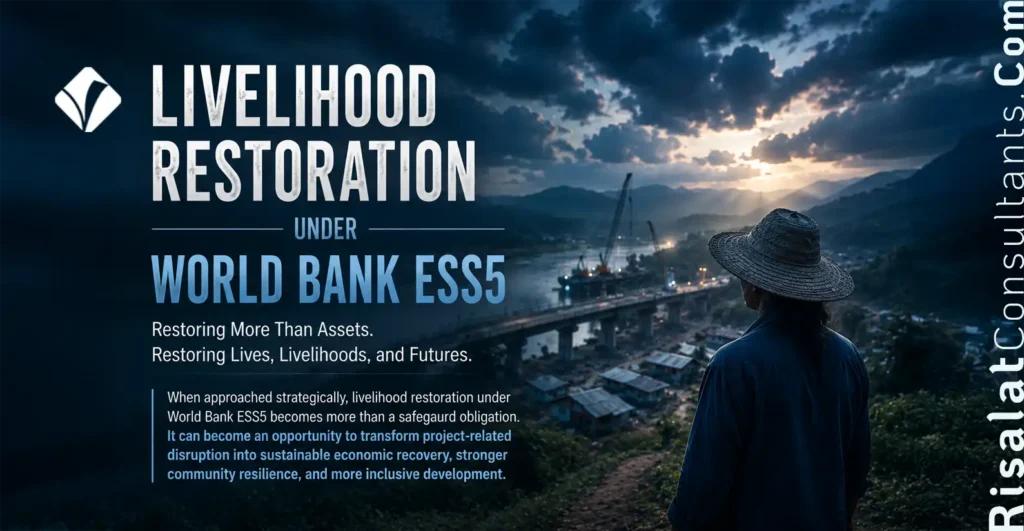
When approached strategically, livelihood restoration under World Bank ESS5 becomes more than a safeguard obligation. It can become an opportunity to transform project-related disruption into sustainable economic recovery, stronger community resilience, and more inclusive development.
Partners in project success since 2011, diagnostics, advisory support and applied learning for ministries, public agencies and project teams.
Need help putting this into practice?
Start with a free 10-minute diagnostic or talk to our experts.