حقائق رئيسية
- المواعيد
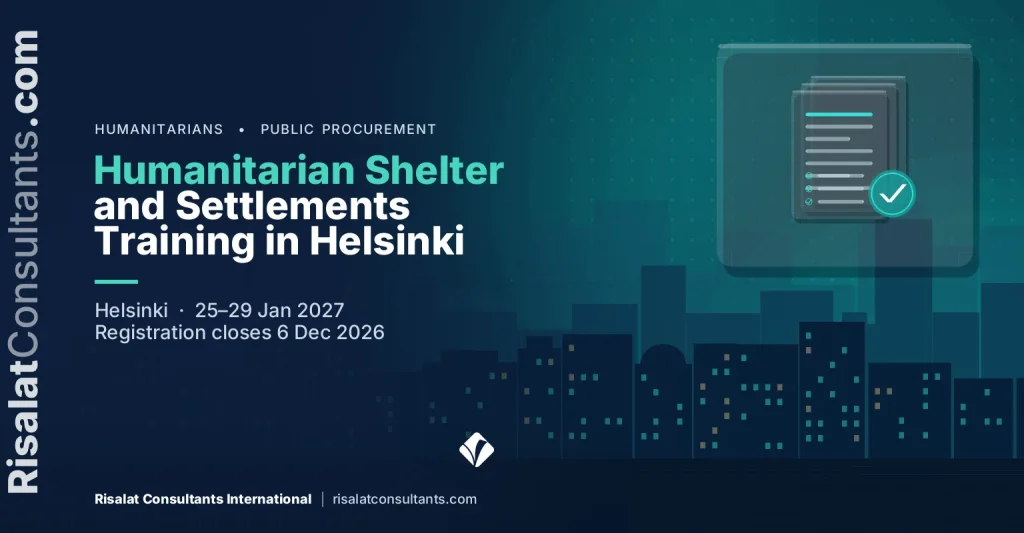
- 25–29 يناير 2027 (5 أيام)
- المكان
- Klaus K Hotel، هلسنكي، فنلندا
- الرسوم لكل مشارك
- 3,710 جنيه استرليني (GBP)
- الدفع
- بالفاتورة والتحويل المصرفي
- إغلاق التسجيل
- 6 ديسمبر 2026
- الصيغة
- 5-day short course: a practical capacity-building programme for government, NGO and project teams in Helsinki
- الشهادة
- شهادة إتمام
- الخيار المؤسسي
- نفّذه لفريقك، في المواعيد التي تناسبك
في هذه الصفحة 17 قسماً
نظرة عامة على البرنامج
Humanitarian Shelter and Settlements Training in Helsinki gives government agencies, donor-financed project units, public service providers and private-sector teams a practical way to strengthen shelter options, site planning and protection-led humanitarian delivery. The five-day learning journey concentrates on tasks that professionals can demonstrate at work, rather than a collection of unrelated management topics.
UNHCR reports that 117.8 million people were forcibly displaced at the end of 2025. This supersedes the older page’s unqualified reference to 70 million and reinforces the importance of adequate shelter and safe settlement choices.
UNHCR’s January 2026 emergency shelter guidance calls for context-sensitive choices that reflect climate, cultural practices, local materials, accessibility and household dignity. It also notes that minimum emergency standards are starting points rather than permanent housing solutions.
The programme distinguishes shelter assistance for households from settlement-level planning for water, sanitation, access, safety, movement and community services. It examines how emergency provision relates to recovery and durable solutions.
In a mixed professional group, participants compare the procedures they use, the documents that demonstrate compliance and the decisions for which they are accountable. Every technical case is assessed for practicality, evidence quality and risks that could arise during implementation. The programme is a skills course, not a promise of institutional accreditation or an externally arranged visit.
The Programme Strengthens Institutional Capability
- Displacement and needs assessment
- Household shelter and settlement distinctions
- Shelter vulnerability prioritisation
- Climate-appropriate shelter typologies
- Covered space and privacy requirements
- Land and tenure risk screening
- Safe site access and accessibility
- Settlement layout and service integration
- Water sanitation and drainage coordination
- Protection and GBV risk mitigation
- Community participation and accountability
- Materials specification and local procurement
- Construction and distribution quality checks
- Cash and in-kind assistance comparisons
- Environmental impacts and waste management
- Repair maintenance and transition planning
The output of the week is an institution-specific working package, combining documented decisions, review checklists, a short executive brief and a realistic adoption plan. Participants are encouraged to bring non-sensitive examples from their own work while all teaching datasets and scenarios can be completed with fictional material.
The Growing Importance of Humanitarian Shelter and Settlements
Technical proficiency in humanitarian shelter and settlements provision is increasingly connected with institutional accountability. Teams need to know not just how a tool or procedure operates but when it is appropriate, who authorises it, what evidence is retained and how problems are escalated. Reliable practice improves the quality of decisions while reducing avoidable rework.
UNHCR reports that 117.8 million people were forcibly displaced at the end of 2025. This supersedes the older page’s unqualified reference to 70 million and reinforces the importance of adequate shelter and safe settlement choices.
تحتاج المؤسسات بشكل متزايد إلى مهنيين قادرين على:
- Planning displacement and needs assessment for a defined operational purpose
- Planning household shelter and settlement distinctions for a defined operational purpose
- Planning shelter vulnerability prioritisation for a defined operational purpose
- Planning climate-appropriate shelter typologies for a defined operational purpose
- Planning covered space and privacy requirements for a defined operational purpose
- Planning land and tenure risk screening for a defined operational purpose
- Planning safe site access and accessibility for a defined operational purpose
- Planning settlement layout and service integration for a defined operational purpose
- Planning water sanitation and drainage coordination for a defined operational purpose
- Planning protection and gbv risk mitigation for a defined operational purpose
- Planning community participation and accountability for a defined operational purpose
- Planning materials specification and local procurement for a defined operational purpose
Strong humanitarian shelter and settlements provision systems help organisations:
- Make shelter vulnerability prioritisation a documented routine instead of an informal assumption
- Make climate-appropriate shelter typologies a documented routine instead of an informal assumption
- Make covered space and privacy requirements a documented routine instead of an informal assumption
- Make land and tenure risk screening a documented routine instead of an informal assumption
- Make safe site access and accessibility a documented routine instead of an informal assumption
- Make settlement layout and service integration a documented routine instead of an informal assumption
- Make water sanitation and drainage coordination a documented routine instead of an informal assumption
- Make protection and gbv risk mitigation a documented routine instead of an informal assumption
- Make community participation and accountability a documented routine instead of an informal assumption
An effective institutional approach links senior management ownership with staff capability, written procedures and proportionate monitoring. This programme uses Helsinki as a professional learning venue while inviting participants to compare methods across agencies and countries.
Who Should Attend This Humanitarian Shelter and Settlements Training?
صُمم هذا البرنامج من أجل:
- Humanitarian shelter coordinators
- UN and NGO emergency programme managers
- National disaster management teams
- Public works and housing officials
- Settlement planning and site engineers
- Protection and safeguarding officers
- WASH project staff
- Camp coordination and management personnel
- Procurement and logistics teams
- Cash assistance programme officers
- Community liaison staff
- Donor-funded recovery project managers
- Monitoring and quality assurance specialists
- Local implementing partner leaders
The course is most useful to people who have a real operational responsibility or are preparing to supervise one. Mixed groups enable a technical specialist to test recommendations with finance, compliance, programme and management colleagues before applying them to an institution.
حدّد ما يحتاج فريقك إلى القدرة على إنجازه.
Humanitarian Shelter and Settlements Training Objectives
Upon successful completion of this Humanitarian Shelter and Settlements Training, participants will be able to:
- Explain displacement and needs assessment and its practical boundaries
- Diagnose gaps in household shelter and settlement distinctions using appropriate evidence
- Apply shelter vulnerability prioritisation to a realistic work case
- Choose suitable approaches for climate-appropriate shelter typologies
- Prepare defensible records for covered space and privacy requirements
- Evaluate operational risks associated with land and tenure risk screening
- Design checks for safe site access and accessibility
- Coordinate staff responsible for settlement layout and service integration
- Interpret data and feedback relating to water sanitation and drainage coordination
- Communicate decisions about protection and gbv risk mitigation to leadership
- Develop a phased institutional plan for community participation and accountability
Each objective is practised through an assessment, demonstration, structured case or group decision. The emphasis is on repeatable methods that can be embedded in existing workflows and adapted to the participant’s legal, organisational and financing constraints.
1. What should guide the selection of an emergency shelter solution?
UNHCR shelter guidance requires context-sensitive, dignified and accessible options.
2. Why must shelter response planning include settlement services?
Site layout and essential service coordination are integral to a safe settlement approach.
3. How many people were forcibly displaced at end-2025 according to UNHCR?
UNHCR Global Trends 2025 reports 117.8 million people forcibly displaced.
محتوى البرنامج وهيكله
- Interpret the displacement context and affected population profiles
- Distinguish emergency shelter transitional support and housing recovery
- Map shelter needs for displaced and host communities
- Identify vulnerable households using safe selection criteria
- Explain shelter versus settlement assistance in practical terms
- Review UNHCR emergency shelter guidance and its limitations
- Compare collective centre and family shelter implications
- Screen possible locations for physical and protection hazards
- Identify land tenure and permission questions
- Plan access routes evacuation and emergency vehicle access
- Consider drainage terrain seasonal temperature and wind
- Integrate water sanitation solid waste and health access
- Provide accessible routes and services for disabilities
- Balance household privacy community spaces and lighting
- Translate assessed needs into a shelter bill of quantities
- Compare locally available and imported material options
- Evaluate shelter performance across different climates
- Review minimum covered-space and ventilation considerations
- Assess maintenance requirements for short-life materials
- Prepare procurement specifications and quality checkpoints
- Plan distributions with household dignity and inclusion
- Map protection threats linked to location and layout
- Develop confidential community complaint channels
- Coordinate shelter with WASH health and education partners
- Assess cash assistance feasibility versus in-kind delivery
- Monitor occupancy use and household satisfaction safely
- Plan repairs maintenance and replacement of damaged materials
- Address cultural suitability and social cohesion issues
- Assemble a shelter response strategy from assessed needs
- Select options using cost risk and protection criteria
- Present an indicative service and infrastructure layout
- Prioritise procurements and contract management actions
- Assign community feedback and accountability responsibilities
- Agree quality standards and monitoring visits
- Link immediate shelter needs with medium-term recovery
المحتوى الكامل يوماً بيوم
The five-day sequence moves from understanding the problem and evidence base through operational design and assurance to an actionable institutional plan. The themes are:
- Day one: displacement profiles and shelter response options
- Day two: selecting safe settlements and designing layouts
- Day three: shelter specifications procurement and quality control
- Day four: protection accountability and transition planning
- Day five: response simulation and settlement recovery roadmap
المحتوى الكامل يوماً بيوم
First Day | Displacement profiles and shelter response options
- Interpret the displacement context and affected population profiles
- Distinguish emergency shelter transitional support and housing recovery
- Map shelter needs for displaced and host communities
- Identify vulnerable households using safe selection criteria
- Explain shelter versus settlement assistance in practical terms
- Review UNHCR emergency shelter guidance and its limitations
- Compare collective centre and family shelter implications
- Integrate community consultation and voluntary choice
- Agree a response planning and evidence checklist
Workshop: Baseline assessment
Use anonymised fictional displacement profiles to choose shelter assistance modalities for different households. The group records evidence used, unresolved assumptions, responsible officers and decisions requiring verification. Participants then compare approaches with colleagues, revise their work and identify a practical step for their own institution.
Second Day | Selecting safe settlements and designing layouts
- Screen possible locations for physical and protection hazards
- Identify land tenure and permission questions
- Plan access routes evacuation and emergency vehicle access
- Consider drainage terrain seasonal temperature and wind
- Integrate water sanitation solid waste and health access
- Provide accessible routes and services for disabilities
- Balance household privacy community spaces and lighting
- Document community feedback and conflict sensitivity
- Draft a settlement-level site risk and service plan
Workshop: Design choices
Draw a provisional site plan and test it for drainage, safe circulation, privacy and inclusive service access. The group records evidence used, unresolved assumptions, responsible officers and decisions requiring verification. Participants then compare approaches with colleagues, revise their work and identify a practical step for their own institution.
Third Day | Shelter specifications procurement and quality control
- Translate assessed needs into a shelter bill of quantities
- Compare locally available and imported material options
- Evaluate shelter performance across different climates
- Review minimum covered-space and ventilation considerations
- Assess maintenance requirements for short-life materials
- Prepare procurement specifications and quality checkpoints
- Plan distributions with household dignity and inclusion
- Set up contractor and volunteer safety procedures
- Design inspection records and corrective action tracking
Case Study: Risk and decisions
Write materials specifications and a quality inspection checklist for a selected shelter type. The group records evidence used, unresolved assumptions, responsible officers and decisions requiring verification. Participants then compare approaches with colleagues, revise their work and identify a practical step for their own institution.
Fourth Day | Protection accountability and transition planning
- Map protection threats linked to location and layout
- Develop confidential community complaint channels
- Coordinate shelter with WASH health and education partners
- Assess cash assistance feasibility versus in-kind delivery
- Monitor occupancy use and household satisfaction safely
- Plan repairs maintenance and replacement of damaged materials
- Address cultural suitability and social cohesion issues
- Coordinate with local authorities on longer-term housing options
- Build an exit and transition decision framework
Workshop: Operations and assurance
Resolve a simulated complaint about unsafe shelter placement without disclosing household-sensitive information. The group records evidence used, unresolved assumptions, responsible officers and decisions requiring verification. Participants then compare approaches with colleagues, revise their work and identify a practical step for their own institution.
Fifth Day | Response simulation and settlement recovery roadmap
- Assemble a shelter response strategy from assessed needs
- Select options using cost risk and protection criteria
- Present an indicative service and infrastructure layout
- Prioritise procurements and contract management actions
- Assign community feedback and accountability responsibilities
- Agree quality standards and monitoring visits
- Link immediate shelter needs with medium-term recovery
- Prepare a phased budget and implementation register
- Defend a coordinated 90-day shelter response plan
Capstone Exercise: Institutional action plan
Present a shelter and settlements strategy covering procurement, protection, services, costs and transition. The group records evidence used, unresolved assumptions, responsible officers and decisions requiring verification. Participants then compare approaches with colleagues, revise their work and identify a practical step for their own institution.
Humanitarian Shelter and Settlements Training Methodology
Facilitators introduce concepts through short explanations and then ask participants to work through realistic decisions related to shelter options, site planning and protection-led humanitarian delivery. The format uses controlled datasets, fictional records and carefully selected public references; participants are never required to share confidential customer information, protected case files or unpublished institutional records.
يجمع البرنامج بين:
- Instructor-led explanations of terminology and current guidance
- ورش عمل تطبيقية يومية باستخدام تمارين خاصة بالموضوع
- Structured comparison of official policies and standards
- تحليل في مجموعات صغيرة لخيارات التشغيل المتنافسة
- Individual review of an institutional readiness baseline
- Short presentations of decisions and their evidence
- Peer scrutiny of assumptions and implementation risks
- Simulation of procedures and escalation decisions
- تطوير القوالب والتحقق منها مقابل المتطلبات
- Daily reflective notes on changes to working practice
- ملاحظات الميسر على المستندات التي أعدها المشاركون
- Final presentation of a feasible institutional action plan
Before arrival, a short pre-assessment identifies job roles, expected outputs and practical barriers. The trainer uses it to adjust examples while retaining the published technical content. Exercises favour local adaptation over copying another country’s arrangements.
The final peer review tests feasibility, ownership, evidence needs and a realistic timetable for introducing the proposed changes.
الزيارات الفنية والبرنامج الميداني
A possible technical exposure component may examine settlement planning, shelter material logistics, volunteer coordination or cold-climate shelter considerations. Any in-person visit depends on a suitable host accepting the request and on operational, safeguarding, insurance and privacy conditions. No agency, shelter facility or humanitarian office is named as a confirmed host. If a visit is unavailable, an equivalent desk-based technical site-planning simulation will be delivered.
النتائج المتوقعة
Upon completion of this Humanitarian Shelter and Settlements Training, participants will be able to:
- Produce a usable review or working document for displacement and needs assessment
- Produce a usable review or working document for household shelter and settlement distinctions
- Produce a usable review or working document for shelter vulnerability prioritisation
- Produce a usable review or working document for climate-appropriate shelter typologies
- Produce a usable review or working document for covered space and privacy requirements
- Produce a usable review or working document for land and tenure risk screening
- Produce a usable review or working document for safe site access and accessibility
- Produce a usable review or working document for settlement layout and service integration
- Produce a usable review or working document for water sanitation and drainage coordination
Participants should be able to explain why a selected method is appropriate, what information is still missing and who must authorise its implementation. Their final products are designed for managerial discussion and further adaptation, not as substitutes for professional certification, legal advice or regulatory approval.
£3,710 per participant · invoice and bank transfer · groups of 5 or more receive a discount
خمسة مشاركين أو أكثر من مؤسسة واحدة: اطلبوا سعر المجموعة عند طلب الفاتورة.
عشرة أشارك أو أكثر: قد تكلفة النسخة المؤسسية الخاصة لمؤسستك أقل لكل شخص. اطلب عرض سعر مؤسسي.
يُغلق باب التسجيل خلال 14 يوماً (6 ديسمبر 2026)
Institutional Application of Humanitarian Shelter and Settlements Training
يدعم هذا البرنامج المؤسسات في تعزيز:
- Governance and staff ownership of displacement and needs assessment
- Governance and staff ownership of household shelter and settlement distinctions
- Governance and staff ownership of shelter vulnerability prioritisation
- Governance and staff ownership of climate-appropriate shelter typologies
- Governance and staff ownership of covered space and privacy requirements
- Governance and staff ownership of land and tenure risk screening
- Governance and staff ownership of safe site access and accessibility
- Governance and staff ownership of settlement layout and service integration
- Governance and staff ownership of water sanitation and drainage coordination
- Governance and staff ownership of protection and gbv risk mitigation
- Governance and staff ownership of community participation and accountability
- Governance and staff ownership of materials specification and local procurement
يعود المشاركون بأدوات عملية لتحسين:
- A practical checklist or decision record for climate-appropriate shelter typologies
- A practical checklist or decision record for covered space and privacy requirements
- A practical checklist or decision record for land and tenure risk screening
- A practical checklist or decision record for safe site access and accessibility
- A practical checklist or decision record for settlement layout and service integration
- A practical checklist or decision record for water sanitation and drainage coordination
- A practical checklist or decision record for protection and gbv risk mitigation
- A practical checklist or decision record for community participation and accountability
- A practical checklist or decision record for materials specification and local procurement
Institutional adaptation begins with a named management sponsor and a narrow process where improvement can be observed. Participants identify baseline records, reporting responsibilities, resources and review dates, then recommend whether to pilot, revise or defer each intervention. A capacity assessment may help the organisation identify readiness gaps.
الأهمية الإقليمية والتطبيق
أوروبا
Helsinki provides a northern climate context for discussing thermal suitability and cold-weather shelter considerations, without implying a formally arranged technical visit.
Africa and the Middle East
Rapid-onset conflict displacement and prolonged crises make protection-led shelter selection, land and access issues, and coordination particularly important.
آسيا والمحيط الهادئ
Floods, cyclones and earthquakes call for geographically adapted shelter designs, local materials, safe site selection and a transition from relief to reconstruction.
The cases are intended as comparative learning, not universal legal advice. Each team must verify the applicable national rules, sector requirements and institutional capacity before adopting a template. For pre-course prioritisation, participants may use Risalat’s Training Needs Assessment.
لمحة عن البلد المضيف – فنلندا
Helsinki, Finland’s capital, is a suitable location for structured professional discussion of humanitarian planning, cold climate considerations and coordination of services.
The substantive technical benchmarks in this programme are UNHCR’s humanitarian shelter guidance and current global displacement reporting. Neither source implies that an external organisation in Helsinki has agreed to receive the group.
Participants must check Schengen travel and visa requirements according to nationality and residence. Practical observations would be limited to arrangements expressly accepted by the relevant host and should not intrude on displaced people’s privacy.
Humanitarian Shelter and Settlements Training Deliverables
تهيكل ريسالات هذا البرنامج بناءً على الإعداد والمشاركة العملية والمتابعة. تم تصميم القوالب الخاصة بالموضوعات لتتناسب مع السياق المؤسسي للمشارك. تظل ترتيبات السفر والإقامة والمشاركة خاضعة لشروط الحجز المؤكدة الصادرة عن ريسالات.
قبل البرنامج
- التقييم المسبق للمشاركين
- Humanitarian Shelter and Settlements Readiness Assessment
- Humanitarian Shelter and Settlements Resource Pack
- مواد قراءة تحضيرية
- دعم واستشارات مجانية بشأن التأشيرة
أثناء البرنامج
- الاستقبال من المطار والمساعدة عند الوصول
- Accommodation with breakfast: 6 nights, check-in Sunday 24 January 2027, check-out Saturday 30 January 2027 (one night before and one night after the programme)
- عشاء ترحيبي للتعارف
- حقيبة Risalat التدريبية (حقيبة، وقارورة، وكوب، وقميص، وقبعة، وغلاف جواز سفر، وأقلام، ودفتر، ومغناطيس وميدالية مفاتيح)
- Comprehensive Humanitarian Shelter and Settlements Training Manual
- Practical diagnostic checklist for displacement and needs assessment
- ورقة عمل رسم العمليات وتحليل خط الأساس
- Risk and controls assessment matrix
- Performance indicator and evidence register
- Case study decision log and peer review form
- Institutional 30, 60 and 90-day action plan template
- ورش عمل عملية ومحاكاة
- مناقشات جماعية وتعلم من الأقران
- غداء ومرطبات يومية
- الاستفادة الكاملة من مرافق مكان التدريب
- جهاز Mini Pad / جهاز لوحي مزود بمواد تعليمية رقمية
- زيارة ميدانية (حسب الاقتضاء)
- جولة ترفيهية في المدينة
بعد البرنامج
- شهادة الإتمام
- جائزة Risalat تقديراً للمشاركة في البرنامج
- مواد مرجعية بعد التدريب
- Completed Humanitarian Shelter and Settlements case and decision toolkit
- Institutional implementation roadmap
- Selected monitoring and quality review templates
- الدعم بعد التدريب وإرشادات المتابعة
- تقرير البرنامج
Organisations seeking dedicated group delivery, tailored case exercises or additional implementation support can request a tailored in-house proposal.
Common Challenges in Humanitarian Shelter and Settlements, And How This Training Helps
كيف يمكن للمنظمة تحديد الأولويات عندما تتطلب عدة مشكلات الاهتمام؟
Day one uses displacement and needs assessment to identify what is known, what is assumed and which operational outcome matters most. The exercise assigns a review owner and produces a practical record of what should change.
How can an organisation find reliable evidence for a difficult decision?
Days one and two develop a documented baseline for shelter vulnerability prioritisation and test whether information is complete and fit for purpose. The exercise assigns a review owner and produces a practical record of what should change.
How can an organisation translate general standards into procedures staff can use?
Day two turns climate-appropriate shelter typologies into a practical checklist, record and decision sequence. The exercise assigns a review owner and produces a practical record of what should change.
كيف يمكن للمؤسسة إدارة المخاطر والأخطاء دون إخفائها؟
Days three and four create clear review gates for land and tenure risk screening and assign accountability for correcting failures. The exercise assigns a review owner and produces a practical record of what should change.
How can an organisation coordinate different units without losing ownership?
The day-four exercises map roles, handoffs and escalation around settlement layout and service integration. The exercise assigns a review owner and produces a practical record of what should change.
How can an organisation measure improvement when resources and time are limited?
Day five chooses a small set of indicators linked to water sanitation and drainage coordination and a realistic review cycle. The exercise assigns a review owner and produces a practical record of what should change.
How can an organisation make training useful after participants return to work?
The final capstone turns community participation and accountability into a 90-day sequence with named owners, management decisions and observable outputs. The exercise assigns a review owner and produces a practical record of what should change.
الأسئلة الشائعة
Who should attend Humanitarian Shelter and Settlements Training in Helsinki?
The course is intended for responsible professionals such as humanitarian shelter coordinators, un and ngo emergency programme managers, national disaster management teams, and cross-functional colleagues whose decisions affect shelter options, site planning and protection-led humanitarian delivery.
Is this a practical course or mainly lectures?
It combines technical explanations with five applied cases, review templates, group decisions and a final action plan linked to humanitarian shelter and settlements provision.
What should participants prepare before attending?
Complete the pre-assessment, identify one relevant process or institutional challenge, and bring only public or appropriately anonymised records. Confidential files are not required.
هل يمكن استخدام هذه الطرق في المشاريع الحكومية والمמוولة من الجهات المانحة؟
Yes, the cases can be adapted to public agencies, implementation units and regulated organisations, provided users check applicable national law, donor requirements and organisational controls.
Is a particular institution or technical visit confirmed?
No external institution or visit is represented as confirmed. Any field or technical exposure component depends on prior host acceptance and appropriate safeguarding arrangements.
Who Will Deliver This Programme
Each date is delivered by a team assigned from Risalat's expert network for this subject. For this programme we assign:
How we choose them: Experience in the region of the participants or comparable settings; Command of the financier rules that apply (World Bank, ADB, AfDB, EU, UN) where relevant; Delivery in English; other languages on request for in-house groups; No conflict of interest with participants' institutions.
Training courses in Helsinkiالدورات التدريبية للعاملين في المجال الإنساني
لماذا هلسنكي لهذا البرنامج
هلسنكي هي موطن للمؤسسات الوطنية الرئيسية، بما في ذلك برلمان فنلندا ومختلف الوزارات الحكومية. يمكن لل官员 الزائرين مراقبة ممارسات القطاع العام المعمول بها، ونماذج الحوكمة البلدية، ومبادرات التخطيط الحضري الحديثة في جميع أنحاء العاصمة. الوصول إلى المدينة سهل عبر رحلات جوية دولية مباشرة تربط بين أوروبا وآسيا وأمريكا الشمالية.
The Humanitarian Shelter and Settlements Training in Helsinki programme in January 2027 brings together officials and professionals from across Europe, Africa, the Middle East and Asia. Sessions combine short inputs, case studies and group work on participants' own files, and the city's institutions can be added as a study visit on request.
Getting there: Helsinki Airport (HEL).
تحقق مما إذا كنت بحاجة إلى تأشيرة عبر أداة التحقق من التأشيرة المجانية، واطلب خطاب دعوة بعد إتمام تسجيلك.
الموضوع نفسه في مدن أخرى
برامج أخرى في هلسنكي
- AI in Education and Skills Systems Training in Helsinki
- بناء القدرات في مجال الذكاء الاصطناعي للحكومات المحلية والمجالس البلدية
- إجراء تقييمات فعالة لاحتياجات التعلم – دورة تدريبية في هلسنكي
- برنامج تدريبي وتجربة عملية في تسعير الكربون وصنع السياسات في هلسنكي
- Teacher Professional Development Training and Study Tour
- شراكة التعاقد المفتوح (Open Contracting Partnership) شراكة التعاقد المفتوح (Open Contracting Partnership)
- إطار المشتريات ولوائحها للمشاريع البنك الدولي
للفرق والمؤسسات
Bring your team
Teams that learn together apply more at work. Tell us how many people and how you would like to take part: we reply with a group quote within two working days.
Watch: this programme in short



تواريخ ومدن أخرى لهذا الموضوع: دورات التدريب على إدارة البرامج الإنسانية (44 موعداً قادماً).
المزيد من الدورات التدريبية في فنلندا · جميع البرامج في أوروبا · تقويم التدريب الكامل
تخطيط هذا البرنامج في خارطة طريق: لماذا هو مهم، ولماذا يجب الموافقة عليه، والتواريخ المراد التخطيط لها، والمسار المهني الذي يبنيه.