Key facts
- Dates
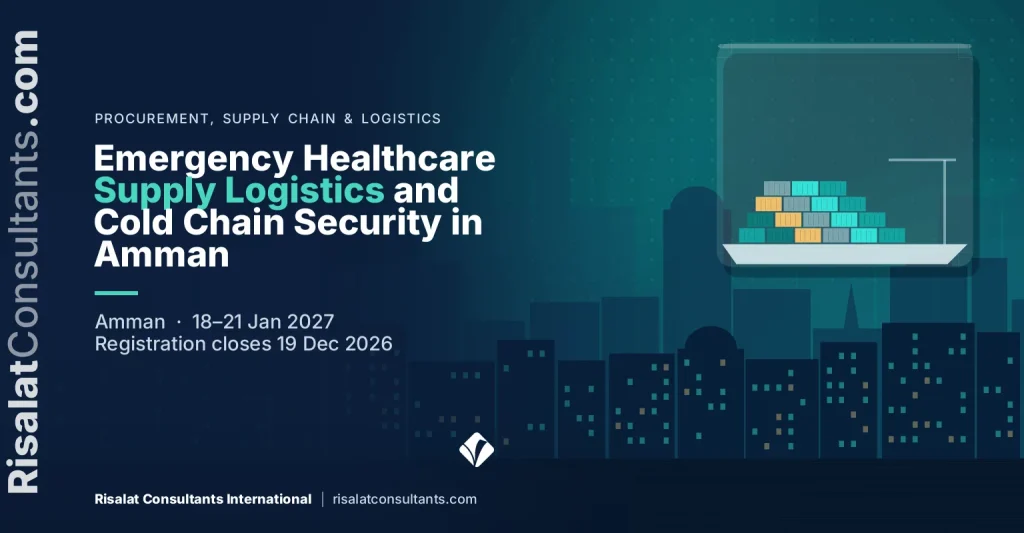
- 18–21 Jan 2027 (4 days)
- Where
- Amman, Jordan
- Fee per participant
- £2,050 (GBP)
- Payment
- By invoice and bank transfer
- Registration closes
- 19 Dec 2026
- Certificate
- Certificate of completion
- In-house option
- Run it for your team, on your dates
On this page 14 sections
Programme Overview
Delivering life-saving medical supplies in conflict zones and humanitarian crises requires robust, compliant, and responsive logistics infrastructure. This four-day intensive programme in Amman equips participants with technical capabilities to safeguard and distribute essential pharmaceuticals, medical consumables, and clinical equipment. Rooted in international standards from the World Health Organization and Good Distribution Practices, the curriculum addresses operational bottlenecks, border clearance delays, and distribution breakdowns that regularly threaten healthcare delivery in volatile environments.
Participants explore practical frameworks for supply chain mapping, multi-modal transport contracting, and inventory visibility across compromised transit corridors. Dedicated modules address end-to-end cold chain management, covering the monitoring of temperature-sensitive pharmaceuticals, vaccine storage integrity, and back-up power provision for clinical storage units. Through structured case exercises, attendees examine realistic field logistics challenges and establish reliable supply pipelines that maintain clinical efficacy from the point of entry down to primary healthcare facilities.
The course focuses heavily on risk mitigation, cross-line delivery mechanisms, and dynamic contingency planning for crisis-affected territories. Participants master standard operating procedures for waste management, reverse logistics, and emergency inventory tracking under severe operational constraints. By completing applied logistics planning exercises, professionals will strengthen institutional readiness, streamline donor reporting requirements, and ensure that emergency health inputs reach vulnerable populations securely, transparently, and without clinical degradation.
Ongoing conflict and widespread infrastructure collapse across the region have disrupted primary transport corridors, destroyed medical warehouses, and severed electricity grids essential for cold chain maintenance. Large-scale humanitarian funding mechanisms, such as the US$86m Sudan Health Assistance and Response to Emergencies, require rapid, accountable, and technically compliant health logistics to sustain life-saving operations. Without trained personnel capable of navigating cross-border supply bottlenecks, temperature excursions, and inventory shrinkage, critical health interventions risk failure, making immediate capacity building in resilient supply chain security an urgent priority for relief agencies and public authorities.
Delivered by Risalat Consultants International in Amman, Jordan, it combines expert-led sessions, real cases and group work, so that participants can apply what they learn in their own institution.
The Programme Strengthens Institutional Capability
- Humanitarian supply chain frameworks: WHO standards, GDP, and emergency operations
- Corridor assessments and port-of-entry bottlenecks in conflict environments
- Pharmaceutical security protocols: Theft prevention, convoy tracking, and cargo escorting
- Warehouse site selection, physical hardening, and emergency inventory protection
- Exercise: Mapping high-risk transport corridors and establishing primary transit hubs
- Thermolabile health products: Maintaining vaccine, insulin, and blood supply chains
- Cold chain equipment selection: WHO PQS prequalified refrigerators, cold boxes, and carriers
- Off-grid power infrastructure: Solar Direct Drive (SDD) systems and hybrid generator setups
- Procurement planning and market analysis
- Choosing procurement methods and approaches
- Writing specifications and terms of reference
- Bidding documents and evaluation criteria
It is designed for health supply chain and logistics officers operating in emergency response programmes, emergency procurement specialists managing multilateral health funding allocations, public health programme coordinators overseeing medical relief operations in Sudan and others who want practical, current skills in procurement and contract management.
The Growing Importance of Emergency Healthcare Supply Logistics and Cold Chain Security in Amman
Procurement is where public money becomes roads, medicines, systems and services. Delays, weak specifications and poor contract management are among the most common reasons projects fall behind or fail their audits.
Financiers and governments now expect value for money, fair competition and well-documented decisions at every stage, from planning to contract completion. Teams who manage the full cycle well deliver faster and with fewer complaints.
Organisations increasingly require professionals capable of:
- Plan procurement that matches project needs and timelines
- Prepare clear specifications and evaluation criteria
- Evaluate bids consistently and defend the decision
- Manage contracts, variations and performance
- Keep complete records for audit and review
Strong procurement and contract management systems help organisations:
- Reduce procurement delays and failed tenders
- Achieve value for money
- Lower the risk of complaints and audit findings
- Deliver contracts on time and to quality
This Emergency Healthcare Supply Logistics and Cold Chain Security in Amman programme brings these elements together in a practical format, so that participants understand not only what good practice looks like but also how to introduce it in their own setting, with the people and resources they have.
Who Should Attend This Emergency Healthcare Supply Logistics and Cold Chain Security in Amman Training?
This programme is designed for:
- Health supply chain and logistics officers operating in emergency response programmes
- Emergency procurement specialists managing multilateral health funding allocations
- Public health programme coordinators overseeing medical relief operations in Sudan
- Cold chain technicians and biomedical engineers managing primary storage depots
- Warehouse and inventory managers in crisis-affected public health facilities
- Humanitarian operations managers coordinating cross-border medical shipments
- Logistics coordinators from ministries of health and regional health directorates
- Monitoring and compliance officers tracking pharmaceutical distribution integrity
- Field distribution leads from national and international humanitarian agencies
- Procurement officers and managers
- Contract managers and administrators
- Project and programme managers
The programme suits experienced professionals as well as those moving into new responsibilities. Groups that mix institutions and countries are encouraged, because participants learn a great deal from each other’s experience.
Tick what your team needs to be able to do.
Emergency Healthcare Supply Logistics and Cold Chain Security in Amman Training Objectives
Upon successful completion of this Emergency Healthcare Supply Logistics and Cold Chain Security in Amman Training, participants will be able to:
- Apply Good Distribution Practices and WHO standards to emergency pharmaceutical supply management
- Design resilient cold chain workflows incorporating passive cooling and autonomous solar equipment
- Formulate multi-modal logistics plans for cross-border and cross-line medical deliveries
- Establish temperature-monitoring protocols to mitigate and document heat or freeze excursions
- Implement tracking and inventory reconciliation tools to minimise losses and diversion in transit
- Develop contingency plans for power grid outages, transport blockades, and warehouse disruptions
- Execute biomedical waste disposal and reverse logistics protocols for damaged or expired health products
- Explain the procurement cycle and the rules that apply to it
- Prepare a procurement plan linked to project timelines
- Choose a suitable method and approach to the market
Each objective is practised during the programme through exercises, cases or group work, so that participants leave able to do it, not only to describe it.
Programme Contents and Structure
- Humanitarian supply chain frameworks: WHO standards, GDP, and emergency operations
- Corridor assessments and port-of-entry bottlenecks in conflict environments
- Pharmaceutical security protocols: Theft prevention, convoy tracking, and cargo escorting
- Warehouse site selection, physical hardening, and emergency inventory protection
- Exercise: Mapping high-risk transport corridors and establishing primary transit hubs
- Thermolabile health products: Maintaining vaccine, insulin, and blood supply chains
- Cold chain equipment selection: WHO PQS prequalified refrigerators, cold boxes, and carriers
- Off-grid power infrastructure: Solar Direct Drive (SDD) systems and hybrid generator setups
- Data loggers, continuous temperature monitors, and excursion root-cause analysis
- Practical session: Calibrating monitoring devices and managing passive cooling packing
- Last-mile transport modalities: Route optimization and community-level delivery points
- Pipeline visibility: Batch-lot tracking, expiry tracking, and stock rationing algorithms
- Managing customs clearance, import permits, and regulatory waivers for medical relief
- Cross-line negotiation and civil-military coordination for humanitarian medical access
- Simulation: Resolving rapid supply stockouts across remote, disconnected field clinics
- Drafting logistics contingency plans for fuel shortages, blockades, and armed escalation
- Safe disposal and reverse logistics of compromised drugs, sharps, and biological waste
- Assurance mechanisms: Third-party monitoring and end-use verification for multilateral funds
- Standard operating procedure drafting for field-level health supply management
- Action plan presentations: Logistics and cold chain safeguarding plans for participants' duty stations
Full day-by-day contents
The programme runs over 4 days. Each day combines expert input, practical work and a closing workshop or case study:
- First Day: Day 1: Emergency Health Logistics Architecture and Supply Chain Security
- Second Day: Day 2: Cold Chain Engineering, Temperature Integrity, and Power Resilience
- Third Day: Day 3: Emergency Distribution Workflows, Tracking, and Last-Mile Access
- Fourth Day: Day 4: Contingency Planning, Waste Management, and Donor Compliance
Full day-by-day contents
First Day | Day 1: Emergency Health Logistics Architecture and Supply Chain Security
- Humanitarian supply chain frameworks: WHO standards, GDP, and emergency operations
- Corridor assessments and port-of-entry bottlenecks in conflict environments
- Pharmaceutical security protocols: Theft prevention, convoy tracking, and cargo escorting
- Warehouse site selection, physical hardening, and emergency inventory protection
- Exercise: Mapping high-risk transport corridors and establishing primary transit hubs
Workshop: Day 1: Emergency Health Logistics Architecture and Supply Chain Security: Applying It to Your Institution
Working in small groups, participants apply the day's methods to examples from their own institutions and agree practical next steps.
Second Day | Day 2: Cold Chain Engineering, Temperature Integrity, and Power Resilience
- Thermolabile health products: Maintaining vaccine, insulin, and blood supply chains
- Cold chain equipment selection: WHO PQS prequalified refrigerators, cold boxes, and carriers
- Off-grid power infrastructure: Solar Direct Drive (SDD) systems and hybrid generator setups
- Data loggers, continuous temperature monitors, and excursion root-cause analysis
- Practical session: Calibrating monitoring devices and managing passive cooling packing
Workshop: Day 2: Cold Chain Engineering, Temperature Integrity, and Power Resilience: Applying It to Your Institution
Working in small groups, participants apply the day's methods to examples from their own institutions and agree practical next steps.
Third Day | Day 3: Emergency Distribution Workflows, Tracking, and Last-Mile Access
- Last-mile transport modalities: Route optimization and community-level delivery points
- Pipeline visibility: Batch-lot tracking, expiry tracking, and stock rationing algorithms
- Managing customs clearance, import permits, and regulatory waivers for medical relief
- Cross-line negotiation and civil-military coordination for humanitarian medical access
- Simulation: Resolving rapid supply stockouts across remote, disconnected field clinics
Case Study: Day 3: Emergency Distribution Workflows, Tracking, and Last-Mile Access in Practice
Participants analyse a realistic case, compare the choices made with good practice and draw lessons they can use in their own setting.
Fourth Day | Day 4: Contingency Planning, Waste Management, and Donor Compliance
- Drafting logistics contingency plans for fuel shortages, blockades, and armed escalation
- Safe disposal and reverse logistics of compromised drugs, sharps, and biological waste
- Assurance mechanisms: Third-party monitoring and end-use verification for multilateral funds
- Standard operating procedure drafting for field-level health supply management
- Action plan presentations: Logistics and cold chain safeguarding plans for participants' duty stations
Capstone Exercise: Emergency Healthcare Supply Logistics and Cold Chain Security in Amman Action Plan for Your Institution
Participants bring the week together in an action plan for their own institution, with priorities, owners and first steps, and present it for feedback from peers and facilitators.
Emergency Healthcare Supply Logistics and Cold Chain Security in Amman Training Methodology
The training employs a practical, scenario-based learning methodology tailored to high-stress emergency environments. Instruction includes technical presentations, standard operating procedure reviews, and small-group simulations based on real-world supply chain crises in the Horn of Africa and the Middle East. Participants work directly with supply chain assessment tools, cold chain temperature loggers, and risk matrices. Facilitated peer discussions encourage cross-learning between logisticians and programme coordinators, culminating in the development of operational supply contingency plans directly applicable to their field programmes.
The programme combines:
- Expert-led sessions on current practice
- Regional and international case studies
- Group work and practical exercises
- Simulations and role plays where relevant
- Discussion of participants' own challenges
- Peer learning across institutions and countries
- Practical tools and templates to take back to work
- Daily reflection and action planning
Before the programme, a short pre-assessment helps the facilitators understand each participant’s role and priorities, so that examples and exercises can be adjusted to the group. Each day ends with a short reflection in which participants note what they will apply at work.
Expected Outcomes
Upon completion of this Emergency Healthcare Supply Logistics and Cold Chain Security in Amman Training, participants will be able to:
- Operational competency in implementing WHO-compliant Good Distribution Practices in crisis zones
- Functional capability to maintain cold chain security utilizing solar direct drive and passive cooling tools
- Standardized procedures for investigating, logging, and reporting pharmaceutical temperature excursions
- Validated emergency distribution contingency plans for high-risk delivery corridors
- Streamlined inventory tracking workflows that satisfy multilateral donor verification requirements
- Practical protocols for hazardous medical waste segregation, neutralisation, and safe disposal
- Plan procurement that fits project needs and timelines
- Prepare clear specifications and evaluation criteria
Participants leave with a personal action plan and practical tools they can use in their institution from the first week back. Institutions that send several participants can use the programme to agree shared methods and templates across teams, which makes improvements easier to sustain.
£2,050 per participant · invoice and bank transfer · groups of 5 or more receive a discount
Five or more from one organisation: ask for the group rate on the invoice request.
Ten or more: an in-house version for your institution may cost less per person. Ask for an in-house quote.
Registration closes in 41 days (19 Dec 2026)
Institutional Application of Emergency Healthcare Supply Logistics and Cold Chain Security in Amman Training
This programme supports organisations in strengthening:
- Procurement planning and strategy
- Evaluation practice
- Contract management
- Complaint handling
- Procurement records and audit readiness
Participants return with practical tools to improve:
- Procurement plans and timelines
- Specifications and evaluation criteria
- Evaluation reports
- Contract monitoring
- Variation and claims management
The programme is built so that learning moves from the classroom into the institution. Participants work on their own processes and documents where possible, and leave with an action plan that their managers can review and support.
Regional Relevance & Application
Europe
European institutions apply procurement and contract management within detailed regulatory frameworks and reform agendas. Participants from Europe can compare their practice with colleagues from other regions and test how established methods work under different conditions.
Africa
Across Africa, ministries, agencies and project teams working in procurement and contract management increasingly operate alongside donor-financed programmes that expect clear systems and evidence. The programme helps participants adapt good practice to the institutions and resources they work with.
Middle East
In the Middle East, national development strategies and diversification plans place growing demands on procurement and contract management. Participants explore how to build the capability these plans need inside public bodies and companies.
Asia
Institutions across Asia combine rapid growth with ambitious modernisation programmes. Participants from Asia can share their experience of scaling systems quickly and learn from approaches used elsewhere.
Pacific
Small island and Pacific states face particular constraints of size, distance and capacity. The programme highlights practical, proportionate approaches to procurement and contract management that suit smaller institutions.
Holding the programme in Amman, Jordan brings participants together away from their daily pressures, so they can compare how procurement and contract management is handled in different settings. The same programme can also be delivered in-house for one institution, in its own country or online, with cases taken from its current work.
Host Country Profile – Jordan
Programmes, Workshops, Exposures, Training Courses in Amman, Jordan by Risalat Consultants International
Studying away from their own country gives participants time to focus, a fresh view of their own institution and the chance to build a network with colleagues from other countries.
Emergency Healthcare Supply Logistics and Cold Chain Security in Amman Training Deliverables
Participants receive support before, during and after the programme, so that preparation, learning and follow-up form one continuous experience.
Before the Programme
- Participant Pre-Assessment
- Emergency Healthcare Supply Logistics and Cold Chain Security in Amman Readiness Assessment
- Emergency Healthcare Supply Logistics and Cold Chain Security in Amman Resource Pack
- Preparatory Reading Materials
- Complimentary Visa Support & Advisory
During the Programme
- Airport Pickup & Welcome Assistance
- Accommodation with Breakfast
- Welcome Networking Dinner
- Risalat Training Kit (Bag, Bottle, Mug, T-Shirt, Cap, Passport Cover, Pens, Notebook, Magnet & Keychain)
- Comprehensive Emergency Healthcare Supply Logistics and Cold Chain Security in Amman Training Manual
- Procurement Plan Template
- Bid Evaluation Scoring Sheet
- Contract Management Plan Template
- Variation and Claims Register
- Practical Workshops & Simulations
- Group Discussions & Peer Learning
- Daily Lunch and Refreshments
- Full Access to Training Venue Facilities
- Mini Pad / Tablet with Digital Learning Materials
- Field Visit (where applicable)
- Entertaining City Tour
After the Programme
- Certificate of Completion
- Risalat Programme Participation Recognition Award
- Post-Training Reference Materials
- Procurement Records Checklist
- Contract Performance Tracker
- Post-Training Support & Follow-Up Guidance
- Programme Report
Institutions can also request a tailored in-house version of this programme, delivered at their premises or online. Request a proposal.
Common Challenges in Emergency Healthcare Supply Logistics and Cold Chain Security in Amman, And How This Training Helps
How can institutions plan procurement that matches project needs and timelines?
The programme addresses this directly on the first day (Day 1: Emergency Health Logistics Architecture and Supply Chain Security), where participants practise the methods involved and adapt them to their own institution, then build it into their action plan.
How can institutions prepare clear specifications and evaluation criteria?
The programme addresses this directly on the second day (Day 2: Cold Chain Engineering, Temperature Integrity, and Power Resilience), where participants practise the methods involved and adapt them to their own institution, then build it into their action plan.
How can institutions evaluate bids consistently and defend the decision?
The programme addresses this directly on the third day (Day 3: Emergency Distribution Workflows, Tracking, and Last-Mile Access), where participants practise the methods involved and adapt them to their own institution, then build it into their action plan.
How can institutions manage contracts, variations and performance?
The programme addresses this directly on the fourth day (Day 4: Contingency Planning, Waste Management, and Donor Compliance), where participants practise the methods involved and adapt them to their own institution, then build it into their action plan.
How can institutions keep complete records for audit and review?
The programme addresses this directly on the first day (Day 1: Emergency Health Logistics Architecture and Supply Chain Security), where participants practise the methods involved and adapt them to their own institution, then build it into their action plan.
Frequently Asked Questions
When and where does the Emergency Healthcare Supply Logistics and Cold Chain Security in Amman programme take place?
It runs from 18 Jan 2027 to 21 Jan 2027, in Amman, Jordan. The registration deadline is shown at the top of this page.
Who should attend?
The programme is designed for health supply chain and logistics officers operating in emergency response programmes, emergency procurement specialists managing multilateral health funding allocations, public health programme coordinators overseeing medical relief operations in Sudan, cold chain technicians and biomedical engineers managing primary storage depots, and others who want practical skills in procurement and contract management.
Will I receive a certificate?
Yes. Participants who complete the programme receive a Certificate of Completion from Risalat Consultants International.
Can this programme be delivered for our institution only?
Yes. We can deliver a tailored in-house version at your premises, in another city or online, built around your own cases. Use the proposal request on this page.
Do I need prior experience in procurement and contract management?
No specialist background is required beyond experience in a related role. A short pre-assessment helps the facilitators adapt the sessions to the group.
Training courses in AmmanProcurement, Supply Chain & Logistics training courses
Why Amman for this programme
Amman is a calm base for Middle East delegations and humanitarian topics.
The Emergency Healthcare Supply Logistics and Cold Chain Security in Amman programme in January 2027 brings together officials and professionals from across the Middle East region and beyond. Sessions combine short inputs, case studies and group work on participants' own files, and the city's institutions can be added as a study visit on request.
Getting there: Queen Alia (AMM).
Check whether you need a visa with the free Visa Checker, and ask for an invitation letter once you are registered.
The same topic in other cities
- Primary Health Facility Upgrading and Service Quality Audits in Kigali (Kigali)
- Outbreak Preparedness and Frontline Epidemic Response in Cairo (Cairo)
- Primary Healthcare Subsidies & Primary Care Network Resilience in Dubai (Dubai)
- Hospital Reconstruction Oversight & Biomedical Equipment Commissioning in Amman (Amman)
- Primary Healthcare Facility Quality and Essential Drug Supply Chains in Kuala Lumpur (Kuala Lumpur)
- Primary Health Clinic Solar Electrification and Cold Chain Management in Sydney (Sydney)
Other programmes in Amman
- Agri-Business SME Challenge Funds and Value Chain Matching Grants in Amman
- Primary Healthcare Service Package Delivery and Clinical Quality Auditing in Amman
- Teacher Support, Psychosocial Care and Learning Recovery in Amman
- Third-Party Monitoring and Field Verification in Fragile Zones in Amman
- Post-Conflict Social Registry Design and Beneficiary Targeting in Amman
- Procurement Framework and Regulations for Projects World Bank
- MAPS: Methodology for Assessing Procurement Systems MAPS Initiative
- Open Contracting Partnership Open Contracting Partnership
More training courses in Jordan · All programmes in Middle East · Full training calendar
Plan this programme in a roadmap: why it matters, why to approve it, the dates to plan and the career it builds.