Programme Introduction
Escalating conflicts, climate extremes, and economic slowdowns continue to undermine food security and drive malnutrition across the globe. The unaffordability of healthy diets, lack of access to healthy food environments, and soaring inequalities together call for the transformation of our food systems. According to UNICEF, about 195 million children across the Global South are stunted and 75 million suffer from wasting, having their physical and cognitive development impaired. Undernutrition is implicated in the death of over 3 million children under the age of five every year.
Natural disasters and other complex crises inevitably exacerbate pre-existing vulnerabilities. Oftentimes, food is one of the very first resources to be affected alongside public health delivery. Without adequate preparation and contingency, food availability, access, and utilization may at once get compromised, leading to devastating results for susceptible communities. The identification and deployment of effective strategies for managing malnutrition in emergencies require seasoned professionals with thorough subject knowledge coupled with essential skills for improving access to food with gender sensitivity in mind.
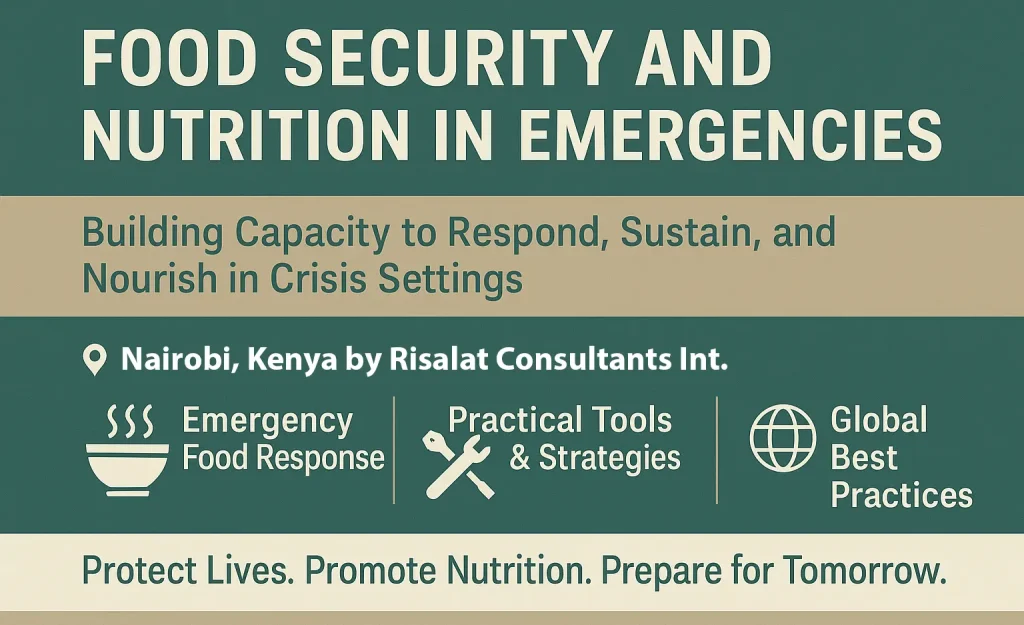
This training programme has been exclusively designed by Risalat to help you understand the peculiarities of food security and nutrition in emergency contexts enhancing your skills in strategic planning, activity implementation, early response, and recovery.
Target Audience
The programme content would be highly beneficial for professionals and practitioners across all disciplines of humanitarian assistance. These may include but not be limited to:
- Relief workers
- Frontline responders
- Emergency project and programme managers
- Health personnel
- Food security professionals
- Members of relevant governmental bodies
- Emergency nutritionists
Programme Objectives
Upon the successful completion of this training programme, it is expected that the delegates will be able to:
- Comprehend the concepts of food security, assistance, and nutrition in emergency contexts.
- Employ practical tools and frameworks to perform quality food security and nutrition needs assessments in emergencies.
- Respond to common food security challenges in crises and design context-specific nutrition interventions.
- Incorporate nutrition-sensitive approaches into emergency response planning.
- Recognize the specific nutritional requirements of vulnerable groups and tailor interventions to their needs.
Programme Contents
First Day
- Core concepts of food security in emergency contexts
- The role of food insecurity and malnutrition in overall health crises
- Classification and typology of food security in emergencies
- Food security information systems
- Food security and nutrition needs assessment
Second Day
- Data collection and interpretation
- Food security indicators
- Nutritional status
- Designing emergency food security and nutrition programmes
- Food aid programmes and interventions
Third Day
- Key principles and guidance on nutrition-sensitive programming
- Food security and nutrition as a part of broader humanitarian response
- Addressing special nutritional needs during crises
- Non-food aid programmes
- Agricultural and livestock programmes
- Emergency selective feeding programmes
Fourth Day
- Supplementary feeding programmes
- Therapeutic feeding programmes
- Prevention and treatment of malnutrition
- Infant and young child feeding in emergencies
- General food distributions
Fifth Day
- Collaboration and partnership-building for greater food security outcomes
- Humanitarian standards and coordination
- MEAL in food security and nutrition programming
- Emergency preparedness, relief, recovery, and development
Programme Methodology
This training programme has been designed alongside best practices in contemporary adult learning. It capitalizes on a variety of structured learning tools from open presentations and group discussions all the way to case studies, analytical assignments, workshops, and demonstrations.
£3,200 per participant · invoice and bank transfer · groups of 5 or more receive a discount
Five or more from one organisation: ask for the group rate on the invoice request.
Ten or more: an in-house version for your institution may cost less per person. Ask for an in-house quote.
Registration closes in 77 days (3 Jan 2027)
Host Country Profile
Kenya’s food security and nutrition programmes in emergencies are geared toward addressing the needs of populations affected by drought, floods, and other crises, especially in arid and semi-arid regions. The country’s approach combines government-led initiatives with strong collaboration with international agencies, NGOs, and community organizations.
The Hunger Safety Net Programme (HSNP) is one of Kenya’s flagship social protection programmes. It provides cash transfers to vulnerable households in times of crisis, primarily during droughts. It is headed by the National Drought Management Authority and forms an integral part of the larger National Safety Net Programme. The goal of HSNP is to construct resilience and a safety net for household food insecurity.