Points clés
- Dates
- 14–18 juin 2027 (5 jours)
- Lieu
- Riyadh, Saudi Arabia
- Frais par participant
- 4 100 £ (GBP)
- Paiement
- Sur facture et par virement bancaire
- Clôture des inscriptions
- 5 May 2027
- Format
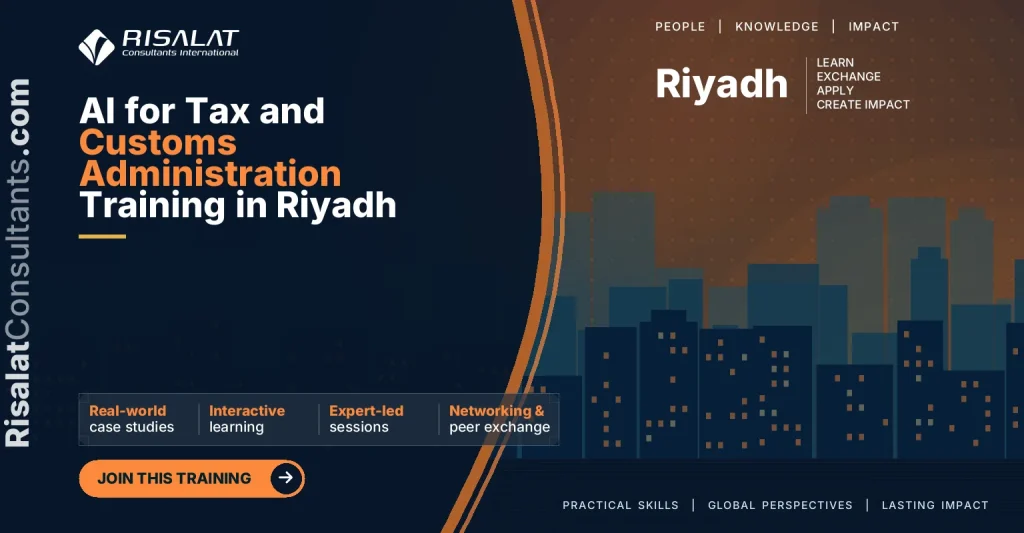
- 5-day short course: a practical capacity-building programme for government, NGO and project teams in Riyadh
- Certificat
- Certificat de participation
- Option intra
- Organisez-le pour votre équipe, à vos dates
Sur cette page 15 sections
Présentation du programme
Tax and customs administrations face growing transaction volumes, sophisticated non-compliance, and expanding public expectations for modern digital services. This five-day course in Riyadh equips revenue authorities with practical insights into artificial intelligence applications. Participants examine how machine learning, automated risk scoring, and modern predictive analytics can be deployed effectively to strengthen border clearance, improve domestic revenue mobilisation, and streamline taxpayer interactions while preserving operational integrity across all departmental functions.
Free self-check: the digital readiness assessment gives how ready your institution is for digital services, data and AI, in about 10 minutes.
The programme provides comprehensive coverage of key operational domains, ranging from cargo valuation and post-clearance audits to VAT fraud identification and automated front-line support. Delegates explore the technical prerequisites for effective deployment, focusing heavily on secure data sharing, inter-agency information exchange, and legacy system integration. Crucially, the curriculum addresses vital governance safeguards, ensuring that algorithmic decisions respect administrative justice, maintain clear audit trails, and uphold procedural fairness for all affected taxpayers and traders.
Designed for immediate workplace application, the training guides participants through the process of formulating robust business cases and technical terms of reference for institutional projects. By reviewing international good practices and multilateral standards, attendees learn to manage procurement, mitigate algorithmic bias, and supervise vendor deliverables. The course delivers the core competencies required to modernise public revenue systems safely, efficiently, and in full alignment with international legal and ethical norms.
Revenue authorities and international development programmes funded by institutions such as the World Bank, Asian Development Bank, African Development Bank, European Union, and United Nations are accelerating public sector modernisation through digital investments. As institutions deploy predictive systems and automated processing, they must navigate strict international benchmarks including the OECD AI Principles, the UNESCO Recommendation on the Ethics of AI, and emerging regulatory measures such as the EU AI Act. Public bodies now urgently require competent officials who can deploy these analytical capabilities securely, manage technology risks, and embed automated decision-support mechanisms into routine tax and customs operations without undermining procedural fairness.
Delivered by Risalat Consultants International in Riyadh, Saudi Arabia, it combines expert-led sessions, real cases and group work, so that participants can apply what they learn in their own institution.
The Programme Strengthens Institutional Capability
- Core machine learning concepts: supervised, unsupervised, and predictive analytics in public finance
- Landscape of current revenue authority automation: cross-border logistics and domestic filings
- Assessing organisational digital maturity, data readiness, and processing infrastructure
- Mapping high-impact operational use cases across customs control and direct tax processing
- Aligning institutional automation strategies with the OECD AI Principles and public governance norms
- Algorithmic targeting for customs clearance: pre-arrival processing and cargo manifest screening
- Automated post-clearance audit selection using classification and anomaly detection models
- Detecting VAT missing trader intra-community fraud and sales suppression schemes
- Préparation et exécution du budget
- Information financière et normes comptables
- Gestion de la trésorerie
- Contrôle interne des paiements et des actifs
It is designed for tax administration directors and operational managers, customs border management and clearance specialists, risk management and intelligence targeting officers and others who want practical, current skills in public financial management and finance.
- Collecter
- Nettoyer
- Stocker
- Analyser
- Décider
The Growing Importance of AI for Tax and Customs Administration
Une gestion financière saine est la base de budgets crédibles, de paiements dans les délais et d'audits sans réserve. Les gouvernements et les bailleurs attendent une information financière exacte, une exécution budgétaire rigoureuse et une utilisation transparente des fonds.
L'évolution des normes d'information financière, des systèmes de paiement numériques et des exigences des bailleurs oblige les équipes financières à maintenir leurs compétences à jour. Une gestion financière solide libère aussi du temps et des moyens pour les services essentiels.
Les organisations ont de plus en plus besoin de professionnels capables de :
- Préparer et exécuter les budgets conformément aux plans
- Produire des rapports financiers exacts et dans les délais
- Appliquer des contrôles sur les paiements et les actifs
- Satisfaire aux exigences des bailleurs en matière de gestion financière
- Utiliser l'information financière pour éclairer les décisions
Des systèmes solides de gestion des finances publiques et de finance aident les organisations à :
- Améliorer la crédibilité et l'exécution du budget
- Produire des rapports fiables et obtenir des audits sans réserve
- Réduire les retards et les erreurs de paiement
- Gagner la confiance des bailleurs et des organes de contrôle
This AI for Tax and Customs Administration programme brings these elements together in a practical format, so that participants understand not only what good practice looks like but also how to introduce it in their own setting, with the people and resources they have.
Who Should Attend This AI for Tax and Customs Administration Training?
Ce programme s'adresse à :
- Tax administration directors and operational managers
- Customs border management and clearance specialists
- Risk management and intelligence targeting officers
- Tax audit and anti-fraud investigators
- Revenue authority IT and digital transformation teams
- Legal advisers and administrative appeals officers
- Post-clearance audit and compliance inspectors
- Policy specialists working on domestic resource mobilisation
- Project coordinators managing donor-funded revenue modernisation programmes
- Responsables financiers et comptables
- Responsables et analystes budgétaires
- Personnel de la trésorerie et de la gestion de caisse
Le programme convient aussi bien aux professionnels expérimentés qu’à ceux qui prennent de nouvelles responsabilités. Les groupes réunissant plusieurs institutions et pays sont encouragés, car les participants apprennent beaucoup de l’expérience des autres.
Cochez ce que votre équipe doit être capable de faire.
AI for Tax and Customs Administration Training Objectives
Upon successful completion of this AI for Tax and Customs Administration Training, participants will be able to:
- Evaluate artificial intelligence applications across revenue collection and customs clearance operations
- Design automated risk-profiling models for cargo targeting and tax audit selection
- Implement robust data-sharing protocols across public registries and financial institutions
- Establish administrative safeguards to protect taxpayer appeal rights and maintain procedural fairness
- Detect carousel fraud, false declarations, and aggressive tax avoidance using predictive techniques
- Formulate bankable business cases and technical specifications for institutional digital investments
- Align algorithmic revenue tools with the OECD AI Principles and international ethical standards
- Expliquer le cycle budgétaire et le rôle de chaque acteur
- Préparer et suivre des budgets liés aux plans
- Appliquer les grands principes des normes d'information financière pertinentes
Chaque objectif est mis en pratique pendant le programme à travers des exercices, des études de cas ou des travaux de groupe, afin que les participants repartent capables de le faire, et pas seulement de le décrire.
Contenu et structure du programme
- Core machine learning concepts: supervised, unsupervised, and predictive analytics in public finance
- Landscape of current revenue authority automation: cross-border logistics and domestic filings
- Assessing organisational digital maturity, data readiness, and processing infrastructure
- Mapping high-impact operational use cases across customs control and direct tax processing
- Aligning institutional automation strategies with the OECD AI Principles and public governance norms
- Algorithmic targeting for customs clearance: pre-arrival processing and cargo manifest screening
- Automated post-clearance audit selection using classification and anomaly detection models
- Detecting VAT missing trader intra-community fraud and sales suppression schemes
- Network analysis techniques for uncovering beneficial ownership and shadow business entities
- Minimising false positives to balance revenue enforcement against genuine trade facilitation
- Data governance frameworks: cleaning, standardising, and enriching legacy administrative datasets
- Facilitating cross-border data exchange using WCO Data Model standards and secure conduits
- Domestic inter-agency linkages: integrating banking registers, land registries, and public procurement records
- Privacy-enhancing technologies, data protection mandates, and role-based access security
- Validating analytical data pipelines to ensure continuous reliability in production environments
- Mitigating algorithmic bias in taxpayer risk selection and customs physical inspection queues
- Explainable AI (XAI): generating intelligible administrative grounds for assessments and penalties
- Safeguarding legal appeal rights and transparency under the UNESCO Recommendation on the Ethics of AI
- Comparative regulatory models: addressing risk tiers and compliance duties under the EU AI Act
- Developing institutional oversight protocols, audit trails, and human-in-the-loop review mechanisms
- Developing economic and operational business cases for revenue authority digitisation
- Drafting technical terms of reference for public tenders and international donor-funded procurements
- Conversational AI and natural language processing for automated front-line taxpayer assistance
- Supervising external system integrators, verifying deliverables, and managing user acceptance testing
- Formulating a multi-year institutional roadmap for sustainable analytical adoption
Contenu détaillé jour par jour
Le programme se déroule sur 5 jours. Chaque journée associe apports d'experts, travail pratique et un atelier ou une étude de cas de clôture :
- First Day: Foundations of AI in Tax and Customs Modernisation
- Second Day: Predictive Risk Profiling and Fraud Detection Systems
- Third Day: Data Architecture, Quality, and Inter-Agency Exchange
- Fourth Day: Governance, Explainability, and Procedural Fairness
- Fifth Day: Business Cases, System Procurement, and Future Modernisation
Contenu détaillé jour par jour
First Day | Foundations of AI in Tax and Customs Modernisation
- Core machine learning concepts: supervised, unsupervised, and predictive analytics in public finance
- Landscape of current revenue authority automation: cross-border logistics and domestic filings
- Assessing organisational digital maturity, data readiness, and processing infrastructure
- Mapping high-impact operational use cases across customs control and direct tax processing
- Aligning institutional automation strategies with the OECD AI Principles and public governance norms
Workshop: Foundations of AI in Tax and Customs Modernisation: Applying It to Your Institution
En petits groupes, les participants appliquent les méthodes du jour à des exemples tirés de leurs institutions et conviennent d'étapes concrètes pour la suite.
Second Day | Predictive Risk Profiling and Fraud Detection Systems
- Algorithmic targeting for customs clearance: pre-arrival processing and cargo manifest screening
- Automated post-clearance audit selection using classification and anomaly detection models
- Detecting VAT missing trader intra-community fraud and sales suppression schemes
- Network analysis techniques for uncovering beneficial ownership and shadow business entities
- Minimising false positives to balance revenue enforcement against genuine trade facilitation
Workshop: Predictive Risk Profiling and Fraud Detection Systems: Applying It to Your Institution
En petits groupes, les participants appliquent les méthodes du jour à des exemples tirés de leurs institutions et conviennent d'étapes concrètes pour la suite.
Third Day | Data Architecture, Quality, and Inter-Agency Exchange
- Data governance frameworks: cleaning, standardising, and enriching legacy administrative datasets
- Facilitating cross-border data exchange using WCO Data Model standards and secure conduits
- Domestic inter-agency linkages: integrating banking registers, land registries, and public procurement records
- Privacy-enhancing technologies, data protection mandates, and role-based access security
- Validating analytical data pipelines to ensure continuous reliability in production environments
Case Study: Data Architecture, Quality, and Inter-Agency Exchange in Practice
Les participants analysent un cas réaliste, comparent les choix effectués aux bonnes pratiques et en tirent des enseignements applicables à leur propre contexte.
Fourth Day | Governance, Explainability, and Procedural Fairness
- Mitigating algorithmic bias in taxpayer risk selection and customs physical inspection queues
- Explainable AI (XAI): generating intelligible administrative grounds for assessments and penalties
- Safeguarding legal appeal rights and transparency under the UNESCO Recommendation on the Ethics of AI
- Comparative regulatory models: addressing risk tiers and compliance duties under the EU AI Act
- Developing institutional oversight protocols, audit trails, and human-in-the-loop review mechanisms
Workshop: Governance, Explainability, and Procedural Fairness: Applying It to Your Institution
En petits groupes, les participants appliquent les méthodes du jour à des exemples tirés de leurs institutions et conviennent d'étapes concrètes pour la suite.
Fifth Day | Business Cases, System Procurement, and Future Modernisation
- Developing economic and operational business cases for revenue authority digitisation
- Drafting technical terms of reference for public tenders and international donor-funded procurements
- Conversational AI and natural language processing for automated front-line taxpayer assistance
- Supervising external system integrators, verifying deliverables, and managing user acceptance testing
- Formulating a multi-year institutional roadmap for sustainable analytical adoption
Capstone Exercise: AI for Tax and Customs Administration Action Plan for Your Institution
Les participants synthétisent la semaine dans un plan d'action pour leur institution, avec des priorités, des responsables et des premières étapes, puis le présentent à leurs pairs et aux animateurs pour recueillir leurs retours.
AI for Tax and Customs Administration Training Methodology
The training employs a participatory public-sector learning approach combining technical briefings, structured policy reviews, and applied administrative case studies. Participants examine practical operational scenarios reflecting real customs declarations and tax assessment records. Working in cross-functional peer groups, delegates draft technical requirements, review model risk assessment protocols, and evaluate simulated enforcement decisions against international ethical and legal benchmarks. Facilitated plenary discussions enable officials to benchmark their current digital operating environments against internationally recognised revenue administration practices.
Le programme associe :
- Sessions animées par des experts sur les pratiques actuelles
- Études de cas régionales et internationales
- Travaux de groupe et exercices pratiques
- Simulations et jeux de rôle le cas échéant
- Discussion des défis rencontrés par les participants dans l'exercice de leurs fonctions
- Apprentissage entre pairs, d'institutions et de pays différents
- Des outils et modèles pratiques à réutiliser au travail
- Réflexion quotidienne et plan d'action
Avant le programme, une courte pré-évaluation aide les animateurs à comprendre le rôle et les priorités de chaque participant, afin d’adapter les exemples et les exercices au groupe. Chaque journée se termine par une brève réflexion au cours de laquelle les participants notent ce qu’ils appliqueront dans leur travail.
Résultats attendus
Upon completion of this AI for Tax and Customs Administration Training, participants will be able to:
- Produce actionable institutional requirements for automated revenue management solutions
- Assess predictive targeting systems to decrease physical inspection rates while raising detection yields
- Institute rigorous data validation and governance standards across departmental record repositories
- Maintain legal defensibility and full audit transparency for automated compliance decisions
- Identify high-risk non-compliance trends using advanced network and transaction analysis methods
- Manage public procurement cycles for modernisation projects funded by domestic or international resources
- Préparer et suivre des budgets liés aux plans
- Produire des rapports financiers exacts
Les participants repartent avec un plan d'action personnel et des outils pratiques utilisables dans leur institution dès la première semaine de retour. Les institutions qui envoient plusieurs participants peuvent s'appuyer sur le programme pour convenir de méthodes et de modèles communs entre équipes, ce qui facilite la pérennité des améliorations.
4 100 £ par participant · facture et virement bancaire · remise pour les groupes de 5 personnes ou plus
Cinq personnes ou plus d'une même organisation : demandez le tarif de groupe lors de votre demande de facture.
Ten or more: an in-house version for your institution may cost less per person. Ask for an in-house quote.
Registration closes in 164 days (5 May 2027)
Institutional Application of AI for Tax and Customs Administration Training
Ce programme aide les organisations à renforcer :
- Préparation et exécution du budget
- Information financière
- Contrôles des paiements et de la trésorerie
- Gestion financière des fonds des bailleurs
- Préparation à l'audit
Les participants repartent avec des outils pratiques pour améliorer :
- Suivi budgétaire
- Rapports financiers intermédiaires
- Rapprochements
- Gestion des actifs
- Suivi des recommandations d'audit
Le programme est conçu pour que l'apprentissage passe de la salle de formation à l'institution. Les participants travaillent, dans la mesure du possible, sur leurs propres processus et documents, et repartent avec un plan d'action que leurs responsables peuvent examiner et soutenir.
Pertinence régionale & mise en application
Europe
Les institutions européennes pratiquent la gestion des finances publiques et la finance dans le cadre de réglementations détaillées et de programmes de réforme. Les participants venus d'Europe peuvent comparer leurs pratiques avec celles de collègues d'autres régions et vérifier comment des méthodes éprouvées fonctionnent dans d'autres conditions.
Afrique
En Afrique, les ministères, agences et équipes de projet œuvrant dans la gestion des finances publiques et la finance travaillent de plus en plus aux côtés de programmes financés par les bailleurs qui exigent des systèmes clairs et des données probantes. Le programme aide les participants à adapter les bonnes pratiques aux institutions et aux ressources avec lesquelles ils travaillent.
Moyen-Orient
Au Moyen-Orient, les stratégies nationales de développement et les plans de diversification sollicitent de plus en plus la gestion des finances publiques et la finance. Les participants examinent comment bâtir, au sein des organismes publics et des entreprises, les capacités dont ces plans ont besoin.
Asie
Les institutions asiatiques conjuguent croissance rapide et programmes de modernisation ambitieux. Les participants venus d'Asie peuvent partager leur expérience du déploiement rapide de systèmes à grande échelle et découvrir les approches adoptées ailleurs.
Pacifique
Les petits États insulaires et du Pacifique font face à des contraintes particulières de taille, de distance et de capacités. Le programme met en avant des approches pratiques et proportionnées de la gestion des finances publiques et de la finance, adaptées aux institutions de petite taille.
Holding the programme in Riyadh, Saudi Arabia brings participants together away from their daily pressures, so they can compare how public financial management and finance is handled in different settings. The same programme can also be delivered in-house for one institution, in its own country or online, with cases taken from its current work.
Host Country Profile – Saudi Arabia
Risalat Consultants International runs open-enrolment training programmes in Riyadh, Saudi Arabia for officials, project teams and professionals from across the region. Dates, fees and what each programme covers are listed above, and any programme can also be delivered in-house for your institution.
Se former hors de son pays permet aux participants de se concentrer, de porter un regard neuf sur leur propre institution et de constituer un réseau avec des collègues d'autres pays.
AI for Tax and Customs Administration Training Deliverables
Les participants sont accompagnés avant, pendant et après le programme, afin que la préparation, l'apprentissage et le suivi forment une expérience continue.
Avant le programme
- Pré-évaluation des participants
- AI for Tax and Customs Administration Readiness Assessment
- AI for Tax and Customs Administration Resource Pack
- Lectures préparatoires
- Aide et conseils gratuits pour le visa
Pendant le programme
- Accueil à l'aéroport & assistance à l'arrivée
- Hébergement avec petit-déjeuner : 6 nuits, arrivée le dimanche 13 juin 2027, départ le samedi 19 juin 2027 (une nuit avant et une nuit après le programme)
- Dîner de bienvenue et de réseautage
- Kit de formation Risalat (sac, gourde, mug, t-shirt, casquette, protège-passeport, stylos, carnet, magnet & porte-clés)
- Comprehensive AI for Tax and Customs Administration Training Manual
- Modèle de suivi budgétaire
- Modèle de rapport financier intermédiaire
- Liste de contrôle des rapprochements
- Liste de contrôle de préparation à l'audit
- Ateliers pratiques & simulations
- Discussions de groupe & apprentissage entre pairs
- Déjeuner et pauses-café quotidiens
- Accès complet aux installations du lieu de formation
- Mini tablette avec supports pédagogiques numériques
- Visite de terrain (le cas échéant)
- Visite récréative de la ville
Après le programme
- Certificat de participation
- Distinction Risalat de participation au programme
- Documents de référence après la formation
- Autoévaluation de la gestion financière
- Liste de contrôle des paiements
- Accompagnement après la formation & conseils de suivi
- Rapport du programme
Institutions can also request a tailored in-house version of this programme, delivered at their premises or online. Request a proposal.
Common Challenges in AI for Tax and Customs Administration, And How This Training Helps
Comment les institutions peuvent-elles préparer et exécuter les budgets conformément aux plans ?
The programme addresses this directly on the first day (Foundations of AI in Tax and Customs Modernisation), where participants practise the methods involved and adapt them to their own institution, then build it into their action plan.
Comment les institutions peuvent-elles produire des rapports financiers exacts et dans les délais ?
The programme addresses this directly on the second day (Predictive Risk Profiling and Fraud Detection Systems), where participants practise the methods involved and adapt them to their own institution, then build it into their action plan.
Comment les institutions peuvent-elles appliquer des contrôles sur les paiements et les actifs ?
The programme addresses this directly on the third day (Data Architecture, Quality, and Inter-Agency Exchange), where participants practise the methods involved and adapt them to their own institution, then build it into their action plan.
Comment les institutions peuvent-elles satisfaire aux exigences des bailleurs en matière de gestion financière ?
The programme addresses this directly on the fourth day (Governance, Explainability, and Procedural Fairness), where participants practise the methods involved and adapt them to their own institution, then build it into their action plan.
Comment les institutions peuvent-elles utiliser l'information financière pour éclairer les décisions ?
The programme addresses this directly on the fifth day (Business Cases, System Procurement, and Future Modernisation), where participants practise the methods involved and adapt them to their own institution, then build it into their action plan.
Questions fréquentes
When and where does the AI for Tax and Customs Administration programme take place?
It runs from 14 Jun 2027 to 18 Jun 2027, in Riyadh, Saudi Arabia. The registration deadline is shown at the top of this page.
Qui devrait participer ?
The programme is designed for tax administration directors and operational managers, customs border management and clearance specialists, risk management and intelligence targeting officers, tax audit and anti-fraud investigators, and others who want practical skills in public financial management and finance.
Recevrai-je un certificat ?
Oui. Les participants qui terminent le programme reçoivent un certificat de participation délivré par Risalat Consultants International.
Ce programme peut-il être dispensé pour notre seule institution ?
Oui. Nous pouvons proposer une version intra sur mesure dans vos locaux, dans une autre ville ou en ligne, construite autour de vos propres cas. Utilisez la demande de proposition sur cette page.
Faut-il une expérience préalable en gestion des finances publiques et en finance ?
Aucune formation spécialisée n'est requise au-delà d'une expérience dans une fonction similaire. Une courte pré-évaluation aide les animateurs à adapter les sessions au groupe.
Who Will Deliver This Programme
Each date is delivered by a team assigned from Risalat's expert network for this subject. For this programme we assign:
How we choose them: Experience in the region of the participants or comparable settings; Command of the financier rules that apply (World Bank, ADB, AfDB, EU, UN) where relevant; Delivery in English; other languages on request for in-house groups; No conflict of interest with participants' institutions.
Training courses in RiyadhAccounting & Finance training courses
Why Riyadh for this programme
Riyadh is the political and administrative centre of Saudi Arabia, hosting major government ministries and national entities. Visiting delegations can observe large-scale public administration reforms and urban planning initiatives such as the King Abdullah Financial District. King Khalid International Airport provides direct flight connections across the region and internationally.
The AI for Tax and Customs Administration Training in Riyadh programme in June 2027 brings together officials and professionals from across the Middle East region and beyond. Sessions combine short inputs, case studies and group work on participants' own files, and the city's institutions can be added as a study visit on request.
Getting there: King Khalid International Airport (RUH).
Vérifiez si vous avez besoin d'un visa avec le vérificateur de visa gratuit, et demandez une lettre d'invitation une fois inscrit.
Le même thème dans d'autres villes
- Digital Government and Citizen e-Services Training for North African Officials in St Julian’s (St Julian's)
- Tax Compliance Risk Management and Risk-Based Audit Strategy in Vienna (Vienna)
- Digital Tax Audit, Electronic Invoicing and Revenue Analytics in Istanbul (Istanbul)
- Formation à la préparation, à l'analyse et à la gestion de la paie à Budapest (Budapest)
- Formation et immersion sur la tarification du carbone et l'élaboration des politiques à Helsinki (Helsinki)
Voir aussi : Gouvernance de l'IA pour les institutions publiques · outil gratuit de préparation à la gouvernance de l'IA · tous les programmes
- Open Contracting Partnership Open Contracting Partnership
- The Institute of Internal Auditors IIA
Pour les équipes et les institutions
Bring your team
Teams that learn together apply more at work. Tell us how many people and how you would like to take part: we reply with a group quote within two working days.
Watch: this programme in short



Autres dates et villes pour ce sujet : Cours de formation en gestion des finances publiques (64 dates à venir).
More training courses in Saudi Arabia · Tous les programmes au Moyen-Orient · Calendrier complet des formations
Plan this programme in a roadmap: why it matters, why to approve it, the dates to plan and the career it builds.