Points clés
- Dates
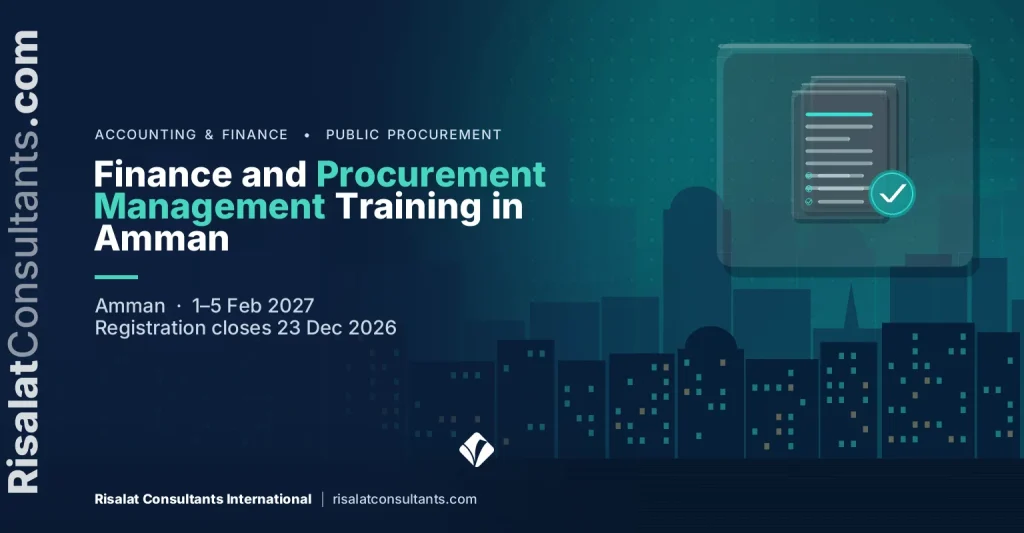
- 1–5 févr. 2027 (5 jours)
- Lieu
- Corp Amman Hotel, Amman, Jordan
- Frais par participant
- 2 850 £ (GBP)
- Paiement
- Sur facture et par virement bancaire
- Clôture des inscriptions
- 23 déc. 2026
- Certificat
- Certificat de participation
- Option intra
- Organisez-le pour votre équipe, à vos dates
Présentation du programme
Finance and procurement are two halves of the same decision. A budget line means little until goods, works or services are bought, delivered and paid for, and a procurement plan fails when cash, commitments and approvals are not lined up behind it. This programme brings finance and procurement staff into one room so they can plan, spend and report as a single system.
Jordan offers a clear working example. Public purchasing is governed by the Government Procurement Bylaw No. 8 of 2022 and its amendments, and the Jordan Online E-Procurement System (JONEPS) is now the central platform. A Council of Ministers circular issued in August 2023 made JONEPS use mandatory for all ministries, departments and agencies, and by 2023 goods and works procured through it represented about 70% of government budget allocations for those categories, according to a 2024 World Bank mission report.
The same report shows how much remains to do. Only about a quarter of ministries and agencies were actively using JONEPS and 43% had been trained, while only 5% of new public investment projects between JD 1 million and JD 10 million followed the public investment management framework. Staff turnover was named as a key constraint. These are capability questions as much as system questions.
Fiscal pressure adds urgency. Jordan’s IMF Extended Fund Facility, approved in January 2024 at about US$1.2 billion, is built around fiscal consolidation, revenue mobilisation and spending efficiency, and humanitarian funding for the refugee response has fallen by more than 92% since 2016. Every dinar committed through procurement now faces closer scrutiny.
Over five days, participants work through budgeting, cash and financial analysis, the procurement cycle under national and World Bank rules, contract and supplier management, and fraud controls, using Jordanian reforms and financed projects as case material.
Le programme renforce les capacités institutionnelles en matière de
- Planification financière stratégique et opérationnelle
- Budget preparation, forecasting and variance analysis
- Cash flow management and commitment control
- Reading and analysing financial statements
- Valeur temps de l'argent et évaluation des investissements
- Linking procurement plans to the budget and cash plan
- Planification des achats et analyse de marché
- Tendering under national rules and the World Bank Procurement Regulations
- E-procurement use and procurement data analysis
- Bid evaluation and value for money decisions
- Contract documentation, negotiation and administration
- Supplier performance measurement and supplier base rationalisation
- Inventory management and stock control
- Fraud and corruption red flags in finance and procurement
- Financial risk management and internal control
- Reporting and accountability to auditors and financiers
- Building and motivating procurement and finance teams
The aim is practical: fewer delays between budget approval and delivery, better prices, and cleaner audit results.
The Growing Importance of Finance and Procurement Management
Governments and financiers are moving from checking individual transactions to managing the whole spending chain. The World Bank’s Strengthening Reform Management in Jordan project (P171965), implemented by the Ministry of Planning and International Cooperation’s Reform Secretariat, has a component of about US$4.2 million dedicated to the public investment, PPP and public procurement framework, and its financing was proposed to rise to US$23.3 million with closing extended to 2028.
Jordan’s 2022 PEFA assessment found that fiscal discipline, cash management and payroll control were generally sound, but that strategic plans were poorly linked to budget decisions and audit work remained focused on compliance rather than value. The World Bank’s Procurement Regulations for borrowers were reissued as a seventh edition in September 2025, so project teams working on financed operations also need to update their practice.
Les organisations ont de plus en plus besoin de professionnels capables de :
- Preparing budgets that reflect real procurement timelines
- Forecasting cash needs and managing commitments
- Analysing financial statements and supplier financial health
- Appraising investments with discounted cash flow methods
- Writing procurement plans and specifications based on market evidence
- Running tenders through e-procurement platforms such as JONEPS
- Applying both national bylaws and financier procurement rules
- Evaluating bids on value for money, not only lowest price
- Negotiating and managing contracts and variations
- Measuring supplier performance with clear indicators
- Spotting fraud and collusion red flags
- Reporting spending results to management, auditors and donors
Strong finance and procurement systems help organisations:
- Execute capital budgets on time
- Reduce prices and transaction costs
- Avoid arrears and late-payment penalties
- Keep inventory at the right level
- Pass audits with fewer findings
- Protect against fraud and conflicts of interest
- Build trust with suppliers and financiers
- Show value for money to citizens and boards
Private companies face the same logic: procurement savings and working capital discipline go straight to the bottom line.
Who Should Attend This Finance and Procurement Management Training?
Ce programme s'adresse à :
- Finance directors and chief accountants
- Budget and planning officers
- Personnel de la trésorerie et de la gestion de caisse
- Procurement directors, managers and officers
- Tender committee and bid evaluation committee members
- Gestionnaires et administrateurs de contrats
- Supply chain, stores and inventory managers
- Sourcing and vendor evaluation specialists
- Financial management and procurement specialists of project implementation units
- Staff of ministries, agencies and municipalities using e-procurement
- Auditeurs internes et responsables de la conformité
- NGO and UN agency finance and procurement staff
- Dirigeants d'entreprises publiques et de services publics
- Finance and purchasing managers in manufacturing and services companies
Joint attendance by a finance officer and a procurement officer from the same organisation is encouraged.
Cochez ce que votre équipe doit être capable de faire.
Finance and Procurement Management Training Objectives
Upon successful completion of this Finance and Procurement Management Training, participants will be able to:
- Read and analyse a set of financial statements and key ratios
- Prepare budgets and forecasts and explain variances
- Control cash flow and commitments within their department
- Appraise investment options using time value of money
- Prepare a procurement plan linked to the budget and cash plan
- Choose suitable procurement methods under national and World Bank rules
- Run and evaluate a tender using e-procurement records
- Negotiate and document contracts with suppliers
- Measure supplier performance and rationalise the supplier base
- Manage inventory using basic control models
- Identify fraud red flags and strengthen internal controls
- Assess training needs and build an effective procurement and finance team
Every objective is practised through exercises based on Jordanian and donor-financed cases.
Contenu et structure du programme
- Role of financial management in sustainability and accountability
- Financial statements quick overview: performance, position, cash flow
- Financial performance analysis and key ratios
- Time value of money and discounted cash flow
- Public sector versus commercial accounting perspectives
- Financial jargon decoded for non-finance managers
- Lessons from Jordan’s PEFA assessment on budget credibility
- Planification financière stratégique et opérationnelle
- Planning, budgeting and forecasting tools
- Budgétisation par programme et axée sur la performance
- Commitment control and multi-year contracts
- Cash management and cash flow forecasting
- Investment planning and public investment management
- Why projects bypass appraisal frameworks: Jordan’s JD 1–10 million gap
- Le rôle de la fonction achats dans l'organisation
- Understanding the needs of users of procurement services
- Jordan’s Government Procurement Bylaw No. 8 of 2022: principles and structure
- When financier rules apply instead of national rules
- World Bank Procurement Regulations, seventh edition (September 2025)
- Procurement planning, market analysis and specifications
- Selecting methods: open tender, request for quotations, direct award, framework agreements
- Contract documentation and key clauses
- Negotiating contracts with suppliers
- Contract administration, variations and claims
- Développer les relations avec les fournisseurs
- Reviewing supplier performance with scorecards
- Rationalising the supplier base
- Inventory management and stock control
- Reporting and accountability to management, auditors and financiers
- Procurement and spending data for performance indicators
- Se préparer à l'audit externe et répondre aux constats
- IT systems in procurement and finance: integration and data quality
- Donor reporting in a period of falling humanitarian funding
- Training needs of procurement and finance personnel
- Building a motivated and effective procurement team
Contenu détaillé jour par jour
The programme follows public money from planning to reporting, one stage per day.
- Day 1: financial analysis and decision-making
- Day 2: budgeting, forecasting and cash control
- Day 3: procurement planning and tendering
- Day 4: contracts, suppliers, inventory and fraud risk
- Day 5: reporting, accountability and team capability
Contenu détaillé jour par jour
First Day | Financial Management Foundations for Decision-Makers
- Role of financial management in sustainability and accountability
- Financial statements quick overview: performance, position, cash flow
- Financial performance analysis and key ratios
- Time value of money and discounted cash flow
- Public sector versus commercial accounting perspectives
- Financial jargon decoded for non-finance managers
- Lessons from Jordan’s PEFA assessment on budget credibility
- Software tools and financial management information systems
- Keys to financial success and common failure points
Workshop: Reading the Numbers
Teams receive the summary financial statements of an illustrative public utility and a supplier company. They calculate liquidity, efficiency and debt ratios, identify three warning signs and decide whether the supplier is financially strong enough to take on a three-year contract. Results are compared and the reasoning discussed in plenary.
Second Day | Budgeting, Forecasting and Cash Control
- Planification financière stratégique et opérationnelle
- Planning, budgeting and forecasting tools
- Budgétisation par programme et axée sur la performance
- Commitment control and multi-year contracts
- Cash management and cash flow forecasting
- Investment planning and public investment management
- Why projects bypass appraisal frameworks: Jordan’s JD 1–10 million gap
- Variance analysis and budget revision
- Financial risk management
Case Study: Public Investment and Procurement Reform in Jordan
Participants examine the World Bank-supported Strengthening Reform Management in Jordan project, which reported that half of new projects above JD 10 million followed the public investment framework while only 5% of smaller ones did. Groups propose budgeting, appraisal and procurement planning steps that would close that gap without slowing delivery.
Third Day | Procurement Planning, Methods and E-Tendering
- Le rôle de la fonction achats dans l'organisation
- Understanding the needs of users of procurement services
- Jordan’s Government Procurement Bylaw No. 8 of 2022: principles and structure
- When financier rules apply instead of national rules
- World Bank Procurement Regulations, seventh edition (September 2025)
- Procurement planning, market analysis and specifications
- Selecting methods: open tender, request for quotations, direct award, framework agreements
- Managing the tendering process on JONEPS
- Bid evaluation, standstill and complaints
Workshop: From Budget Line to Tender Notice
Each group receives an approved budget line and a user requirement. They prepare a short procurement plan, choose the method and justify it, set a realistic timetable including minimum bidding periods and standstill, and draft the key evaluation criteria. A second group reviews the file as an auditor would and lists any gaps.
Fourth Day | Contracts, Suppliers, Inventory and Fraud Risk
- Contract documentation and key clauses
- Negotiating contracts with suppliers
- Contract administration, variations and claims
- Développer les relations avec les fournisseurs
- Reviewing supplier performance with scorecards
- Rationalising the supplier base
- Inventory management and stock control
- Detecting fraud: red flags in bids, invoices and payments
- Conflict of interest and segregation of duties
Workshop: Supplier Scorecard and Red-Flag Review
Using an anonymised contract file, participants score a supplier on delivery, quality, cost and responsiveness, then review a bundle of bids and invoices for signs of collusion, split purchases or inflated quantities. They recommend actions for each finding and decide what should be escalated to internal audit.
Fifth Day | Reporting, Accountability and Team Capability
- Reporting and accountability to management, auditors and financiers
- Procurement and spending data for performance indicators
- Se préparer à l'audit externe et répondre aux constats
- IT systems in procurement and finance: integration and data quality
- Donor reporting in a period of falling humanitarian funding
- Training needs of procurement and finance personnel
- Building a motivated and effective procurement team
- Cross-functional working between finance, procurement and users
- Plan d'action personnel
Capstone Exercise: Integrated Spend Improvement Plan
Teams combine the week’s work into an improvement plan for their own organisation or a case agency: budget and procurement calendar, priority controls, supplier management actions, indicators and a training plan for staff. They present to a panel playing a finance director, head of procurement and auditor, then refine the plan into 90-day commitments.
Finance and Procurement Management Training Methodology
The programme uses adult-learning methods with a strong emphasis on practice. Concepts are introduced briefly and then applied immediately to realistic files, figures and documents.
Le programme associe :
- Short expert briefings
- Financial analysis exercises in spreadsheets
- Case studies from Jordanian reforms and donor-financed projects
- Procurement file simulations from plan to award
- Bid evaluation practice with scoring sheets
- Contract negotiation role plays
- Red-flag reviews of bids and invoices
- Discussions de groupe et apprentissage entre pairs
- Self-assessment of procurement maturity
- Daily feedback and review sessions
- A capstone presentation to a mock management panel
Before arrival, participants can complete our free procurement maturity diagnostic, so that the facilitators can focus discussion on the gaps the group actually faces.
Résultats attendus
Upon completion of this Finance and Procurement Management Training, participants will be able to:
- Interpret financial statements and use them in decisions
- Prepare a budget and cash forecast aligned with a procurement plan
- Select and justify procurement methods under applicable rules
- Run a compliant tender and evaluation process
- Manage contracts and supplier performance with clear indicators
- Control inventory levels and costs
- Recognise and respond to fraud red flags
- Report spending results credibly to auditors and financiers
- Lead a plan to strengthen their finance and procurement team
Participants leave with completed templates and a 90-day plan they can present to their management.
2 850 £ par participant · facture et virement bancaire · réduction pour les groupes de 5 personnes ou plus
Cinq personnes ou plus d'une même organisation : demandez le tarif de groupe lors de votre demande de facture.
Ten or more: an in-house version for your institution may cost less per person. Ask for an in-house quote.
Registration closes in 51 days (23 Dec 2026)
Institutional Application of Finance and Procurement Management Training
Ce programme aide les organisations à renforcer :
- Budget credibility and execution
- Cash and commitment management
- Évaluation et sélection des investissements publics
- Procurement planning and method selection
- E-procurement adoption and data use
- Bid evaluation and award decisions
- Contract management and supplier relations
- Inventory and asset control
- Internal control and fraud prevention
- Audit readiness and financial reporting
- Capability of finance and procurement staff
Les participants repartent avec des outils pratiques pour améliorer :
- Financial ratio analysis sheet
- Budget and cash flow forecast template
- Integrated procurement and payment calendar
- Procurement method selection guide
- Bid evaluation scoring template
- Contract management plan
- Supplier performance scorecard
- Fraud red-flag checklist
For a broader review of controls, organisations can use our governance audit diagnostic before or after the programme.
Pertinence régionale & mise en application
Moyen-Orient
Jordan’s move to mandatory e-procurement, its public investment management reforms under World Bank support and its IMF programme reflect a wider regional push for spending efficiency. Hosting the refugee response, with about 420,000 registered refugees in early 2026 according to UNHCR and sharply lower humanitarian funding, adds pressure on government and NGO finance and procurement teams to do more with less.
Afrique
Many African ministries and project units work under both national procurement laws and financier rules, with e-procurement rollouts and audit findings on contract management. The dual-rules approach practised in this programme matches their daily reality.
Asie
Governments in South and Central Asia are expanding e-procurement and investment appraisal, and project units on financed operations must apply the September 2025 World Bank Procurement Regulations alongside national rules.
Europe
EU-funded cooperation programmes with Jordanian partners show how financier rules interact with national law: Jordan’s bylaw allows donor rules to be applied, but some national provisions, for example on complaints and courts, still apply. Teams in Europe’s neighbourhood face similar choices.
Participants from any region can apply the same integrated approach to planning, buying and reporting.
Source: World Bank, Strengthening Reform Management in Jordan (P171965), Aide Memoire, August 2024
1. Which instrument currently governs government procurement in Jordan?
Jordan's public procurement is governed by Bylaw No. 8 of 2022 and its amendments (TESIM factsheet, 2025).
2. What share of new public investment projects between JD 1 million and JD 10 million followed Jordan's PIM framework?
The World Bank's 2024 mission report found 50% compliance above JD 10 million but only 5% for JD 1–10 million projects.
3. Which edition of the World Bank Procurement Regulations for borrowers was issued in September 2025?
The World Bank published the Procurement Regulations 7th Edition in September 2025.
Profil du pays d'accueil – Jordanie
Amman, Jordan’s capital, is home to the government ministries, many regional offices of international organisations and a large community of NGOs working on the refugee response. It is a compact, well-connected city with a long history as a regional meeting place, and it offers modern training and hotel facilities.
For finance and procurement professionals, Jordan is a useful benchmark. It has a recent procurement bylaw, a central e-procurement platform, a PEFA assessment that documents both strengths and gaps, a World Bank-supported reform management project with a procurement and public investment component, and an IMF programme focused on fiscal discipline. Jordan’s economy grew by 2.8% in 2025, with the IMF approving its fifth programme review in 2026.
Queen Alia International Airport has direct flights from the Gulf, Europe, North Africa and parts of Asia. Many nationalities can obtain a visa on arrival or an electronic visa, while others need to apply in advance; participants should check current rules on official Jordanian government channels. Our team supports every registered participant with visa letters and guidance.
Finance and Procurement Management Training Deliverables
Each participant receives a complete package from preparation to follow-up.
Avant le programme
- Pré-évaluation des participants
- Finance and Procurement Readiness Assessment
- Finance and Procurement Resource Pack
- Lectures préparatoires
- Aide et conseils gratuits pour le visa
- Accueil à l'aéroport & assistance à l'arrivée
- Hébergement avec petit-déjeuner
- Dîner de bienvenue et de réseautage
Pendant le programme
- Kit de formation Risalat (sac, gourde, mug, t-shirt, casquette, protège-passeport, stylos, carnet, magnet & porte-clés)
- Comprehensive Finance and Procurement Training Manual
- Financial Ratio Analysis Workbook
- Budget and Cash Flow Forecast Template
- Procurement Plan and Method Selection Guide
- Bid Evaluation Scoring Template
- Modèle de plan de gestion des contrats
- Supplier Performance Scorecard
- Fraud Red-Flag Checklist
- Ateliers pratiques & simulations
- Discussions de groupe & apprentissage entre pairs
- Déjeuner et pauses-café quotidiens
- Accès complet aux installations du lieu de formation
- Mini tablette avec supports pédagogiques numériques
- Visite de terrain (le cas échéant)
- Visite récréative de la ville
Après le programme
- Certificat de participation
- Distinction Risalat de participation au programme
- Documents de référence après la formation
- Integrated Spend Improvement Plan
- Procurement Regulations Update Note (September 2025 edition)
- Team Training Needs Template
- Accompagnement après la formation & conseils de suivi
- Rapport du programme
Ministries, agencies, project units, NGOs and companies can request a tailored in-house proposal for an in-house version of this programme, built around their own budget, procurement rules and supplier base.
Common Challenges in Finance and Procurement Management, And How This Training Helps
How can budgets reflect real procurement timelines?
Budgets are often approved before anyone checks how long tendering and delivery will take, so funds lapse or arrears build up. The Second and Third Days link the budget, cash plan and procurement calendar in one integrated template.
How can smaller investment projects get proper appraisal?
In Jordan only 5% of new projects between JD 1 million and JD 10 million followed the public investment framework. The Second Day case study shows proportionate appraisal steps that work for mid-sized projects.
How can organisations make full use of e-procurement?
A mandate does not guarantee adoption: many entities still had limited active use of JONEPS. Third Day sessions cover tendering on the platform and using its records for monitoring and audit.
How can teams apply national and financier rules at the same time?
Project units often switch between the national bylaw and donor rules. The Third Day compares the two and introduces the September 2025 World Bank Procurement Regulations.
How can organisations measure supplier performance fairly?
Without data, supplier reviews become disputes. The Fourth Day introduces a supplier scorecard with agreed indicators and evidence.
How can finance and procurement staff detect fraud early?
Red flags in bids, invoices and payments are often visible but missed. Fourth Day exercises train participants to spot them and decide what to escalate.
How can organisations keep capability when staff move on?
Turnover was named as a key constraint in Jordan’s reform reporting. The Fifth Day covers training needs analysis, documentation and team building so knowledge stays in the institution.
Questions fréquentes
Who should attend this Finance and Procurement Management programme?
Finance, budget and treasury staff, procurement and contract managers, tender committee members, project unit specialists, internal auditors and company finance or purchasing managers.
Does the programme cover Jordan's procurement rules?
Yes. It explains the Government Procurement Bylaw No. 8 of 2022 and JONEPS e-procurement, and compares them with the World Bank Procurement Regulations (September 2025 edition).
Is it suitable for private sector participants?
Yes. Financial analysis, budgeting, supplier management, inventory and fraud controls apply equally to companies; public sector rules are used as examples.
Les participants doivent-ils avoir une formation en comptabilité ?
No. The First Day explains financial statements and terminology for non-specialists, while finance professionals deepen their procurement knowledge.
Can we run this programme for our own team?
Yes. Organisations can request an in-house version adapted to their budget process, procurement rules and supplier base, in Amman or another location.
Tous les programmes à AmmanPlus de programmes Comptabilité & Finance
Pourquoi Amman pour ce programme
Amman est une base sereine pour les délégations du Moyen-Orient et les thématiques humanitaires.
The Finance and Procurement Management Training in Amman programme in February 2027 brings together officials and professionals from across the Middle East region and beyond. Sessions combine short inputs, case studies and group work on participants' own files, and the city's institutions can be added as a study visit on request.
Accès : Queen Alia (AMM).
Vérifiez si vous avez besoin d'un visa avec le vérificateur de visa gratuit, et demandez une lettre d'invitation une fois inscrit.
Le même thème dans d'autres villes
- Formation à la gestion des contrats de travaux financés par les bailleurs à Dubaï (Dubaï)
- Formation au financement de l'entretien routier & à la supervision des contrats à Nairobi (Nairobi)
- Formation à la protection des recettes & à la réduction des pertes des services publics à Dubaï (Dubaï)
- Réhabilitation d'infrastructures publiques résilientes & gestion de la qualité des travaux de génie civil (Nadi)
- Formation à la protection sociale numérique : protection sociale assistée par l'IA & gestion intégrée des dossiers (Lisbonne)
- Atteinte des résultats & suivi-évaluation (S&E) intégré pour les projets de développement (Suva)
Autres programmes à Amman
- Formation à la gestion de projet pour les secteurs du développement et de l'humanitaire
- Formation aux négociations humanitaires et au plaidoyer pour la protection
Voir aussi : Passation des marchés et gestion des contrats · diagnostic gratuit de maturité de la passation des marchés · tous les programmes
Plus de formations en Jordanie · Tous les programmes au Moyen-Orient · Calendrier complet des formations