Points clés
- Dates
- 1–5 févr. 2027 (5 jours)
- Lieu
- Novotel Singapore On Stevens, Singapour
- Frais par participant
- 3 380 £ (GBP)
- Paiement
- Sur facture et par virement bancaire
- Clôture des inscriptions
- 23 déc. 2026
- Format
- 5-day short course: a practical capacity-building programme for government, NGO and project teams in Singapore
- À qui s'adresse-t-il
- Operational risk identification; Risk assessment techniques; Key Risk Indicators
- Certificat
- Certificat de participation
- Option intra
- Organisez-le pour votre équipe, à vos dates
Sur cette page 12 sections
Présentation du programme
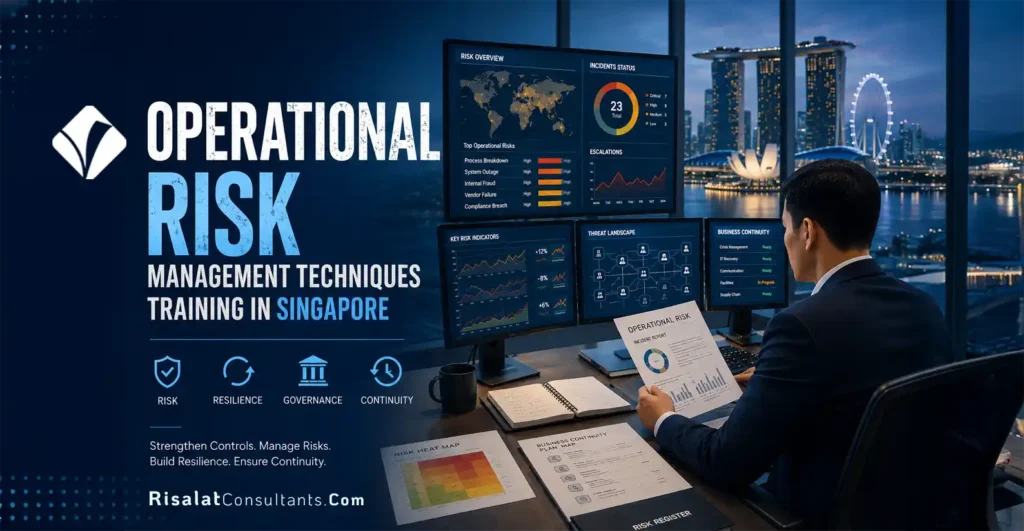
Operational Risk Management Techniques Training in Singapore equips professionals with practical tools to identify, assess, monitor, control, and report operational risks across modern organizations.
Free self-check: the governance self-audit gives a quick check of governance, controls and accountability, in about 10 minutes.
As institutions face increasing pressure from regulatory requirements, digital transformation, fraud exposure, third-party dependencies, process failures, cyber threats, business continuity risks, and governance weaknesses, operational risk management has become essential for organizational resilience and sustainable performance.
This programme helps participants understand how operational risks arise from people, processes, systems, external events, and institutional decision-making gaps. It also strengthens their ability to develop practical controls, improve risk reporting, support compliance, and embed risk awareness across departments.
Participants will gain applied knowledge in:
- Operational risk identification
- Risk assessment techniques
- Key Risk Indicators
- Conception et test des contrôles
- Rapport d'incidents et analyse des données de pertes
- Contrôles des risques liés à la fraude et aux processus
- Business continuity and resilience planning
- Third-party and outsourcing risks
- Culture du risque et gouvernance
- Operational risk reporting and escalation
The training combines international risk management principles with practical tools that can be applied across banking, insurance, government institutions, development organizations, utilities, regulators, and corporate environments.
The Growing Importance of Operational Risk Management Training
Operational risk is no longer limited to back-office failures or internal process weaknesses. Today, organizations face interconnected risks caused by technology disruption, outsourcing, regulatory expectations, human error, fraud, cyber incidents, supply chain exposure, and weak internal controls.
Strong operational risk management helps institutions:
- Reduce financial and reputational losses
- Improve internal control systems
- Strengthen regulatory compliance
- Detect process weaknesses earlier
- Improve business continuity readiness
- Reduce fraud and misconduct exposure
- Enhance decision-making and accountability
- Build stronger institutional resilience
Operational risk management is especially important in sectors where service continuity, public trust, compliance, and accountability are critical.
Public cible
This Operational Risk Management Techniques Training in Singapore is designed for professionals involved in risk, governance, compliance, operations, audit, finance, and institutional management, including:
- Operational risk managers and officers
- Professionnels de la gestion des risques
- Internal auditors and control officers
- Compliance officers
- Professionnels de la banque et de l'assurance
- Personnel des régulateurs et des autorités de supervision
- Finance and operations managers
- Business continuity professionals
- Fraud risk and investigation officers
- Public-sector governance officials
- Gestionnaires de projets et de programmes
- Corporate governance professionals
- Quality assurance and process improvement teams
- Professionals responsible for internal controls and risk reporting
Cochez ce que votre équipe doit être capable de faire.
Programme Objectives of Operational Risk Management Training
Upon completion this Operational Risk Management Training, participants will be able to:
- Understand operational risk concepts and risk categories
- Identify risks arising from people, processes, systems, and external events
- Apply practical operational risk assessment techniques
- Develop effective Key Risk Indicators
- Strengthen internal controls and process risk management
- Improve incident reporting and loss event analysis
- Support fraud prevention and misconduct risk controls
- Strengthen business continuity and resilience planning
- Improve third-party and outsourcing risk oversight
- Develop operational risk reports for management decision-making
- Promote risk awareness and accountability across the organization
Structure & contenu du programme
- Introduction à la gestion du risque opérationnel
- Sources and categories of operational risk
- People, process, system, and external event risks
- Operational risk in financial, public-sector, and corporate environments
- Risk governance roles and responsibilities
- Relationship between operational risk, compliance, audit, and internal control
- Building a risk-aware organizational culture
- Risk identification tools and techniques
- Process mapping and risk discovery
- Approches d'auto-évaluation des risques et des contrôles
- Inherent risk and residual risk assessment
- Control design principles
- Preventive, detective, and corrective controls
- Control weaknesses and root cause analysis
- Developing effective Key Risk Indicators
- Selecting measurable and meaningful risk indicators
- Risk thresholds, escalation triggers, and reporting dashboards
- Incident reporting systems and loss event classification
- Root cause analysis of operational incidents
- Using risk data to improve management decisions
- Linking operational risk reporting with performance monitoring
- Business continuity risk and operational resilience
- Critical process identification and impact analysis
- Crisis response and continuity planning
- Gestion des risques liés aux tiers, aux fournisseurs et à la sous-traitance
- Technology dependency and cyber-related operational risks
- Fraud, misconduct, and process integrity risks
- Strengthening resilience through testing and scenario planning
- Operational risk reporting for senior management
- Designing risk dashboards and escalation processes
- Appétit pour le risque opérationnel et niveaux de tolérance
- Strengthening accountability and ownership
- Integrating operational risk into governance frameworks
- Plan d'action pour les organisations des participants
Contenu détaillé jour par jour
First Day | Foundations of Operational Risk Management
- Introduction à la gestion du risque opérationnel
- Sources and categories of operational risk
- People, process, system, and external event risks
- Operational risk in financial, public-sector, and corporate environments
- Risk governance roles and responsibilities
- Relationship between operational risk, compliance, audit, and internal control
- Building a risk-aware organizational culture
Exercise: Operational risk identification across business functions
Second Day | Risk Identification, Assessment and Control Design
- Risk identification tools and techniques
- Process mapping and risk discovery
- Approches d'auto-évaluation des risques et des contrôles
- Inherent risk and residual risk assessment
- Control design principles
- Preventive, detective, and corrective controls
- Control weaknesses and root cause analysis
Workshop: Operational risk and control assessment exercise
Internal audit practices increasingly support organizations in identifying control weaknesses, improving accountability, and strengthening operational governance frameworks.
Third Day | Key Risk Indicators, Incident Reporting and Loss Data
- Developing effective Key Risk Indicators
- Selecting measurable and meaningful risk indicators
- Risk thresholds, escalation triggers, and reporting dashboards
- Incident reporting systems and loss event classification
- Root cause analysis of operational incidents
- Using risk data to improve management decisions
- Linking operational risk reporting with performance monitoring
Case Study: Operational incident analysis and corrective action planning
Fourth Day | Business Continuity, Third-Party Risk and Resilience
- Business continuity risk and operational resilience
- Critical process identification and impact analysis
- Crisis response and continuity planning
- Gestion des risques liés aux tiers, aux fournisseurs et à la sous-traitance
- Technology dependency and cyber-related operational risks
- Fraud, misconduct, and process integrity risks
- Strengthening resilience through testing and scenario planning
Workshop: Business continuity and operational resilience scenario exercise
Modern institutions increasingly integrate crisis management, operational resilience, and business continuity planning to strengthen preparedness against operational disruptions and unexpected incidents.
Fifth Day | Risk Reporting, Governance and Practical Application
- Operational risk reporting for senior management
- Designing risk dashboards and escalation processes
- Appétit pour le risque opérationnel et niveaux de tolérance
- Strengthening accountability and ownership
- Integrating operational risk into governance frameworks
- Plan d'action pour les organisations des participants
Capstone Exercise: Operational risk management improvement plan
Effective operational risk management supports stronger governance, improved controls, better resilience, and more reliable institutional performance.
Méthodologie du programme
This Operational Risk Management Techniques Training in Singapore uses an applied and practice-oriented learning approach combining expert-led sessions, case studies, group exercises, simulations, risk assessment workshops, and practical templates.
Participants will work through real-world operational risk scenarios and develop tools that can be adapted to their own organizations.
Principales méthodes pédagogiques :
- Sessions techniques interactives
- Operational risk case studies
- Risk and control assessment exercises
- Incident analysis simulations
- KRI development workshops
- Scénarios de continuité des activités
- Activités de résolution de problèmes en groupe
- Practical templates and reporting tools
Organizations increasingly integrate crisis management and operational resilience strategies to strengthen preparedness against disruptions, operational failures, and institutional emergencies.
- Opération
- Enregistrement
- Contrôle
- Données probantes
- Opinion
Expected Outcomes of Operational Risk Management Training
Participants will strengthen their ability to identify, assess, monitor, and manage operational risks across institutional environments.
Les participants seront en mesure de :
- Improve operational risk identification and assessment
- Strengthen internal controls and process governance
- Develop practical Key Risk Indicators
- Improve incident reporting and risk escalation
- Support fraud and misconduct prevention
- Strengthen business continuity and operational resilience
- Improve third-party and outsourcing risk oversight
- Develop stronger risk reports for management decision-making
- Promote a stronger risk culture across departments
3 380 £ par participant · facture et virement bancaire · remise pour les groupes de 5 personnes ou plus
Cinq personnes ou plus d'une même organisation : demandez le tarif de groupe lors de votre demande de facture.
Ten or more: an in-house version for your institution may cost less per person. Ask for an in-house quote.
Registration closes in 31 days (23 Dec 2026)
Application institutionnelle
This programme supports banks, insurance companies, regulators, public institutions, state-owned enterprises, development organizations, and private companies in strengthening operational resilience, governance, compliance, and internal control systems.
Les participants repartent avec des outils pratiques pour améliorer :
- Risk assessment processes
- Internal control systems
- Operational risk reporting
- Incident management
- Business continuity planning
- Compliance oversight
- Process improvement
- Gouvernance et redevabilité
Strong operational risk management helps organizations reduce preventable losses, improve service continuity, strengthen stakeholder confidence, and support long-term institutional performance.
Operational resilience increasingly depends on stronger cybersecurity governance, data protection practices, and institutional safeguards designed to reduce digital and operational vulnerabilities across modern organizations.
Regional Relevance & Application of Operational Risk Management Training
Organizations across Asia, Africa, the Middle East, and emerging economies are increasingly strengthening operational risk management due to rising regulatory expectations, digital transformation, fraud risks, third-party dependencies, cyber-related disruptions, and the need for stronger governance systems.
Cette formation exécutive sur la gestion des risques opérationnels est particulièrement pertinente pour les professionnels travaillant dans :
- Southeast Asia, where financial institutions, regulators, public agencies, and corporations continue strengthening risk governance, operational resilience, and digital transformation controls
- South Asia, where banks, public institutions, utilities, and development organizations face increasing pressure to improve internal controls, process reliability, and compliance systems
- Africa, where expanding financial services, public-sector reform, donor-funded programmes, and infrastructure institutions require stronger operational risk oversight and accountability frameworks
- Middle East, where rapid economic diversification, financial sector growth, digital services, and large-scale institutional transformation increase the need for advanced operational risk management
- Central Asia, where banking, energy, transport, public administration, and state-owned institutions continue developing stronger governance, compliance, and operational control systems
Across these regions, operational risk management is essential for improving institutional resilience, reducing losses, strengthening service delivery, and supporting sustainable organizational performance.
Profil du pays d'accueil – Singapour
Singapore provides an ideal environment for Operational Risk Management Techniques Training due to its strong reputation as a global financial, regulatory, logistics, and governance hub.
The country is internationally recognized for its advanced risk management practices, strong regulatory environment, digital innovation, business continuity culture, and high standards of institutional governance. Its banking, insurance, technology, public administration, and corporate sectors provide a strong reference point for professionals seeking to improve operational resilience and control systems.
Hosting this programme in Singapore allows participants to engage with practical approaches to operational risk, compliance, internal controls, business continuity, and governance within one of Asia’s most developed institutional environments.
Singapore’s international connectivity, professional learning ecosystem, and strong business infrastructure make it a highly suitable destination for executive training in operational risk management, governance, and institutional resilience.
Livrables de la formation
Avant le programme
- Évaluation des besoins avant la formation
- Note d'information sur le programme et documents préparatoires
- Liste de contrôle d'auto-évaluation des risques opérationnels
- Risk and control reading materials
- Conseils pour le visa et soutien logistique
Pendant le programme
- Hébergement avec petit-déjeuner quotidien
- Séance de réseautage de bienvenue
- Kit de formation Executive
- Comprehensive operational risk manual
- Modèles d'évaluation des risques
- KRI development worksheets
- Control assessment checklists
- Incident reporting templates
- Business continuity planning tools
- Études de cas et exercices pratiques
- Déjeuner et pauses-café quotidiens
- Accès au lieu de formation et aux ressources pédagogiques
- Mini tablette avec supports numériques
Après le programme
- Certificat de participation
- Distinction de participation au programme
- Accompagnement et conseils après la formation
- Modèle de plan d'action pour le risque opérationnel
- Continued access to selected learning resources
- Practical recommendations for improving institutional risk systems
Le renforcement de la résilience opérationnelle, de la gouvernance et de la supervision des risques est essentiel pour les organisations cherchant à améliorer la continuité, à réduire les vulnérabilités et à bâtir une confiance institutionnelle à long terme dans des environnements opérationnels de plus en plus complexes.
Organizations seeking customized group participation may request tailored programme dates, delivery formats, and institutional-focused content aligned with their operational risk management, governance, compliance, and resilience priorities.
Who Will Deliver This Programme
Each date is delivered by a team assigned from Risalat's expert network for this subject. For this programme we assign:
How we choose them: Experience in the region of the participants or comparable settings; Command of the financier rules that apply (World Bank, ADB, AfDB, EU, UN) where relevant; Delivery in English; other languages on request for in-house groups; No conflict of interest with participants' institutions.
Formations à SingapourGovernance, Risk & Compliance training courses
Can "Operational Risk Management Techniques Training in Singapore" be delivered in-house for one organisation?
Quels autres programmes Risalat propose-t-il en gestion des risques ?
Comment les organisations s'inscrivent-elles et paient-elles ?
Pour les équipes et les institutions
Bring your team
Teams that learn together apply more at work. Tell us how many people and how you would like to take part: we reply with a group quote within two working days.
Watch: this programme in short
Autres dates et villes pour ce sujet : Cours de formation sur la gouvernance, les risques et la lutte contre la corruption (102 dates à venir).
Plus de formations à Singapour · Tous les programmes en Asie · Calendrier complet des formations
Plan this programme in a roadmap: why it matters, why to approve it, the dates to plan and the career it builds.