Points clés
- Dates
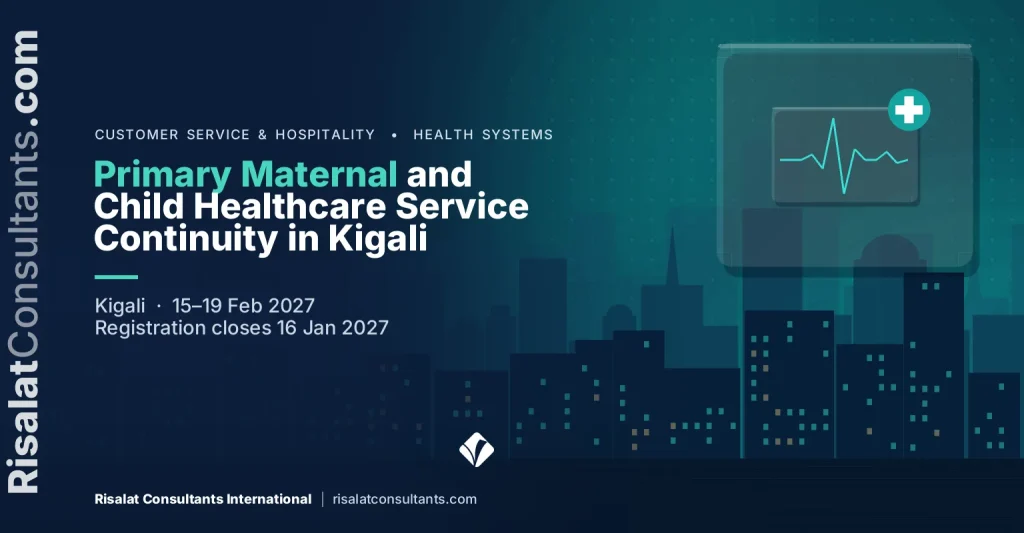
- 15–19 févr. 2027 (5 jours)
- Lieu
- Kigali, Rwanda
- Frais par participant
- 2 400 £ (GBP)
- Paiement
- Sur facture et par virement bancaire
- Clôture des inscriptions
- 16 janv. 2027
- Certificat
- Certificat de participation
- Option intra
- Organisez-le pour votre équipe, à vos dates
Sur cette page 15 sections
Présentation du programme
Primary maternal and child health services face severe operational pressures during protracted public health emergencies and system disruptions. This five-day executive programme in Kigali equips health leaders to maintain vital care pathways when facilities face acute resource diversion. Participants analyse essential package delivery, workforce reallocation, and risk-informed service preservation. Grounded in internationally recognised health system resilience frameworks, the course provides clinical managers with actionable strategies to safeguard mothers and newborns without compromising basic primary care standards during critical system stresses.
Delegates examine practical models for emergency obstetric preparedness, safe antenatal care adjustments, and infection prevention within high-demand primary facilities. The curriculum links clinical triage methodologies with frontline logistics to prevent preventable maternal and neonatal mortality during disruptions. Through rigorous analysis of primary health centre operations, attendees identify bottleneck vulnerabilities in maternal supply chains and referral networks. Practical modules focus on sustaining routine immunisation and perinatal consultations alongside surging infection control and acute care mandates.
By the conclusion of the workshop, participants translate international service continuity guidance into customised operational procedures for district networks. Working through realistic crisis simulations, clinical leaders draft robust continuity plans tailored to resource-constrained district environments. The programme delivers contextualised institutional approaches that enable public health teams to balance staffing, maintain community trust, and direct essential medicines to vulnerable clinics, ensuring that statutory maternal health targets remain achievable despite wider public health shocks.
Sustaining primary maternal and child healthcare has become an urgent priority across Southern Africa as health authorities address service backlogs and operational shocks following major epidemiological disruptions. This training aligns with the strategic priorities of essential services restoration under the Zimbabwe COVID-19 Response and Essential Health Services Additional Financing, reflecting broader World Bank and Global Financing Facility approaches to resilient system rebuilding. Without robust, proactive continuity mechanisms at district level, sudden resource reallocations inevitably trigger dangerous reversals in perinatal outcomes and routine childhood immunization coverage.
Proposé par Risalat Consultants International à Kigali (Rwanda), il associe sessions animées par des experts, cas réels et travaux de groupe, afin que les participants puissent appliquer leurs acquis dans leur propre institution.
The Programme Strengthens Institutional Capability
- Mapping vulnerable clinical pathways in primary maternal and neonatal care
- World Health Organisation guidelines on maintaining essential health services during outbreaks
- Assessing district-level operational vulnerabilities and baseline resource allocations
- Clinical governance and statutory accountability during protracted public health disruptions
- Developing rapid facility assessment protocols for reproductive health services
- Risk-informed planning for Basic Emergency Obstetric and Newborn Care (BEmONC)
- Infection prevention and control adaptations for active labour and delivery wards
- Maintaining blood product, oxytocin, and essential maternal drug pipelines
- Planification et gestion des services
- Amélioration de la qualité et normes
- Ressources humaines et planification des effectifs
- Financement et budgétisation des services
It is designed for district reproductive health focal points, maternal and neonatal care supervisors, clinical nursing directors and chief nursing officers and others who want practical, current skills in health, education and social services.
The Growing Importance of Primary Maternal and Child Healthcare Service Continuity in Kigali
La santé, l'éducation et les services sociaux touchent directement la population, et leur qualité dépend de la planification, de la gestion et de l'utilisation des données probantes. Les gouvernements et les partenaires attendent de meilleurs résultats avec des budgets limités.
Les dirigeants et managers de ces secteurs font face à une demande croissante, à des pénuries de personnel et à de nouvelles technologies. De solides compétences de management aident les institutions à planifier les services, à bien utiliser les ressources et à démontrer les résultats.
Les organisations ont de plus en plus besoin de professionnels capables de :
- Planifier et gérer les services pour répondre à la demande
- Améliorer la qualité au regard des normes
- Gérer efficacement le personnel et les ressources
- Utiliser les données pour orienter les décisions
- Travailler avec les communautés et les partenaires
Des systèmes solides de santé, d'éducation et de services sociaux aident les organisations à :
- Offrir de meilleurs services à un plus grand nombre de personnes
- Utiliser efficacement les budgets et le personnel
- Respecter les normes de qualité
- Démontrer les résultats au gouvernement et aux partenaires
This Primary Maternal and Child Healthcare Service Continuity in Kigali programme brings these elements together in a practical format, so that participants understand not only what good practice looks like but also how to introduce it in their own setting, with the people and resources they have.
Who Should Attend This Primary Maternal and Child Healthcare Service Continuity in Kigali Training?
Ce programme s'adresse à :
- District reproductive health focal points
- Maternal and neonatal care supervisors
- Clinical nursing directors and chief nursing officers
- District medical officers and primary healthcare coordinators
- Heads of district maternity and paediatric units
- Quality improvement leads in maternal and child health
- Health programme officers managing donor-funded healthcare projects
- Public health planners focused on primary care resilience
- Gestionnaires et administrateurs de services
- Directeurs et hauts fonctionnaires
- Chargés de planification et de politiques
- Chargés de la qualité et des normes
Le programme convient aussi bien aux professionnels expérimentés qu’à ceux qui prennent de nouvelles responsabilités. Les groupes réunissant plusieurs institutions et pays sont encouragés, car les participants apprennent beaucoup de l’expérience des autres.
Cochez ce que votre équipe doit être capable de faire.
Primary Maternal and Child Healthcare Service Continuity in Kigali Training Objectives
Upon successful completion of this Primary Maternal and Child Healthcare Service Continuity in Kigali Training, participants will be able to:
- Evaluate emergency obstetric service planning mechanisms to protect high-risk deliveries during operational shocks
- Adapt antenatal and postnatal care workflows to maintain clinical safety standards under infection control constraints
- Formulate resource balancing strategies to allocate clinical staff, consumables, and utility backups across health facilities
- Apply World Health Organisation continuity guidance to primary reproductive, maternal, newborn, and child health settings
- Design district-level referral pathways that secure uninterrupted transport for complicated obstetric emergencies
- Construct community-level surveillance and engagement protocols to prevent drops in routine clinic attendance
- Draft operational continuity standard operating procedures for immediate adoption within district primary clinics
- Expliquer les principaux défis de leur secteur
- Planifier des services adaptés à la demande et aux ressources
- Appliquer des méthodes d'amélioration de la qualité
Chaque objectif est mis en pratique pendant le programme à travers des exercices, des études de cas ou des travaux de groupe, afin que les participants repartent capables de le faire, et pas seulement de le décrire.
Contenu et structure du programme
- Mapping vulnerable clinical pathways in primary maternal and neonatal care
- World Health Organisation guidelines on maintaining essential health services during outbreaks
- Assessing district-level operational vulnerabilities and baseline resource allocations
- Clinical governance and statutory accountability during protracted public health disruptions
- Developing rapid facility assessment protocols for reproductive health services
- Risk-informed planning for Basic Emergency Obstetric and Newborn Care (BEmONC)
- Infection prevention and control adaptations for active labour and delivery wards
- Maintaining blood product, oxytocin, and essential maternal drug pipelines
- Emergency triage, assessment, and treatment (ETAT) continuity for neonates
- Obstetric emergency referral mechanisms under transport and fuel limitations
- Adapting scheduled antenatal care visits to maintain screening and prophylaxis
- Infection risk mitigation during routine childhood immunisation sessions
- Postnatal follow-up mechanisms for mothers and vulnerable infants during travel restrictions
- Integrated Management of Childhood Illness (IMCI) delivery under diagnostic constraints
- Community engagement strategies to mitigate patient fear and counter health service avoidance
- Midwifery and nursing staff surge capacity planning and task-shifting models
- Protecting occupational health, safety, and psychosocial wellbeing of maternity staff
- Buffer stocking and inventory control for essential reproductive health commodities
- Utility continuity: water, sanitation, and off-grid power solutions for delivery rooms
- District data capture, hybrid registers, and tracking displaced patient cohorts
- Drafting facility-level operational continuity standard operating procedures
- Inter-facility mutual aid agreements and cross-district resource sharing protocols
- Simulation exercise: responding to sudden supply chain cut-offs in district maternity units
- Reviewing participant continuity plans against national quality standards
- Action planning: integrating service continuity SOPs into annual district budgets
Contenu détaillé jour par jour
Le programme se déroule sur 5 jours. Chaque journée associe apports d'experts, travail pratique et un atelier ou une étude de cas de clôture :
- First Day: Day 1: Foundations of Maternal and Child Health Service Continuity
- Second Day: Day 2: Emergency Obstetric Service Continuity and Labour Ward Safety
- Third Day: Day 3: Routine Antenatal, Postnatal, and Child Health Preservation
- Fourth Day: Day 4: Clinical Workforce Balancing and Resource Allocation
- Fifth Day: Day 5: Standard Operating Procedure Development and Institutionalisation
Contenu détaillé jour par jour
First Day | Day 1: Foundations of Maternal and Child Health Service Continuity
- Mapping vulnerable clinical pathways in primary maternal and neonatal care
- World Health Organisation guidelines on maintaining essential health services during outbreaks
- Assessing district-level operational vulnerabilities and baseline resource allocations
- Clinical governance and statutory accountability during protracted public health disruptions
- Developing rapid facility assessment protocols for reproductive health services
Workshop: Day 1: Foundations of Maternal and Child Health Service Continuity: Applying It to Your Institution
En petits groupes, les participants appliquent les méthodes du jour à des exemples tirés de leurs institutions et conviennent d'étapes concrètes pour la suite.
Second Day | Day 2: Emergency Obstetric Service Continuity and Labour Ward Safety
- Risk-informed planning for Basic Emergency Obstetric and Newborn Care (BEmONC)
- Infection prevention and control adaptations for active labour and delivery wards
- Maintaining blood product, oxytocin, and essential maternal drug pipelines
- Emergency triage, assessment, and treatment (ETAT) continuity for neonates
- Obstetric emergency referral mechanisms under transport and fuel limitations
Workshop: Day 2: Emergency Obstetric Service Continuity and Labour Ward Safety: Applying It to Your Institution
En petits groupes, les participants appliquent les méthodes du jour à des exemples tirés de leurs institutions et conviennent d'étapes concrètes pour la suite.
Third Day | Day 3: Routine Antenatal, Postnatal, and Child Health Preservation
- Adapting scheduled antenatal care visits to maintain screening and prophylaxis
- Infection risk mitigation during routine childhood immunisation sessions
- Postnatal follow-up mechanisms for mothers and vulnerable infants during travel restrictions
- Integrated Management of Childhood Illness (IMCI) delivery under diagnostic constraints
- Community engagement strategies to mitigate patient fear and counter health service avoidance
Case Study: Day 3: Routine Antenatal, Postnatal, and Child Health Preservation in Practice
Les participants analysent un cas réaliste, comparent les choix effectués aux bonnes pratiques et en tirent des enseignements applicables à leur propre contexte.
Fourth Day | Day 4: Clinical Workforce Balancing and Resource Allocation
- Midwifery and nursing staff surge capacity planning and task-shifting models
- Protecting occupational health, safety, and psychosocial wellbeing of maternity staff
- Buffer stocking and inventory control for essential reproductive health commodities
- Utility continuity: water, sanitation, and off-grid power solutions for delivery rooms
- District data capture, hybrid registers, and tracking displaced patient cohorts
Workshop: Day 4: Clinical Workforce Balancing and Resource Allocation: Applying It to Your Institution
En petits groupes, les participants appliquent les méthodes du jour à des exemples tirés de leurs institutions et conviennent d'étapes concrètes pour la suite.
Fifth Day | Day 5: Standard Operating Procedure Development and Institutionalisation
- Drafting facility-level operational continuity standard operating procedures
- Inter-facility mutual aid agreements and cross-district resource sharing protocols
- Simulation exercise: responding to sudden supply chain cut-offs in district maternity units
- Reviewing participant continuity plans against national quality standards
- Action planning: integrating service continuity SOPs into annual district budgets
Capstone Exercise: Primary Maternal and Child Healthcare Service Continuity in Kigali Action Plan for Your Institution
Les participants synthétisent la semaine dans un plan d'action pour leur institution, avec des priorités, des responsables et des premières étapes, puis le présentent à leurs pairs et aux animateurs pour recueillir leurs retours.
Primary Maternal and Child Healthcare Service Continuity in Kigali Training Methodology
The programme utilises adult learning methodologies grounded in participatory analysis, structured case studies, and clinical problem-solving. Facilitators guide participants through real-world scenarios drawn from district hospital and primary clinic environments, combining plenary presentations with intensive small-group working sessions. Delegates critique existing operational frameworks, conduct risk matrices on their home districts, and participate in guided simulations that test crisis responses. The methodology prioritises practical document creation, ensuring that attendees directly translate theoretical concepts into usable administrative tools.
Le programme associe :
- Sessions animées par des experts sur les pratiques actuelles
- Études de cas régionales et internationales
- Travaux de groupe et exercices pratiques
- Simulations et jeux de rôle le cas échéant
- Discussion des défis rencontrés par les participants dans l'exercice de leurs fonctions
- Apprentissage entre pairs, d'institutions et de pays différents
- Des outils et modèles pratiques à réutiliser au travail
- Réflexion quotidienne et plan d'action
Avant le programme, une courte pré-évaluation aide les animateurs à comprendre le rôle et les priorités de chaque participant, afin d’adapter les exemples et les exercices au groupe. Chaque journée se termine par une brève réflexion au cours de laquelle les participants notent ce qu’ils appliqueront dans leur travail.
Résultats attendus
Upon completion of this Primary Maternal and Child Healthcare Service Continuity in Kigali Training, participants will be able to:
- Proficiency in applying international service continuity frameworks to maternal and child healthcare
- Ability to rapidly adjust labour ward workflows to ensure safety during health system crises
- Competence in managing district staff deployment and task-shifting during critical clinical shortages
- Capability to identify and rectify fragile links in obstetric and neonatal referral pathways
- A finalised operational continuity standard operating procedure tailored to the participant's clinic
- Enhanced leadership skills for coordinating with district emergency response committees and donors
- Planifier les services pour répondre à la demande
- Améliorer la qualité au regard des normes
Les participants repartent avec un plan d'action personnel et des outils pratiques utilisables dans leur institution dès la première semaine de retour. Les institutions qui envoient plusieurs participants peuvent s'appuyer sur le programme pour convenir de méthodes et de modèles communs entre équipes, ce qui facilite la pérennité des améliorations.
2 400 £ par participant · facture et virement bancaire · remise pour les groupes de 5 personnes ou plus
Cinq personnes ou plus d'une même organisation : demandez le tarif de groupe lors de votre demande de facture.
À partir de dix participants, une version intra pour votre institution peut revenir moins cher par personne. Demander un devis intra.
Clôture des inscriptions dans 65 jours (16 janv. 2027)
Institutional Application of Primary Maternal and Child Healthcare Service Continuity in Kigali Training
Ce programme aide les organisations à renforcer :
- Planification des services
- Gestion de la qualité
- Gestion des effectifs
- Utilisation des données
- Partenariats
Les participants repartent avec des outils pratiques pour améliorer :
- Plans de services
- Examens de la qualité
- Plans d'effectifs
- Rapports de performance
- Planification des approvisionnements
Le programme est conçu pour que l'apprentissage passe de la salle de formation à l'institution. Les participants travaillent, dans la mesure du possible, sur leurs propres processus et documents, et repartent avec un plan d'action que leurs responsables peuvent examiner et soutenir.
Pertinence régionale & mise en application
Europe
Les institutions européennes mettent en œuvre la santé, l'éducation et les services sociaux dans des cadres réglementaires détaillés et des programmes de réforme. Les participants européens peuvent comparer leurs pratiques avec celles de collègues d'autres régions et vérifier comment des méthodes éprouvées fonctionnent dans d'autres conditions.
Afrique
Partout en Afrique, les ministères, organismes et équipes de projet qui interviennent dans la santé, l'éducation et les services sociaux travaillent de plus en plus aux côtés de programmes financés par les bailleurs, qui attendent des systèmes et des données probantes clairs. Le programme aide les participants à adapter les bonnes pratiques aux institutions et aux ressources dont ils disposent.
Moyen-Orient
Au Moyen-Orient, les stratégies nationales de développement et les plans de diversification imposent des exigences croissantes à la santé, à l'éducation et aux services sociaux. Les participants examinent comment développer, au sein des organismes publics et des entreprises, les capacités dont ces plans ont besoin.
Asie
Les institutions asiatiques conjuguent croissance rapide et programmes de modernisation ambitieux. Les participants venus d'Asie peuvent partager leur expérience du déploiement rapide de systèmes à grande échelle et découvrir les approches adoptées ailleurs.
Pacifique
Les petits États insulaires et du Pacifique font face à des contraintes particulières de taille, de distance et de capacités. Le programme met en avant des approches pratiques et proportionnées en matière de santé, d'éducation et de services sociaux, adaptées aux petites institutions.
Holding the programme in Kigali, Rwanda brings participants together away from their daily pressures, so they can compare how health, education and social services is handled in different settings. The same programme can also be delivered in-house for one institution, in its own country or online, with cases taken from its current work.
Profil du pays d'accueil – Rwanda
Programmes, ateliers, visites et formations à Kigali, au Rwanda, par Risalat Consultants International
Se former hors de son pays permet aux participants de se concentrer, de porter un regard neuf sur leur propre institution et de constituer un réseau avec des collègues d'autres pays.
Primary Maternal and Child Healthcare Service Continuity in Kigali Training Deliverables
Les participants sont accompagnés avant, pendant et après le programme, afin que la préparation, l'apprentissage et le suivi forment une expérience continue.
Avant le programme
- Pré-évaluation des participants
- Primary Maternal and Child Healthcare Service Continuity in Kigali Readiness Assessment
- Primary Maternal and Child Healthcare Service Continuity in Kigali Resource Pack
- Lectures préparatoires
- Aide et conseils gratuits pour le visa
Pendant le programme
- Accueil à l'aéroport & assistance à l'arrivée
- Hébergement avec petit-déjeuner
- Dîner de bienvenue et de réseautage
- Kit de formation Risalat (sac, gourde, mug, t-shirt, casquette, protège-passeport, stylos, carnet, magnet & porte-clés)
- Comprehensive Primary Maternal and Child Healthcare Service Continuity in Kigali Training Manual
- Modèle de planification des services
- Modèle de plan d'amélioration de la qualité
- Modèle de planification des effectifs
- Modèle de tableau de bord de la performance
- Ateliers pratiques & simulations
- Discussions de groupe & apprentissage entre pairs
- Déjeuner et pauses-café quotidiens
- Accès complet aux installations du lieu de formation
- Mini tablette avec supports pédagogiques numériques
- Visite de terrain (le cas échéant)
- Visite récréative de la ville
Après le programme
- Certificat de participation
- Distinction Risalat de participation au programme
- Documents de référence après la formation
- Liste de contrôle d'examen des services
- Fiche de suivi des améliorations
- Accompagnement après la formation & conseils de suivi
- Rapport du programme
Les institutions peuvent aussi demander une version intra sur mesure de ce programme, dispensée dans leurs locaux ou en ligne. Demander une proposition.
Common Challenges in Primary Maternal and Child Healthcare Service Continuity in Kigali, And How This Training Helps
Comment les institutions peuvent-elles planifier et gérer les services pour répondre à la demande ?
The programme addresses this directly on the first day (Day 1: Foundations of Maternal and Child Health Service Continuity), where participants practise the methods involved and adapt them to their own institution, then build it into their action plan.
Comment les institutions peuvent-elles améliorer la qualité au regard des normes ?
The programme addresses this directly on the second day (Day 2: Emergency Obstetric Service Continuity and Labour Ward Safety), where participants practise the methods involved and adapt them to their own institution, then build it into their action plan.
Comment les institutions peuvent-elles gérer efficacement le personnel et les ressources ?
The programme addresses this directly on the third day (Day 3: Routine Antenatal, Postnatal, and Child Health Preservation), where participants practise the methods involved and adapt them to their own institution, then build it into their action plan.
Comment les institutions peuvent-elles s'appuyer sur les données pour orienter leurs décisions ?
The programme addresses this directly on the fourth day (Day 4: Clinical Workforce Balancing and Resource Allocation), where participants practise the methods involved and adapt them to their own institution, then build it into their action plan.
Comment les institutions peuvent-elles travailler avec les communautés et les partenaires ?
The programme addresses this directly on the fifth day (Day 5: Standard Operating Procedure Development and Institutionalisation), where participants practise the methods involved and adapt them to their own institution, then build it into their action plan.
Questions fréquentes
When and where does the Primary Maternal and Child Healthcare Service Continuity in Kigali programme take place?
It runs from 15 Feb 2027 to 19 Feb 2027, in Kigali, Rwanda. The registration deadline is shown at the top of this page.
Qui devrait participer ?
The programme is designed for district reproductive health focal points, maternal and neonatal care supervisors, clinical nursing directors and chief nursing officers, district medical officers and primary healthcare coordinators, and others who want practical skills in health, education and social services.
Recevrai-je un certificat ?
Oui. Les participants qui terminent le programme reçoivent un certificat de participation délivré par Risalat Consultants International.
Ce programme peut-il être dispensé pour notre seule institution ?
Oui. Nous pouvons proposer une version intra sur mesure dans vos locaux, dans une autre ville ou en ligne, construite autour de vos propres cas. Utilisez la demande de proposition sur cette page.
Faut-il une expérience préalable dans la santé, l'éducation et les services sociaux ?
Aucune formation spécialisée n'est requise au-delà d'une expérience dans une fonction similaire. Une courte pré-évaluation aide les animateurs à adapter les sessions au groupe.
Who Will Deliver This Programme
Each date is delivered by a team assigned from Risalat's expert network for this subject. For this programme we assign:
How we choose them: Experience in the region of the participants or comparable settings; Command of the financier rules that apply (World Bank, ADB, AfDB, EU, UN) where relevant; Delivery in English; other languages on request for in-house groups; No conflict of interest with participants' institutions.
Names and short CVs of the assigned experts are shared with registered participants and sponsoring organisations before the programme, on request. Are you an expert in this subject? Join our expert network.
Training courses in KigaliHealthcare training courses
Pourquoi Kigali pour ce programme
Kigali est réputée pour ses rues propres et sûres et ses réformes du secteur public, avec des visas faciles à obtenir pour les voyageurs africains.
The Primary Maternal and Child Healthcare Service Continuity in Kigali programme in February 2027 brings together officials and professionals from across the Africa region and beyond. Sessions combine short inputs, case studies and group work on participants' own files, and the city's institutions can be added as a study visit on request.
Accès : aéroport international de Kigali (KGL).
Vérifiez si vous avez besoin d'un visa avec le vérificateur de visa gratuit, et demandez une lettre d'invitation une fois inscrit.
Le même thème dans d'autres villes
- Community Health Worker Logistics and Child Nutrition Delivery in Kigali (Kigali)
- Maternal and Neonatal Referral Protocols and Obstetric Care Auditing in Lisbon (Lisbon)
- District Health Infrastructure Commissioning and Clinical Works in Casablanca (Casablanca)
- Child Healthcare Quality Benchmarking and Human Capital Financing in London (London)
- EPI Cold Chain Infrastructure Management and Clinical Vaccination Systems in Istanbul (Istanbul)
- Contracting Primary Care Networks and Essential Health Service Packages in Amman (Amman)
Autres programmes à Kigali
- Agri-Tech Startup Incubation and Digital Venture Matching in Kigali
- Sub-National Capital Investment Auditing and Municipal Grants in Kigali
- Basic Education Equity Grants and School-Based Management in Kigali
- Rural Electrification Grid Extension and Line Construction in Kigali
- Management of International Technical Assistance Teams and Knowledge Transfer in Kigali
- OCDE (Organisation de coopération et de développement économiques) OCDE
- Programme des Nations Unies pour le développement PNUD
- Open Contracting Partnership Open Contracting Partnership
For teams and institutions
Bring your team
Teams that learn together apply more at work. Tell us how many people and how you would like to take part: we reply with a group quote within two working days.
Other dates and cities for this subject: Health Systems and Health Project Management training courses (109 upcoming dates).
Plus de formations au Rwanda · Tous les programmes en Afrique · Calendrier complet des formations
Plan this programme in a roadmap: why it matters, why to approve it, the dates to plan and the career it builds.