Points clés
- Dates
- 1–5 févr. 2027 (5 jours)
- Lieu
- TBD, Lisbon, Portugal
- Frais par participant
- 3 850 £ (GBP)
- Paiement
- Sur facture et par virement bancaire
- Clôture des inscriptions
- 23 déc. 2026
- Format
- 5-day short course: a practical capacity-building programme for government, NGO and project teams in Lisbon
- Option intra
- Organisez-le pour votre équipe, à vos dates
Sur cette page 13 sections
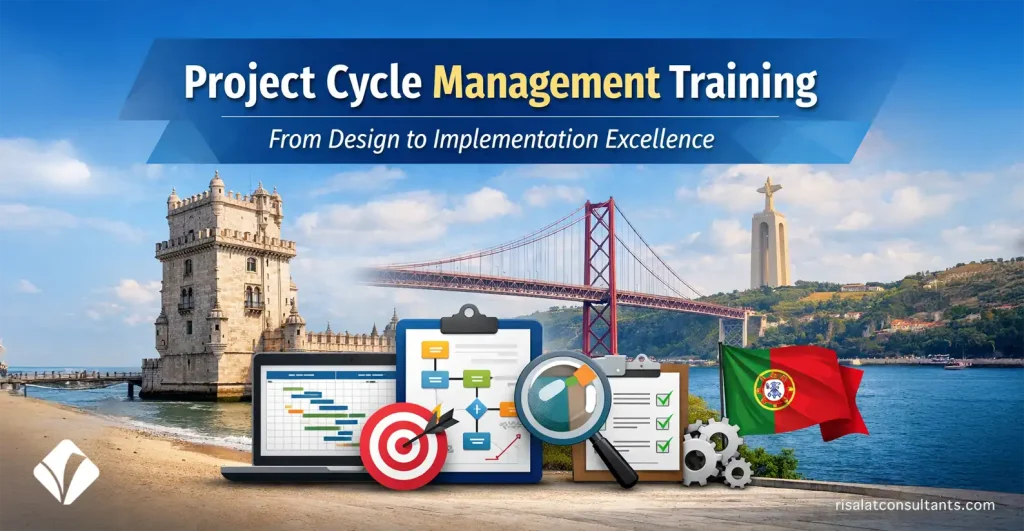
Formation à la gestion du cycle de projet – De la conception à l'excellence dans la mise en œuvre
Présentation du programme
The Project Cycle Management Course equips government officials, development practitioners, and project teams with practical tools to design, implement, monitor, and close projects effectively across the full project lifecycle. Across Asia, Africa, the Middle East, and Oceania, many donor-funded and public-sector projects face similar challenges: weak project design, unclear results frameworks, delayed implementation, fragmented reporting, and limited learning from past projects. These issues reduce development impact and strain institutional capacity. This training responds directly to these realities by strengthening participants’ ability to manage projects from identification and formulation through implementation, monitoring, evaluation, and closure.
Free self-check: the procurement maturity assessment gives 30 questions on planning, tendering, contract management, integrity and e-procurement, with a score per area, in about 10 minutes.
Rather than focusing on theory alone, the programme emphasizes applied Project Cycle Management (PCM) practices aligned with international development standards, helping participants translate plans into results, manage risks proactively, and improve accountability throughout the project lifecycle. Participants gain hands-on experience in project design, logical frameworks, implementation planning, monitoring systems, reporting structures, and adaptive management. See how effective Project Cycle Management transforms project design, implementation, and results across real-world development programmes.
Delivered by Risalat Consultants International in Lisbon, Portugal, it combines expert-led sessions, real cases and group work, so that participants can apply what they learn in their own institution. Participants will return to their organizations with practical Project Cycle Management tools and structured action plans that can be directly applied within ministries and project units, supporting stronger implementation oversight, reporting quality, and portfolio performance.
Le programme renforce les capacités institutionnelles en matière de :
- Introduction to Project Cycle Management
- From development needs to project concepts
- Stakeholder analysis and problem trees
- Théorie du changement et chaînes de résultats
- Logical Framework Approach (LFA)
- Common causes of weak project design
- Work planning and activity scheduling
- Budgeting and resource allocation
- Stratégie numérique et planification de la transformation
- Gouvernance et qualité des données
- Analyse et visualisation des données
- Notions de base en cybersécurité et gestion des risques
Why this matters now
Digital services, data and new technologies are changing how institutions work and how citizens are served. Done well, they make services faster, cheaper and more transparent; done badly, they waste money and expose data to risk. Institutions need people who can plan digital change, manage data responsibly, protect systems and use evidence from data in decisions. These skills are now expected across all functions, not only in IT.
Les organisations ont de plus en plus besoin de professionnels capables de :
- Planifier des initiatives numériques qui résolvent de vrais problèmes
- Gérer la qualité, la protection et le partage des données
- Analyser les données et les présenter clairement
- Gérer les risques cyber et technologiques
- Accompagner les équipes dans le changement numérique
Des systèmes solides d'administration numérique, de données et de technologies aident les organisations à :
- Fournir des services plus rapides et plus accessibles
- Mieux utiliser les données dans les décisions
- Protéger les systèmes et les données personnelles
- Tirer parti des investissements technologiques
- Collecter
- Nettoyer
- Stocker
- Analyser
- Décider
Public concerné
Ce programme s'adresse à :
- Responsables de projets et de planification des ministères
- Personnel des UGP / UEP et coordinateurs de projet
- Monitoring & Evaluation professionals
- Finance and procurement teams supporting projects
- Sector specialists (infrastructure, health, education, climate, community development)
- Chargés de liaison avec les partenaires au développement
- Équipes de mise en œuvre des collectivités locales
- NGO and donor-funded programme managers
- Professionals seeking practical skills to apply Project Cycle Management principles across all project phases, design projects using logical frameworks and theories of change, develop realistic implementation plans and schedules, and establish monitoring and reporting systems aligned with project objectives
Cochez ce que votre équipe doit être capable de faire.
Objectifs du programme
À l'issue de ce programme, les participants seront en mesure de :
- Expliquer les grandes tendances de l'administration numérique et de l'utilisation des données
- Planifier une initiative numérique liée aux objectifs de service
- Appliquer les principes de gouvernance et de qualité des données
- Analyser et visualiser les données pour les décideurs
- Identifier et gérer les risques cyber et technologiques
- Adopter des pratiques responsables dans l'utilisation de l'IA et de l'automatisation
- Planifier l'acquisition et la gestion des technologies
- Accompagner les équipes dans le changement numérique
- Préparer un plan d'action numérique pour leur institution
Training Structure & Contents
- Introduction to Project Cycle Management
- From development needs to project concepts
- Stakeholder analysis and problem trees
- Théorie du changement et chaînes de résultats
- Logical Framework Approach (LFA)
- Common causes of weak project design
- Workshop: Project Identification & Design Foundations: Applying It to Your Institution
- Work planning and activity scheduling
- Budgeting and resource allocation
- Identification des risques et planification de leur atténuation
- Procurement and implementation sequencing
- Institutional roles and coordination mechanisms
- Atelier : Planification et état de préparation à la mise en œuvre : application à votre institution
- Designing monitoring frameworks and indicators
- Valeurs de référence, cibles et jalons
- Rapports sur l'état d'avancement de la mise en œuvre
- Managing deviations and performance bottlenecks
- Linking financial and physical progress
- Étude de cas : Suivi, rapport et suivi des performances en pratique
- Mid-term and completion evaluations
- Using evidence for course correction
- Gestion des connaissances et documentation
- Institutionnaliser les boucles de rétroaction
- Building organizational learning culture
- Workshop: Evaluation, Learning & Adaptive Management: Applying It to Your Institution
- Group work on real participant projects
- Building complete PCM frameworks
- Examen par les pairs et retours d'experts
- Plan d'action institutionnel
- Roadmaps for strengthening project management systems
- Capstone Exercise: Project Cycle Management Action Plan for Your Institution
Contenu détaillé jour par jour
First Day | Project Identification & Design Foundations
- Introduction to Project Cycle Management
- From development needs to project concepts
- Stakeholder analysis and problem trees
- Théorie du changement et chaînes de résultats
- Logical Framework Approach (LFA)
- Common causes of weak project design
- Workshop: Project Identification & Design Foundations: Applying It to Your Institution
Second Day | Planning & Implementation Readiness
- Work planning and activity scheduling
- Budgeting and resource allocation
- Identification des risques et planification de leur atténuation
- Procurement and implementation sequencing
- Institutional roles and coordination mechanisms
- Atelier : Planification et état de préparation à la mise en œuvre : application à votre institution
Third Day | Monitoring, Reporting & Performance Tracking
- Designing monitoring frameworks and indicators
- Valeurs de référence, cibles et jalons
- Rapports sur l'état d'avancement de la mise en œuvre
- Managing deviations and performance bottlenecks
- Linking financial and physical progress
- Étude de cas : Suivi, rapport et suivi des performances en pratique
Fourth Day | Evaluation, Learning & Adaptive Management
- Mid-term and completion evaluations
- Using evidence for course correction
- Gestion des connaissances et documentation
- Institutionnaliser les boucles de rétroaction
- Building organizational learning culture
- Workshop: Evaluation, Learning & Adaptive Management: Applying It to Your Institution
Cinquième jour | Laboratoire appliqué du cycle de projets
- Group work on real participant projects
- Building complete PCM frameworks
- Examen par les pairs et retours d'experts
- Plan d'action institutionnel
- Roadmaps for strengthening project management systems
- Capstone Exercise: Project Cycle Management Action Plan for Your Institution
Méthodologie de formation
The programme combines expert-led sessions, practical group exercises, and project clinics so participants leave with draft project tools and action plans that can be immediately adapted to their institutional context. Before the programme, a short pre-assessment helps the facilitators understand each participant's role and priorities, so that examples and exercises can be adjusted to the group. Each day ends with a short reflection in which participants note what they will apply at work.
- Sessions techniques interactives
- Études de cas de projets de développement réels
- Exercices de groupe et simulations
- Project design workshops
- Ateliers d'aide au reporting
- Apprentissage entre pairs et retours d'experts
- Modèles pratiques et listes de contrôle de mise en œuvre
- Sessions animées par des experts sur les pratiques actuelles
- Études de cas régionales et internationales
- Travaux de groupe et exercices pratiques
Résultats attendus
- Planifier des initiatives numériques liées aux objectifs de service
- Appliquer les principes de gouvernance et de qualité des données
- Analyser et présenter clairement les données
- Gérer les risques cyber et technologiques
- Utiliser l'IA et l'automatisation de manière responsable
- Piloter le changement numérique dans leur institution
- Return with a personal action plan and practical tools to improve data inventories, dashboards, risk registers, technology procurement, and change plans
- Strengthen institutional digital strategy, data governance, data-driven decisions, cybersecurity, and technology management
3 850 £ par participant · facture et virement bancaire · réduction pour les groupes de 5 personnes ou plus
Cinq personnes ou plus d'une même organisation : demandez le tarif de groupe lors de votre demande de facture.
Dix personnes ou plus : une version interne pour votre institution peut coûter moins cher par personne. Demander un devis interne.
Registration closes in 30 days (23 Dec 2026)
Pertinence régionale & mise en application
Europe: European institutions apply digital government, data and technology within detailed regulatory frameworks and reform agendas. Participants from Europe can compare their practice with colleagues from other regions and test how established methods work under different conditions.
Africa: Across Africa, ministries, agencies and project teams working in digital government, data and technology increasingly operate alongside donor-financed programmes that expect clear systems and evidence. The programme helps participants adapt good practice to the institutions and resources they work with.
Middle East: In the Middle East, development and public-sector entities balance rapid modernization with institutional capacity building and governance needs.
Profil du pays d'accueil
Lisbon offers a professional and neutral learning environment for international development practitioners, with strong connectivity to Europe, Africa, and the Middle East. Hosting the programme in Lisbon supports cross-regional knowledge exchange while providing a conducive setting for focused professional learning and institutional capacity building. Lisbon provides a neutral learning environment for project lifecycle management and results-based delivery across international development portfolios.
Who Will Deliver This Programme
Each date is delivered by a team assigned from Risalat's expert network for this subject. For this programme we assign:
How we choose them: Experience in the region of the participants or comparable settings; Command of the financier rules that apply (World Bank, ADB, AfDB, EU, UN) where relevant; Delivery in English; other languages on request for in-house groups; No conflict of interest with participants' institutions.
Livrables de la formation
Before the Programme: Pre-assessment to identify participant roles, institutional priorities, and learning expectations.
During the Programme: Expert-led sessions, applied case studies, practical templates, peer reviews, and daily reflection activities.
After the Programme: Completed institutional action plans, customized implementation checklists, and tools ready for immediate workplace application.
Cours de formation à LisbonneCours de formation en gestion de projets et de contrats &
Pourquoi Lisbonne pour ce programme
Lisbonne est un lieu naturel pour les délégations lusophones d'Afrique et du Brésil.
The Project Cycle Management Training – From Design to Implementation Excellence programme in February 2027 brings together officials and professionals from across Europe, Africa, the Middle East and Asia. Sessions combine short inputs, case studies and group work on participants' own files, and the city's institutions can be added as a study visit on request.
Accès : aéroport Humberto Delgado de Lisbonne (LIS).
Vérifiez si vous avez besoin d'un visa avec le vérificateur de visa gratuit, et demandez une lettre d'invitation une fois inscrit.
Le même thème dans d'autres villes
- Mini Degree in Environmental and Social Safeguards in Istanbul (Istanbul)
- Digital Government and Citizen e-Services Training for North African Officials in Sliema (Sliema)
- Mini Degree in Leadership and Public Policy in London (London)
- Mini Degree in Digital Government and AI in Tallinn (Tallinn)
- Disaster Risk Management and Early Warning Systems in Sapporo (Sapporo)
- Mini Degree in Climate Finance and Resilience in Copenhagen (Copenhagen)
Autres programmes à Lisbonne
- ESG Reporting and Sustainability Strategy in Lisbon
- Public Investment Project Appraisal and Capital Budget Prioritisation in Lisbon
- Primary Curriculum Alignment and Formative Student Assessment Tools in Lisbon
- Civil Service Payroll Control, Biometric Audits and HR Verification in Lisbon
- Maternal and Neonatal Referral Protocols and Obstetric Care Auditing in Lisbon
Teams often travel here from Mozambique, Angola, Cabo Verde, Guinea-Bissau, Brazil. Funding, visa letters and group rates are explained on each country page.
Is there project management training for government officials in Lisbon in February 2027?
Can "Project Cycle Management Training – From Design to Implementation Excellence" be delivered in-house for one organisation?
Quels autres programmes Risalat propose-t-il en gestion de projet ?
Comment les organisations s'inscrivent-elles et paient-elles ?
Pour les équipes et les institutions
Bring your team
Teams that learn together apply more at work. Tell us how many people and how you would like to take part: we reply with a group quote within two working days.
Watch: this programme in short



Other dates and cities for this subject: Project Management for Donor-Funded Projects training courses (27 upcoming dates).
Plus de formations au Portugal · Tous les programmes en Europe · Calendrier complet des formations
Plan this programme in a roadmap: why it matters, why to approve it, the dates to plan and the career it builds.