Points clés
- Dates
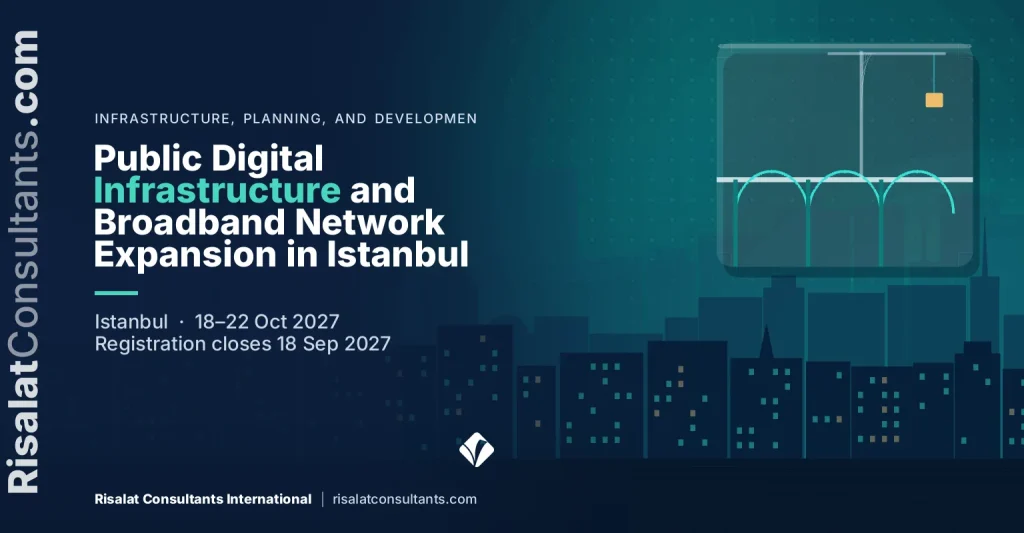
- 18–22 Oct 2027 (5 days)
- Lieu
- Istanbul, Türkiye
- Frais par participant
- 3 100 £ (GBP)
- Paiement
- Sur facture et par virement bancaire
- Clôture des inscriptions
- 18 Sep 2027
- Certificat
- Certificat de participation
- Option intra
- Organisez-le pour votre équipe, à vos dates
Sur cette page 14 sections
Présentation du programme
Modern socio-economic development relies on resilient public digital infrastructure and pervasive broadband networks. This comprehensive programme delivers essential competencies for managing large-scale telecommunications assets, nationwide optical fibre connectivity rollout, and sovereign data exchange frameworks. Held in Istanbul, a strategic bridge of global connectivity and critical infrastructure, the training provides public sector specialists with actionable methodologies to design, procure, and supervise open-access transport networks, middle-mile corridors, and trusted citizen-facing digital registries.
Free self-check: the digital readiness assessment gives how ready your institution is for digital services, data and AI, in about 10 minutes.
Delegates examine institutional mechanisms, regulatory tools, and engineering standards necessary to implement secure government data interchange frameworks and foundational digital identity platforms. The curriculum addresses critical engineering challenges in civil infrastructure sharing, dark fibre deployment, universal access financing, and international IP transit management. By navigating established International Telecommunication Union (ITU) and European Telecommunications Standards Institute (ETSI) benchmarks, participants gain practical capability to supervise high-value infrastructure contracts effectively.
Through technical exercises, structured peer reviews, and institutional case studies, the programme equips delegates to resolve complex interoperability and spectrum management challenges. Practical modules cover digital backbone oversight, interoperability design, and spectrum allocation for high-capacity mobile broadband networks. Participants will leave prepared to align complex technical deliverables with international procurement procedures, donor monitoring frameworks, and national digital economy transformation strategies across expanding public networks.
Rapid digital transformation across developing markets demands the urgent, transparent expansion of high-capacity digital backbones, open-access broadband infrastructure, and scalable e-government interoperability platforms. Public institutions are tasked with executing technically demanding capital investments, such as those financing cross-border connectivity and last-mile access through the multi-million dollar Digital Acceleration Project. Sound technical preparation ensures public investments remain technically resilient, interoperable, vendor-neutral, and aligned with standard multilateral development bank disbursement conditions.
Delivered by Risalat Consultants International in Istanbul, Turkey, it combines expert-led sessions, real cases and group work, so that participants can apply what they learn in their own institution.
The Programme Strengthens Institutional Capability
- Engineering parameters for terrestrial optical fibre deployment: DWDM systems and dark fibre architectures
- Civil infrastructure sharing models: ducts, utility poles, rights of way, and rail corridors
- Open-access regime enforcement: wholesale pricing principles and non-discriminatory access rules
- Quality of Service (QoS) metrics, testing protocols, and compliance oversight under ITU-T recommendations
- Review of optical transport network contract specifications and acceptance testing procedures
- Spectrum allocation frameworks: dynamic spectrum access, spectrum caps, and regional harmonisation
- Technical appraisal of 4G, 5G, and fixed-wireless access (FWA) deployment models in underserved regions
- Universal Service and Access Fund (USAF) design: subsidising rural rollout and market failure interventions
- Stratégie numérique et planification de la transformation
- Gouvernance et qualité des données
- Analyse et visualisation des données
- Notions de base en cybersécurité et gestion des risques
It is designed for telecommunications engineers from national regulatory bodies, digital infrastructure planners in ministries of ICT, ICT regulators overseeing spectrum and open access compliance and others who want practical, current skills in digital government, data and technology.
The Growing Importance of Public Digital Infrastructure and Broadband Network Expansion in Istanbul
- Engineering parameters for terrestrial optical fibre deployment: DWDM systems and dark fibre architectures
- Civil infrastructure sharing models: ducts, utility poles, rights of way, and rail corridors
- Open-access regime enforcement: wholesale pricing principles and non-discriminatory access rules
- Quality of Service (QoS) metrics, testing protocols, and compliance oversight under ITU-T recommendations
- Review of optical transport network contract specifications and acceptance testing procedures
- Spectrum allocation frameworks: dynamic spectrum access, spectrum caps, and regional harmonisation
- Technical appraisal of 4G, 5G, and fixed-wireless access (FWA) deployment models in underserved regions
- Universal Service and Access Fund (USAF) design: subsidising rural rollout and market failure interventions
- Microwave backhaul versus optical transport trade-offs for hard-to-reach terrain
- Managing electromagnetic field (EMF) compliance, site approvals, and green power solutions for rural base stations
- Architectural principles of national data interchange: federated versus centralised data exchange systems
- Implementation of API management gateways, open standards, and public sector messaging layers
- Data governance, lineage, and privacy: GDPR alignment and regional data protection compliance
- National Enterprise Architecture (NEA) operationalisation using standard reference frameworks
- Practical design of cross-agency registry linking: health, taxation, business, and civil registers
- Foundational versus functional digital identity platforms: architecture, coverage, and security models
- Biometric data deduplication, multimodal capture, and enrolment logistics in urban and rural environments
- Public Key Infrastructure (PKI) deployment: digital certificates, timestamping, and electronic signatures
- Cybersecurity controls for critical national identity registries and multi-factor authentication systems
- Designing offline verification workflows and privacy-by-design modules for inclusive public access
- Procurement frameworks for major ICT infrastructure contracts under World Bank and AfDB guidelines
- Contract administration: FIDIC approaches tailored to telecommunications civil works and equipment supply
- Environmental and Social Frameworks (ESF) application to fibre cable laying and tower erection
- Risk management matrices: supply chain bottlenecks, vendor lock-in mitigation, and asset protection
- Formulation of individual institutional action plans for backbone and digital infrastructure expansion
Les services numériques, les données et les nouvelles technologies transforment le fonctionnement des institutions et le service rendu aux citoyens. Bien utilisés, ils rendent les services plus rapides, moins coûteux et plus transparents ; mal utilisés, ils gaspillent de l'argent et exposent les données à des risques.
Les institutions ont besoin de personnes capables de planifier le changement numérique, de gérer les données de manière responsable, de protéger les systèmes et d'utiliser les données probantes dans leurs décisions. Ces compétences sont désormais attendues dans toutes les fonctions, et pas seulement dans l'informatique.
Les organisations ont de plus en plus besoin de professionnels capables de :
- Planifier des initiatives numériques qui résolvent de vrais problèmes
- Gérer la qualité, la protection et le partage des données
- Analyser les données et les présenter clairement
- Gérer les risques cyber et technologiques
- Accompagner les équipes dans le changement numérique
Des systèmes solides d'administration numérique, de données et de technologies aident les organisations à :
- Fournir des services plus rapides et plus accessibles
- Mieux utiliser les données dans les décisions
- Protéger les systèmes et les données personnelles
- Tirer parti des investissements technologiques
This Public Digital Infrastructure and Broadband Network Expansion in Istanbul programme brings these elements together in a practical format, so that participants understand not only what good practice looks like but also how to introduce it in their own setting, with the people and resources they have.
Who Should Attend This Public Digital Infrastructure and Broadband Network Expansion in Istanbul Training?
Ce programme s'adresse à :
- Telecommunications engineers from national regulatory bodies
- Digital infrastructure planners in ministries of ICT
- ICT regulators overseeing spectrum and open access compliance
- Project coordinators managing donor-funded infrastructure portfolios
- Technical specialists responsible for national fibre backbone expansion
- Broadband rollout managers in national transmission utilities
- Enterprise architects developing government data exchange frameworks
- Identity systems specialists working on digital identity infrastructure
- Public procurement specialists handling digital infrastructure tenders
- Responsables et chargés des TIC
- Responsables de la transformation numérique
- Analystes de données et statisticiens
Le programme convient aussi bien aux professionnels expérimentés qu’à ceux qui prennent de nouvelles responsabilités. Les groupes réunissant plusieurs institutions et pays sont encouragés, car les participants apprennent beaucoup de l’expérience des autres.
Cochez ce que votre équipe doit être capable de faire.
Public Digital Infrastructure and Broadband Network Expansion in Istanbul Training Objectives
Upon successful completion of this Public Digital Infrastructure and Broadband Network Expansion in Istanbul Training, participants will be able to:
- Evaluate nationwide optical fibre connectivity rollout options using established ITU and ETSI technical standards
- Formulate robust governance mechanisms for government data interchange frameworks and API exchange layers
- Design architectural requirements for foundational digital identity platforms linked to public service delivery
- Appraise digital backbone oversight protocols to ensure contractor compliance during civil engineering and cabling phases
- Establish structured interoperability design models across public sector databases and municipal services
- Apply technical principles of spectrum allocation to support nationwide mobile broadband and 5G deployment
- Develop procurement, contract supervision, and environmental monitoring tools aligned with international financial institution standards
- Expliquer les grandes tendances de l'administration numérique et de l'utilisation des données
- Planifier une initiative numérique liée aux objectifs de service
- Appliquer les principes de gouvernance et de qualité des données
Chaque objectif est mis en pratique pendant le programme à travers des exercices, des études de cas ou des travaux de groupe, afin que les participants repartent capables de le faire, et pas seulement de le décrire.
Contenu et structure du programme
Le programme se déroule sur 5 jours. Chaque journée associe apports d'experts, travail pratique et un atelier ou une étude de cas de clôture :
- First Day: National Fibre Backbone Infrastructure and Optical Network Expansion
- Second Day: Spectrum Allocation, Management, and Last-Mile Broadband Delivery
- Third Day: Government Data Interchange Frameworks and Cross-Agency Interoperability
- Fourth Day: Digital Identity Infrastructure, Registries, and Trust Services
- Fifth Day: Infrastructure Governance, Project Oversight, and Environmental Resilience
Contenu détaillé jour par jour
First Day | National Fibre Backbone Infrastructure and Optical Network Expansion
- Engineering parameters for terrestrial optical fibre deployment: DWDM systems and dark fibre architectures
- Civil infrastructure sharing models: ducts, utility poles, rights of way, and rail corridors
- Open-access regime enforcement: wholesale pricing principles and non-discriminatory access rules
- Quality of Service (QoS) metrics, testing protocols, and compliance oversight under ITU-T recommendations
- Review of optical transport network contract specifications and acceptance testing procedures
Workshop: National Fibre Backbone Infrastructure and Optical Network Expansion: Applying It to Your Institution
En petits groupes, les participants appliquent les méthodes du jour à des exemples tirés de leurs institutions et conviennent d'étapes concrètes pour la suite.
Second Day | Spectrum Allocation, Management, and Last-Mile Broadband Delivery
- Spectrum allocation frameworks: dynamic spectrum access, spectrum caps, and regional harmonisation
- Technical appraisal of 4G, 5G, and fixed-wireless access (FWA) deployment models in underserved regions
- Universal Service and Access Fund (USAF) design: subsidising rural rollout and market failure interventions
- Microwave backhaul versus optical transport trade-offs for hard-to-reach terrain
- Managing electromagnetic field (EMF) compliance, site approvals, and green power solutions for rural base stations
Workshop: Spectrum Allocation, Management, and Last-Mile Broadband Delivery: Applying It to Your Institution
En petits groupes, les participants appliquent les méthodes du jour à des exemples tirés de leurs institutions et conviennent d'étapes concrètes pour la suite.
Third Day | Government Data Interchange Frameworks and Cross-Agency Interoperability
- Architectural principles of national data interchange: federated versus centralised data exchange systems
- Implementation of API management gateways, open standards, and public sector messaging layers
- Data governance, lineage, and privacy: GDPR alignment and regional data protection compliance
- National Enterprise Architecture (NEA) operationalisation using standard reference frameworks
- Practical design of cross-agency registry linking: health, taxation, business, and civil registers
Case Study: Government Data Interchange Frameworks and Cross-Agency Interoperability in Practice
Les participants analysent un cas réaliste, comparent les choix effectués aux bonnes pratiques et en tirent des enseignements applicables à leur propre contexte.
Fourth Day | Digital Identity Infrastructure, Registries, and Trust Services
- Foundational versus functional digital identity platforms: architecture, coverage, and security models
- Biometric data deduplication, multimodal capture, and enrolment logistics in urban and rural environments
- Public Key Infrastructure (PKI) deployment: digital certificates, timestamping, and electronic signatures
- Cybersecurity controls for critical national identity registries and multi-factor authentication systems
- Designing offline verification workflows and privacy-by-design modules for inclusive public access
Workshop: Digital Identity Infrastructure, Registries, and Trust Services: Applying It to Your Institution
En petits groupes, les participants appliquent les méthodes du jour à des exemples tirés de leurs institutions et conviennent d'étapes concrètes pour la suite.
Fifth Day | Infrastructure Governance, Project Oversight, and Environmental Resilience
- Procurement frameworks for major ICT infrastructure contracts under World Bank and AfDB guidelines
- Contract administration: FIDIC approaches tailored to telecommunications civil works and equipment supply
- Environmental and Social Frameworks (ESF) application to fibre cable laying and tower erection
- Risk management matrices: supply chain bottlenecks, vendor lock-in mitigation, and asset protection
- Formulation of individual institutional action plans for backbone and digital infrastructure expansion
Capstone Exercise: Public Digital Infrastructure and Broadband Network Expansion in Istanbul Action Plan for Your Institution
Les participants synthétisent la semaine dans un plan d'action pour leur institution, avec des priorités, des responsables et des premières étapes, puis le présentent à leurs pairs et aux animateurs pour recueillir leurs retours.
Public Digital Infrastructure and Broadband Network Expansion in Istanbul Training Methodology
The training is delivered through practical, interactive modules led by experienced sector specialists. Sessions incorporate technical problem-solving exercises, hands-on review of actual network topologies, policy design simulations, and contract administration walk-throughs. Delegates actively engage in structured peer reviews, collaborative drafting of infrastructure specifications, and technical critique of digital identity architectures, ensuring direct applicability to ongoing national capital works.
Le programme associe :
- Sessions animées par des experts sur les pratiques actuelles
- Études de cas régionales et internationales
- Travaux de groupe et exercices pratiques
- Simulations et jeux de rôle le cas échéant
- Discussion des défis rencontrés par les participants dans l'exercice de leurs fonctions
- Apprentissage entre pairs, d'institutions et de pays différents
- Des outils et modèles pratiques à réutiliser au travail
- Réflexion quotidienne et plan d'action
Avant le programme, une courte pré-évaluation aide les animateurs à comprendre le rôle et les priorités de chaque participant, afin d’adapter les exemples et les exercices au groupe. Chaque journée se termine par une brève réflexion au cours de laquelle les participants notent ce qu’ils appliqueront dans leur travail.
Résultats attendus
Upon completion of this Public Digital Infrastructure and Broadband Network Expansion in Istanbul Training, participants will be able to:
- Capability to supervise nationwide optical fibre design, civil works, and open-access network operations
- Competence in designing scalable, secure government data interchange frameworks based on open API standards
- Mastery of digital identity platform technical specifications, authentication standards, and trust services
- Proficiency in developing competitive spectrum allocation frameworks for nationwide broadband coverage
- Skills to draft bankable technical specifications and bidding documents for donor-financed ICT programmes
- Readiness to enforce robust project monitoring, environmental compliance, and risk controls on civil infrastructure contracts
- Planifier des initiatives numériques liées aux objectifs de service
- Appliquer les principes de gouvernance et de qualité des données
Les participants repartent avec un plan d'action personnel et des outils pratiques utilisables dans leur institution dès la première semaine de retour. Les institutions qui envoient plusieurs participants peuvent s'appuyer sur le programme pour convenir de méthodes et de modèles communs entre équipes, ce qui facilite la pérennité des améliorations.
3 100 £ par participant · facture et virement bancaire · remise pour les groupes de 5 personnes ou plus
Cinq personnes ou plus d'une même organisation : demandez le tarif de groupe lors de votre demande de facture.
Ten or more: an in-house version for your institution may cost less per person. Ask for an in-house quote.
Registration closes in 305 days (18 Sep 2027)
Institutional Application of Public Digital Infrastructure and Broadband Network Expansion in Istanbul Training
Ce programme aide les organisations à renforcer :
- Stratégie numérique
- Gouvernance des données
- Décisions fondées sur les données
- Cybersécurité
- Gestion des technologies
Les participants repartent avec des outils pratiques pour améliorer :
- Inventaires des données
- Tableaux de bord
- Registres des risques
- Achats de technologies
- Plans de changement
Le programme est conçu pour que l'apprentissage passe de la salle de formation à l'institution. Les participants travaillent, dans la mesure du possible, sur leurs propres processus et documents, et repartent avec un plan d'action que leurs responsables peuvent examiner et soutenir.
Pertinence régionale & mise en application
Europe
Les institutions européennes pratiquent l'administration numérique, la gestion des données et des technologies dans le cadre de réglementations détaillées et de programmes de réforme. Les participants venus d'Europe peuvent comparer leurs pratiques avec celles de collègues d'autres régions et vérifier comment des méthodes éprouvées fonctionnent dans d'autres conditions.
Afrique
En Afrique, les ministères, agences et équipes de projet œuvrant dans l'administration numérique, les données et les technologies travaillent de plus en plus aux côtés de programmes financés par les bailleurs qui exigent des systèmes clairs et des données probantes. Le programme aide les participants à adapter les bonnes pratiques aux institutions et aux ressources avec lesquelles ils travaillent.
Moyen-Orient
Au Moyen-Orient, les stratégies nationales de développement et les plans de diversification sollicitent de plus en plus l'administration numérique, les données et les technologies. Les participants examinent comment bâtir, au sein des organismes publics et des entreprises, les capacités dont ces plans ont besoin.
Asie
Les institutions asiatiques conjuguent croissance rapide et programmes de modernisation ambitieux. Les participants venus d'Asie peuvent partager leur expérience du déploiement rapide de systèmes à grande échelle et découvrir les approches adoptées ailleurs.
Pacifique
Les petits États insulaires et du Pacifique font face à des contraintes particulières de taille, de distance et de capacités. Le programme met en avant des approches pratiques et proportionnées de l'administration numérique, des données et des technologies, adaptées aux institutions de petite taille.
Holding the programme in Istanbul, Turkey brings participants together away from their daily pressures, so they can compare how digital government, data and technology is handled in different settings. The same programme can also be delivered in-house for one institution, in its own country or online, with cases taken from its current work.
- Collecter
- Nettoyer
- Stocker
- Analyser
- Décider
Host Country Profile – Turkey
Programmes, ateliers, immersions et formations à Istanbul, Turquie, par Risalat Consultants International
Se former hors de son pays permet aux participants de se concentrer, de porter un regard neuf sur leur propre institution et de constituer un réseau avec des collègues d'autres pays.
Public Digital Infrastructure and Broadband Network Expansion in Istanbul Training Deliverables
Les participants sont accompagnés avant, pendant et après le programme, afin que la préparation, l'apprentissage et le suivi forment une expérience continue.
Avant le programme
- Pré-évaluation des participants
- Public Digital Infrastructure and Broadband Network Expansion in Istanbul Readiness Assessment
- Public Digital Infrastructure and Broadband Network Expansion in Istanbul Resource Pack
- Lectures préparatoires
- Aide et conseils gratuits pour le visa
Pendant le programme
- Accueil à l'aéroport & assistance à l'arrivée
- Accommodation with breakfast: 6 nights, check-in Sunday 17 October 2027, check-out Saturday 23 October 2027 (one night before and one night after the programme)
- Dîner de bienvenue et de réseautage
- Kit de formation Risalat (sac, gourde, mug, t-shirt, casquette, protège-passeport, stylos, carnet, magnet & porte-clés)
- Comprehensive Public Digital Infrastructure and Broadband Network Expansion in Istanbul Training Manual
- Liste de contrôle de la maturité numérique
- Modèle d'inventaire des données
- Modèle de planification de tableau de bord
- Registre des risques technologiques
- Ateliers pratiques & simulations
- Discussions de groupe & apprentissage entre pairs
- Déjeuner et pauses-café quotidiens
- Accès complet aux installations du lieu de formation
- Mini tablette avec supports pédagogiques numériques
- Visite de terrain (le cas échéant)
- Visite récréative de la ville
Après le programme
- Certificat de participation
- Distinction Risalat de participation au programme
- Documents de référence après la formation
- Autoévaluation de la gouvernance des données
- Liste de contrôle d'examen des projets numériques
- Accompagnement après la formation & conseils de suivi
- Rapport du programme
Institutions can also request a tailored in-house version of this programme, delivered at their premises or online. Request a proposal.
Common Challenges in Public Digital Infrastructure and Broadband Network Expansion in Istanbul, And How This Training Helps
Comment les institutions peuvent-elles planifier des initiatives numériques qui résolvent de vrais problèmes ?
The programme addresses this directly on the first day (National Fibre Backbone Infrastructure and Optical Network Expansion), where participants practise the methods involved and adapt them to their own institution, then build it into their action plan.
Comment les institutions peuvent-elles gérer la qualité, la protection et le partage des données ?
The programme addresses this directly on the second day (Spectrum Allocation, Management, and Last-Mile Broadband Delivery), where participants practise the methods involved and adapt them to their own institution, then build it into their action plan.
Comment les institutions peuvent-elles analyser les données et les présenter clairement ?
The programme addresses this directly on the third day (Government Data Interchange Frameworks and Cross-Agency Interoperability), where participants practise the methods involved and adapt them to their own institution, then build it into their action plan.
Comment les institutions peuvent-elles gérer les risques cyber et technologiques ?
The programme addresses this directly on the fourth day (Digital Identity Infrastructure, Registries, and Trust Services), where participants practise the methods involved and adapt them to their own institution, then build it into their action plan.
Comment les institutions peuvent-elles accompagner les équipes dans le changement numérique ?
The programme addresses this directly on the fifth day (Infrastructure Governance, Project Oversight, and Environmental Resilience), where participants practise the methods involved and adapt them to their own institution, then build it into their action plan.
Questions fréquentes
When and where does the Public Digital Infrastructure and Broadband Network Expansion in Istanbul programme take place?
It runs from 18 Oct 2027 to 22 Oct 2027, in Istanbul, Turkey. The registration deadline is shown at the top of this page.
Qui devrait participer ?
The programme is designed for telecommunications engineers from national regulatory bodies, digital infrastructure planners in ministries of ICT, ICT regulators overseeing spectrum and open access compliance, project coordinators managing donor-funded infrastructure portfolios, and others who want practical skills in digital government, data and technology.
Recevrai-je un certificat ?
Oui. Les participants qui terminent le programme reçoivent un certificat de participation délivré par Risalat Consultants International.
Ce programme peut-il être dispensé pour notre seule institution ?
Oui. Nous pouvons proposer une version intra sur mesure dans vos locaux, dans une autre ville ou en ligne, construite autour de vos propres cas. Utilisez la demande de proposition sur cette page.
Faut-il une expérience préalable en administration numérique, données et technologies ?
Aucune formation spécialisée n'est requise au-delà d'une expérience dans une fonction similaire. Une courte pré-évaluation aide les animateurs à adapter les sessions au groupe.
Who Will Deliver This Programme
Each date is delivered by a team assigned from Risalat's expert network for this subject. For this programme we assign:
How we choose them: Experience in the region of the participants or comparable settings; Command of the financier rules that apply (World Bank, ADB, AfDB, EU, UN) where relevant; Delivery in English; other languages on request for in-house groups; No conflict of interest with participants' institutions.
Names and short CVs of the assigned experts are shared with registered participants and sponsoring organisations before the programme, on request. Are you an expert in this subject? Join our expert network.
Training courses in IstanbulTechnology training courses
Pourquoi Istanbul pour ce programme
Istanbul se trouve entre l'Europe et l'Asie, avec des vols directs depuis la plupart des capitales et un visa facile à obtenir pour de nombreuses délégations.
The Public Digital Infrastructure and Broadband Network Expansion in Istanbul programme in October 2027 brings together officials and professionals from across the Europe and Asia region and beyond. Sessions combine short inputs, case studies and group work on participants' own files, and the city's institutions can be added as a study visit on request.
Accès : aéroport d'Istanbul (IST).
Vérifiez si vous avez besoin d'un visa avec le vérificateur de visa gratuit, et demandez une lettre d'invitation une fois inscrit.
Le même thème dans d'autres villes
- Public Sector Fiber Backbone Contracting and Open Access Regulation in Casablanca (Casablanca)
- National Fibre Optic Backbone Contracting and Telecom PPPs in Geneva (Geneva)
- Rural Broadband Infrastructure PPPs and Last-Mile Telecom Concessions in Kigali (Kigali)
- National Fibre Backbone and Regional IXP Infrastructure Deployment in Lisbon (Lisbon)
- National Broadband Backbone Expansion and IXP Governance in Casablanca (Casablanca)
- Off-Grid Solar Mini-Grid Engineering and Rural Concession Models in Cape Town (Cape Town)
Autres programmes à Istanbul
- Risk-Based Internal Audit in the Public Sector in Istanbul
- AI Governance, Ethics and Risk in Istanbul
- Social Registry Dynamic Expansion and Shock-Triggered Cash Delivery in Istanbul
- EPI Cold Chain Infrastructure Management and Clinical Vaccination Systems in Istanbul
- Sub-National Payroll Auditing and Intergovernmental Fiscal Verification in Istanbul
Teams often travel here from Pakistan, Afghanistan, Mongolia, Kazakhstan, Uzbekistan, Kyrgyzstan, Tajikistan, Turkmenistan. Funding, visa letters and group rates are explained on each country page.
- OCDE (Organisation de coopération et de développement économiques) OCDE
- Open Contracting Partnership Open Contracting Partnership
- Programme des Nations Unies pour le développement PNUD
For teams and institutions
Bring your team
Teams that learn together apply more at work. Tell us how many people and how you would like to take part: we reply with a group quote within two working days.
Other dates and cities for this subject: Digital Government and Data Governance training courses (97 upcoming dates).
Plus de formations en Türkiye · Tous les programmes en Europe · Calendrier complet des formations
Plan this programme in a roadmap: why it matters, why to approve it, the dates to plan and the career it builds.