Points clés
- Dates
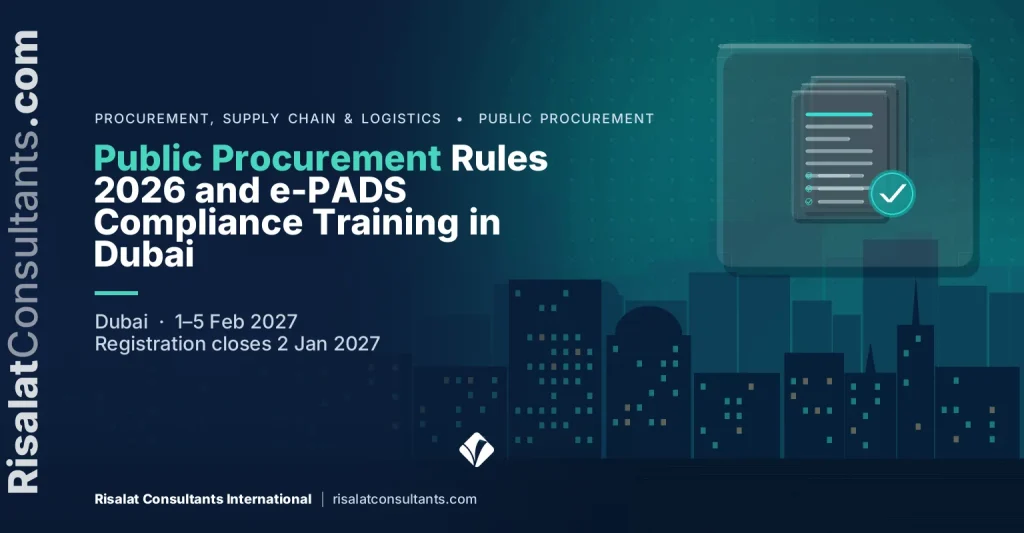
- 1–5 févr. 2027 (5 jours)
- Lieu
- Communiqué lors de l'inscription, Dubaï, Émirats arabes unis
- Frais par participant
- 3 630 £ (GBP)
- Paiement
- Sur facture et par virement bancaire
- Clôture des inscriptions
- 2 janv. 2027
- Certificat
- Certificat de participation
- Option intra
- Organisez-le pour votre équipe, à vos dates
On this page 14 sections
Présentation du programme
Pakistan’s federal procurement framework changed on 28 September 2026, when the Cabinet Division notified the Public Procurement Rules, 2026 through S.R.O. 1658(I)/2026. The Rules took effect at once and repealed the Public Procurement Rules, 2004 (Rule 69), while proceedings already started continue under the old Rules (Rule 68). For procuring agencies, the change is practical rather than theoretical: every procurement must now run through the E-Pak Acquisition and Disposal System, known as EPADS or e-PADS (Rule 8), and each agency needs a Procurement Cell staffed by officers accredited by the Public Procurement Regulatory Authority (PPRA).
The new Rules arrive after PPRA published its first federal monitoring and compliance reports for 2025–26. The compliance review of 103 open procurements from 101 agencies found at least one violation in 80.58% of cases; only 19.42% were fully compliant. The monitoring report, based on e-PADS 1.0 data, found that open competitive bidding took an average of 101.48 days from publication to award and that 12.25% of those records attracted a single bid. Several of these gaps are now listed as material deviations that can lead to mis-procurement.
The IMF’s Governance and Corruption Diagnostic for Pakistan had already asked PPRA to remove preferences for state-owned entities, mandate e-procurement for all transactions, publish quarterly monitoring reports, certify procurement professionals and set standards for complaint handling. Development partners are moving in the same direction: the World Bank’s Public Resources for Inclusive Development (PRID) operations for the federal government and Sindh both cite delays and leakages in procurement and include investment components for technical assistance and capacity building.
This five-day programme is for the officers who must make the Rules work: Procurement Cell staff, evaluation and grievance committee members, project implementation unit (PIU) procurement specialists, and finance and audit officers in federal and provincial agencies and donor-financed projects. Participants test their own files against the Rules and leave with a 12-month compliance plan.
Le programme renforce les capacités institutionnelles en matière de
- Setting up and running a Procurement Cell under Rules 9 and 10
- Planning for PPRA accreditation within the 12-month window
- Preparing and publishing annual procurement plans on e-PADS
- Justifying the choice of method when open competitive bidding is not used
- Using national standard bidding documents correctly
- Designing and using closed and open framework agreements
- Applying the limits on direct contracting, force account and SOE contracting
- Running bid evaluation committees with accredited members
- Working with third-party validation committees above Rs500 million
- Publishing evaluation reports and award documents on time
- Handling grievances within the 10-day and 45-day timelines
- Recognising the material deviations listed in Rule 67(4)
- Reconciling national rules with World Bank and ADB requirements
The aim is a procurement function that can show, file by file, that each decision followed the Rules and was recorded in e-PADS.
The Growing Importance of Public Procurement Compliance in Pakistan
e-PADS is now the backbone of public buying in Pakistan. PPRA reported in January 2026 that 9,846 procuring agencies and around 43,000 suppliers, including 600 foreign firms, were registered, and that the system handled 526,271 transactions worth Rs1,408.58 billion in 2024–25 across the federal government and three provinces. The draft National Procurement Strategy 2025–28 notes, however, that only bid submission modules are available, that bid and performance securities are still collected physically, that procurement financed by multilateral banks is often run in isolation, and that most agencies lack specialised procurement units.
Provincial systems are moving at different speeds. Punjab’s procurement regulator, the Punjab Information Technology Board and the Bank of Punjab announced a province-wide e-procurement rollout from 1 July 2026, with digital bid security and online grievance management. In Sindh, Transparency International Pakistan, as reported by The News, has objected to exemptions that let two departments continue manual tendering. PPRA now runs two-day sessions on the 2026 Rules every week.
Les organisations ont de plus en plus besoin de professionnels capables de :
- Reading the 2026 Rules and applying them to live procurements
- Planning a full year of procurement and publishing it on e-PADS
- Choosing and justifying the procurement method in writing
- Preparing bidding documents from national standard templates
- Setting fair qualification and evaluation criteria in advance
- Managing bid validity, extensions and award timelines
- Serving on evaluation, validation and inspection committees
- Answering grievances with reasoned, timely decisions
- Managing contracts after award and recording performance
- Explaining national rules to World Bank and ADB reviewers
Strong procurement compliance systems help organisations:
- Avoid mis-procurement declarations and audit objections
- Shorten the time from publication to award
- Attract more bidders and reduce single-bid tenders
- Protect officers who make defensible decisions
- Resolve complaints before they become disputes
- Meet the conditions of donor financing
- Build a record that supports performance reviews
- Prepare for PPRA monitoring and compliance reviews
For a fuller explanation of what the Rules change and what agencies must do in the next year, see our guide to the Public Procurement Rules 2026 in Pakistan.
Source: PPRA, Public Procurement Compliance and Violations Analysis Report FY2025-26 (September 2026)
1. Within how many days must a Grievance Redressal Committee decide a complaint under Rule 65 of the 2026 Rules?
Rule 65(6) gives the committee ten days; an appeal then goes to PPRA's Appellate Committee, which decides within 45 days.
2. Which procurements need a third-party validation committee under Rule 12?
Rule 12 covers procurements above Rs500 million and up to Rs2 billion; above Rs2 billion, Rule 13 requires at least two external committee members.
3. In PPRA's 2025–26 monitoring report, what was the average time from publication to award for open competitive bidding?
The report, based on e-PADS 1.0 data, gives an average of 101.48 days and a median of 94.08 days.
Who Should Attend This Public Procurement Rules 2026 Training?
Ce programme s'adresse à :
- Heads and officers of Procurement Cells
- Officers preparing for PPRA accreditation
- Bid evaluation committee members
- Members of grievance redressal committees
- Third-party validation and inspection committee members
- Procurement specialists in World Bank and ADB-financed PIUs
- Project directors and deputy project directors
- Engineers who prepare specifications and cost estimates
- Finance officers and drawing and disbursing officers
- Internal auditors and audit liaison officers
- Officers of state-owned enterprises that buy or supply under the Rules
- Staff of federal and provincial procurement regulators
Teams of three or four from one agency, for example a Procurement Cell officer, an engineer, a finance officer and an auditor, gain most because they practise the hand-offs where files usually go wrong.
Cochez ce que votre équipe doit être capable de faire.
Public Procurement Rules 2026 Training Objectives
Upon successful completion of this Public Procurement Rules 2026 Training, participants will be able to:
- Explain the structure of the 2026 Rules and the transition from the 2004 Rules
- Set up a Procurement Cell and an accreditation plan for its officers
- Prepare and publish an annual procurement plan on e-PADS
- Select the right method and record the justification
- Apply thresholds, response times and publication duties
- Use framework agreements and the limits on direct contracting
- Run an evaluation that is defensible and published on time
- Work with third-party validation and external committee members
- Handle grievances and appeals within the set timelines
- Identify and prevent the material deviations in Rule 67(4)
- Plan contract performance evaluation and inspection
- Align national procedures with World Bank and ADB requirements
Each objective is linked to a checklist or template that participants complete during the week using their own documents.
Contenu et structure du programme
- What S.R.O. 1658(I)/2026 changes and what stays under the 2004 Rules
- Rule 5: when international agreements prevail over the Rules
- Rule 8: carrying out all procurement through e-PADS
- Roles of the Principal Accounting Officer and Head of agency under Rule 9
- Procurement Cells and the 12-month accreditation window in Rule 10
- Quarterly reporting by the Procurement Cell
- Lessons from PPRA’s 2025–26 monitoring and compliance reports
- Annual procurement plans and their publication under Rule 15(2)
- Open competitive bidding as the principal method (Rule 26(1)(a)) and written justification for others (Rule 15(4))
- Shopping and requests for quotations below Rs700,000 (Rule 32(1)(a) and (b))
- Gallop tendering from Rs700,000 to Rs2 million (Rule 31)
- Closed and open framework agreements under Rule 30
- Direct contracting, force account and negotiated tendering under Rule 32
- Conditions for direct contracting with state-owned entities
- Bid evaluation committees up to Rs2 billion and accredited membership (Rule 11)
- Third-party validation from Rs500 million to Rs2 billion (Rule 12)
- External committee members above Rs2 billion (Rule 13)
- Opening bids through e-PADS and recording the opening
- Evaluating only against criteria stated in advance
- Single bids, abnormally low bids and price reasonableness
- Managing bid validity and recording extensions before award
- Grievance redressal committees under Rule 65 and their independence
- Deadlines for complaints on bidding documents and evaluation reports
- The 10-day decision period and the appeal to PPRA’s Appellate Committee
- Writing a reasoned grievance decision
- The material deviations in Rule 67(4), one by one
- Condoning non-material deviations and the Rs250 million referral (Rule 67(6))
- Blacklisting periods and review petitions under Rule 25
- Contract signature, performance security and start-up
- Performance evaluation and the third-party requirement above Rs500 million (Rule 60)
- Inspection committees and inspection above Rs1 billion (Rule 61)
- Managing contracts while e-PADS offers only bid submission modules
- World Bank Procurement Regulations for IPF Borrowers (September 2025)
- ADB’s procurement framework and borrower-administered procurement
- Applying Rule 5 when donor and national rules differ
Contenu détaillé jour par jour
The five days follow a procurement from plan to contract close-out.
- Day 1: the 2026 Rules, e-PADS and the Procurement Cell
- Day 2: planning, methods, thresholds and bidding documents
- Day 3: evaluation, validation, award and publication
- Day 4: grievances, mis-procurement and integrity
- Day 5: contract management, donor interfaces and a 12-month plan
Contenu détaillé jour par jour
First Day | Rules, e-PADS and Procurement Cells
- What S.R.O. 1658(I)/2026 changes and what stays under the 2004 Rules
- Rule 5: when international agreements prevail over the Rules
- Rule 8: carrying out all procurement through e-PADS
- Roles of the Principal Accounting Officer and Head of agency under Rule 9
- Procurement Cells and the 12-month accreditation window in Rule 10
- Quarterly reporting by the Procurement Cell
- Lessons from PPRA’s 2025–26 monitoring and compliance reports
- The IMF diagnostic recommendations on procurement
- Mapping your agency’s current gaps
Workshop: Procurement Cell Readiness Map
Each team maps who does what in its agency today, who must be accredited, which committees exist and which procurements are still outside e-PADS. The map becomes the first part of the week’s compliance plan.
Second Day | Planning, Methods and Bidding Documents
- Annual procurement plans and their publication under Rule 15(2)
- Open competitive bidding as the principal method (Rule 26(1)(a)) and written justification for others (Rule 15(4))
- Shopping and requests for quotations below Rs700,000 (Rule 32(1)(a) and (b))
- Gallop tendering from Rs700,000 to Rs2 million (Rule 31)
- Closed and open framework agreements under Rule 30
- Direct contracting, force account and negotiated tendering under Rule 32
- Conditions for direct contracting with state-owned entities
- Publication on e-PADS and in national dailies (Rule 18) and response times (Rule 19)
- Using national standard bidding documents and avoiding tailor-made specifications
- Bid security limits and bid-securing declarations (Rule 36)
Workshop: Method Selection and Document Review
Participants take three procurements from their own plans, select the method, write the justification and check the draft bidding document against the national standard template, noting every clause that could restrict competition or be read as a tailor-made specification.
Third Day | Evaluation, Validation and Award
- Bid evaluation committees up to Rs2 billion and accredited membership (Rule 11)
- Third-party validation from Rs500 million to Rs2 billion (Rule 12)
- External committee members above Rs2 billion (Rule 13)
- Opening bids through e-PADS and recording the opening
- Evaluating only against criteria stated in advance
- Single bids, abnormally low bids and price reasonableness
- Managing bid validity and recording extensions before award
- Publishing evaluation results before award (Rule 48)
- Publishing award documents after award (Rule 57) and keeping records for five years (Rule 56)
Case Study: An Award After Bid Validity Expired
Based on the patterns in PPRA’s 2025–26 compliance report, teams review an anonymised file where evaluation took longer than planned and the award was made after bid validity lapsed. They rebuild the timeline, identify where the delay started, and design a tracking sheet that warns the committee before validity runs out.
Fourth Day | Grievances, Mis-procurement and Integrity
- Grievance redressal committees under Rule 65 and their independence
- Deadlines for complaints on bidding documents and evaluation reports
- The 10-day decision period and the appeal to PPRA’s Appellate Committee
- Writing a reasoned grievance decision
- The material deviations in Rule 67(4), one by one
- Condoning non-material deviations and the Rs250 million referral (Rule 67(6))
- Blacklisting periods and review petitions under Rule 25
- Red flags of collusion, bid rotation and specification bias
- Lessons from the IMF diagnostic on complaint handling
Workshop: Grievance Committee Simulation
Participants sit as a grievance redressal committee on a complaint about evaluation criteria. They have a fixed time to review the file, hear both sides and issue a written decision within the Rule 65 timeline. The group then tests the file against Rule 67(4).
Fifth Day | Contract Management and Donor Interfaces
- Contract signature, performance security and start-up
- Performance evaluation and the third-party requirement above Rs500 million (Rule 60)
- Inspection committees and inspection above Rs1 billion (Rule 61)
- Managing contracts while e-PADS offers only bid submission modules
- World Bank Procurement Regulations for IPF Borrowers (September 2025)
- ADB’s procurement framework and borrower-administered procurement
- Applying Rule 5 when donor and national rules differ
- Procurement in the PRID federal and Sindh operations
- Monitoring indicators for a Procurement Cell
Capstone Exercise: 12-Month Compliance Plan
Each team completes a 12-month compliance plan for its agency covering accreditation, the procurement plan, standard documents, committee membership, grievance handling, publication and contract records. Plans are presented to a panel acting as senior management, which tests whether each action has an owner, a date and a measurable result.
Public Procurement Rules 2026 Training Methodology
The programme is practical and document-based. Each session starts with the text of the Rules, moves to a real or anonymised file and ends with a tool participants can use at work.
Le programme associe :
- Short briefings on each part of the Rules
- Rule-by-rule checklists
- Review of participants’ own procurement plans and documents
- Anonymised case files based on published PPRA findings
- Committee simulations for evaluation and grievances
- Timeline and bid validity tracking exercises
- Red-flag analysis of specifications and bids
- Comparison with World Bank and ADB procedures
- Peer review between agencies
- A capstone plan presented to a panel
Résultats attendus
Upon completion of this Public Procurement Rules 2026 Training, participants will be able to:
- Run procurements on e-PADS in line with the 2026 Rules
- Lead or support their agency’s Procurement Cell
- Prepare for PPRA accreditation with confidence
- Produce method justifications that stand up to review
- Complete evaluations within bid validity
- Publish the documents the Rules require, on time
- Decide grievances within the set timelines
- Prevent the deviations that lead to mis-procurement
- Coordinate national and donor procurement requirements
Agencies gain staff who understand the Rules in the same way, which reduces disputes, delays and audit observations.
3 630 £ par participant · facture et virement bancaire · réduction pour les groupes de 5 personnes ou plus
Cinq personnes ou plus d'une même organisation : demandez le tarif de groupe lors de votre demande de facture.
À partir de dix participants, une version intra pour votre institution peut revenir moins cher par personne. Demander un devis intra.
Clôture des inscriptions dans 60 jours (2 janv. 2027)
Institutional Application of Public Procurement Rules 2026 Training
Ce programme aide les organisations à renforcer :
- Procurement Cell structure and staffing
- Accreditation and continuing professional development
- Annual procurement planning
- Use of standard bidding documents
- Evaluation quality and timeliness
- Grievance handling and record keeping
- Publication and transparency on e-PADS
- Contract performance evaluation
- Internal control and audit readiness
- Coordination with donor procurement teams
Les participants repartent avec des outils pratiques pour améliorer :
- Procurement Cell readiness map
- Method selection and justification template
- Bidding document compliance checklist
- Bid validity and evaluation timeline tracker
- Grievance decision template
- Rule 67(4) material deviation checklist
- Contract performance report format
- 12-month compliance plan
Agencies that want a structured baseline before or after the programme can use Risalat’s free procurement maturity diagnostic and, for wider capacity questions, the institutional capacity assessment.
Pertinence régionale & mise en application
Asie
Pakistan is the main focus. PPRA’s 2025–26 compliance review found that 40.96% of the procurements with violations had not adopted national standard bidding documents and 36.14% were awarded after bid validity expired, while contract agreements could not be confirmed for 34.95% of the sample. The IMF diagnostic found that some large entities, such as NHA, CDA and WAPDA, still used their own systems, that complaints took two to six months at federal level and that decisions were not published. The World Bank’s PRID operations, P509827 (federal, US$600 million) and P511459 (Sindh, US$200 million), both identify delays and leakages in procurement and each includes a US$30 million investment component for technical assistance and capacity building.
Moyen-Orient
The UAE has moved government procurement onto digital platforms that run from tender to contract and payment. Dubai’s eSupply portal and the UAE federal Digital Procurement Platform show what an integrated system looks like when contract signing, supplier evaluation and invoicing sit in the same place, which is where e-PADS is heading.
Africa and Central Asia
Many countries in Africa and Central Asia are rolling out national e-procurement systems alongside World Bank and ADB-financed projects, and face the same questions on committees, complaints and contract records.
Participants from other countries can adapt every tool to their own national rules.
Profil du pays d'accueil – EAU
Dubai is one of the most accessible training venues for Pakistani officials: it is a short flight from Karachi, Lahore and Islamabad, with frequent direct services, and it has a large Pakistani community and a wide choice of hotels and meeting venues. Early February offers mild weather, and the programme dates fall before Ramadan.
The UAE is a useful benchmark for digital procurement. In Dubai, eSupply is the official portal for Dubai Government tenders, listing tenders from around 40 government entities with the whole bidding process managed online. Law No. 12 of 2020 on contracts and warehouse management, in force since 1 January 2021, aims to unify procurement, automate procurement and warehouse operations and create a central registry of suppliers, with the Department of Finance issuing governance guidelines. At federal level, the Ministry of Finance’s Digital Procurement Platform covers tenders, bidding, purchase orders and invoicing, and its third phase, launched in February 2023, added electronic contract signing through UAE PASS and supplier performance and risk evaluation, the contract-stage features that Pakistan’s draft National Procurement Strategy plans for e-PADS.
Pakistani passport holders normally need to arrange a UAE visit visa before travel, usually through a sponsoring hotel, airline or licensed travel agency. Risalat provides visa support letters and guidance, but requirements change, so participants should confirm current rules with the UAE embassy or an authorised visa service well before travel and allow time for official travel approvals.
Public Procurement Rules 2026 Training Deliverables
Every participant receives a complete package before, during and after the programme so that learning turns into changes at work.
Avant le programme
- Pré-évaluation des participants
- Procurement Compliance Readiness Assessment
- Public Procurement Rules 2026 Resource Pack
- Lectures préparatoires
- Aide et conseils gratuits pour le visa
- Accueil à l'aéroport & assistance à l'arrivée
- Hébergement avec petit-déjeuner
- Dîner de bienvenue et de réseautage
Pendant le programme
- Kit de formation Risalat (sac, gourde, mug, t-shirt, casquette, protège-passeport, stylos, carnet, magnet & porte-clés)
- Comprehensive Public Procurement Rules 2026 Training Manual
- Procurement Cell Readiness Map Template
- Method Justification Template
- Bidding Document Compliance Checklist
- Bid Validity and Evaluation Timeline Tracker
- Grievance Decision Template
- Rule 67(4) Material Deviation Checklist
- Ateliers pratiques & simulations
- Discussions de groupe & apprentissage entre pairs
- Déjeuner et pauses-café quotidiens
- Accès complet aux installations du lieu de formation
- Mini tablette avec supports pédagogiques numériques
- Visite de terrain (le cas échéant)
- Visite récréative de la ville
Après le programme
- Certificat de participation
- Distinction Risalat de participation au programme
- Documents de référence après la formation
- 12-Month Compliance Plan Template
- Contract Performance Report Format
- Accompagnement après la formation & conseils de suivi
- Rapport du programme
Ministries, provincial departments, regulators and project implementation units can request a tailored in-house version built around their own procurement plans and documents, delivered in Pakistan or at a hub of their choice, through our request a proposal form.
Common Challenges in Public Procurement Compliance, And How This Training Helps
How can an agency set up a Procurement Cell when few officers are accredited?
Rule 10(2) gives unaccredited officers twelve months to obtain accreditation. On the First Day participants build a readiness map and an accreditation schedule so the Cell can start work now and meet the deadline.
How can we stop awards being made after bid validity has expired?
The Third Day case study rebuilds a delayed evaluation and produces a timeline tracker that alerts the committee early, so extensions are requested and recorded before validity runs out.
How do we make sure national standard bidding documents are used every time?
Not using standard documents is a material deviation under Rule 67(4). The Second Day workshop checks participants’ own drafts against the standard templates and records each permitted change.
How should we justify a method other than open competitive bidding?
Rule 15(4) requires written justification. The Second Day sessions on thresholds, framework agreements and Rule 32 give a template that links each justification to the specific condition in the Rules.
How can a grievance committee decide complaints within ten days?
The Fourth Day simulation practises the Rule 65 process under time pressure and provides a decision template that records the facts, the rule applied and the reasons.
How do we avoid a mis-procurement declaration?
The Fourth Day reviews each material deviation in Rule 67(4) with examples and gives a checklist that Procurement Cells can run before each award.
How can we manage contracts when e-PADS does not yet have a contract module?
The Fifth Day sets out a simple contract register and performance report format, aligned with Rule 60, that can later move into an e-contract management module.
How do we handle projects financed by the World Bank or ADB under the new Rules?
The Fifth Day explains Rule 5, compares national steps with donor procedures and shows PIU teams how to document which rules apply to each contract.
Questions fréquentes
What are Pakistan's Public Procurement Rules 2026?
They are federal procurement rules notified by S.R.O. 1658(I)/2026 on 28 September 2026. They replace the Public Procurement Rules 2004, make e-PADS mandatory and require Procurement Cells with PPRA-accredited officers.
Does this programme count towards PPRA accreditation?
No such recognition has been confirmed. The programme complements PPRA's own training and accreditation by giving teams practical tools and time to apply the Rules to their own files.
Qui devrait participer ?
Procurement Cell officers, evaluation and grievance committee members, PIU procurement specialists on World Bank and ADB projects, finance officers, auditors and regulators' staff.
Why is the programme held in Dubai?
Dubai is a short direct flight from Pakistan's main cities, and the UAE's eSupply and federal Digital Procurement Platform offer a working example of e-procurement that extends to contract signing and supplier evaluation.
Peut-il être dispensé en intra ?
Yes. Agencies and project teams can request a tailored version built around their own procurement plans and documents through Risalat's proposal form.
Tous les programmes à DubaïPlus de programmes Passation des marchés, chaîne d'approvisionnement & logistique
Pourquoi Dubaï pour ce programme
Dubaï est une plateforme accessible en un seul vol depuis l'Afrique, l'Asie et l'Europe, avec des visas simples pour de nombreuses nationalités et des lieux de formation modernes.
The Public Procurement Rules 2026 and e-PADS Compliance Training in Dubai programme in February 2027 brings together officials and professionals from across the Middle East region and beyond. Sessions combine short inputs, case studies and group work on participants' own files, and the city's institutions can be added as a study visit on request.
Accès : aéroport international de Dubaï (DXB).
Vérifiez si vous avez besoin d'un visa avec le vérificateur de visa gratuit, et demandez une lettre d'invitation une fois inscrit.
Autres programmes à Dubaï
- Formation à la gestion des contrats de travaux financés par les bailleurs à Dubaï
- Formation à la protection des recettes & à la réduction des pertes des services publics à Dubaï
- Formation à la gestion des achats et aux techniques de réduction des coûts à Dubaï
- Formation à la gestion stratégique des RH et à l'analyse des effectifs à Dubaï
- Formation à l'intégration du genre & au renforcement des capacités à Dubaï
Voir aussi : Passation des marchés et gestion des contrats · diagnostic gratuit de maturité de la passation des marchés · tous les programmes
- Procurement Framework and Regulations for Projects Banque mondiale
- MAPS: Methodology for Assessing Procurement Systems MAPS Initiative
- Open Contracting Partnership Open Contracting Partnership
Plus de formations aux Émirats arabes unis · Tous les programmes au Moyen-Orient · Calendrier complet des formations