Points essentiels
- Background and practical significance. Our daily choices affect the environment more than ever before.
- Waste reduction strategies. We take a practical approach to waste reduction.
- Zero-waste lifestyle tips. Zero waste isn't about perfection – it's about progress.
- Alternative transportation methods. A variety of transportation options creates the best eco-friendly results.
- Application for public agencies and donor-funded projects. Seasonal eating brings more benefits than just helping the environment.
In short: Explore how to embrace sustainable living for a greener future with practical examples, implementation risks and clear steps for institutions, public.
En bref : Adopter un mode de vie durable pour un avenir plus vert nécessite des choix pratiques concernant les ressources, les données probantes et la mise en œuvre. Ce guide explique les principales opportunités et contraintes, ainsi que la manière dont les organisations peuvent traduire les idées sous-jacentes en décisions mesurables.
Contexte et portée pratique
Contexte et portée pratique
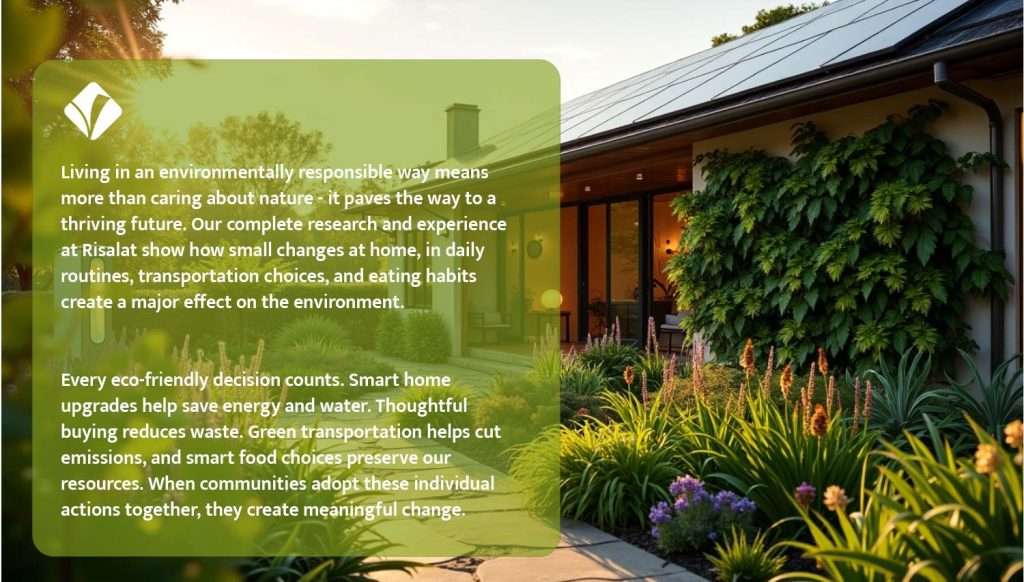
Our daily choices affect the environment more than ever before. Recent studies reveal that a single household can cut its carbon footprint by up to 48% through sustainable living. These numbers demonstrate our ability to create positive change.
The transition to an eco-friendly lifestyle might seem daunting at first. Our team at Risalat has created a complete guide that will help you welcome eco-friendly practices. We believe in realistic and future-focused solutions. Your journey toward creating an energy-efficient home and building eco-friendly communities starts with practical steps that make a difference.
Proven strategies for sustainable living await your discovery. The guide covers home improvements, daily habits, transportation choices, and food practices. These changes will help you create a greener future for the next generations.
Creating a Sustainable Home Foundation
A sustainable home begins with its foundation. At Risalat, we believe building a sustainable living space needs careful planning and smart implementation of proven systems.
Améliorations éconergétiques des logements
Our experience shows that proper insulation is the life-blood of an energy-efficient home. Homeowners can cut their energy costs by 5% to 30% annually with complete insulation solutions. The best results come from focusing on these core areas:
Attic and roof insulation
Wall cavity insulation
Floor and basement sealing
Window and door weatherstripping
Low-E coated energy-efficient windows reduce heat transfer by a lot. You can earn up to AED 11,750.21 in tax credits through 2032 with qualified improvements.
Water conservation systems
Smart water management is a vital part of sustainable living. Low-flow fixtures deliver remarkable savings – about 11,000 gallons of water per person annually. A family of four can save around AED 807.83 yearly.
Le moyen le plus rapide d'améliorer l'efficacité de l'eau :
Water-efficient toilets use 1.6 gallons per flush instead of 3-5 gallons, saving about 12 gallons daily per person
Low-flow showerheads save about 1,000 gallons annually per person
Efficient faucet aerators can save roughly 2,000 gallons yearly per person
For how to embrace sustainable living for a greener future, a useful implementation plan should explicitly consider learning outcomes, institutional roles and the time available for implementation. A responsible decision starts by identifying who experiences the problem, who has authority to respond, and what information would change the proposed action. These questions help separate an attractive concept from a feasible intervention.
Par exemple, une organisation qui envisage une nouvelle initiative peut documenter le processus existant, consulter les personnes qui l'utilisent, choisir un projet pilote maîtrisable et en établir la situation de référence. Le pilote doit avoir un responsable désigné, un calendrier de mise en œuvre, une voie de réclamation et un budget de fonctionnement réaliste. Les progrès doivent être jugés au regard des résultats observés plutôt que du nombre de réunions, d'ateliers ou d'annonces réalisés.
Stratégies de réduction des déchets
Stratégies de réduction des déchets
We take a practical approach to waste reduction. EPA data shows that yard waste and food scraps make up 30% of household waste – all of which could be composted. Your home needs a complete waste management system with proper sorting facilities and recycling bins.
Reusable materials work best for cleaning tasks along with proper product usage. Insulation made from recycled paper and glass makes sense during renovations. These materials cut waste and provide excellent thermal protection.
These foundational changes create sustainable homes and build a more resilient future. Each improvement adds to our broader goal of sustainable living, no matter its size.
Sustainable Daily Practices
Green practices are the life-blood of environmental stewardship in our daily routine. At Risalat, lasting change stems from consistent and mindful practices that people can maintain.
Mindful consumption habits
Products we purchase leave an environmental footprint, from manufacturing to disposal. These proven consumption habits can make a difference:
Review purchase necessity before buying
Choisir des produits avec un emballage minimal
Opt for secondhand items when possible
Support local and seasonal products
Ask about borrowing instead of buying
The average US family wastes over AED 2,350 each year on discarded food alone. Mindful shopping practices can substantially reduce financial waste and environmental effects.
For how to embrace sustainable living for a greener future, a useful implementation plan should explicitly consider costs, procurement options, stakeholder incentives and the risks of premature scaling. A responsible decision starts by identifying who experiences the problem, who has authority to respond, and what information would change the proposed action. These questions help separate an attractive concept from a feasible intervention.
Par exemple, une organisation qui envisage une nouvelle initiative peut documenter le processus existant, consulter les personnes qui l'utilisent, choisir un projet pilote maîtrisable et en établir la situation de référence. Le pilote doit avoir un responsable désigné, un calendrier de mise en œuvre, une voie de réclamation et un budget de fonctionnement réaliste. Les progrès doivent être jugés au regard des résultats observés plutôt que du nombre de réunions, d'ateliers ou d'annonces réalisés.
Zero-waste lifestyle tips
Zero-waste lifestyle tips
Zero waste isn't about perfection – it's about progress. Environmental experts say up to 40% of edible food goes to waste in the United States. The five R's can help curb this: Refuse, Reduce, Reuse, Recycle, and Rot (composting).
Simple swaps lead to successful zero-waste and sustainable living. To cite an instance, reusable containers instead of foil and plastic wrap can cut household waste substantially. Our clients see amazing results when they switch to cloth napkins from paper towels and use rechargeable batteries.
Eco-friendly cleaning solutions
Natural cleaning alternatives create healthier homes and protect our environment. Here are our best eco-friendly cleaning tips:
Use plant-based cleaning products free from phthalates and harmful chemicals
Choose concentrated cleaners to reduce packaging waste
Opt for reusable cleaning tools over disposable ones
Select products with minimal or recyclable packaging
Eco-friendly cleaning products reduce household chemical exposure while cleaning effectively. To cite an instance, natural bathroom cleaners with vinegar and citric acid tackle soap scum without harsh chemicals.
These green practices in our daily routines contribute to a larger movement toward environmental consciousness. Each small action builds a more sustainable future.
Green Transportation Choices
Transportation choices stand among the most effective ways to reduce our environmental footprint. Our team at Risalat has witnessed how thoughtful mobility decisions create lasting positive changes for our planet and communities.
Electric vehicle options
Transportation technology continues to evolve rapidly. Today's electric vehicles (EVs) can reach 130 MPGe and cover 100 miles with just 25-40 kWh of energy. Switching to EVs brings several compelling advantages:
Zero tailpipe emissions that lead to cleaner air
Energy efficiency reaches 60% compared to 17-21% in conventional vehicles
Fewer moving parts mean lower maintenance costs
Fuel costs drop well below traditional vehicles
Drivers can access more than 53,000 public charging stations nationwide
For how to embrace sustainable living for a greener future, a useful implementation plan should explicitly consider quality assurance, privacy or environmental safeguards where relevant, and transparent reporting. A responsible decision starts by identifying who experiences the problem, who has authority to respond, and what information would change the proposed action. These questions help separate an attractive concept from a feasible intervention.
Par exemple, une organisation qui envisage une nouvelle initiative peut documenter le processus existant, consulter les personnes qui l'utilisent, choisir un projet pilote maîtrisable et en établir la situation de référence. Le pilote doit avoir un responsable désigné, un calendrier de mise en œuvre, une voie de réclamation et un budget de fonctionnement réaliste. Les progrès doivent être jugés au regard des résultats observés plutôt que du nombre de réunions, d'ateliers ou d'annonces réalisés.
Alternative transportation methods
Alternative transportation methods
A variety of transportation options creates the best eco-friendly results. People who take public transportation instead of driving alone cut their CO2 emissions by 45%. Public transportation in the U.S. saves 37 million metric tons of carbon dioxide each year.
Walking and cycling remain the greenest transportation choices. Riders who choose a bike over a car once daily reduce their transportation-related emissions by 67%. A few bike trips can lower a household's carbon footprint by up to 1,000 pounds yearly.
Reducing travel carbon footprint
These proven strategies help minimize travel-related emissions:
Direct flight routes produce fewer pollutants since planes emit most during takeoff and landing
Train and bus travel for intercity trips cuts emissions by 50-80% compared to flying
Sharing rides helps split the environmental load
Lighter luggage improves fuel efficiency – cutting 15 pounds of baggage reduces emissions by about 80 pounds on a ten-hour flight
Daily commutes work best with mixed approaches. Many transit systems now offer bike racks that let riders combine cycling with mass transit for longer trips. This flexibility helps people overcome common barriers to eco-friendly transportation while maximizing environmental benefits.
Sustainable Food and Nutrition
Food choices are central to sustainable living and they affect our health and the environment. Our team at Risalat has seen how conscious eating habits create waves of change throughout our ecosystem and communities.
For how to embrace sustainable living for a greener future, a useful implementation plan should explicitly consider the difference between a pilot that works once and a process that an institution can sustain. A responsible decision starts by identifying who experiences the problem, who has authority to respond, and what information would change the proposed action. These questions help separate an attractive concept from a feasible intervention.
Par exemple, une organisation qui envisage une nouvelle initiative peut documenter le processus existant, consulter les personnes qui l'utilisent, choisir un projet pilote maîtrisable et en établir la situation de référence. Le pilote doit avoir un responsable désigné, un calendrier de mise en œuvre, une voie de réclamation et un budget de fonctionnement réaliste. Les progrès doivent être jugés au regard des résultats observés plutôt que du nombre de réunions, d'ateliers ou d'annonces réalisés.
Application aux organismes publics et aux projets financés par les bailleurs
Local and seasonal eating
Seasonal eating brings more benefits than just helping the environment. Locally grown, seasonal produce gives us fruits and vegetables that taste better and pack more nutrients. The prices are substantially lower because of simple supply and demand. Seasonal eating makes a difference because:
Vine-ripened produce has higher nutrients
Food travels less – current average is over 1,500 miles
Food tastes better and stays fresh longer
Les économies locales se renforcent
Peak seasons mean lower food costs
Reducing food waste
Les chiffres du gaspillage alimentaire sont alarmants : nous perdons ou gaspillons un tiers de tous les aliments produits dans le monde entre la ferme et la table. Cela représente plus d'un milliard de tonnes. L'économie mondiale perd plus de 3,67 billions d'AED chaque année en raison de ce gaspillage.
These proven strategies can help curb this waste:
Make meal plans and shopping lists before buying groceries
Garder les aliments frais – régler la température du réfrigérateur à 40 °F ou moins
Know your labels – "best before" is not the same as "use-by" dates
Freeze foods that are close to expiring
Turn food scraps into compost to enrich soil
Plant-based diet options
Dietary patterns are moving toward choices that help both health and environment. Research shows that switching half of meat and milk products with plant-based alternatives by 2050 can cut greenhouse gas emissions from agriculture and land use by 31%. Plant-based diets need f
For how to embrace sustainable living for a greener future, a useful implementation plan should explicitly consider the needs of implementing agencies, suppliers, community representatives and development partners. A responsible decision starts by identifying who experiences the problem, who has authority to respond, and what information would change the proposed action. These questions help separate an attractive concept from a feasible intervention.
Par exemple, une organisation qui envisage une nouvelle initiative peut documenter le processus existant, consulter les personnes qui l'utilisent, choisir un projet pilote maîtrisable et en établir la situation de référence. Le pilote doit avoir un responsable désigné, un calendrier de mise en œuvre, une voie de réclamation et un budget de fonctionnement réaliste. Les progrès doivent être jugés au regard des résultats observés plutôt que du nombre de réunions, d'ateliers ou d'annonces réalisés.
For a ministry or project implementation unit, the practical sequence is to agree the public purpose, map responsibilities across agencies, identify procurement and safeguard requirements, and record the evidence needed for approval. Where a donor finances the work, the project team should use the applicable financing agreement, procurement framework and environmental and social commitments rather than assuming that one generic procedure applies to every project.
Prenons l'exemple fictif d'un programme financé par un bailleur, avec une période de mise en œuvre limitée. Le chef de projet pourrait commander une évaluation de référence, associer les parties prenantes locales à la définition des normes de service, tester l'intervention proposée sur un petit nombre de sites et évaluer les résultats avant toute extension. Un examen indépendant des dépenses et des résultats permet de vérifier si le programme atteint les bénéficiaires visés et si l'agence d'exécution pourra le maintenir une fois le financement extérieur terminé.
Liste de contrôle de mise en œuvre
- Définir la décision et les bénéficiaires visés.
- Confirmer les contraintes juridiques, financières et opérationnelles.
- Établir une situation de référence et des indicateurs mesurables.
- Désigner des responsables et recueillir l'avis des parties prenantes.
- Piloter, évaluer et ajuster avant de passer à l'échelle.
Questions fréquentes
Quel est le principal avantage pratique ?
Elle aide les décideurs à relier le sujet à des besoins définis, à des ressources réalistes et à des résultats observables.
Que doit évaluer une organisation en premier ?
Commencer par une situation de référence, les besoins des parties prenantes, les responsabilités de mise en œuvre et les exigences juridiques applicables.
Quels risques de mise en œuvre méritent l'attention ?
Être attentif à l'accessibilité financière, à la capacité institutionnelle, à l'inclusion, à la qualité des données et à la maintenance continue.
Comment mesurer les progrès ?
Utiliser un petit nombre d'indicateurs liés à la situation de référence, les retours des usagers et un examen indépendant périodique.
Comment cela s'applique-t-il aux projets financés par les bailleurs ?
Appliquer l'accord de financement du projet et les obligations pertinentes en matière de passation des marchés, de sauvegardes, de suivi et de reporting.
Regarder

Know people who should read this? Become an Ambassador or write with Risalat.
Partenaires de la réussite des projets depuis 2011 : diagnostics, conseil et apprentissage appliqué pour les ministères, les organismes publics et les équipes de projet.
Besoin d'aide pour passer à la pratique ?
Commencez par un diagnostic gratuit de 10 minutes ou échangez avec nos experts.